
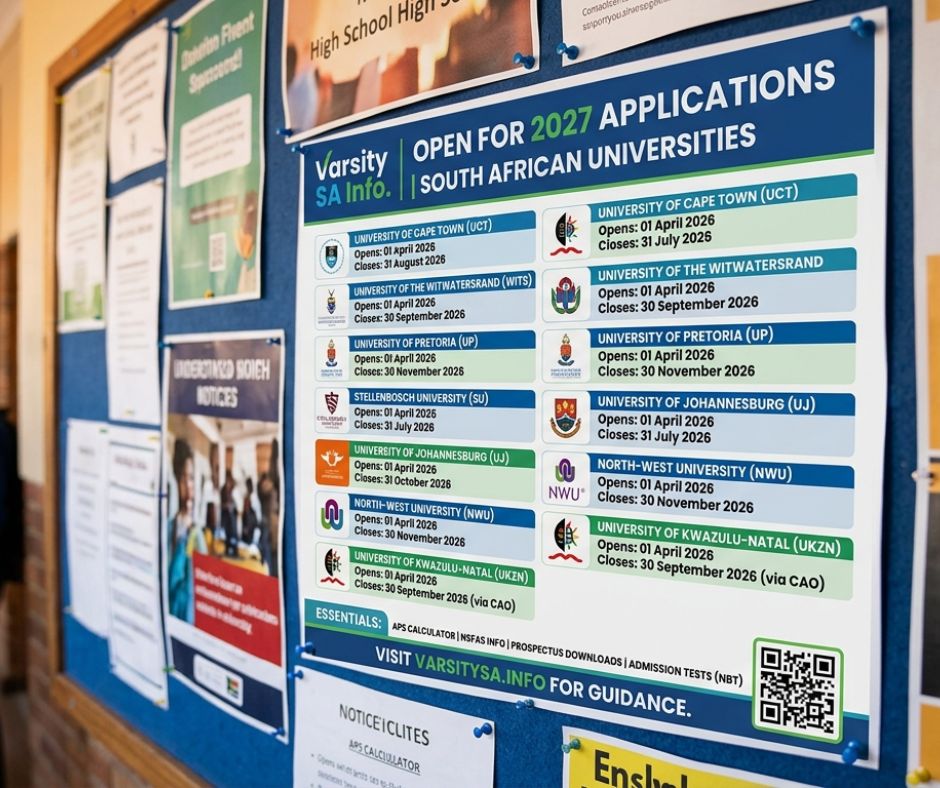
As of April 2026, 20 of South Africa’s 26 public universities are actively accepting applications for the 2027 academic year. Most opened their portals on Wednesday, April 1, 2026.
Four KwaZulu-Natal universities — UKZN, DUT, MUT, and UniZulu — opened earlier, on Sunday, March 1, 2026, via the Central Applications Office (CAO). Three universities — NWU, WSU, and UMP — open on Monday, June 1, 2026.
This guide covers every public university open for 2027 applications, their exact closing dates, application fees, APS requirements, funding timelines, and what to do if you missed a deadline.
All data is sourced from official university admission portals and the Department of Higher Education and Training (DHET).
Table of Contents
List of South African Universities Open for 2027 Applications
Every South African public university currently open for 2027 applications is listed below. The table is sourced from official institutional portals and reflects confirmed dates as of April 2026. Verify with each institution before submitting, as faculty-specific deadlines may differ from the general closing date shown.
| University | Opens | Closes | Fee (ZAR) | Apply Via | Critical Note |
|---|---|---|---|---|---|
| University of Cape Town (UCT) | 1 April 2026 | 31 July 2026 | R100 (SA/SADC) / R300 (Intl) | Direct portal | No late applications. Final. |
| University of the Witwatersrand (Wits) | 1 April 2026 | 30 September 2026 | R100 | Direct portal | Health Sciences & Architecture close 30 June 2026 |
| University of Pretoria (UP) | 1 April 2026 | 30 September 2026 | R300 | Direct portal | Selection programmes (Vet Science, Medicine) close 30 June 2026 |
| Stellenbosch University (SU) | 18 April 2026 | 31 July 2026 | R100 | Direct portal | Competitive selection; no late applications |
| University of Johannesburg (UJ) | 1 April 2026 | 31 October 2026 | Free | Direct portal | Engineering Management closes 30 September 2026 |
| Nelson Mandela University (NMU) | 13 April 2026 | 30 September 2026 | Free | Direct portal | — |
| Central University of Technology (CUT) | 1 April 2026 | 30 September 2026 | Free | Direct portal | — |
| University of the Western Cape (UWC) | 1 April 2026 | 30 September 2026 | Free | Direct portal | — |
| Cape Peninsula University of Technology (CPUT) | 1 April 2026 | 30 September 2026 | — | Direct portal | Confirm fee with institution |
| Tshwane University of Technology (TUT) | 1 April 2026 | 30 September 2026 | R240 | Direct portal | — |
| Rhodes University | 1 April 2026 | 30 September 2026 | R100 | Direct portal | — |
| University of the Free State (UFS) | 1 April 2026 | 30 September 2026 | Free | Direct portal | Health Sciences closes 31 May 2026; International closes 31 August 2026 |
| University of Fort Hare (UFH) | 1 April 2026 | 30 September 2026 | Free | Direct portal | — |
| University of Limpopo (UL) | 1 April 2026 | 30 September 2026 | R200 | Direct portal | — |
| University of Venda (UniVen) | 1 April 2026 | 30 September 2026 | R100 | Direct portal | — |
| Sol Plaatje University (SPU) | 1 April 2026 | 31 October 2026 | R100 | Direct portal | — |
| Sefako Makgatho Health Sciences University (SMU) | 1 April 2026 | 31 July 2026 | R200 | Direct portal | Health Sciences-focused institution |
| Vaal University of Technology (VUT) | 1 April 2026 | 30 September 2026 | R100 | Direct portal | — |
| North-West University (NWU) | 1 June 2026 | TBA | Free | Direct portal | Unique email registration required before portal access |
| Walter Sisulu University (WSU) | 1 June 2026 | 30 September 2026 | Free | Direct portal | — |
| University of Mpumalanga (UMP) | 1 June 2026 | 30 November 2026 | R200 | Direct portal | Latest standard closing date nationally |
| UKZN | 1 March 2026 | 30 September 2026 | R250 | CAO only | cao.ac.za |
| Durban University of Technology (DUT) | 1 March 2026 | 30 September 2026 | R250 | CAO only | cao.ac.za |
| Mangosuthu University of Technology (MUT) | 1 March 2026 | 30 September 2026 | R250 | CAO only | cao.ac.za |
| University of Zululand (UniZulu) | 1 March 2026 | 30 September 2026 | R250 | CAO only | cao.ac.za |
| UNISA | 18 August 2026 | 10 September 2026 | R135 | Direct portal | Distance learning; dates based on previous cycles |
8 universities charge no application fee for online submissions: UJ, NWU, NMU, CUT, UWC, UFS, UFH, and WSU. For cost-constrained applicants, these institutions represent the lowest-barrier entry points into the 2027 application cycle.
Universities With 2027 Application Deadlines You Cannot Miss
Featured Snippet Answer: Health Sciences faculties at UFS, UCT, Wits, and UP close between 31 May and 30 June 2026 — 3 to 4 months before the general September deadline. Missing these dates means reapplying in 2027 for a 2028 intake. Apply early.
Not all closing dates are equal. The general 30 September 2026 date applies to most undergraduate programmes, but high-demand faculties operate on separate, earlier schedules. These earlier deadlines receive significantly less visibility in search results, which is why many applicants miss them.
Health Sciences, Medicine, and Veterinary Science — Closes 31 May 2026
The earliest hard deadline in the 2027 cycle falls on Sunday, 31 May 2026 and applies to Health Sciences faculties at UFS, Sefako Makgatho Health Sciences University (SMU), and competitive health programmes at several other institutions. UP’s Veterinary Science (BVSc) and Pharmacy programmes also fall under the early selection window aligned with June 30.
Programmes affected by the 31 May 2026 deadline include:
- MBChB (Bachelor of Medicine and Bachelor of Surgery) at UFS
- All health-related qualifications at SMU (institution-wide)
- Physiotherapy, Occupational Therapy, and Dietetics at UFS
- Nursing Science at institutions with faculty-specific cutoffs
Students applying to any Health Sciences programme must treat 31 May 2026 as their non-negotiable deadline, regardless of the institution’s general closing date.
Architecture, Engineering, and Law — Closes 30 June 2026
Wits closes its Health Sciences and Architecture faculties on Tuesday, 30 June 2026. UP’s selection programmes — which include Engineering, Law, and several Commerce degrees — follow the same 30 June 2026 deadline.
At Wits, applicants may submit a maximum of 3 programme choices per application. This restriction is institution-specific and does not apply at most other universities. Applicants to competitive programmes at Wits who submit after 30 June 2026 will not be considered for the 2027 intake.
UJ’s Engineering Management programme closes on 30 September 2026, but competitive selection begins earlier in the cycle. Submitting at the boundary of the closing date reduces an applicant’s chances even when technically still accepted.
UCT and Stellenbosch — General Undergraduate Closes 31 July 2026
UCT and Stellenbosch University close general undergraduate applications on Friday, 31 July 2026. Both institutions explicitly do not offer late applications. There is no appeal window, no late portal, and no admissions office discretion after this date.
UCT, ranked first in Africa by the QS World University Rankings 2025, processes applications through a competitive selection model. An application submitted in July competes against the full applicant pool from April onwards. Earlier submission gives no formal priority — but it does reduce the risk of portal errors or missing documentation causing a last-minute rejection.
Stellenbosch opened its 2027 undergraduate portal on Saturday, 18 April 2026 — 18 days after most other institutions.
How to Apply to a South African University for 2027
South African university applications are completed entirely online. No physical submission is accepted at any of the 26 public universities for standard undergraduate applications.
The process below applies to direct-portal universities; CAO applicants should refer to the dedicated CAO section below.
Step 1 — Calculate Your APS Score Before Selecting Any University
Your APS score determines which universities and programmes you are eligible to apply to. Submitting to a programme whose minimum APS exceeds your score wastes an application fee and your time.
APS stands for Admission Point Score. It is calculated by converting your NSC (National Senior Certificate) percentage in each subject into a numerical point value, then summing those values. Most universities use your best 6 subjects, excluding Life Orientation or capping its contribution at a reduced value.
APS Conversion Table (NSC to Points)
| Percentage Achieved | APS Points |
|---|---|
| 90% – 100% | 7 |
| 80% – 89% | 6 |
| 70% – 79% | 5 |
| 60% – 69% | 4 |
| 50% – 59% | 3 |
| 40% – 49% | 2 |
| 30% – 39% | 1 |
A student achieving 75% in 6 subjects scores an APS of 30 (6 × 5 points). A student achieving 65% in 6 subjects scores an APS of 24 (6 × 4 points). These are approximations — subject weightings and Life Orientation exclusions vary by institution.
Step 2 — Gather and Certify All Required Documents
Collect all required documents before opening any application portal. Incomplete submissions are rejected at most institutions without notification. Assembling documents first prevents mid-application delays.
Standard documents required across all 26 public universities:
- Certified copy of South African ID book or card, or a valid passport for non-SA citizens — certification must not be older than 3 months
- Grade 11 final results (for current Grade 12 learners applying provisionally)
- Grade 12 mid-year or September examination results (where already completed at the time of application)
- Certified copy of the NSC/matric certificate (for gap-year students and mature applicants)
- Proof of payment of the application fee, where applicable
- Motivation or personal statement letter (required by some competitive programmes, including Law at UP and Fine Arts)
- Portfolio of work (required by Architecture at UCT and Wits, Fine Art, and Music programmes)
Certification means a stamped and signed copy authenticated by a commissioner of oaths. Commissioners of oaths include South African Police Service (SAPS) officers at any police station, bank officials, post office employees, and practising attorneys. A copy recertified more than 3 months before the submission date will be rejected.
Step 3 — Register on the Correct Application Portal
Each university operates its own independent online portal. Applying to the wrong portal — or assuming one application reaches multiple institutions — results in no application being received.
Exceptions: UKZN, DUT, MUT, and UniZulu require applications through the Central Applications Office portal at cao.ac.za. NWU requires applicants to register a unique, permanent email address before the application portal becomes accessible. Using a school-issued email address at NWU causes access issues after matric.
Use a permanent personal email address — Gmail or similar — at every institution. Record usernames, passwords, and student reference numbers in a secure location immediately after registration.
Step 4 — Submit the Application and Pay the Fee
Submit the application with all documents attached before the closing date — not on it. Portal congestion on closing dates is well-documented across South African university systems. Submission on the final day risks technical failure with no recourse.
Payment methods accepted vary by institution. Common options include:
- EFT (Electronic Funds Transfer) using the student reference number as the payment reference
- Credit or debit card via the online portal
- Cash payment at the institution’s cashier (confirmed available at TUT and UL, among others)
Application fees are non-refundable at all institutions, regardless of the outcome.
Step 5 — Monitor Your Application Status
All 26 public universities provide a self-service portal or student number that enables applicants to track their application status. The three standard status categories are:
- Provisionally accepted — offer made on Grade 11 or preliminary results; confirmed upon receipt of final NSC results
- Conditionally accepted — acceptance depends on meeting a specific condition, such as submitting a missing document or achieving a minimum final result
- Waitlisted — no space currently available; applicant is considered if a space opens
Respond to any communication from the admissions office within the specified window. Failing to respond to a conditional acceptance offer within the stated timeframe results in automatic cancellation of the offer at most institutions.
Applying via the CAO — KwaZulu-Natal Universities 2027
The Central Applications Office (CAO) is the mandatory application gateway for four KwaZulu-Natal universities.
Applying directly to UKZN, DUT, MUT, or UniZulu through any other channel will not result in a valid application being received.
Which Universities Require CAO Applications?
The four KZN-based universities processed through cao.ac.za are:
- University of KwaZulu-Natal (UKZN)
- Durban University of Technology (DUT)
- Mangosuthu University of Technology (MUT)
- University of Zululand (UniZulu)
CAO applications for 2027 opened on Sunday, 1 March 2026 — one month earlier than the national April opening.
The R250 fee covers applications to all four institutions simultaneously, making CAO more cost-efficient than applying separately to multiple direct-portal universities.
How CAO Differs From a Direct University Application
A CAO application is a single submission form through which an applicant selects multiple institutions and programmes in KwaZulu-Natal. The CAO then distributes the application to the relevant universities. The applicant does not submit separate forms to each institution.
This system does not apply outside KwaZulu-Natal. An applicant applying to Wits and UKZN simultaneously must submit one application on Wits’ direct portal and one through CAO. These are entirely separate processes.
How to Apply via CAO for 2027 — Step by Step
- Navigate to the official portal at cao.ac.za — confirm the URL before entering any personal information
- Register a new account using a permanent personal email address
- Complete the online application form in full, including programme preferences in ranked order
- Upload all certified documents in the required file format and size — the portal specifies these on screen
- Pay the R250 application fee via EFT or card payment
- Submit the completed application and retain the confirmation reference number
NSFAS 2027 — How University and Funding Applications Interact
NSFAS (National Student Financial Aid Scheme) is a separate application from university admission. Receiving a university offer does not trigger an NSFAS application, and an NSFAS application does not constitute a university application. Both must be completed independently.
NSFAS 2027 Eligibility Requirements
NSFAS eligibility for the 2027 academic year is based on the following confirmed criteria:
- South African citizenship (non-citizens are ineligible regardless of residency status)
- Enrollment or provisional enrollment at a public university or accredited TVET college
- Combined household income below R350,000 per year for a full bursary
- Combined household income between R350,001 and R600,000 per year for consideration under ISFAP (Ikusasa Student Financial Aid Programme), which covers the “missing middle”
- Enrollment in an NSFAS-approved qualification (not all private institution qualifications qualify)
NSFAS does not fund postgraduate studies, short courses, or qualifications at unaccredited institutions.
When Does NSFAS Open for 2027?
NSFAS typically opens its 2027 application portal in August 2026, based on the application cycle timelines from 2024 and 2025.
The exact date is announced via nsfas.org.za and the NSFAS social media channels. Applications for prior cycles closed within 4 to 6 weeks of opening. Delayed applications are routinely rejected.
University Application and NSFAS — Dual Timeline
Managing both applications simultaneously requires tracking two distinct deadlines.
The table below shows how the timelines interact across the 2026 window.
| Month | University Application Milestone | NSFAS / Funding Milestone |
|---|---|---|
| March 2026 | CAO opens for KZN universities | NWU, WSU, and UMP portals open |
| April 2026 | Most direct-portal universities open | Monitor nsfas.org.za for announcements |
| May 2026 | Health Sciences deadlines close (31 May) | Confirm NSFAS eligibility documents |
| June 2026 | Engineering/Architecture deadlines (30 June) | NSFAS 2027 portal is expected to open |
| July 2026 | UCT and Stellenbosch close (31 July) | ISFAP applications typically open |
| August 2026 | UNISA portal opens (18 August) | NSFAS is expected to close within 4–6 weeks of opening |
| September 2026 | Most universities close (30 September) | NSFAS expected to close within 4–6 weeks of opening |
| October 2026 | UJ and SPU close (31 October) | Await NSFAS outcome communications |
| November 2026 | UMP closes (30 November) | Begin registration with provisionally accepted institutions |
APS Score Requirements for South African Universities — 2027
APS requirements vary significantly across the 26 public universities and by faculty within each institution. The figures below represent general minimum entry scores for a standard Bachelor’s degree.
Competitive programmes — particularly MBChB, BEng, and LLB — carry substantially higher requirements.
Minimum APS by University — General Undergraduate Entry (2027)
| University | Min APS (General Degree) | Notes |
|---|---|---|
| UCT | 36+ | Faculty-specific; some programmes require 42+ |
| Wits | 35+ | Faculty-specific; up to 3 programme choices |
| Stellenbosch (SU) | 30–35 | Faculty-dependent; some as high as 40 |
| UP | 30+ | Selection programmes require 36–42 |
| UJ | 28+ | Varies by programme and campus |
| Rhodes | 28+ | — |
| NWU | 24+ | Campus and programme dependent |
| UFS | 26+ | Faculty-specific |
| UNISA | 23+ | Distance learning; more flexible entry routes |
| UKZN | 24+ | Programme-specific via CAO |
| UWC | 25+ | — |
| NMU | 24+ | — |
| TUT | 22+ | — |
| CPUT | 22+ | — |
| CUT | 22+ | — |
| DUT | 20+ | Via CAO |
| SMU | 28+ | Health Sciences focus; highly competitive |
| VUT | 20+ | — |
| UFH | 20+ | — |
| UL | 20+ | — |
| UniVen | 20+ | — |
| SPU | 22+ | — |
| WSU | 20+ | — |
| MUT | 20+ | Via CAO |
| UniZulu | 20+ | Via CAO |
| UMP | 20+ | Newer institution; expanding intake |
These figures are indicative general minima. MBChB at UCT, Wits, and UP typically requires an APS of 40 or above, combined with strong NBT performance. BEng programmes at these institutions commonly require 35 to 38. LLB at UP and Wits generally requires 30 to 34, though selection is competitive. Always consult the official faculty prospectus for programme-specific thresholds.
Which University Accepts the Lowest APS Score in South Africa?
WSU, UMP, DUT (via CAO), VUT, UFH, UL, and UniVen have confirmed minimum APS entry points starting from 20 for certain undergraduate programmes, including Higher Certificates and diploma qualifications. A minimum APS of 20 is achievable with an average of approximately 40% across 6 subjects.
These institutions are not lower in quality because of accessible entry requirements. They prioritise access and redress in line with the DHET transformation policy. Several offer nationally accredited degrees with strong graduate employment outcomes in education, nursing, agriculture, and applied sciences.
Do You Need to Write the NBT for 2027?
The NBT (National Benchmark Test) is compulsory for applications to UCT, Wits, UP, and Stellenbosch for most undergraduate programmes. These four institutions use NBT results alongside APS scores to assess academic readiness. NBT results do not replace APS — they supplement it.
Other institutions, including UJ, UFS, NMU, Rhodes, and all CAO-affiliated universities, do not require NBT results for general undergraduate entry. Specific programmes at some of these universities may require NBTs — confirm directly with the faculty.
NBT registration is managed through the NBT programme at UCT. Test dates for the 2026 sitting (relevant to 2027 applications) are published at nbt.ac.za.
Universities Still Open for Late Applications — South Africa 2027
A late application is any submission made after the institution’s published closing date. Not all universities offer a formal late application window.
UCT and Stellenbosch explicitly do not — missing their July 31, 2026 deadline closes all options for the 2027 intake at those institutions.
Which Universities Are Most Likely to Accept Late Applications?
Based on confirmed historical late-application patterns from 2024 and 2025 cycles, the following institutions have offered formal or informal late placement for qualifying applicants:
- UJ — Official closing date 31 October 2026; a formal late application window has opened in November in prior years for programmes with unfilled spaces
- UMP — Standard closing date is 30 November 2026, which is the latest in the country; UMP has accepted late submissions beyond this in limited cases
- SPU — Closes 31 October 2026; late applications considered at the admissions office’s discretion
- WSU, UFH, UniVen, UL — Have historically offered late placement for applicants meeting minimum APS requirements, typically from October to November
- UNISA — Distance learning model permits more flexible intake; contact the UNISA application centre directly after the official window
UCT, Stellenbosch, Wits (for Health Sciences), and UP (for selection programmes) do not accept late applications. This is stated explicitly in their official admission documentation.
What to Do If You Missed a Deadline
Missing a public university deadline does not eliminate all higher education options for 2027. Four structured alternatives exist:
- Contact the admissions office directly — Some universities manage informal late placement outside the public portal. A direct call or email to the admissions department, referencing a specific unfilled programme, may yield a manual late consideration. This is not guaranteed but has been documented at WSU, UFH, and UL.
- Apply to a university with a later standard deadline — UMP (30 November 2026), UJ (31 October 2026), and SPU (31 October 2026) are still within their standard windows if the missed deadline was at an earlier-closing institution.
- Apply to a TVET college — Technical and Vocational Education and Training colleges, overseen by DHET, offer Nated (N courses) and NATED Report 191 programmes, as well as NCV (National Certificate Vocational) qualifications. Many TVET diploma graduates ladder into university degree programmes via RPL (Recognition of Prior Learning) or articulation agreements.
- Apply to an accredited private higher education institution — IIE (Independent Institute of Education), which operates Varsity College, Rosebank College, and The Design School SA, and accepts applications with rolling intake. Boston City Campus, Damelin, and AFDA also process 2027 applications beyond the public university cycle. Confirm NSFAS eligibility for each private institution before enrolling.
South African Universities With No Application Fee for 2027
8 public universities charge no application fee for online submissions in the 2027 cycle. These institutions represent the most accessible application entry points for cost-constrained applicants.
The 8 fee-free universities for 2027 applications are:
- University of Johannesburg (UJ)
- North-West University (NWU)
- Nelson Mandela University (NMU)
- Central University of Technology (CUT)
- University of the Western Cape (UWC)
- University of the Free State (UFS)
- University of Fort Hare (UFH)
- Walter Sisulu University (WSU)
At institutions that do charge fees — including UP (R300), TUT (R240), and UL (R200) — fee waivers are available for applicants from quintile 1, 2, or 3 schools, or for applicants who can demonstrate financial hardship via a sworn affidavit.
Contact the admissions office directly to request a waiver before submitting the application. Waivers are not advertised publicly on most portals.
Private Universities and Higher Education Institutions Open for 2027
Private higher education institutions registered with DHET and accredited by SAQA offer an additional application pathway with later intake windows than most public universities.
They are not a fallback option of inferior standing — they are formally regulated institutions offering recognised qualifications on the NQF (National Qualifications Framework).
Private institutions do not replace public university applications. They are an alternative route, particularly for students who have missed public deadlines or who are pursuing qualifications in fields such as media production, game design, fashion, creative arts, or business leadership, where private institutions have established industry pipelines.
Key accredited private institutions accepting 2027 applications include:
- IIE — The Independent Institute of Education: Operates Varsity College, Rosebank College, and The Design School SA. Offers NQF-registered degrees, diplomas, and higher certificates in business, law, IT, media, and design. Multiple intake windows per year.
- Boston City Campus: Business, accounting, and commerce-focused. Operates rolling admissions across campuses in Johannesburg, Pretoria, Cape Town, and Durban.
- AFDA (The School for the Creative Economy): Specialist institution for film, television, radio, live performance, and business innovation. Entry is portfolio- and audition-based.
- Regent Business School: Postgraduate-focused business management qualifications. Accepts applications on a rolling basis.
- Damelin: Broad offering including certificates, diplomas, and degrees across business, IT, and health. Operates in major urban centres.
NSFAS currently funds a limited number of accredited private institutions. Before enrolling at any private institution with the expectation of NSFAS support, confirm with NSFAS directly that the specific programme and institution appear on the current NSFAS-approved list at nsfas.org.za.
Frequently Asked Questions — University Applications 2027 South Africa
When do South African universities open for 2027 applications?
Most of South Africa’s 26 public universities opened their 2027 application portals on Wednesday, 1 April 2026. KwaZulu-Natal universities (UKZN, DUT, MUT, UniZulu) opened on Sunday, 1 March 2026 via the CAO. NWU, WSU, and UMP open on Monday, 1 June 2026. UNISA opens approximately on 18 August 2026.
Can I apply to multiple universities at the same time?
Yes. Applicants may submit applications to multiple South African universities simultaneously. Each university has an independent portal and processes applications separately.
There is no central registry that limits the number of institutions an applicant may approach, except via CAO, where one form covers multiple KZN institutions.
Applying to 3 to 5 institutions is a practical strategy for competitive programme applicants. Each application incurs its own fee (where applicable) and requires its own set of certified documents.
Can I apply with Grade 11 results for the 2027 intake?
Yes. Most South African universities accept applications from current Grade 12 learners based on Grade 11 final results. A provisional offer of admission is issued contingent on achieving the stated minimum NSC results.
This offer is confirmed or withdrawn once final Grade 12 results are released, typically in January 2027. Applicants who have already completed matric apply using their final NSC certificate results.
What is the difference between a provisional acceptance and a final offer?
A provisional acceptance is a conditional offer issued before final NSC results are available. It becomes a confirmed admission offer once the applicant meets the stated minimum results.
A final offer is unconditional and issued to applicants who have already completed matric with qualifying results.
Provisional acceptances are automatically cancelled if final results do not meet the stated threshold. No appeal process applies at most institutions once a provisional offer has lapsed due to insufficient results.
Is NSFAS automatically linked to a university application?
No. NSFAS is a separate, independent application that must be completed at nsfas.org.za. A university acceptance does not trigger an NSFAS application, and an NSFAS application does not constitute a university application. Both must be submitted before their respective deadlines. NSFAS for 2027 is expected to open in August 2026.