
Category: TVET Colleges

  • Waterberg TVET College: Online Application, Courses, Campuses & NSFAS Bursaries 2026

    Waterberg TVET College: Online Application, Courses, Campuses & NSFAS Bursaries 2026

    Waterberg TVET College delivers accredited National Certificate Vocational (NCV) and Report 191 technical programmes across four campuses in Limpopo Province.

    The college operates under the Department of Higher Education and Training (DHET) and provides qualifications registered on the National Qualifications Framework (NQF).

    Students access theoretical instruction, practical workshop training, and Work Integrated Learning (WIL) placements through programmes in engineering, business studies, hospitality, agriculture, and information technology.

    Table of Contents

    What Is Waterberg TVET College?

    Waterberg TVET College is a public further education and training institution established under the FET Act No. 98 of 1998. The college holds registration with the Limpopo Department of Education (EMIS number 991102502) and operates as a deemed-accredited provider under Umalusi quality assurance standards.

    The institution delivers three qualification types: NCV Levels 2–4 (vocational certificates), Report 191 programmes (N1–N6 technical certificates), and occupational skills programmes aligned with Sector Education and Training Authority (SETA) requirements.

    Regulatory Framework and Accreditation

    The college maintains accreditation through Umalusi, the quality assurance body responsible for general and further education training institutions in South Africa.

    All programme offerings undergo moderation and assessment verification processes to meet DHET compliance standards. Students receive NQF-registered certificates upon successful completion of formative assessments, summative examinations, and required workplace learning hours.

    Student Capacity and Demographics

    As of Wednesday, January 21, 2026, the college serves 9,800 enrolled students across its four training centers. The student population consists of 65% learners from surrounding mining and agricultural sectors, with 78% originating from rural villages within a 50-kilometer radius of campus locations. First-generation tertiary students represent 62% of total enrollment.

    Waterberg TVET College Campuses and Contact Details

    The college operates four main training centers with designated programme specializations and administrative functions. Each campus maintains separate contact points for admissions inquiries, registration procedures, and academic support services.

    Campus NameLocationPrimary FocusContact InformationOperating Hours
    Business Studies CentreMahwelerengBusiness management, office administration, financeTel: 015-483-2441/5 / mahwelereng@waterbergcollege.co.zaMon–Thu: 07:30–16:00 / Fri: 07:30–14:00
    Engineering and Skills Training CentreLebowakgomoEngineering design, civil construction, electrical infrastructureTel: 015-633-6772/0 / lebowakgomo@waterbergcollege.co.zaMon–Thu: 07:30–16:00 / Fri: 07:30–14:00
    IT and Computer Science CentreMokopane (Central Office)Information technology, hospitality, tourism, primary agricultureTel: 015-483-0090/1 / mokopane@waterbergcollege.co.zaMon–Thu: 07:30–16:00 / Fri: 07:30–14:00
    Thabazimbi CampusThabazimbiEducation development, technical trades, office administrationTel: 014-880-0222 / thabdata@waterbergcollege.co.zaMon–Thu: 07:30–16:00 / Fri: 07:30–14:00

    The central administration office is located at Postnet Suite #59, Corner Totius and Hooge Street, Private Bag X2449, Mokopane, 0600. General inquiries can be directed to marketing@waterbergcollege.co.za or the main switchboard at 015-492-9000.

    Specialized Training Facilities

    The college maintains dedicated training infrastructure across campuses:

    Hotel School (Mokopane): Operational since Monday, January 10, 2011, the facility includes industry-standard training kitchens, a 48-seater auditorium, two boardrooms, bed-and-breakfast accommodation, and a licensed restaurant. Students complete practical modules in food preparation, laundry services, bedroom servicing, waitering, and reception management.

    Simulation Centre (Business Studies Centre): This facility replicates actual business operations without real-money transactions. Students process orders, generate salary slips, manage accounts, and handle taxation submissions (PAYE and UIF) in a controlled environment. The center develops skills in teamwork, crisis management, decision-making, and communication.

    Mechanical Workshop (Engineering and Skills Training Centre): Fully equipped for NCV Engineering Related Design programmes, the workshop supports modules in automotive repair and maintenance. Students perform engine diagnostics, wheel balancing, vehicle lifting procedures, battery servicing, and scheduled maintenance tasks.

    Waterberg TVET College Courses Offered in 2026

    The college delivers 37 registered programmes across NCV and Report 191 qualification frameworks, with additional occupational certificates for workplace-specific skills. Programme selection varies by campus location and available infrastructure.

    NCV Programmes (Levels 2–4)

    National Certificate Vocational qualifications span three sequential levels, with each level requiring approximately one academic year of full-time study. Students complete theoretical modules, practical assessments, and workplace learning components at each level.

    IT and Computer Science Centre (Mokopane)

    Hospitality: Level 2, Level 3, Level 4

    • Core modules include food preparation, accommodation services, food and beverage service, and hospitality supervision
    • WIL placement hours: 240 hours minimum per level
    • Equipment requirements: Chef uniform, safety shoes, hospitality toolkit

    Information Technology and Computer Science: Level 2, Level 3, Level 4

    • Core modules cover systems development, computer hardware, network administration, and IT support
    • Assessment methods include portfolio evidence, practical demonstrations, and written examinations
    • Laboratory access: 40 workstations with industry-standard software

    Primary Agriculture: Level 2, Level 3, Level 4

    • Modules encompass crop production, animal production, agricultural management, and agribusiness
    • Practical training at Rooywal Farm training site
    • Entry requirement: Interest in the agricultural sector employment

    Tourism: Level 2, Level 3, Level 4

    • Content includes sustainable tourism, tour operations, tourist destinations, and tourism communication
    • Hotel School integration for practical hospitality modules
    • Industry placement opportunities with regional tourism operators

    Business Studies Centre (Mahwelereng)

    Finance, Economics, and Accounting: Level 2, Level 3, Level 4

    • Modules address financial accounting, management accounting, economics, and mathematical literacy
    • Simulation Centre practical training in bookkeeping and financial statement preparation

    Office Administration: Level 2, Level 3, Level 4

    • Content covers office practice, communication, computer applications, and business organization
    • Work readiness preparation through Simulation Centre operations

    Primary Health: Level 2, Level 3, Level 4

    • Modules include basic anatomy, primary health care, health promotion, and patient care
    • Clinical placement coordination with regional health facilities

    Safety in Society: Level 2, Level 3, Level 4

    • Programme content addresses community safety, law enforcement, security operations, and emergency response
    • Partnerships with local security and emergency services providers

    Engineering and Skills Training Centre (Lebowakgomo)

    Civil Engineering and Building Construction: Level 2, Level 3, Level 4

    • Core modules cover construction technology, building drawing, construction science, and site management
    • Workshop training in concrete work, bricklaying, and structural systems

    Electrical Infrastructure Construction: Level 2, Level 3, Level 4

    • Content includes electrical systems, wiring installation, power distribution, and electrical safety
    • Practical training with industry-standard electrical equipment and tools

    Engineering and Related Design: Level 2, Level 3, Level 4

    • Modules encompass mechanical systems, engineering drawing, manufacturing processes, and automotive technology
    • Mechanical workshop access for hands-on competency development

    Thabazimbi Campus

    Education and Development: Level 2, Level 3, Level 4

    • The programme addresses early childhood development, education support, learner development, and teaching practice
    • School placement arrangements for practical teaching experience

    The campus also offers Electrical Infrastructure Construction, Engineering and Related Design, Office Administration, and Tourism programmes identical to those delivered at other centers.

    Report 191 (NATED) Programmes

    NATED qualifications follow the N-level progression system, with students advancing from N1 through N3 (foundational technical education) to N4–N6 (advanced technical certification). Entry requirements vary by N-level, with N4 programmes typically requiring Grade 12 completion.

    IT and Computer Science Centre

    Tourism: N4, N5, N6

    • Subject combinations include Tourism Operations, Tour Planning, Tourism Communication, and Sustainable Tourism
    • Programme duration: Three semesters for full N4–N6 completion (part-time options available)

    Business Studies Centre

    Business Management: N4, N5, N6 (Phased Out)

    • Current students complete remaining levels; no new N4 enrollments accepted
    • Modules cover business communication, entrepreneurship, and management principles

    Management Assistant: N4, N5, N6 (Phased Out at Business Studies Centre)

    • Subjects include office practice, communication, computer practice, and management functions

    Engineering and Skills Training Centre

    Engineering Studies – Civil Engineering: N4

    • Technical subject content: Engineering Drawing, Engineering Science, Mathematics N4, and Mechanotechnology
    • Practical components completed in construction workshops

    Thabazimbi Campus

    Engineering Studies – Millwright: N1, N2, N3 (Phased Out)

    • Existing students complete qualifications; new enrollments redirected to alternative engineering streams

    Management Assistant: N4, N5, N6

    • Active programme with subject content matching Business Studies Centre offerings
    • Local business partnerships for workplace learning placements

    Occupational and Skills Programmes

    The college delivers short-course qualifications and learnerships developed in partnership with sector education authorities. Programme durations range from 6 weeks to 24 months, depending on credit requirements and assessment schedules.

    Recent occupational programme examples from college vacancy advertisements include:

    • ETDP SETA Internships: 24-month duration, R3,500 monthly stipend, workplace mentorship included
    • Artisan Skills Development: Trade-specific technical training with SETA certification
    • Computer Literacy Short Courses: Modular programmes for workplace digital skills
    • Industry-Specific Skills Updates: Customized training for employer-sponsored learners

    How to Apply to Waterberg TVET College Online in 2026

    Applications are submitted through the college’s online student portal at wbtvetcollege.co.za/application, with all documentation uploaded in PDF format during the application process. The system operates on a first-time applicant model; students who skip a trimester, semester, or year must reapply as new candidates.

    Application Period and Closing Dates

    NCV Level 2 applications open Thursday, August 1, 2026, and close Friday, September 30, 2026. Other programme types and levels maintain separate intake calendars published on the college website. Late applications receive consideration only if space remains available after the primary intake processing concludes.

    Step-by-Step Online Application Process

    Step 1: Create Portal Account

    Visit wbtvetcollege.co.za/application and select “First Time Here?” to register a new account. Provide a valid email address and cellphone number; these credentials grant access to application tracking and student portal services throughout enrollment.

    Choose a username and password that remain memorable, as these credentials are required for application status checks, career guidance screening, and placement assessment access. If login credentials are lost, use the “Returning User” button to reset and recover access.

    Step 2: Complete Career Guidance Exploration (Compulsory)

    The portal requires completion of career guidance screening before programme selection. Navigate to the “Pre-Entry Information” folder and complete all assessment batteries provided. Each assessment concludes with a “Finish” button that saves progress.

    The screening process generates personalized career recommendations based on aptitude, interests, and academic strengths. While recommendations guide programme selection, applicants retain the right to choose any programme regardless of screening outcomes. A signed acknowledgment confirms programme choice when selections differ from recommended pathways.

    Career guidance reports remain accessible for download and review throughout the application period.

    Step 3: Complete Placement Assessment (Compulsory)

    Log in to the student profile and complete literacy, numeracy, and course selection assessments. This placement screening does not function as a pass-fail test; results inform academic support planning and course placement decisions.

    Assessment results contribute to student success planning but do not determine admission eligibility. Complete assessments independently without assistance; inaccurate data leads to inappropriate support recommendations and potential academic difficulties.

    Step 4: Submit Online Application and Upload Documents

    Complete all application form sections with accurate personal details, including ID number, home address, and previous educational qualifications. Select the preferred campus and programme, confirming that the chosen programme operates at the selected campus location.

    Upload certified documents in PDF format when prompted:

    • Certified ID or passport: All pages if using a passport
    • Latest academic results: Grade 9, 10, 11, or 12 statement of results, or highest completed qualification certificate
    • Proof of residence: Municipal account, affidavit, or lease agreement

    Certification requirements: Documents must bear a Commissioner of Oaths stamp and signature. Scanned files should not exceed the portal’s maximum file size; compress large PDFs if system errors occur.

    Step 5: Final Submission

    Review all entered information for accuracy before clicking the final “Submit” button. Incomplete applications cannot be processed; the portal displays warnings if required fields or documents are missing.

    Upon successful submission, the system generates an application reference number. Record this number for status tracking and future correspondence with admissions offices.

    Document Requirements and Formatting Guidelines

    All uploaded documents must meet these specifications:

    Document TypeFormatCertificationFile Naming Convention
    Identity DocumentPDFCommissioner of Oaths stamp requiredSurname_ID_2026.pdf
    Academic ResultsPDFSchool stamp or Commissioner certificationSurname_Grade12_2026.pdf
    Proof of ResidencePDFMunicipal account acceptable without certification; affidavits require the Commissioner’s stampSurname_Residence_2026.pdf

    File size limits apply; compress documents exceeding 2MB to ensure successful upload. If portal errors occur, capture screenshots showing error messages, application reference numbers, and timestamps for troubleshooting support.

    Application Status Tracking

    Access the online status-check tool at waterbergcollege.co.za using the application reference number provided at submission. Status updates appear only after the intake closing date; the college processes all applications within the advertised period before communicating outcomes.

    Successful applicants receive SMS or email notifications inviting them to register. These communications include registration dates, required documents for in-person registration, and fee payment instructions.

    Recognition of Prior Learning (RPL) Applications

    Applicants with relevant work experience may request a credit evaluation for modules matching documented competencies. Submit employment letters, task descriptions, and portfolio evidence with the initial application. The admissions office schedules credit-evaluation meetings to assess prior learning against programme module requirements.

    International Student Applications

    Non-South African citizens must upload passport copies (all pages), equivalent qualification evaluation statements, and proof of study permit status. The college requires a SAQA foreign qualification evaluation for entry-level determination. International applicants contact the admissions office for specific documentation requirements before submitting applications.

    Waterberg TVET College Fees and NSFAS Bursaries 2026

    Programme fees vary by qualification type and campus location, with detailed fee schedules published annually in downloadable fee memos on the college website. The institution accepts NSFAS applications and maintains additional bursary options for qualifying students.

    Fee Structure Overview

    The college categorizes fees across three programme types:

    NCV Programme Fees: Full-year tuition covers all level modules, assessment fees, and prescribed learning materials. Example fee components include registration, tuition per module, examination fees, and resource levies.

    Report 191 (NATED) Programme Fees: Fees apply per N-level, with separate charges for N1–N3 foundational levels and N4–N6 advanced technical levels. Costs include subject enrollment fees, examination fees, and practical module charges.

    Occupational Programme Fees: Short course fees depend on programme duration and credit values. SETA-sponsored programmes may have reduced fees or full employer-sponsored funding.

    The 2024 Programme Fees document (signed November 14, 2023) provides historical reference; confirm current 2026 fees through the official website or campus finance offices before payment.

    Registration Fee Requirements

    The college charges 30% of the total programme tuition fees as a registration fee payable during the enrollment process. This deposit secures placement and allows access to timetables, student portal services, and campus facilities. Registration fees apply toward total programme costs; they are not additional charges beyond tuition.

    NSFAS Funding for TVET Students

    The National Student Financial Aid Scheme (NSFAS) provides bursary funding for eligible South African students enrolled at public TVET colleges. NSFAS covers tuition fees, learning materials, accommodation allowances, and transport costs for approved applicants meeting financial need criteria.

    NSFAS Application Process

    1. Apply Online: Visit www.nsfas.org.za to create an account and complete the NSFAS bursary application. Applications for the 2026 academic year close according to NSFAS-published deadlines (typically October–November of the preceding year).
    2. Upload Supporting Documents: NSFAS requires certified ID copies, proof of household income, proof of residence, and academic results. Vulnerable groups (SASSA grant recipients, orphans) submit additional documentation for qualification verification.
    3. Complete NSFAS Verification: NSFAS conducts income verification and sends applicants instructions for document submission through the NSFAS portal. Respond to all verification requests within specified timeframes to avoid application rejection.
    4. Present NSFAS Approval at College Registration: Bring the NSFAS funding approval letter to Waterberg TVET College during registration. The finance office processes NSFAS registrations and confirms funding coverage with NSFAS directly.

    Students with pending NSFAS applications at registration may qualify for conditional enrollment pending final NSFAS approval. Consult the campus finance office for hold procedures and provisional timetable access during funding verification periods.

    Alternative Bursary Options

    The college administers internal bursaries for students ineligible for NSFAS funding:

    DHET TVET College Bursaries: Available to NCV and Report 191 students meeting academic performance standards and demonstrating financial need. Application procedures are communicated during registration periods.

    College Bursaries: Reserved for international students, occupational programme enrollees, and South African students with good academic standing who do not qualify for DHET bursaries. Awards are made according to the College Bursary and Administration Policy.

    Contact the campus bursary office for eligibility criteria, application deadlines, and required documentation for alternative funding sources.

    Payment Methods and Procedures

    The finance office accepts electronic fund transfers, card payments, and approved installment plans. All payments must reference student invoice numbers to ensure correct account allocation.

    Banking Details for Electronic Transfers: Bank details appear on invoice statements issued during registration. Include student number and invoice reference in payment descriptions. Electronic payments take up to 72 hours to reflect on student accounts; retain payment confirmation receipts for reconciliation disputes.

    Installment Payment Plans: Students unable to pay full tuition upfront may apply for payment plans through the campus finance office. Approved plans divide tuition into monthly installments with specified due dates. Financial holds apply to student accounts with overdue installments, blocking exam access and certificate issuance until accounts clear.

    Fee Dispute Resolution

    Students disputing fee charges or payment allocations should contact the campus finance office with invoice references and proof of payment. The office issues corrected statements after verification and provides formal letters for sponsor or employer confirmation when required.

    Financial holds preventing timetable access or resource use require clearance through the finance office. Supply invoice numbers, payment proof, and contact information to expedite hold removal.

    Waterberg TVET College Admission Requirements by Programme

    Entry requirements vary by qualification type and NQF level, with specific academic prerequisites outlined for each programme category. Applicants must meet the minimum criteria to qualify for programme enrollment.

    NCV Programme Entry Requirements

    NCV LevelAcademic RequirementMinimum APS ScoreAdditional Requirements
    Level 2Grade 9 passNoneAge 16 or older
    Level 3NCV Level 2 certificate or Grade 10 passNoneProgression from Level 2 requires 40% average across all modules
    Level 4NCV Level 3 certificate or Grade 11 passNoneProgression from Level 3 requires 40% average across all modules

    Engineering-Specific NCV Requirements:

    • NCV Engineering and Related Design, Electrical Infrastructure Construction, Civil Engineering and Building Construction: Grade 9/10/11/12 pass with Mathematics and Physical Science
    • Minimum APS Score: 26 for direct entry to Level 2

    Report 191 (NATED) Entry Requirements

    N-LevelAcademic RequirementSubject PrerequisitesMinimum APS Score
    N1Grade 12 with Mathematics and Physical Science (for Engineering)Mathematics, Physical Science22 (Engineering Studies)
    N4Grade 12 certificateNone for Business Studies22 (Business Studies and Management Assistant)

    Business Studies N4 Requirements:

    • Grade 12 completion
    • No specific subject prerequisites
    • Minimum APS Score: 22 for Business Management and Management Assistant programmes

    APS Score Calculation

    The Admission Point Score (APS) is calculated from Grade 12 subject results using this conversion:

    PercentageAPS Points
    80–100%7
    70–79%6
    60–69%5
    50–59%4
    40–49%3
    30–39%2
    0–29%1

    Calculate APS by converting six subject percentages to points and adding the total. Life Orientation counts as a full subject for APS calculations.

    Occupational Programme Requirements

    Short courses and learnerships maintain varied entry criteria depending on programme content and industry requirements. Common prerequisites include:

    • Learnerships: Grade 12 or equivalent qualification; employment or placement guarantee
    • Artisan Skills: Grade 9 or N3 technical certificate; mathematical literacy competency
    • SETA-Sponsored Internships: Programme-specific requirements detailed in vacancy advertisements

    Consult individual programme pages or contact campus coordinators for detailed occupational programme entry requirements.

    Medical and Physical Requirements

    Certain programmes require medical clearance:

    • Hospitality and Primary Health: Medical certificates confirming fitness for food handling or patient care
    • Engineering and Construction: Physical fitness assessment for workshop safety
    • Agriculture: Tetanus vaccination records and allergy declarations

    Medical requirement notifications appear during the application process; complete required examinations before registration dates.

    Work Integrated Learning and Industry Partnerships

    All NCV programmes require a minimum workplace learning hours ranging from 240 to 360 hours, depending on level and programme type. WIL placements provide supervised on-the-job training where students apply theoretical knowledge in actual work environments.

    WIL Placement Requirements

    Each programme specifies WIL duration and workplace assessment criteria:

    Hospitality NCV: Students complete WIL at the college’s Hotel School, regional hotels, restaurants, or catering operations. Practical modules include food preparation shifts, accommodation service rotations, reception duties, and food and beverage service practice. Workplace supervisors complete assessment forms confirming competency achievement in required tasks.

    Engineering NCV: WIL placements occur at construction sites, manufacturing facilities, electrical contractors, or automotive workshops. Students maintain logbooks documenting daily tasks, supervisor feedback, and competency evidence. Assessment includes supervisor interviews, portfolio submissions, and practical demonstrations.

    Business Studies NCV: Simulation Centre training provides controlled workplace experience, supplemented by placements at local businesses, government offices, or financial institutions. Students document administrative procedures, customer service interactions, and office system operations.

    Agriculture NCV: Rooywal Farm serves as the primary WIL site, with additional placements at commercial farms, agricultural cooperatives, and agribusiness operations. Practical training covers crop management cycles, animal husbandry, agricultural equipment operation, and farm record-keeping systems.

    Employer Partnership Network

    The college maintains formal partnerships with regional employers providing WIL placements and potential graduate employment:

    Mining Sector: Anglo American (Modimolle operations), Exxaro Resources (Lephalale operations), Rio Tinto (Mokopane facilities)

    Agricultural Sector: Senwes grain processing facilities, Tiger Brands food safety operations, commercial farms in the Waterberg region

    Hospitality and Tourism: Regional hotels, guest houses, restaurants, and tourism operators in Limpopo Province

    Construction and Engineering: Local contractors, municipal infrastructure projects, manufacturing plants

    Employers sign learner agreements specifying WIL duration, supervision arrangements, workplace assessment responsibilities, and health and safety compliance. The careers office coordinates placement logistics, conducts employer site visits, and manages assessment documentation.

    Career Services and Job Placement Support

    The Student Support Services Unit provides career guidance, CV preparation workshops, interview skills training, and employer networking events. Services include:

    Career Development Workshops: Semester-based sessions covering CV writing, cover letter preparation, LinkedIn profile optimization, and job search strategies

    Employer Panels: Quarterly events bringing industry representatives to campus for sector insights, recruitment information, and networking opportunities

    Job Placement Database: Maintained by the careers office, listing current vacancies from partner employers and SETA-sponsored opportunities

    Portfolio Preparation Support: Guidance on compiling workplace evidence, reference letters, and competency certification required for job applications

    Students access career services by contacting the Student Support Services Unit at their respective campus. Appointment booking information appears on the campus pages of the college website.

    Student Support Services and Campus Resources

    The Student Support Services Unit operates across all four campuses, providing counseling, academic support, health referrals, and financial aid assistance. Services address student wellbeing, academic development, and barriers to successful programme completion.

    Counseling and Personal Support

    Professional counselors schedule individual sessions addressing:

    • Academic stress management
    • Personal and family challenges affecting studies
    • Mental health support and referrals to external professionals
    • Career guidance and programme selection assistance
    • Conflict resolution and peer relationship support

    Counseling services maintain confidentiality according to professional ethics standards. Students book appointments through campus Student Support offices or request drop-in consultations during published hours.

    Academic Support and Tutoring

    The college provides academic development services, including:

    Study Skills Workshops: Term-based sessions covering time management, note-taking strategies, examination preparation techniques, and assignment planning

    Peer Tutoring Programme: Senior students provide subject-specific tutoring in mathematics, science, languages, and technical modules. Tutoring schedules appear on campus notice boards.

    Academic Writing Support: Assistance with report writing, research methodology, referencing systems, and academic integrity requirements

    Exam Preparation Sessions: Pre-examination review workshops covering module content, past paper analysis, and test-taking strategies

    Students requiring intensive academic support or accommodation for learning difficulties contact Student Support Services for assessment and intervention planning.

    Accommodation and Housing Guidance

    The Engineering and Skills Training Centre (Lebowakgomo) offers on-campus residence accommodation for enrolled students. Other campuses maintain lists of vetted private accommodation providers near campus locations.

    Accommodation services include:

    • Residence Applications: Submit housing applications through the Student Support offices during the application period
    • Private Accommodation Lists: Vetted landlords, boarding houses, and shared housing options with verified safety credentials
    • Accommodation Inspections: Student Support staff conduct periodic inspections of listed private accommodation for safety and habitability standards
    • Tenancy Agreement Guidance: Review of lease terms, deposit requirements, and tenant rights before signing agreements

    Students experiencing accommodation difficulties or unsafe housing conditions report concerns to Student Support for intervention and alternative arrangements.

    Health and Safety Services

    Campus health and safety provisions include:

    Emergency Response: Campus security maintains 24-hour contact numbers for medical emergencies, safety incidents, and crime reporting. Emergency contact information appears on student ID cards and campus notice boards.

    First Aid Facilities: Each campus maintains first aid rooms staffed during operational hours. Serious medical incidents receive ambulance dispatch coordination.

    Safety Protocols: Campus codes of conduct outline prohibited behaviors, visitor policies, and security procedures. Students receive safety orientation during registration.

    Disability Support: Students requiring mobility assistance, assistive technology, or academic accommodations for disabilities register with Student Support Services. Assessment determines reasonable accommodation provisions.

    Financial Aid Office

    The Financial Aid Office, located within Student Support Services, assists with:

    • NSFAS application procedures and verification requirements
    • College bursary applications and eligibility assessments
    • Payment plan arrangements and installment agreement setup
    • Financial literacy workshops on budgeting, banking, and debt management
    • Emergency financial assistance for students facing temporary hardship

    Students contact the Financial Aid Office for funding-related questions, NSFAS status checks, and financial clearance documentation.

    Frequently Asked Questions About Waterberg TVET College

    How do I apply to Waterberg TVET College?

    Apply online through the college portal at www.wbtvetcollege.co.za/application by creating an account, completing career guidance screening, uploading certified documents in PDF format, and submitting the final application before the closing date. NCV Level 2 applications open Thursday, August 1, 2026, and close Friday, September 30, 2026.

    What documents are required for the Waterberg TVET College application?

    Required documents include a certified ID or passport, latest academic results (Grade 9–12 statement or highest qualification), and proof of residence. All documents must be uploaded in PDF format with Commissioner of Oaths certification stamps where required.

    Which campuses does Waterberg TVET College operate?

    The college operates four campuses: Business Studies Centre (Mahwelereng), Engineering and Skills Training Centre (Lebowakgomo), IT and Computer Science Centre (Mokopane), and Thabazimbi Campus. Contact details and programme offerings appear on each campus page of the official website.

    Does Waterberg TVET College accept NSFAS?

    Yes, Waterberg TVET College accepts NSFAS funding for eligible South African students. Apply directly to NSFAS at www.nsfas.org.za and present the NSFAS approval letter during college registration to process bursary coverage.

    How do I check my Waterberg TVET College application status?

    Use the online status-check tool at waterbergcollege.co.za with your application reference number. Status updates appear after the intake closing date when the college completes application processing.

    Can I apply with Grade 11 results?

    Yes, some NCV programmes accept Grade 11 completion for entry to Level 2 or Level 3. Check specific programme entry requirements on course pages; engineering programmes may require Mathematics and Physical Science subjects.

    Are part-time or blended study options available?

    Selected N4–N6 and occupational programmes offer part-time or blended delivery modes. Delivery options appear on individual programme pages; confirm timetable arrangements with campus coordinators before enrollment.

    What fees apply at Waterberg TVET College?

    Fees vary by programme type and include 30% registration fee plus the remaining tuition payable during enrollment. Download the official fee memo from the college website or contact campus finance offices for the current 2026 fee schedules.

    How long are Waterberg TVET College internships?

    Internship durations vary by programme and SETA sponsor; for example, ETDP SETA internships advertised in June 2025 specified a 24-month duration with R3,500 monthly stipends. Check the college vacancies page for current internship opportunities and terms.

    Where can I get student support at Waterberg TVET College?

    Contact the Student Support Services Unit at your campus for counseling, academic support, disability accommodations, and financial aid assistance. Appointment booking information and office hours appear on the campus pages of the college website.

    Next Steps: Applying to Waterberg TVET College in 2026

    Begin the application process by visiting www.wbtvetcollege.co.za/application to create a student portal account and explore programme options through the career guidance screening. Complete all three application steps—career exploration, placement assessment, and document upload—before the Friday, September 30, 2026 closing date for NCV Level 2 intake.

    Download the college prospectus and current fee memo from the official website at www.waterbergcollege.co.za to review detailed programme descriptions, module lists, and cost structures before submitting applications. Contact campus admissions offices using the phone numbers and email addresses listed above for programme-specific questions, campus tour arrangements, or application troubleshooting.

    Apply to NSFAS immediately at www.nsfas.org.za if you require financial assistance. NSFAS applications for the 2026 academic year close according to NSFAS deadlines (typically three to four months before registration dates); early submission ensures verification completion before college enrollment begins.

    Monitor application status through the portal status-check tool using your application reference number. Successful applicants receive SMS or email notifications after the intake closing date with registration instructions, required documents for in-person enrollment, and fee payment deadlines.
  • South Cape TVET College: Application, Campuses & Courses 2026

    South Cape TVET College: Application, Campuses & Courses 2026

    South Cape TVET College operates six campuses across the Western Cape, delivering National Certificate Vocational (NCV) qualifications, Report 191 programmes (N1–N6), and occupational certificates aligned to industry requirements.

    The institution serves the Garden Route, Central Karoo and Kannaland districts with vocational education that combines classroom theory, practical workshops, and Work Integrated Learning placements.

    Prospective students access online applications, campus information, programme details, and NSFAS funding guidance through the official college portal and published resources.

    Table of Contents

    About South Cape TVET College

    The college merged in 2000 from four technical institutes to create a unified vocational education provider registered with the Department of Higher Education and Training. South Cape TVET College combines the former George Technical College (founded in 1968), Oudtshoorn Technical College (founded in 1981), South Cape Technical Institute and Mossel Bay Technical College into a single institution. The college migrated to DHET administration between April 2014 and April 2016, adopting national TVET policies and procedures for curriculum delivery and quality assurance.

    The college serves a catchment area of 80,822 square kilometers, the largest of six TVET colleges in the Western Cape. Six campuses provide regional access: George (with the central office), Mossel Bay, Oudtshoorn, Beaufort West, Hessequa (Riversdale) and Bitou (Plettenberg Bay). Senior management coordinates operations centrally from George, while campus managers oversee local programme delivery, student services and industry partnerships.

    Vision: To be a Technical and Vocational Education and Training institution of first choice leading Education and Skills development.

    Mission: Committed to holistic student development by providing responsive, quality education and training leading to employment, self-employment and higher education.

    Core values include leadership, people-centered service, integrity, courage, inclusivity and creativity. The college prioritizes student outcomes through employer engagement, WIL coordination and curriculum alignment with SETA standards and regional skills demands.

    South Cape TVET College Campuses and Contact Details

    Six campuses deliver programmes across the Garden Route, Central Karoo and Kannaland districts, each offering specialized programmes based on regional industry needs and infrastructure capacity. Campus locations, contact numbers and programme offerings vary by site. Prospective students should confirm programme availability at their preferred campus before applying to ensure the qualification runs at that location.

    George Campus

    George Campus operates as the main site with the central office coordinating institutional management and senior leadership. Established in 1968 as George Technical Institute, the campus moved to its current premises at 46 Hibernia Street, George in 1987. A new wing added in 1996 expanded classroom capacity and administration facilities.

    Address: 46 Hibernia Street, George, 6530
    Phone: 044 874 2360
    Email: george@sccollege.co.za
    Campus Manager: Ms Vernalda Hartnick

    Programmes offered:

    • NCV Level 2–4: Office Administration
    • Report 191 N4–N6: Business Management, Educare, Human Resource Management, Management Assistant, Marketing Management, Public Management, Tourism Management
    • National Introductory Certificate (bridging programme)

    The campus maintains workshops, computer laboratories and business simulation spaces for practical assessments. George Campus serves as a regional hub for business studies and office administration pathways with strong employer links in the Garden Route business sector.

    Mossel Bay Campus

    Mossel Bay Campus specializes in engineering, technical trades and artisan development with dedicated workshops for electrical, mechanical, plumbing and welding instruction. The campus began in 1993 as a satellite of Oudtshoorn Technical College and expanded infrastructure through industry partnerships. PetroSA donated a computer center and electronics workshop; additional workshop facilities support boilermaking, fitting and NATED engineering streams.

    Address: c/o Essenhout & Kreupelhout Street, Heiderand, Mossel Bay, 6500
    Phone: 044 693 2613
    Email: mosselbay@sccollege.co.za
    Campus Manager: Mr Whaleed Abdullah

    Programmes offered:

    • NCV Level 2–4: Electrical Infrastructure Construction, Engineering & Related Design, Tourism
    • Report 191 N1–N3: Boilermaking, Electrical Engineering, Fitting and Turning, Instrumentation
    • Report 191 N4–N6: Educare, Human Resource Management, Public Management
    • Centre of Specialisation: Bricklaying (DHET-designated)

    Mossel Bay Campus functions as the primary engineering campus with large-scale workshop capacity for practical training. Students complete theory modules on-campus and practical assessments in fully equipped workshops under qualified instructors.

    Oudtshoorn Campus

    Oudtshoorn Campus focuses on hospitality, catering and tourism programmes with industry-standard kitchens and service training facilities. The campus operates from the former Commercial High School building and includes Foster’s Manor Guest House for hospitality practical training.

    Address: Adderley Street, Oudtshoorn, 6620
    Phone: 044 272 2110
    Email: oudtshoorn@sccollege.co.za
    Campus Manager: Ms Thabisa La Fleur

    Programmes offered:

    • NCV Level 2–4: Hospitality, Safety in Society
    • Report 191 N4–N6: Educare, Human Resource Management, Hospitality and Catering Services, Public Management, Tourism Management
    • National Introductory Certificate

    The campus maintains partnerships with local hospitality employers for WIL placements in hotels, guesthouses and catering operations. Training kitchens meet industry hygiene and safety standards for food preparation and service assessments.

    Beaufort West Campus

    Beaufort West Campus serves the Central Karoo as a declared nodal area for skills development and community upliftment. Located 260 kilometers from the central office, the campus delivers programmes targeting local employment needs and entrepreneurship.

    Address: c/o van Schalkwyk & de Vries Streets, Rustdene, Beaufort West, 6970
    Phone: 023 449 1140
    Email: beaufort@sccollege.co.za
    Acting Campus Manager: Ms Linda Khoza

    Programmes offered:

    • NCV Level 2–4: Office Administration
    • Report 191 N4–N6: Educare, Human Resource Management, Public Management
    • National Introductory Certificate

    Beaufort West Campus emphasizes employability and self-employment pathways through business and administration training. The campus responds to regional skills gaps with programmes supporting small-enterprise development and public-sector employment.

    Hessequa Campus

    Hessequa Campus operates in Riversdale through partnerships between the college, local authorities and provincial government. The campus delivers learnerships, skills programmes and Report 191 qualifications aligned to regional employer requirements.

    Address: Varkevisser Street, Riversdale, 6500
    Phone: 028 713 4775
    Email: hessequa@sccollege.co.za
    Campus Manager: Mr Gilbert Hartley

    Programmes offered:

    • Report 191 N4–N6: Human Resource Management
    • National Introductory Certificate
    • Skills programmes and learnerships (variable, SETA-funded)

    Hostel accommodation supports students from surrounding rural areas who meet eligibility criteria. The campus coordinates closely with local SETAs for learnership placements and occupational certificates.

    Bitou Campus

    Bitou Campus serves Plettenberg Bay and the Bitou Municipality with programmes targeting tourism, hospitality and office administration sectors. The campus expanded facilities in recent years with new classrooms and a training kitchen to support hospitality instruction.

    Address: Hillview, Kwanonkuthula, Plettenberg Bay, 6600
    Phone: 044 533 2388
    Email: bitou@sccollege.co.za
    Campus Manager: Mr Chumani Webber

    Programmes offered:

    • NCV Level 2–4: Office Administration
    • Report 191 N4–N6: Human Resource Management, Tourism Management
    • National Introductory Certificate

    The campus partners with local tourism operators, accommodation providers and service businesses for WIL placements and employer engagement. Programmes align with Garden Route tourism economy requirements and seasonal employment patterns.

    CampusCityPhoneKey Programmes
    GeorgeGeorge044 874 2360Business Studies, Office Administration
    Mossel BayMossel Bay044 693 2613Engineering, Electrical Trades
    OudtshoornOudtshoorn044 272 2110Hospitality, Catering, Tourism
    Beaufort WestBeaufort West023 449 1140Office Administration, Educare
    HessequaRiversdale028 713 4775Human Resource Management
    BitouPlettenberg Bay044 533 2388Tourism, Office Administration

    Operating hours for most campuses: Monday to Thursday 08:00–15:00, Friday 08:00–13:00. Prospective students should confirm programme availability and schedule campus visits by calling the campus contact number directly.

    South Cape TVET College Courses, Programmes and Qualifications Offered

    The college delivers three qualification pathways: National Certificate Vocational (NCV) Levels 2 to 4, Report 191 programmes (N1–N3 and N4–N6), and occupational certificates aligned to QCTO standards. Programmes integrate theory, practical workshops and workplace learning to meet SAQA and DHET accreditation requirements. Each qualification specifies entry requirements, duration, assessment methods and progression routes to employment or further study.

    National Certificate Vocational (NCV) Programmes Level 2–4

    NCV qualifications provide an alternative to academic matric with vocational focus, combining fundamental subjects (English, Mathematics or Mathematical Literacy, Life Orientation) with four specialized vocational subjects per level. NCV runs over three years (Level 2, Level 3, Level 4) with each level equivalent to one school grade (Grades 10, 11, 12 respectively). Successful completion of Level 4 enables articulation to Higher Certificate (NQF Level 5), National Diploma (NQF Level 6) or Bachelor’s Degree (NQF Level 7) at universities or universities of technology.

    Entry requirements for NCV Level 2:

    • Grade 9 pass certificate or equivalent qualification
    • Minimum 40% in Mathematics, English, Life Orientation and one additional subject, OR
    • ABET Level 4 certificate

    Duration: Three years full-time (one year per level)

    Assessment: Formative assessments (classwork, tests, assignments), summative examinations (ICASS—Internal Continuous Assessment), practical demonstrations, portfolio evidence

    NCV programmes available:

    Office Administration Level 2–4

    Office Administration prepares students for secretarial, administrative and clerical roles across all business sectors. Vocational subjects include Business Practice, Office Practice, Office Data Processing and New Venture Creation. Students develop keyboarding skills, business communication, computer literacy (Microsoft Office suite), filing systems and reception procedures.

    Career pathways: Administrative officer, bookkeeper, personal assistant, company secretary, human resource clerk, legal secretary, freight forwarder, hospital administrator

    Campuses: Beaufort West, Bitou, George, Mossel Bay, Oudtshoorn, Hessequa

    Electrical Infrastructure Construction Level 2–4

    Electrical Infrastructure Construction covers heavy-current overhead power lines, domestic and industrial electrical installations, and light-current systems including digital electronics and instrumentation. Vocational subjects include Electrical Principles and Practice, Workshop Practice (Level 2) or Electrical Workmanship (Levels 3–4), Electronic Control and Digital Electronics, and Electrical Systems and Construction.

    Career pathways: Electrician, construction electrician, industrial engineering technician, sound technology, theatre technician, process control, digital electronics, instrumentation

    Campus: Mossel Bay (only campus offering this programme)

    Engineering & Related Design introduces students to manufacturing, fabrication, extraction and assembly processes with focus on mechanical engineering principles and automotive systems. Vocational subjects include Engineering Fundamentals (Level 2), Engineering Technology, Engineering Systems, Automotive Repair and Maintenance (all levels), Engineering Practice and Maintenance (Level 3), Materials Technology, Engineering Graphics and Design (CAD) (Level 3), Engineering Processes, Professional Engineering Practice, Applied Engineering Technology (Level 4).

    Career pathways: Manufacturing and industrial engineering, metallurgical engineering, boilermaking, automotive repair and maintenance, aerospace engineering, tool making, fitting and machining, welding

    Campus: Mossel Bay (only campus offering this programme)

    Hospitality Level 2–4

    Hospitality NCV trains students in food preparation, client service, accommodation operations and hospitality management for hotel, restaurant, guesthouse and catering sectors. Vocational subjects include Hospitality Generics, Food Preparation, Client Services and Human Relations, Hospitality Services. Practical modules cover food hygiene, menu planning, cooking techniques, food and beverage service, accommodation housekeeping and event coordination.

    Career pathways: Housekeeping supervisor, hotel management, events management, food and beverage management, waitron, bartender, accommodation services

    Campus: Oudtshoorn (only campus offering this programme)

    Note: The kitchens used for hospitality instruction are not Kosher or Halaal compliant. Products and ingredients used in training kitchens do not meet Halaal or Kosher certification standards.

    Tourism Level 2–4

    Tourism NCV prepares students for careers in travel services, tour operations, guiding, accommodation and tourism information roles. Vocational subjects include Science of Tourism, Client Service and Human Relations, Sustainable Tourism, Tourism Operations. Curriculum covers travel products, destination geography, tourism economics, conservation principles, customer service, travel documentation and tour planning.

    Career pathways: Conference and events planner, tourism development officer, transportation manager, travel counselor, game ranger, adventure guide, safari operator, entrepreneur

    Campuses: Bitou, George, Mossel Bay

    Safety in Society Level 2–4

    Safety in Society trains students for public safety, law enforcement and correctional services roles through instruction in policing, criminal law, governance and criminal justice systems. Vocational subjects include Introduction to Governance (Level 2) or Governance (Levels 3–4), Introduction to Law (Level 2) or Criminal Law (Level 3) or Law of Procedures and Evidence (Level 4), Principles of Criminal Justice (Level 2) or Criminal Justice Structures and Mandates (Level 3) or Criminal Justice Process (Level 4), Introduction to Policing Practices (Level 2) or Theory of Policing Practices (Level 3) or Applied Policing (Level 4).

    Career pathways: South African Police Service, Metro Police, Traffic Police, Military Police, South African Defense Force, security services, intelligence services, legal assistance, correctional services

    Campuses: George, Oudtshoorn

    Report 191 Business Studies (N4–N6)

    Report 191 Business Studies programmes target post-matric students for business, administration, hospitality and public-sector careers. Students complete theory at N4, N5 and N6 levels over 18 months, then acquire 18 months of relevant practical work experience to qualify for the National N Diploma. Programmes emphasize self-employment readiness and practical workplace competencies.

    Entry requirements for N4:

    • Grade 12 (National Senior Certificate) or NCV Level 4 certificate
    • Minimum 40% for English
    • Overall average 40% excluding Life Orientation

    Duration: Three years total (18 months theory across N4, N5, N6 plus 18 months workplace experience)

    Assessment: Trimester-based modules, formative tests, summative examinations, practical projects, workplace logbooks

    Report 191 N4–N6 programmes available:

    Business Management N4–N6

    Business Management develops entrepreneurship skills, business planning, sales management and organizational operations. Subjects include Introductory Accounting (N4), Management Communication (N4), Computer Practice (all levels), Entrepreneurship and Business Management (all levels), Public Relations (N5–N6), Sales Management (N5–N6).

    Career pathways: Entrepreneur, sales representative, bookkeeper, administrative roles

    Campus: George

    Educare N4–N6

    Educare equips students with skills to work with children aged 0 to 4 years, operate crèches and manage early childhood development centers. Subjects include Education (N4), Child Health (N4), Educare Didactics Theory and Practical (all levels), Daycare Personnel Development (N4), Educational Psychology (N5–N6), Business Management and Entrepreneurship (N5), Daycare Communication (N5–N6), Daycare Management (N6).

    Career pathways: Grade R assistant, crèche manager, au pair, early childhood facilitator, center manager

    Campuses: Beaufort West, George, Mossel Bay, Oudtshoorn

    Hospitality and Catering Services N4–N6

    Hospitality and Catering Services prepares students for professional roles in hotels, restaurants, guesthouses and catering operations. Subjects include Nutrition and Menu Planning (N4), Sanitation and Safety (N4), Catering Theory and Practical (all levels), Applied Management (all levels), Food and Beverage Service (N5), Business Management (N5), Human Relations (N6), Computer Practice (N4).

    Career pathways: Hotel and guesthouse management, restaurant management, tasting room management, food services management, food and beverage management, function catering, test kitchen staff, events management, entrepreneur

    Campus: Oudtshoorn

    Note: The kitchens used for hospitality instruction are not Kosher or Halaal compliant.

    Human Resource Management N4–N6

    Human Resource Management trains students in personnel functions, recruitment, training, labor relations and workplace management. Subjects include Personnel Management (all levels), Management Communication (N4), Computer Practice (all levels), Entrepreneurship and Business Management (N4), Personnel Training (N5–N6), Labour Relations (N5–N6).

    Career pathways: Human resource assistant, administrative assistant, entrepreneur

    Campuses: Beaufort West, Bitou, George, Hessequa, Mossel Bay, Oudtshoorn

    Management Assistant N4–N6

    Management Assistant develops secretarial and office management competencies for executive support roles. Entry requirement includes Computer Applications Technology (CAT) subject completion. Subjects include Information Processing (all levels), Computer Practice (all levels), Communication (all levels), Office Practice (all levels). Focus areas: typing speed and accuracy, business communication, meeting management, office technology.

    Career pathways: Executive assistant, private secretary, office manager, front desk reception, administrative clerk

    Campuses: Beaufort West, Bitou, George, Hessequa, Mossel Bay, Oudtshoorn

    Marketing Management N4–N6

    Marketing Management covers marketing principles, consumer behavior, sales management, market research and promotional campaigns. Subjects include Marketing Management (all levels), Management Communication (N4), Computer Practice (all levels), Entrepreneurship and Business Management (N4–N5), Sales Management (N5–N6), Marketing Research (N6), Marketing Communication (N6).

    Career pathways: Marketing coordinator, sales representative, market researcher, advertising specialist, branding consultant, distribution manager, entrepreneur

    Campuses: Beaufort West, George

    Public Management N4–N6

    Public Management prepares students for administrative and management roles in government departments and municipalities. Subjects include Computer Practice (all levels), Public Administration (N4–N6), Management Communication (N4), Introductory Accounting (N4), Municipal Administration (N5–N6), Public Finance (N5), Public Law (N6).

    Career pathways: Municipal worker, government employee at local, provincial or national level

    Campuses: Online Distance Learning available; on-campus at Beaufort West, Bitou, George, Hessequa, Mossel Bay, Oudtshoorn

    Tourism Management N4–N6

    Tourism Management trains travel consultants, tour operators and tourism service providers. Entry requirement: Grade 12 with minimum 50% average. Subjects include Travel Services (all levels), Tourist Destinations (N4–N6), Tourism Communication (N4–N5), Travel Office Procedures (all levels), Hotel Reception (N6).

    Career pathways: Travel agent, guesthouse manager, hotel reception, tour operator consultant, airport staff, event organizer, entrepreneur

    Campuses: Bitou, George, Oudtshoorn

    Report 191 Engineering Studies (N1–N3)

    Report 191 Engineering N1–N3 programmes address artisan skills shortages with affordable study pathways to trade qualifications. Students completing N1–N3 certificates with two years of workplace experience in the same trade can register to write trade tests and qualify as artisans.

    Entry requirements:

    • N1: Grade 9 pass with minimum 40% in Mathematics, OR Grade 12 without Mathematics and Physical Science
    • N2: N1 certificate OR Grade 12 with minimum 40% for Mathematics and Physical Science
    • N3: N2 certificate with at least three of four subjects passed

    Duration: Each level requires four subjects and runs for 10 weeks per trimester. Enrollments occur every trimester (three intakes per year).

    Assessment: Formative tests, assignments, summative examinations per subject

    Report 191 N1–N3 programmes available:

    Boilermaking N1–N3

    Boilermaking covers metal fabrication, structural steel work, plating, welding and assembly techniques. Subjects include Metalworkers Theory (N1), Plater’s Theory (N2), Mechano Technology (N3), Plating and Structural Steel Drawing (all levels), Engineering Science (all levels), Mathematics (all levels).

    Career pathways: Manufacturing and industrial engineering, metallurgical engineering, boilermaking, automotive repair and maintenance, aerospace engineering, tool making, fitting and machining, welding

    Campus: Mossel Bay

    Electrical Engineering Studies N1–N3

    Electrical Engineering Studies prepares students for electrician, technician and electrical artisan roles in domestic, commercial and industrial electrical systems. Subjects include Electrical Trade Theory (N1–N2), Electro-Technology (N3), Industrial Electronics (all levels), Engineering Science (all levels), Mathematics (all levels).

    Career pathways: Production section head, foreman, electrical artisan, electrical technician

    Campus: Mossel Bay

    Fitting and Turning N1–N3

    Fitting and Turning teaches machinery maintenance, component fitting, blueprint reading and machine operation for manufacturing and maintenance roles. Subjects include Fitting and Machining Theory (N1–N2), Mechano-Technology (N3), Engineering Drawing (all levels), Engineering Science (all levels), Mathematics (all levels).

    Career pathways: Manufacturing and industrial engineering, metallurgical engineering, boilermaking, automotive repair and maintenance, aerospace engineering, tool making, fitting and machining, welding

    Campus: Mossel Bay

    Instrumentation N1–N3

    Instrumentation covers measurement systems, control instruments, electrical control systems and process monitoring for industrial applications. Subjects include Industrial Electronics (all levels), Electrical Trade Theory (N1), Instrumentation Trade Theory (N2), Electro-Technology (N3), Engineering Science (all levels), Mathematics (all levels).

    Career pathways: Manufacturing and industrial engineering, metallurgical engineering, boilermaking, automotive repair and maintenance, aerospace engineering, tool making, fitting and machining, welding, electrical engineering

    Campus: Mossel Bay

    National Introductory Certificate

    The National Introductory Certificate bridges students into N4–N6 programmes when academic entry requirements are not met. The certificate prepares students for Report 191 N4 business studies through foundational modules.

    Entry requirements: Students who do not meet direct entry requirements for N4 programmes

    Duration: One year

    Subjects: Introductory Entrepreneurship N4, Introductory Communication N4, Introductory Computer Practice N4, Introductory Accounting N4

    Campuses: Beaufort West, Bitou, George, Hessequa, Mossel Bay, Oudtshoorn

    Pre-Vocational Learning Programme (PLP)

    Pre-Vocational Learning Programme provides foundational academic upgrading for students who do not meet NCV entry criteria. The one-year programme improves marks and bridges academic gaps before entry into vocational or occupational programmes.

    Subjects: Foundational Mathematics, Foundational Science, Foundational English, Foundational Life Skills and Technology

    Occupational Programmes

    Occupational programmes deliver job-specific training through skills programmes, learnerships and apprenticeships for rapid employment entry. Programmes vary by SETA funding, employer partnerships and regional skills needs. Current occupational offerings include:

    • ECD Development Practitioner
    • Computer Technician
    • Cook
    • Management Assistant (occupational level)
    • Bookkeeper
    • Office Administration (occupational level)
    • Conference and Events Organiser
    • Tourism Information Officer
    • Automotive Motor Mechanic
    • Boilermaker (occupational level)
    • Bricklayer (Centre of Specialisation at Mossel Bay)
    • Electrician (apprenticeship pathway)

    Occupational programme availability changes annually based on SETA approvals and employer demand. Prospective students should monitor the college website news section and social media channels for announcements of new occupational programme intakes.

    How to Apply: Online Application Process for 2026

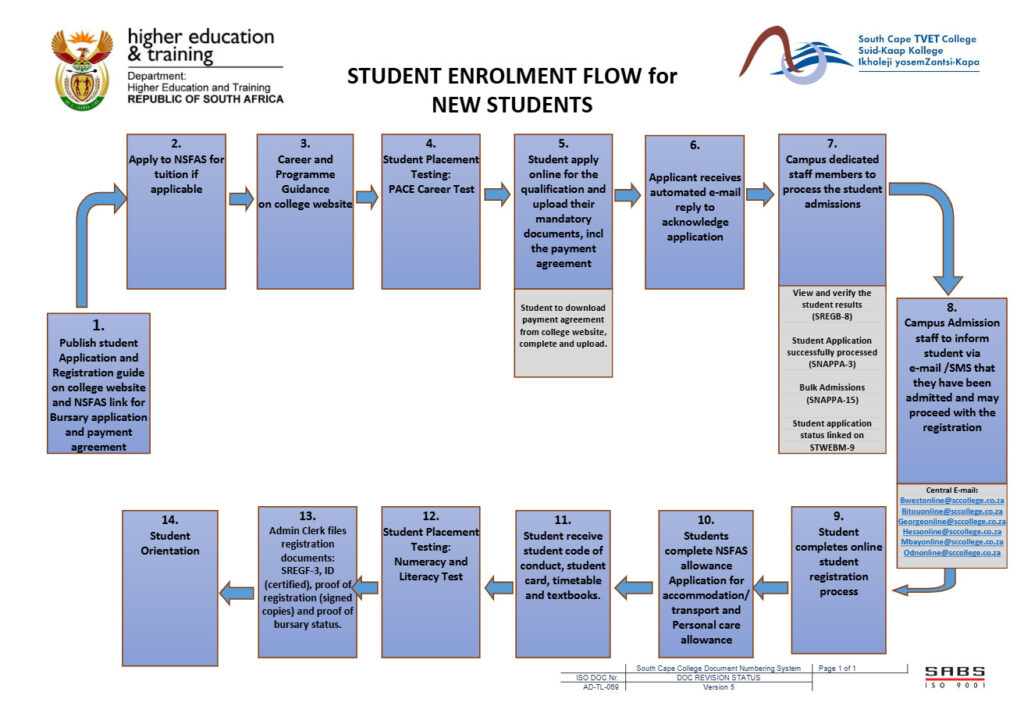
    Prospective students apply online through the Coltech Student Portal by creating an account, uploading certified documents and submitting the application form. The application system operates year-round with specific intake periods for different programmes. Applicants receive a unique student number upon submission and can track application status through the portal.

    south cape tvet college online application process.
    south cape tvet college online application process.

    Step 1: Prepare Required Documents

    Certified copies of three documents must be prepared before starting the online application:

    1. Identity Document or Smart ID Card (both sides) – for applicants under 16, certified birth certificate or passport
    2. Highest school grade passed – most recent academic results showing final marks and grade completion
    3. Proof of residential address – utility bill, municipal account or lease agreement in applicant’s name, or sworn affidavit if documents are in another person’s name

    Certification requirements: Documents must be certified by a South African Police Service officer, commissioner of oaths, attorney, justice of the peace or bank official. Certification stamps must include the certifier’s signature, stamp and date. Certified documents must not be older than six months from the date of application.

    Digital preparation: Scan each document separately as a PDF file. Name files clearly (example: “Surname_Name_ID_2026.pdf”). Compress large files to ensure upload speed. Keep file sizes under 5MB per document.

    Step 2: Access the Application Portal

    Visit the official South Cape TVET College website at sccollege.co.za and click “Apply for 2026” or navigate directly to the Coltech Student Portal.

    1. Click “Register an Account” if applying for the first time
    2. Provide a valid, active email address that will receive all correspondence
    3. Create a secure password following the system requirements
    4. Accept the Protection of Personal Information Act (POPIA) consent clause

    Important: Email addresses cannot be changed after account creation without contacting the campus directly. Use a personal email address that the applicant checks regularly.

    Step 3: Complete the Application Form

    The application form requires four sections of information:

    1. Personal details: Full name as per ID, date of birth, ID number, gender, home language, contact number
    2. Next of kin: Emergency contact name, relationship, contact number
    3. Academic history: Highest grade completed, year completed, school name
    4. Programme selection: Preferred campus, programme choice, intake year

    Read each section carefully and provide accurate information. The system may time out after 20 minutes of inactivity; complete all sections before uploading documents.

    Step 4: Upload Certified Documents

    Upload the three required certified documents in PDF format:

    1. Click “Upload Documents” in the application portal
    2. Select document type from the dropdown menu
    3. Choose the scanned file from your device
    4. Confirm upload completion for each document
    5. Review the document list to ensure all three documents appear as uploaded

    Incomplete applications: Applications submitted without all three certified documents will be marked “Only some documents submitted” and will not be processed. Log back into the portal under “Student Administration” then “Upload Documents” to complete the submission.

    Step 5: Submit Application and Receive Student Number

    Click “Accept Application” to finalize submission. The system generates a unique student number immediately and sends a confirmation email with the student number and application reference. Save this email for all future correspondence.

    Application acknowledgment: Applicants receive an automated email reply acknowledging receipt of the application. Processing times vary by programme and intake period. High-demand programmes process applications within 10 to 15 working days during peak periods.

    Step 6: Check Application Status

    Log in to the Student i-Enabler portal using the student number and five-digit PIN provided in the confirmation email.

    1. Go to www.sccollege.co.za and click “Student i-Enabler Login.”
    2. Enter student number and five-digit PIN
    3. Click “Student Enquiry” then “Academic Admission Status.”

    Application status meanings:

    • Application without status: Application submitted but not yet processed by admissions staff
    • Only some documents submitted: Missing documents or documents not certified or older than six months. Upload outstanding documents via “Student Administration” > “Upload Documents.”
    • Provisionally accepted: Application meets initial criteria; awaiting final academic results to confirm entry requirements
    • Admitted academically: Entry requirements met; student must proceed to registration at the selected campus
    • Project enrollment target reached: Programme at the selected campus is full; applicant may apply to another campus or consider alternative programmes
    • Not in catchment area: Application unsuccessful in current round; applicant resides outside primary catchment area. May be considered in later rounds, or can attend another college

    Step 7: Respond to Admission Notification

    Campus admission staff send email or SMS notification when applications are processed. Admitted students receive instructions to complete online registration, attend placement testing,, and prepare for orientation.

    Placement testing: Students complete numeracy and literacy placement tests through the PACE Career Test system. Test results inform academic support planning and module placement where applicable.

    Step 8: Complete Online Registration

    Admitted students must complete online registration by the published deadline to secure enrollment.

    1. Log in to the Student i-Enabler portal
    2. Click “Student Administration” then “Online Registration”
    3. Confirm programme details and campus assignment
    4. Accept the Student Code of Conduct
    5. Complete payment arrangement or upload NSFAS approval documentation

    Registration materials provided: Student card, timetable, textbook list, orientation schedule

    Step 9: Apply for Second-Choice Programme (if needed)

    Applicants who applied for one programme can add a second-choice application through the portal:

    1. Log into Student i-Enabler with student number and PIN
    2. Click “Returning Student Application” then “Show Academic Applications”
    3. Click “Add New Qualification”
    4. Complete programme selection and submit

    Note: Second-choice applications do not require re-uploading documents if original documents are on file and current.

    Important Application Notes

    Email address changes: Contact the campus directly with full name and student number to request email or contact detail changes. The Communications team cannot process contact detail changes.

    Forgotten PIN: Click “Forgot PIN” on the Student i-Enabler login page. The PIN will be sent to the registered email address.

    Application support: For technical issues, email communications@sccollege.co.za with student number as reference. For campus-specific questions, call the campus directly:

    • Bitou: 044 533 2388 / 044 518 0066
    • Beaufort West: 083 460 0963 / 023 449 1140
    • George: 044 874 2360
    • Hessequa: 028 713 4775
    • Mossel Bay: 044 693 2613 / 044 693 3089
    • Oudtshoorn: 044 272 2110

    Operating hours: Monday to Thursday 08:00–15:00, Friday 08:00–13:00

    South Cape TVET College Fees and Payment Information 2026

    Tuition fees vary by programme type with separate fee structures for NCV, Report 191 and occupational qualifications. Fees cover tuition, prescribed learning materials, facility usage and assessment costs. Registration fees and payment deadlines apply per academic year. NSFAS-funded students do not pay registration fees upfront; the college invoices NSFAS directly upon disbursement approval.

    Fee Schedule 2026

    Programme TypeProgrammeAnnual Fee (ZAR)
    NCV Level 2–4Office Administration10,885
    Electrical Infrastructure Construction16,705
    Tourism15,850
    Safety in Society11,144
    Report 191 N4–N6Human Resource Management3,302
    Management Assistant3,302
    Public Management3,302
    Business Management3,302
    Tourism Management7,259
    Hospitality & Catering Services7,450
    Occupational CertificatesECD Development Practitioner10,181
    Computer Technician12,596
    Cook26,964
    Management Assistant (Occupational)9,406
    Bookkeeper11,791
    Office Administration (Occupational)9,566
    Conference and Events Organiser20,772
    Tourism Information Officer12,305
    Automotive Motor Mechanic10,738
    Boilermaker14,404
    Bricklayer10,437
    Electrician13,911
    Exam FeesExam Only150

    Correspondence | 700 | | Residence Fees | Per annum (subject to NSFAS maximum) | 42,640 |

    Note: Fees are subject to change without prior notice. Contact the campus finance office for the most current fee schedule and banking details.

    Payment Options

    Self-funded students can pay via electronic transfer, debit/credit card, or approved installment arrangements. The college provides banking details on fee invoices and the official website. Payment codes must be included on all transfers to ensure correct allocation to student accounts.

    Payment plans: Contact the campus finance office to request installment agreements. Payment plans require approval and may include deposit requirements. Submit payment plan requests at least 10 working days before registration deadlines.

    Proof of payment: Retain all payment receipts, bank transaction confirmations, and NSFAS disbursement notices. Upload proof of payment through the Student i-Enabler portal or submit it to the campus finance office during registration.

    Electronic payment processing: Payments take 72 hours to reflect on student accounts during peak registration periods. Contact the finance office with invoice reference numbers if payments do not reflect after three working days.

    NSFAS Funding and Bursary Information

    NSFAS (National Student Financial Aid Scheme) provides tuition, learning materials, and allowances for eligible TVET college students. Applicants must apply to NSFAS separately through the NSFAS online portal at www.nsfas.org.za. NSFAS determines eligibility based on household income, academic results, and vulnerability criteria.

    NSFAS application requirements:

    • Own phone number and active email address
    • Copy of ID or birth certificate
    • ID copies of parents, guardians, or spouse
    • Proof of household income or one year’s IRP5 documents
    • Parents, guardians or spouse proof of income
    • SASSA grant recipients do not require income proof
    • Applicants with disabilities submit completed Disability Annexure A Form
    • Vulnerable children submit Vulnerable Child Declaration and Consent Form

    NSFAS coverage for TVET students:

    • Full tuition fees
    • Registration fees
    • Learning materials
    • Transport allowance (not accommodation allowance)
    • Personal care allowance

    Important: NSFAS-funded students at South Cape TVET College receive transport allowances, not accommodation allowances. Students must arrange private accommodation and budget transport costs accordingly.

    NSFAS application timeline: Apply to NSFAS as early as possible, ideally before submitting the college application. NSFAS processing takes 4 to 8 weeks. Applicants must complete the college application separately; NSFAS approval does not constitute college admission.

    NSFAS status checks: Log in to the NSFAS portal at www.nsfas.org.za to check application status. Contact the campus bursary officer for assistance with NSFAS queries, appeals, and allowance applications.

    Bursary officer contact: Call the campus main number and request a connection to the bursary officer. Provide the student number and NSFAS reference number for faster assistance.

    Payment Agreement and Financial Holds

    All students must complete a payment agreement as part of the registration process. Download the payment agreement form from the college website, complete and sign the document, and upload it through the application portal or submit it during in-person registration.

    Financial holds: Unpaid fees result in financial holds that block access to timetables, examination entry, and student resources. Clear financial holds by submitting proof of payment or NSFAS approval documentation to the campus finance office.

    Refund policy: Contact the campus finance office for refund policy details and withdrawal procedures. Refunds follow DHET guidelines and may be subject to administrative fees.

    Contact for Fee Queries

    Campus finance offices handle billing, payment arrangements, NSFAS coordination, and account statements. Call the campus main number and request a connection to the finance office. Provide the student number and invoice reference for all queries.

    For detailed fee breakdowns, invoice requests, or payment plan applications, visit the campus finance office during operating hours or email the campus main address with “FINANCE QUERY” in the subject line.

    Student Support Services and Campus Life

    All campuses provide student support officers, academic tutoring, counseling services and student representative councils (SRC) to support holistic student development. Support services assist with academic performance, personal challenges, career planning and campus integration throughout the student lifecycle.

    Student Support Officers

    Student and Academic Support Officers operate at each campus delivering orientation, counseling, academic tutoring and referrals to external support services. Officers coordinate student wellness programs, study skills workshops and intervention for students experiencing academic or personal difficulties.

    Services include:

    • Individual counseling for mental health, stress management and personal challenges
    • Academic tutoring in mathematics, languages and technical subjects
    • Study skills workshops covering time management, note-taking and exam preparation
    • Referral pathways to external mental health services, substance abuse support and crisis intervention
    • Disability accommodations and learning support plans for students with documented disabilities
    • Financial counseling on NSFAS processes, budget planning and emergency funding options

    Access support services: Contact the Student Support Officer at your campus by visiting the student services office or calling the campus main number. Appointments can be scheduled in advance or accessed during drop-in hours published on campus notice boards.

    Academic Support and Tutoring

    Academic support includes scheduled tutoring sessions, supplementary instruction and peer-learning groups for high-risk subjects. Mathematics, engineering science and language modules receive dedicated tutoring hours each week. Tutors are senior students, alumni or contracted subject specialists.

    Tutoring access: Check campus timetables for drop-in tutoring hours per subject. Group tutoring sessions run in the afternoons and evenings; individual appointments can be requested through the Student Support Officer.

    Exam preparation workshops: The college runs intensive revision workshops in the two weeks before summative examinations. Workshops cover exam technique, past paper practice and concept review for high-failure-rate modules.

    Counseling and Wellness Services

    Counseling services provide confidential mental health support, crisis intervention and wellness programming. Trained counselors assist students experiencing anxiety, depression, relationship challenges, substance use concerns and trauma.

    Session availability: Counseling appointments are scheduled through the Student Support Officer. Emergency walk-in sessions are available during office hours for urgent situations. For after-hours crises, counselors provide referral contact details for provincial mental health crisis lines.

    Referral services: Counselors connect students to external psychologists, social workers, substance abuse treatment programs and community health clinics where ongoing care is required. The college maintains partnerships with Western Cape Department of Health facilities for student referrals.

    Student Representative Council (SRC)

    Student-elected SRC members represent student interests, facilitate communication between students and management, and organize campus events and activities. SRC elections occur annually with students voting for representatives from each programme and campus.

    SRC responsibilities:

    • Advocate for student needs and concerns to campus management
    • Organize orientation activities, social events and awareness campaigns
    • Represent students on college governance committees
    • Assist with resolving student grievances and policy questions
    • Coordinate volunteer projects and community engagement activities

    Leadership criteria: SRC candidates must demonstrate leadership, accountability, reliability and commitment to student welfare. Nomination and election processes follow published timelines each academic year.

    Career Services and Work Integrated Learning (WIL) Coordination

    Career services coordinate WIL placements, employer engagement, CV workshops and job-readiness training. WIL coordinators maintain employer databases, negotiate placement agreements and monitor student progress during workplace learning periods.

    Career development support:

    • CV and cover letter writing workshops
    • Interview preparation and mock interviews
    • Employer information sessions and campus recruitment events
    • Industry mentorship programmes linking students with working professionals
    • Job vacancy listings and application support
    • Entrepreneurship workshops for students pursuing self-employment

    WIL placement process: Students receive WIL placement guidelines during orientation. Placement coordinators match students to employers based on programme requirements, student location and employer capacity. Students sign learner agreements specifying learning outcomes, duration, supervision and assessment criteria.

    Employer partnerships: The college partners with businesses across construction, hospitality, manufacturing, retail, tourism, information technology and public-sector organizations. Employers provide workplace supervisors, assessment opportunities and potential post-graduation employment for successful students.

    Accommodation Guidance

    Most campuses do not have on-campus hostel accommodation. Campus residence or accommodation managers maintain lists of vetted private accommodation providers including boarding houses, shared flats and homestays near campus locations.

    Accommodation costs: Private accommodation is self-funded as NSFAS provides transport allowances (not accommodation allowances) to TVET students. Costs vary by location and accommodation type. Students should budget R2,000 to R4,500 per month for private accommodation.

    Finding accommodation: Contact the campus accommodation manager for current accommodation listings, landlord contact details and advice on lease agreements. Visit accommodation options before signing leases; verify proximity to campus and public transport access.

    Hessequa Campus hostel: Hessequa Campus offers limited hostel accommodation for students meeting eligibility criteria. Contact the campus manager to inquire about hostel availability, costs and application procedures.

    Accommodation contacts: Call the campus main number and request connection to the accommodation or residence manager. Provide programme name and expected start date when inquiring.

    Student Conduct and Campus Safety

    All students agree to the Student Code of Conduct during registration. The code specifies expected behavior, prohibited activities, disciplinary procedures and student rights.

    Key conduct rules:

    • Obscene language, sexual harassment and discrimination are prohibited
    • Smoking only in designated outdoor areas (smoking inside buildings is illegal)
    • Cellular phones and communication devices prohibited during classes and examinations
    • Alcohol, illegal drugs and weapons prohibited on college property
    • Gambling, fighting and theft result in disciplinary action or suspension
    • Vandalism and property damage incur financial liability and disciplinary consequences

    Serious offenses resulting in suspension or expulsion: Assault, dishonesty during examinations, theft, drug or alcohol use on campus, possession of weapons, inciting violence, sexual or racial harassment.

    Safety reporting: Report safety concerns, harassment, theft or emergency situations to campus security or the Campus Manager immediately. After-hours emergencies should be reported to campus security hotlines listed on student cards and campus notice boards.

    Campus security: Campuses maintain security personnel during operating hours and after-hours for evening classes. CCTV coverage varies by campus. Students should report suspicious activity and secure personal belongings in lockers or designated storage areas.

    Orientation and Onboarding

    New student orientation occurs at the start of each academic year and introduces students to campus facilities, academic expectations, support services and student policies. Orientation attendance is mandatory for all first-year students.

    Orientation content:

    • Campus tour and facility introductions (libraries, computer labs, workshops, cafeterias)
    • Academic expectations and assessment policies
    • Student Code of Conduct review
    • Timetable distribution and class scheduling
    • Textbook collection and learning material orientation
    • Student card activation and IT system access
    • Introduction to Student Support Officers and Counseling Services
    • SRC introductions and student activities overview

    Orientation schedule: Admitted students receive orientation dates and times via email and SMS. Orientation typically runs for two to three days before the start of lectures.

    South Cape TVET College Frequently Asked Questions

    What kind of college is South Cape TVET College?

    South Cape TVET College is a public vocational education institution registered with the Department of Higher Education and Training (DHET). The college delivers National Qualifications Framework-aligned programmes in technical, business, hospitality, and occupational fields.

    What is the medium of instruction?

    The official language of teaching and learning is English. All prescribed textbooks and learning materials are in English. Students of all language backgrounds are welcome to enroll.

    What is a National Certificate Vocational (NCV) qualification?

    NCV is a three-year vocational alternative to academic matric, covering Levels 2 to 4 (equivalent to Grades 10, 11, and 12). Students combine fundamental subjects (English, Mathematics or Mathematical Literacy, Life Orientation) with specialized vocational subjects in fields such as engineering, office administration, hospitality, tourism, and safety. Successful completion of NCV Level 4 enables articulation to Higher Certificate, National Diploma, or Bachelor’s Degree programmes at universities or universities of technology.

    Can I apply with Grade 11 results?

    Yes, NCV Level 2 accepts applicants who passed Grade 9 with a minimum 40% in Mathematics, English, Life Orientation, and one additional subject. Report 191 N4 programmes require Grade 12 or NCV Level 4 completion. Check specific programme entry requirements before applying.

    How do I apply for accommodation?

    Contact the campus accommodation or residence manager for private accommodation listings near your campus. Most campuses do not have on-campus hostels. Accommodation costs are self-funded as NSFAS provides transport allowances (not accommodation allowances) for TVET students. Hessequa Campus offers limited hostel accommodation for eligible students.

    Does NSFAS fund TVET students at South Cape TVET College?

    Yes, eligible students receive NSFAS funding covering tuition, registration, learning materials, transport allowance and personal care allowance. Apply to NSFAS at www.nsfas.org.za separately from the college application. NSFAS determines eligibility based on household income and vulnerability criteria. Contact the campus bursary officer for NSFAS application guidance and status queries.

    How do I check my application status?

    Log in to the Student i-Enabler portal at www.sccollege.co.za using your student number and five-digit PIN. Click “Student Enquiry” then “Academic Admission Status” to view application progress. Status updates include: application without status (not yet processed), only some documents submitted (missing or uncertified documents), provisionally accepted (awaiting final results), admitted academically (entry requirements met, proceed to registration), project enrollment target reached (programme full), not in catchment area (outside primary service region).

    What if I forgot my PIN?

    Click “Forgot PIN” on the Student i-Enabler login page. The five-digit PIN will be sent to the email address registered during the application. If the email address is no longer accessible, contact the campus with your full name and student number to request a PIN reset.

    Can I complete or upgrade my Grade 12 at the college?

    No, South Cape TVET College does not offer matric subject rewrites or Grade 12 completion. Students seeking matric subject upgrades should contact local community education centers or distance learning providers. NCV Level 2–4 provides an alternative vocational pathway equivalent to Grades 10–12 for students who did not complete academic matric.

    How much are TVET college fees at South Cape in 2026?

    NCV programme fees range from R10,885 (Office Administration) to R16,705 (Electrical Infrastructure Construction). Report 191 N4–N6 business studies fees range from R3,302 to R7,450. Occupational certificate fees range from R9,406 to R26,964. Exam-only fees are R150. Refer to the fee schedule table for specific programme costs. NSFAS covers full tuition for eligible students.

    What documents do I need to apply?

    ertified documents must be signed by a commissioner of oaths, police officer, attorney or bank official. Certifications must not be older than six months. Scan documents as separate PDF files before starting the online application.

    What programmes does South Cape TVET College offer near George?

    George Campus offers NCV Office Administration Level 2–4 and Report 191 N4–N6 in Business Management, Educare, Human Resource Management, Management Assistant, Marketing Management, Public Management and Tourism Management. George also offers the National Introductory Certificate bridging programme. For engineering and technical trades, students should consider Mossel Bay Campus.

    When do South Cape applications open and close for 2026?

    Application periods vary by programme and intake cycle. The online application portal operates year-round with specific deadlines published for each intake. Monitor the college website and campus announcements for intake opening and closing dates. Apply early for high-demand programmes to secure placement.

    Can I apply to more than one programme at the same time?

    Yes, applicants can add a second-choice programme through the Student i-Enabler portal after submitting the initial application. Log in with your student number and PIN, click “Returning Student Application” then “Show Academic Applications,” and select “Add New Qualification” to submit a second choice.

    What if my ID is lost, damaged, or stolen?

    Request a Temporary Identification Certificate (TIC) from Home Affairs. The TIC is an official document valid for three months and accepted for college applications. Provide a certified TIC instead of the ID when uploading application documents.

    Who do I contact if I didn’t get a response on my application?

    Contact the campus directly by phone or email communications@sccollege.co.za with your student number as reference. Campus contact numbers: Bitou 044 533 2388, Beaufort West 023 449 1140, George 044 874 2360, Hessequa 028 713 4775, Mossel Bay 044 693 2613, Oudtshoorn 044 272 2110. Operating hours Monday to Thursday 08:00–15:00, Friday 08:00–13:00.

    Apply Now for 2026 Intake

    Start your application online today through the Coltech Student Portal. Prepare certified documents, create your account, select your campus and programme, and submit your application to receive your student number. Track your application status through the Student i-Enabler portal and respond promptly to admission notifications.

    Download the 2026 Prospectus: Visit www.sccollege.co.za to download the full prospectus with detailed programme descriptions, module lists, campus information, and admission requirements.

    Book a Campus Tour: Contact your preferred campus directly to schedule a visit, view facilities, and speak with programme coordinators. Campus tours provide opportunities to ask questions, explore workshops, and meet current students.

    Apply for NSFAS Funding: Visit www.nsfas.org.za to apply for financial aid. Complete the NSFAS application before or alongside your college application to ensure funding is in place before registration deadlines.

    Contact Admissions for Support: Email communications@sccollege.co.za or call your preferred campus for application assistance, programme guidance, and document certification queries.

    Operating Hours: Monday to Thursday 08:00–15:00, Friday 08:00–13:00

    Follow South Cape TVET College: Stay updated on intake dates, programme announcements, and campus events by following the college on social media platforms and subscribing to the newsletter on the official website.

    Secure your place at South Cape TVET College for 2026 and activate your future through quality vocational education, industry partnerships, and career-focused training. Apply today.

  • iEnabler Login: How to Apply & Student Portal Guide 2026

    iEnabler Login: How to Apply & Student Portal Guide 2026

    iEnabler is the web-based student portal used by South African universities and TVET colleges for online applications, document uploads, course registration, and results access.

    Developed by Adapt IT as part of the ITS Integrator suite, the system centralizes student services across multiple campuses and academic periods.

    This guide provides step-by-step instructions for South African students accessing institutional portals in 2026. It covers account creation, login procedures, document submission, application tracking, and troubleshooting for common errors.

    Table of Contents

    What is iEnabler?

    iEnabler is student self-service software that enables online application submission, document uploads, course registration, and academic record access at South African higher education institutions.

    The platform operates as a web interface to the ITS Integrator database, which stores student records, financial accounts, qualifications, and module data.

    The system manages four primary data domains:

    1. Personal entities: Student records, identification numbers, contact details, and next-of-kin information
    2. Academic entities: Qualifications, subjects, modules, NQF levels, prerequisites, and academic periods
    3. Financial entities: Student accounts, NSFAS funding agreements, bursary records, and fee structures
    4. Administrative entities: Applications, registrations, results, and assessment records

    Institutions configure portal settings to match local requirements. Configuration options include intake deadlines, required document categories, file format specifications, and size limits. Most South African instances accept PDF and JPG files between 2 MB and 10 MB per upload.

    The platform validates student credentials using unique identifiers (student number or ID number) paired with a PIN. Role-based access control ensures students view only their own financial statements and academic records.

    South African Institutions Using iEnabler in 2026

    Twenty-three universities and TVET colleges in South Africa operate institutional instances of the portal for student services. The table below lists confirmed deployments with direct login URLs verified.

    Universities Using iEnabler

    InstitutionAcronymInstitution TypeiEnabler Portal URLAccess Notes
    Tshwane University of TechnologyTUTUniversity of Technologyhttps://ienabler.tut.ac.za/pls/prodi41/w99pkg.mi_loginDirect iEnabler instance
    Vaal University of TechnologyVUTUniversity of Technologyhttps://ienablerprod.vut.ac.za/pls/prodi41/w99pkg.mi_loginProduction instance
    University of Fort HareUFHTraditional Universityhttps://ienabler.ufh.ac.za/pls/prodi41/w99pkg.mi_loginDirect iEnabler instance
    Sol Plaatje UniversitySPUTraditional Universityhttps://ienabler.spu.ac.za/pls/prodi41/w99pkg.mi_loginDirect iEnabler instance
    University of MpumalangaUMPTraditional Universityhttps://ienabler.ump.ac.za/pls/prodi41/w99pkg.mi_loginDirect iEnabler instance
    University of JohannesburgUJTraditional Universityhttps://ienabler.uj.ac.za/pls/prodi41/w99pkg.mi_loginDirect iEnabler instance
    University of ZululandUNIZULUTraditional Universityhttps://jasper.unizulu.ac.za/pls/prodi41/w99pkg.mi_loginCustom domain (Jasper)
    University of LimpopoULTraditional Universityhttps://ulc-prod-webserver.ul.ac.za/pls/prodi41/w99pkg.mi_loginProduction webserver instance
    University of VendaUNIVENTraditional Universityhttps://univenierp01.univen.ac.za/pls/prodi41/w99pkg.mi_loginERP-integrated instance
    Sefako Makgatho Health Sciences UniversitySMUHealth Sciences Universityhttps://ienabler.smu.ac.za/pls/prodi41/w99pkg.mi_loginDirect iEnabler instance
    Durban University of TechnologyDUTUniversity of Technologyhttps://mercury.dut.ac.za/pls/prodi41/w99pkg.mi_loginCustom domain (Mercury)
    Central University of TechnologyCUTUniversity of Technologyhttps://enroll.cut.ac.za/pls/prodi41/w99pkg.mi_loginEnrollment-focused domain
    Cape Peninsula University of TechnologyCPUTUniversity of Technologyhttps://alecto.cput.ac.za/pls/prodi41/w99pkg.mi_loginCustom domain (Alecto)
    Mangosuthu University of TechnologyMUTUniversity of TechnologyVia https://www.mut.ac.za/student-portal/Accessible through main portal
    University of KwaZulu-NatalUKZNTraditional Universityhttps://sciman.ukzn.ac.zaCustom system (SCIMAN)

    TVET Colleges Using iEnabler

    College NameAcronymProvinceiEnabler Portal URLCommon Features
    Coastal KZN TVET CollegeKZNTVETKwaZulu-Natalhttps://ienabler.kzntvet.edu.za/pls/prodi41/w99pkg.mi_loginApplications, results, financial statements, residence applications
    Ekurhuleni West TVET CollegeEWCGautenghttps://ienabler.ewc.edu.za/pls/prodi41/w99pkg.mi_loginFull self-service, online applications, document uploads
    Ekurhuleni East TVET CollegeEECGautenghttps://ienabler.eec.edu.za/pls/prodi41/w99pkg.mi_loginStudent registration, biographical updates, exam results
    Central Johannesburg TVET CollegeCJCGautenghttps://ienabler.cjc.edu.za/pls/prodi41/w99pkg.mi_loginStudent self-service, registration, status tracking
    South West Gauteng TVET CollegeSWGCGautenghttps://ienabler.swgc.co.za/pls/prodi41/w99pkg.mi_loginOnline registration, academic records, account management
    Tshwane North TVET CollegeTNCGautenghttps://ienabler.tnc.edu.za/pls/prodi41/w99pkg.mi_loginApplication processing, graduation information, results
    Northlink CollegeNLCWestern Capehttps://ienabler.northlink.co.za/pls/prodi41/w99pkg.mi_login?numtype=SStudent number-based access (numtype=S parameter)
    West Coast TVET CollegeWCTCWestern Capehttps://ienabler.westcoastcollege.co.za/pls/prodi41/w99pkg.mi_loginFull student portal, applications, financial statements
    Port Elizabeth TVET CollegePECEastern Capehttps://ienabler.pec.edu.za/pls/prodi41/w99pkg.mi_loginOnline registration, student account management, results
    Buffalo City TVET CollegeBCTCEastern CapeBCollege Student PortalOnline applications, exam results, financial statements
    Ingwe TVET CollegeITCKwaZulu-NatalStudent PortalFull self-service for new and returning students
    Orbit TVET CollegeOTCNorthern CapeOrbit College Student PortalRegistration, biographical updates, academic records
    Vhembe TVET CollegeVTCLimpopoVhembe Student PortalOnline application, student profile management

    Key Portal Functions by User Type

    User TypeAvailable FunctionsExamples
    Prospective StudentsView internal marks, check final examination results, and print proof of registrationSubmit ID copy, latest results, proof of residence; track Submitted/Provisionally Accepted status
    Registered StudentsView account balance, check NSFAS funding status, and download fee statementsMonitor outstanding fees, confirm bursary allocation, and print payment receipts
    All Students (Financial)Access semester marks, download registration confirmation, and view module selectionMonitor outstanding fees, confirm bursary allocation, print payment receipts
    All Students (Personal)Update contact details, change PIN, manage communication preferencesUpdate cell number, change email address, reset password

    Technical Access Requirements

    RequirementSpecificationNotes
    Student NumberBirth date (DDMMYYYY) or generic code provided by the collegeFirst-time users receive a number via email or SMS after the application
    Default PINInternet Explorer is not supportedMust be changed on first login for security
    Recommended BrowsersChrome 115+, Edge 115+, Firefox 115+, Safari 16+Clear the cache if experiencing session timeouts
    Mobile CompatibilityChrome for Android, Safari for iOSDesktop preferred for complex tasks like module registration
    Required SettingsJavaScript enabled, cookies allowed, pop-ups permitted for portal domainClear cache if experiencing session timeouts

    Important Notes

    1. Coltech Alternative: Some TVET colleges (e.g., Majuba TVET) use the Coltech system instead of iEnabler. Check the institutional website for “Student Portal” or “Online Application” links.
    2. URL Verification: Always access portals via official institutional domains listed above. Bookmark the correct URL after the first successful login to avoid phishing sites.
    3. Peak Period Access: Portal traffic increases during application periods (October–February) and registration periods (January, July). Access during off-peak hours (early morning, late evening) for faster performance.
    4. Support Channels: Contact campus IT helpdesk or admissions office if the portal URL does not work. Provide student number, error message, and browser details when requesting assistance.
    5. Data Updated: Institutions may update URLs—always check the official campus website if the link fails.

    Students should always access the portal using the official campus domain listed above. Bookmark the correct URL after the first successful login to avoid phishing sites.

    How to Create an Account and Log In

    Create a new account by visiting your institution’s portal, clicking Register or Create Account, entering your South African ID number or application reference, setting a 6-to-8-character PIN, and confirming via email. After account activation, log in using your ID number and PIN.

    Step-by-Step Account Creation

    1. Navigate to your institution’s official portal URL from the table above
    2. Select Register, Create Account, or New User (button text varies by campus)
    3. Enter your 13-digit South African ID number exactly as it appears on your identity document (remove spaces and dashes)
    4. Provide your full legal name, matching your ID document
    5. Enter a valid email address you check regularly (institutional email if already issued, otherwise personal email)
    6. Create a PIN between 6 and 8 characters, combining letters and numbers
    7. Confirm the PIN by entering it a second time
    8. Submit the registration form
    9. Check your email inbox (and spam folder) for an activation link within 10 to 30 minutes
    10. Click the activation link to verify your email address
    11. Return to the login page and sign in using your ID number and newly created PIN

    Important: Some institutions issue application numbers before ID-based access. If you have an application number from a previous paper or online application, use that number instead of your ID during initial registration. Contact campus admissions if unsure which identifier to use.

    Standard Login Procedure

    1. Open your institution’s portal URL in Chrome, Edge, Firefox, or Safari
    2. Locate the Student Login or Sign In section (usually top-right or center of page)
    3. Enter your student ID number, application number, or South African ID number in the username field
    4. Enter your PIN in the password field
    5. Click Login or Sign In
    6. After successful authentication, the portal displays your dashboard with Application Status, Document Upload, Registration, and Results sections

    If login fails after three attempts, wait 15 minutes before retrying (most systems temporarily lock accounts after multiple failed attempts). Use the Forgot PIN procedure below if you cannot remember your credentials.

    How to Reset Your PIN or Password

    Reset forgotten credentials by clicking Forgot PIN or Forgot Password on the login screen, entering your registered email address or ID number, and following the reset link sent to your email within 10 to 30 minutes. If no email arrives, check spam folders and contact the campus helpdesk with your ID and proof of identity.

    Reset Process

    1. On the login page, click Forgot PIN, Forgot Password, or Reset Password (exact text varies)
    2. Enter either your registered email address or your student ID number
    3. Click Submit or Send Reset Link
    4. Open your email inbox and locate the message from your institution’s IT services or admissions office
    5. Click the reset link (link typically expires after 24 hours)
    6. Enter your new PIN twice to confirm
    7. Return to the login page and sign in with new credentials

    If the reset email does not arrive:

    • Check spam, junk, and promotions folders
    • Verify the email address you provided matches the one registered during account creation
    • Wait 30 minutes (some institutions batch email processing)
    • Contact the campus helpdesk via phone or in-person visit with your ID document and application number

    Institutions may require manual verification for security. Keep your registered email address current by updating contact details in the portal’s Personal Information section after each successful login.

    iEnabler Document Upload: Requirements and Process

    Upload required documents by logging in, navigating to Document Upload or Supporting Documents, selecting the correct document category (ID, Matric certificate, proof of residence), attaching PDF or JPG files under the institution’s size limit, and clicking Upload. Save the upload reference number or confirmation message for tracking.

    Accepted File Formats and Size Limits

    South African institutions typically accept:

    • PDF (Portable Document Format) – preferred for multi-page documents
    • JPG or JPEG (Joint Photographic Experts Group) – used for scanned images
    • PNG (Portable Network Graphics) – accepted by some campuses

    File size limits range from 2 MB to 10 MB per document, depending on institutional configuration. Check your campus portal’s Document Upload page for exact specifications.

    Document Categories and Examples

    CategoryDescriptionExample Filenames
    South African IDCertified copy or clear scan of ID book/cardID_Sipho_Ngwenya.pdf
    Matric CertificateNSC results or Senior CertificateMatric_2023_Thandi_Mokoena.pdf
    Academic TranscriptPrevious tertiary results if applying with creditsTranscript_UNISA_2022.pdf
    Proof of ResidenceMunicipal account, lease agreement, affidavitResidence_Proof_Durban.pdf
    NSFAS ConfirmationBursary approval letter or funding agreementNSFAS_Approval_2025.pdf

    Step-by-Step Upload Instructions

    1. Log in to your student portal
    2. Click Document Upload, Supporting Documents, or My Documents
    3. Review the list of required documents for your qualification or application type
    4. Select the document category from the dropdown menu (e.g., “South African ID Document”)
    5. Click Choose File or Browse
    6. Navigate to the saved document on your computer or phone
    7. Select the file and click Open
    8. Verify the filename appears in the upload field
    9. Click Upload or Submit Document
    10. Wait for the confirmation message or reference number (appears within 5 to 30 seconds)
    11. Record the reference number in a safe place or take a screenshot
    12. Repeat steps 4 through 11 for each additional required document

    Mobile upload tips:

    • Use Wi-Fi instead of mobile data to avoid timeouts and reduce data costs
    • Compress images before uploading (many phone camera apps create files over 10 MB)
    • If upload fails on mobile, switch to a desktop computer or campus computer lab
    • Disable battery-saving mode during upload to prevent session interruption

    File Rejected: Common Causes and Fixes

    Error MessageCauseSolution
    File size too largeDocument exceeds institutional limit (e.g., 15 MB file when limit is 5 MB)Compress PDF using online tools or scan at lower resolution (150–300 DPI instead of 600 DPI)
    Invalid file typeDelete the previous upload if allowed, or contact helpdesk to replaceConvert file to PDF using free converters or phone PDF apps
    Document already uploadedSame category submission existsRetry using a wired connection or campus Wi-Fi; upload one file at a time
    Connection timeoutSlow or unstable network during uploadRetry using wired connection or campus Wi-Fi; upload one file at a time

    Always rename files clearly before uploading. Use format: DocumentType_YourName.pdf (example: ID_Lerato_Dlamini.pdf). Avoid special characters, spaces, or symbols in filenames.

    How to Check Application Status on iEnabler

    View application status by logging in, selecting Application Tracker, My Applications, or Application Status, and reviewing the status label assigned to your submission. Status options include Submitted, Provisionally Accepted, Awaiting Documents, Documents Under Review, and Rejected.

    Understanding Status Labels

    StatusMeaningRequired Action
    SubmittedApplication received and queued for reviewNo action; wait for admissions review (typically 7–21 days)
    Provisionally AcceptedConditional acceptance pending final documents or paymentUpload outstanding documents and confirm registration
    Awaiting DocumentsMissing required files or documents not verifiedCheck Document Upload section, submit missing files, email admissions
    Documents Under ReviewAll documents received; admissions team verifying authenticityNo action; verification takes 5–14 days depending on peak periods
    Rejected / Not AdmittedApplication declined due to unmet requirementsReview rejection reason, appeal if eligible, or apply for alternative qualification

    Step-by-Step Status Check

    1. Log in to your portal
    2. Navigate to Application Tracker, My Applications, or Application Status (menu location varies by institution)
    3. Locate your current application by year and qualification (e.g., “N6 Electrical Engineering 2026”)
    4. Note the status label and any accompanying messages or instructions
    5. If status shows Awaiting Documents, click View Required Documents or Outstanding Items
    6. Upload missing files immediately via Document Upload section
    7. After uploading, send email notification to admissions office with your application number and upload confirmation reference
    8. Check status again after 3–5 business days

    Printing proof of application:

    Most portals include a Print Receipt or Download Confirmation button next to each application. Click this button to save a PDF confirmation including:

    • Application number
    • Submission date and time
    • Qualification applied for
    • Current status
    • Documents submitted

    Save this PDF for appeals, bursary applications, or campus visit verification.

    Course Registration and Module Selection

    Register for courses by logging in, navigating to Registration or Module Selection, choosing your qualification (NCV, NATED, Diploma, Degree), selecting required modules based on your programme curriculum, submitting the registration form, and saving the confirmation receipt. Verify selected modules match NQF requirements before final submission.

    Registration Process for TVET Programmes

    TVET colleges typically offer NCV (National Certificate Vocational) and NATED (N1–N6) qualifications. Module selection depends on programme level and semester.

    Example: NATED N4 Electrical Engineering Registration

    1. Log in and select Registration or Course Registration
    2. Choose NATED as qualification type
    3. Select N4 level
    4. Pick programme: Electrical Engineering
    5. System displays required subjects:
      • Engineering Mathematics N4
      • Engineering Science N4
      • Industrial Electronics N4
      • Electrical Trade Theory N4
    6. Confirm all four subjects are selected
    7. Click Submit Registration
    8. Download registration confirmation and fee statement
    9. Proceed to payment (bursary, NSFAS, or self-funded)

    Registration Process for University Programmes

    University students select modules based on degree requirements, semester, and year of study.

    Example: First-Year Diploma Registration

    1. Navigate to Module Registration or Course Selection
    2. Select year of study: First Year
    3. Choose semester: Semester 1 2026
    4. System displays core modules and electives
    5. Select all compulsory modules (usually 4–6 per semester)
    6. Choose elective modules if required by programme
    7. Verify total credits match minimum requirement (typically 60 credits per semester)
    8. Click Submit or Finalize Registration
    9. Print registration confirmation showing module codes, credits, and timetable links

    NSFAS-funded students: Confirm bursary approval appears in Financial Statement section before finalizing registration. Contact financial aid office if funding status shows Pending or Not Approved.

    How to Access Results and Academic Records

    Access examination results and academic transcripts by logging in, selecting Results, Examination Results, or Academic Record, choosing the relevant academic year and semester, and viewing or downloading your statement. Final results typically publish 4–8 weeks after examination period ends.

    Viewing Results

    1. Log in to portal
    2. Click Results, Examination Results, or My Results
    3. Select academic year (e.g., 2025, 2026)
    4. Choose semester or trimester
    5. View module-by-module results including:
      • Module code and name
      • Credits
      • Mark or grade (percentage, symbol, or pass/fail)
      • Status (Pass, Fail, Supplementary Required, Deferred)
    6. Check overall GPA or average if displayed

    Downloading official transcripts:

    1. Navigate to Academic Record or Download Transcript
    2. Select record type: Interim Statement or Full Academic Transcript
    3. Click Generate PDF or Download
    4. Save PDF to secure location
    5. Print certified copies through campus registry office if required for job applications or further study

    Results are typically “enabled” (made visible) on specific release dates announced by academic administration. If results do not appear on the expected date, contact your department or faculty office.

    Troubleshooting Common Portal Errors

    Resolve login failures, session timeouts, upload errors, and portal unavailability by clearing browser cache, using supported browsers, compressing files, and providing detailed error information to helpdesk. Most issues resolve through basic browser maintenance and file format verification.

    Session Timeout Errors

    Cause: Portal automatically logs out users after 15–30 minutes of inactivity to protect account security.

    Solutions:

    • Close all browser tabs except the portal tab
    • Disable browser extensions or add-ons that might interfere with session cookies
    • Enable cookies and JavaScript in browser settings
    • Avoid using in-app browsers (Facebook, Instagram browsers); open portal in full Chrome, Edge, or Firefox
    • Clear browser cache: Settings > Privacy > Clear Browsing Data > Select “Cookies and other site data” and “Cached images and files”
    • Log in again and complete tasks within 15 minutes

    Invalid Credentials or Login Failures

    Cause: Incorrect ID format, forgotten PIN, or account locked after multiple failed attempts.

    Solutions:

    • Verify ID number contains exactly 13 digits with no spaces or dashes
    • Remove leading zeros if system rejects ID
    • Check Caps Lock is off when entering PIN
    • Use Forgot PIN function to reset credentials
    • Wait 15 minutes if account locked, then retry
    • Contact helpdesk with ID document and application number if problem persists

    File Upload Failures

    Common upload errors and fixes:

    ErrorCauseFix
    Upload failedFile too largeCompress PDF or reduce image resolution to under 5 MB
    Invalid formatWrong file type (e.g., HEIC, BMP)Convert to PDF using online converter or phone app
    Connection resetNetwork interruptionSwitch to stable Wi-Fi or wired connection; retry upload
    File already existsDocument category previously uploadedDelete old file if allowed, or contact helpdesk to replace

    General upload best practices:

    • Upload one file at a time instead of multiple simultaneous uploads
    • Rename files using simple text: ID_FirstName_LastName.pdf
    • Scan documents at 150–300 DPI resolution (not 600+ DPI)
    • Use PDF format for multi-page documents instead of multiple JPG files
    • Test upload on desktop if mobile repeatedly fails

    Portal Unreachable or Down

    Cause: Server maintenance, network issues, or peak traffic overload.

    Solutions:

    • Check institution’s website or social media for maintenance announcements
    • Try accessing portal at off-peak hours (early morning, late evening)
    • Clear DNS cache: Command Prompt > type ipconfig /flushdns > press Enter (Windows) or Terminal > type sudo dscacheutil -flushcache (Mac)
    • Test connection by visiting other websites to confirm internet works
    • Use mobile data instead of campus Wi-Fi if campus network is congested
    • Contact IT helpdesk to report downtime with screenshot and exact error message

    Error Code Reference

    Some institutions display numeric error codes. Common codes:

    • Error 404: Page not found – verify URL is correct; try removing extra characters
    • Error 500: Internal server error – wait 30 minutes and retry; report to IT if persists
    • Error 403: Access forbidden – clear cookies; log out completely and log in again

    When contacting helpdesk, always include:

    1. Full name and student/application number
    2. Exact error message (copy-paste text or screenshot)
    3. Browser name and version (e.g., Chrome 120, Edge 119)
    4. Device type (Windows PC, Mac, Android phone, iPhone)
    5. Date and time error occurred
    6. Steps you took before error appeared

    Browser and Mobile Compatibility

    Use the latest version of Chrome, Edge, Firefox, or Safari with cookies and JavaScript enabled for optimal portal performance. Avoid outdated browsers (Internet Explorer) and in-app browsers that block session cookies.

    Desktop:

    • Chrome 115+ or Edge 115+ (Windows, Mac, Linux)
    • Firefox 115+ (Windows, Mac, Linux)
    • Safari 16+ (Mac only)

    Mobile:

    • Chrome for Android (latest version)
    • Safari for iOS (latest version)
    • Avoid Samsung Internet, Opera Mini, or UC Browser (limited compatibility)

    Required settings:

    1. Enable JavaScript: Settings > Privacy and Security > Site Settings > JavaScript > Allowed
    2. Enable Cookies: Settings > Privacy and Security > Cookies > Allow all cookies (or allow for your institution’s domain)
    3. Disable pop-up blocker for portal domain: Settings > Privacy and Security > Pop-ups and redirects > Add institution URL to exceptions
    4. Clear cache weekly: Settings > Privacy and Security > Clear browsing data

    Mobile Upload Guidelines

    Data and connectivity:

    South African mobile data costs affect portal usage. Follow these practices:

    • Use campus Wi-Fi for large file uploads (academic transcripts, multi-page documents)
    • Schedule uploads during off-peak hours (after 8:00 PM) when mobile data bundles are cheaper
    • Compress images before uploading: Use phone apps like PDF Compressor or Adobe Scan to reduce file size from 10 MB to 2 MB
    • Disable auto-play videos and images in mobile browser settings to save data while navigating portal

    Mobile-specific settings:

    • Set camera resolution to Medium (not High or Ultra) when scanning documents
    • Use portrait orientation for ID documents and landscape for certificates
    • Ensure adequate phone storage (at least 500 MB free) before uploading
    • Disable battery-saving mode during uploads (can interrupt connection)
    • Close background apps to free RAM and improve browser performance

    Timeout prevention on mobile:

    • Complete one section at a time (upload all documents, then register modules separately)
    • Do not switch between apps while portal session is active
    • If form has multiple pages, save progress at each page if option available
    • Use desktop for complex tasks like module registration with 10+ selections

    Coltech vs iEnabler: Complete Comparison for South African Students 2026

    Coltech and iEnabler are separate student portal systems used by South African TVET colleges and universities for online applications, document uploads, and registration. Both platforms provide similar core functions but differ in vendor, deployment structure, institutional footprint, and technical architecture.

    This comparison helps students identify which system their institution uses and understand the differences in access patterns, support resources, and functionality.

    Quick Identification: Which Portal Does Your Institution Use?

    Check your institution’s admissions page or application link to determine your portal system.

    If You See This URL PatternYou Are UsingExample Institutions
    admissionportal.coltech.co.zaColtechSouth Cape TVET, Capricorn TVET
    [institution].coltech.co.zaColtechmajuba.coltech.co.za, capricorn.coltech.co.za
    ienabler.[institution].ac.zaiEnablerienabler.ufh.ac.za, ienabler.tut.ac.za
    [custom].ac.za/pls/prodi41/iEnablerenroll.cut.ac.za, mercury.dut.ac.za

    Side-by-Side Feature Comparison

    FeatureColtechiEnabler (ITS Student iEnabler)
    Vendor/ProviderColtech (coltech.co.za, coltechit.com, admissionportal.coltech.co.za)ITS Tertiary Software (Adapt IT) – long history in higher education administration
    Primary Customer BaseTVET colleges and select HEIs in South AfricaUniversities and TVET colleges across South Africa and Africa
    Deployment ModelCentralized multi-institution hosting (one Coltech portal serves multiple colleges)Instance-per-institution model (each campus has dedicated subdomain or hostname)
    Typical URL Structureadmissionportal.coltech.co.za/[college] OR [college].coltech.co.zaienabler.[institution].ac.za OR custom hostname with /pls/prodi41/ path
    Account CreationID/passport number, email address, PIN/password setupStudent ID or application number, email address, 6–8 character PIN
    Authentication MethodID/passport + password/PIN; “Forgot Password” reset via emailStudent ID + PIN; “Forgot PIN” reset via email or helpdesk verification
    Document UploadSupports PDF, JPG, PNG; institution sets size limits (typically 2–10 MB)Supports PDF, JPG, PNG; institution sets size limits (typically 2–10 MB)
    File ValidationReal-time validation for file type and size; rejection messages shownReal-time validation for file type and size; rejection messages shown
    Application StatusesPending Verification, Provisionally Accepted, Outstanding Documents, RegisteredSubmitted, Provisionally Accepted, Awaiting Documents, Documents Under Review, Rejected
    Registration FunctionsPrimarily admission and application workflows; some colleges include course registrationFull admission and post-admission workflows including module selection, course registration, fee statements
    Results AccessLimited; some institutions enable results viewingStandard feature; students access exam results, transcripts, academic records
    Financial IntegrationAccount balance viewing; NSFAS status integration varies by institutionComplete financial module: account balance, NSFAS agreements, fee structures, payment tracking
    Institutional BrandingCollege-specific pages, logos, and status labels within Coltech frameworkFull institutional customization of forms, statuses, upload rules, and interface elements
    Mobile CompatibilityResponsive design; works on mobile browsersResponsive design; desktop preferred for complex tasks
    Support ResourcesInstitution helpdesk, college-published PDF guides, video tutorials, status explanation pagesITS support documentation, institutional help pages, self-service guides, campus IT helpdesk
    Integration with Campus SystemsIntegrates with campus admissions, finance, and registration systemsDeep integration with ITS Integrator MIS backend (student records, financial accounts, academic data)
    Multi-Campus ManagementSingle Coltech portal can serve multiple campuses/collegesEach institution manages own instance with campus-specific configuration

    Institutional Footprint: Who Uses Which System?

    Coltech User Institutions

    InstitutionPortal URLProvince
    South Cape TVET Collegeadmissionportal.coltech.co.zaWestern Cape
    Capricorn TVET Collegecapricorn.coltech.co.zaLimpopo
    Majuba TVET Collegemajuba.coltech.co.zaKwaZulu-Natal
    Additional TVET CollegesVia admissionportal.coltech.co.zaVarious

    Note: Coltech serves primarily TVET colleges through centralized portal infrastructure. Students from multiple institutions may access admissionportal.coltech.co.za and select their specific college from a dropdown menu.

    iEnabler User Institutions

    Universities:

    • Tshwane University of Technology (TUT)
    • Vaal University of Technology (VUT)
    • University of Fort Hare (UFH)
    • Central University of Technology (CUT)
    • Durban University of Technology (DUT)
    • Sol Plaatje University (SPU)
    • University of Mpumalanga (UMP)
    • University of Johannesburg (UJ)
    • University of Zululand (UNIZULU)
    • Sefako Makgatho Health Sciences University (SMU)
    • Cape Peninsula University of Technology (CPUT)

    TVET Colleges:

    • Coastal KZN TVET College
    • Ekurhuleni West TVET College
    • Ekurhuleni East TVET College
    • Central Johannesburg TVET College
    • South West Gauteng TVET College
    • Tshwane North TVET College
    • Northlink College
    • West Coast TVET College
    • Port Elizabeth TVET College

    Core Functionality Comparison

    Account Creation and Authentication

    Coltech Process:

    1. Visit the institution’s admissions page or admissionportal.coltech.co.za
    2. Select New Applicant or Register
    3. Enter South African ID or passport number
    4. Provide email address and create password/PIN
    5. Verify email via confirmation link
    6. Log in using ID/passport and password

    iEnabler Process:

    1. Navigate to institution-specific iEnabler URL (e.g., ienabler.ufh.ac.za)
    2. Click Register or Create Account
    3. Enter student ID, application number, or South African ID
    4. Create a 6–8 character PIN
    5. Confirm via email activation link
    6. Log in using ID and PIN

    Key Difference: Coltech uses centralized authentication across multiple colleges; iEnabler uses institution-specific authentication tied to campus student records systems.

    Document Upload Workflows

    Coltech:

    • Upload categories: ID document, academic results, proof of residence, additional supporting documents
    • Status updates appear as: Outstanding Documents, Documents Received, Provisionally Accepted
    • Colleges publish specific upload guides with accepted formats and size limits
    • Students receive email notifications when the document status changes

    iEnabler:

    • Upload categories: South African ID, Matric certificate, academic transcript, NSFAS confirmation, proof of residence
    • Status updates appear as: Awaiting Documents, Documents Under Review, Provisionally Accepted
    • Institutions configure document categories and validation rules per campus requirements
    • Reference numbers generated after each successful upload

    Similarity: Both systems accept PDF, JPG, and PNG formats with file size limits between 2 MB and 10 MB per document (institution-specific). Both validate files in real-time and display rejection reasons.

    Application Status Tracking

    Coltech Status Labels:

    StatusMeaningStudent Action
    Pending VerificationApplication received; awaiting initial reviewNo action required; check status in 5–10 days
    Outstanding DocumentsMissing required filesUpload documents immediately via portal
    Provisionally AcceptedConditional acceptance pending document verification or paymentComplete outstanding requirements and await final confirmation
    RegisteredFull acceptance; student successfully enrolledProceed to registration, fee payment, and orientation

    iEnabler Status Labels:

    StatusMeaningStudent Action
    SubmittedApplication received and queuedWait 7–21 days for admissions review
    Awaiting DocumentsRequired files missing or not verifiedUpload documents and notify admissions
    Documents Under ReviewAll files received; verification in progressNo action; verification takes 5–14 days
    Provisionally AcceptedConditional acceptanceComplete registration and confirm funding
    Rejected / Not AdmittedApplication declinedReview rejection reason; appeal if eligible

    Key Difference: Status terminology varies, but workflows are functionally equivalent. Coltech uses business-friendly labels; iEnabler uses technical academic administration terminology.

    Registration and Course Selection

    Coltech:

    • Primarily focused on admissions and application intake
    • Some institutions extend the portal to include basic course registration
    • Students typically complete a detailed module selection through separate campus systems after admission
    • Registration confirmation generated as a PDF download

    iEnabler:

    • Full registration functionality, including module selection, prerequisite validation, and credit calculation
    • Students select NCV, NATED, Diploma, or Degree programmes directly in the portal
    • System validates module prerequisites and NQF level requirements automatically
    • Integration with campus timetabling and class allocation systems
    • Registration receipts include module codes, credits, timetable links, and fee statements

    Key Difference: iEnabler offers comprehensive post-admission academic management; Coltech focuses on pre-admission application workflows with limited post-admission functionality.

    Results and Academic Records Access

    Coltech:

    • Limited results functionality in most deployments
    • Some colleges enable basic grade viewing
    • Academic transcripts are typically requested through separate campus registry systems

    iEnabler:

    • Standard results module across all deployments
    • Students access semester results, exam marks, and cumulative GPA
    • Downloadable academic transcripts and statements
    • Results “enabled” (published) on institutional release dates
    • Historical academic record viewing for all completed terms

    Key Difference: iEnabler includes comprehensive academic record management as core functionality; Coltech requires separate systems for detailed academic history.

    Financial Management and NSFAS Integration

    Coltech:

    • Basic account balance viewing
    • NSFAS status integration varies by institution
    • Limited fee statement functionality
    • Payment tracking is typically handled through separate campus finance systems

    iEnabler:

    • Complete financial module integrated with the ITS Integrator backend
    • Detailed student account showing debits (tuition, fees) and credits (payments, bursaries)
    • NSFAS funding agreements are linked directly to student accounts
    • Fee structure displayed per module or qualification
    • Payment history and outstanding balance tracking
    • Integration with campus finance offices for real-time updates

    Key Difference: iEnabler provides enterprise-level financial management; Coltech offers basic account visibility with external system dependencies.

    Technical Architecture and Integration

    Coltech Technical Model

    Hosting: Centralized Software-as-a-Service (SaaS) model where Coltech hosts and maintains portal infrastructure

    Integration: APIs connect the Coltech portal to campus admissions databases and student information systems

    Customization: Institutions configure application forms, document categories, and status workflows through the Coltech admin interface

    Data Ownership: Student data replicated between Coltech servers and campus systems

    URL Pattern: admissionportal.coltech.co.za serves as a shared gateway; college-specific subdomains provide branding

    iEnabler Technical Model

    Hosting: Institution-hosted or cloud-hosted instances managed by campus IT departments

    Integration: Deep integration with the ITS Integrator MIS (Management Information System) backend, storing student records, financial accounts, qualifications, and module data

    Customization: Full institutional control over forms, validation rules, status labels, and workflows through ITS configuration

    Data Ownership: All student data resides in campus-controlled ITS database; portal serves as web interface layer

    URL Pattern: Each institution operates dedicated subdomain (ienabler.[institution].ac.za) or custom hostname

    Technical Components:

    • ITS Integrator Database: Relational database storing four entity domains (personal, academic, financial, administrative)
    • Web Interface Layer: Oracle PL/SQL-based web layer (common path: /pls/prodi41/w99pkg.mi_login)
    • Role-Based Access Control: A security layer ensuring students view only their own records
    • API Integration Points: Connections to NSFAS, banking systems, and external student services

    Support and Documentation Resources

    Coltech Support Model

    Primary Support: Institution admissions office and campus helpdesk

    Available Resources:

    • College-published applicant guides (PDF downloads)
    • Status explanation pages on institutional websites
    • Video tutorials (some colleges)
    • Email support through admissions offices
    • In-person assistance at campus application centers

    Vendor Support: Coltech provides backend support to institutional administrators; students contact campus staff for portal assistance

    iEnabler Support Model

    Primary Support: Campus IT helpdesk and student support centers

    Available Resources:

    • ITS product documentation and technical manuals
    • Institution-specific self-help pages (login, reset, upload guides)
    • Campus-published video tutorials
    • ITS knowledge base articles (accessible by institutional IT staff)
    • Email and phone support through campus channels
    • In-person assistance at campus computer labs

    Vendor Support: ITS provides technical support to institutional IT departments; students contact the campus helpdesk for portal issues

    Deployment Patterns: How Institutions Implement Each System

    Coltech Deployment Pattern

    Centralized Multi-Institution Model:

    1. Multiple colleges share admissionportal.coltech.co.za infrastructure
    2. Students select institution from dropdown menu on portal homepage
    3. College-specific branding and forms load after institution selection
    4. Single codebase serves all participating institutions
    5. Coltech manages hosting, security updates, and infrastructure maintenance
    6. Colleges configure admission cycles, document requirements, and status workflows through admin panel

    Advantages:

    • Lower IT infrastructure costs for colleges
    • Consistent user experience across institutions
    • Centralized maintenance and updates
    • Rapid deployment for new participating colleges

    Disadvantages:

    • Less flexibility for institution-specific customization
    • Dependence on vendor for system changes
    • Shared infrastructure may experience peak-period congestion

    iEnabler Deployment Pattern

    Instance-Per-Institution Model:

    1. Each institution hosts dedicated iEnabler instance on campus servers or cloud infrastructure
    2. Campus IT department manages server configuration, security, and updates
    3. Full control over customization, integration, and feature deployment
    4. Direct connection to campus ITS Integrator database
    5. Institution-specific URLs and branding
    6. Independent deployment schedules and maintenance windows

    Advantages:

    • Complete institutional control over system configuration
    • Deep integration with campus academic and financial systems
    • Customizable workflows matching institutional policies
    • No shared infrastructure congestion

    Disadvantages:

    • Higher IT infrastructure and staffing costs
    • Institution responsible for security updates and maintenance
    • Requires technical expertise to manage and customize

    Mobile Access and Browser Compatibility

    Coltech Mobile Experience

    Supported Devices:

    • Android smartphones and tablets (Chrome browser recommended)
    • iOS devices (Safari browser recommended)
    • Responsive design adapts to screen sizes

    Mobile-Specific Features:

    • Simplified navigation for smaller screens
    • Touch-optimized buttons and form fields
    • Camera integration for direct document capture and upload
    • Mobile-friendly status dashboards

    Limitations:

    • Document uploads over 5 MB may timeout on mobile networks
    • Complex forms may require horizontal scrolling on small screens
    • Some colleges recommend desktop for initial application submission

    iEnabler Mobile Experience

    Supported Devices:

    • Android and iOS devices with modern browsers
    • Responsive interface on most institutional deployments
    • Desktop strongly recommended for module registration and financial transactions

    Mobile-Specific Challenges:

    • Session timeouts more frequent on mobile due to connection interruptions
    • Multi-page forms may lose data if mobile browser backgrounds
    • File upload success rates lower on mobile (78–85%) versus desktop (94–98%)
    • Complex module selection interfaces difficult to navigate on small screens

    Recommended Approach:

    • Use mobile for: login, status checks, single document uploads under 5 MB
    • Use desktop for: initial applications, module registration, multiple document uploads, financial transactions

    Cost and Licensing Models

    Coltech Pricing Model

    Institutional Cost: Software-as-a-Service (SaaS) subscription pricing

    Student Cost: Free for students; institutions pay licensing fees

    Pricing Factors: Number of annual applications processed, storage allocation, support level, custom feature requests

    Payment Structure: Annual or multi-year contracts between Coltech and participating institutions

    iEnabler Pricing Model

    Institutional Cost: Perpetual license or subscription depending on deployment model

    Student Cost: Free for students; institutions pay licensing and maintenance fees

    Pricing Factors: Institution size (student population), number of modules deployed, integration complexity, hosting model (self-hosted vs. ITS-managed cloud)

    Payment Structure: Initial implementation fee plus annual maintenance and support contracts

    Additional Costs: Campus IT infrastructure (servers, bandwidth, security), staffing for system administration and maintenance

    Data Security and Privacy Compliance

    Coltech Security Measures

    • Encrypted data transmission (HTTPS/TLS)
    • Regular security audits by vendor
    • Compliance with South African Protection of Personal Information Act (POPIA)
    • Multi-factor authentication options (institution-dependent)
    • Automated backups and disaster recovery

    iEnabler Security Measures

    • Role-based access control (RBAC) limiting data visibility by user type
    • Encrypted communication between portal and database
    • Campus-controlled security policies and access rules
    • Compliance with POPIA and institutional data governance policies
    • Campus IT responsible for security updates, penetration testing, and audit compliance
    • Student data remains under institutional control (not shared with external vendor)

    Key Difference: Coltech stores student data on vendor servers with replications to campus systems; iEnabler stores all data on campus-controlled infrastructure with portal serving as interface layer.

    Choosing Between Coltech and iEnabler: Institutional Considerations

    Institutions considering Coltech typically prioritize:

    • Lower upfront IT infrastructure investment
    • Rapid deployment timelines (weeks vs. months)
    • Shared maintenance responsibility with vendor
    • Standardized admission workflows across multiple campuses
    • Limited internal IT capacity or expertise

    Institutions considering iEnabler typically prioritize:

    • Complete control over data and system configuration
    • Deep integration with existing campus MIS and ERP systems
    • Comprehensive academic and financial management beyond admissions
    • Customizable workflows matching institutional policies
    • Long-term strategic control over student information systems

    Frequently Asked Questions

    What is the ITS Integrator system?

    ITS Integrator is the backend database platform that stores student records, financial accounts, academic results, and administrative data for iEnabler portal access. Developed by Adapt IT, the system manages relational data across personal entities (students, staff), academic entities (qualifications, modules), financial entities (accounts, NSFAS agreements), and administrative entities (applications, registrations).

    How long does application review take?

    Admissions teams typically review applications within 7 to 21 business days after submission. Processing time increases during peak intake periods (October through February for most institutions). Applications missing required documents remain in Awaiting Documents status until files are uploaded and verified.

    Can I register for modules without NSFAS approval?

    No – students relying on NSFAS funding must wait for bursary approval before finalizing module registration. The portal links student accounts to funding agreements; registration submission without approved funding may result in blocked access or automatic deregistration. Contact financial aid office if funding status shows Pending beyond expected approval dates.

    What if my uploaded document is rejected?

    Rejected documents require re-upload after addressing the rejection reason (wrong format, poor quality, or expired document). Log in, navigate to Document Upload, check rejection notes, correct the issue, and resubmit. Common rejection causes include:

    • Unreadable scans (too dark, blurry, or cropped)
    • Expired documents (ID older than 10 years, certificates older than institutional limit)
    • Incorrect file type (HEIC, BMP instead of PDF or JPG)
    • Wrong category selection (uploaded Matric under ID category)

    How do I appeal a rejected application?

    Submit appeals through formal institutional appeals process, not via portal. Most campuses require:

    1. Written appeal letter explaining grounds for reconsideration
    2. Supporting documents (improved Matric results, medical certificates)
    3. Submission to admissions office within 14–30 days of rejection notice

    Check campus website for Appeals Policy and deadlines. Portal status typically does not change during appeal review; final decision arrives via email or postal mail.

    Is mobile upload as reliable as desktop?

    Mobile uploads succeed at lower rates than desktop due to connection instability, file size handling, and browser limitations. Statistics from institutional IT departments indicate:

    • Desktop upload success rate: 94–98%
    • Mobile upload success rate: 78–85%

    Recommendations:

    • Use mobile for single-file uploads under 5 MB (ID, proof of residence)
    • Use desktop for multi-page documents over 5 MB (academic transcripts, Matric certificates)
    • Switch to desktop if mobile upload fails twice

    Can I change module selection after registration?

    Module changes require Add/Drop process during designated change periods (typically first 2 weeks of semester). Log in during change period, navigate to Module Registration, select Add or Drop options, and submit revised selection. Late changes after deadline require head of department approval and may incur administrative fees.

    Where do I find my student number?

    Student numbers appear on registration confirmation, fee statements, and student ID cards issued after first registration. If not yet registered, use application number or South African ID number to log in. Student number typically follows format: YearOfEntry + Sequential Number (e.g., 2026123456).


    Contact and Support Resources

    Contact campus admissions office, IT helpdesk, or student support center for unresolved portal issues. Provide full name, ID or application number, exact error message, screenshot, and detailed description when requesting assistance.

    General Helpdesk Contacts

    Most institutions offer multiple support channels:

    • Email: admissions@[institution].ac.za or studentIT@[institution].ac.za
    • Phone: Campus switchboard > request Admissions or IT Support extension
    • In-person: Visit admissions office during business hours (Monday–Friday, 8:00 AM–4:00 PM)
    • Self-service knowledge base: Many campuses publish PDF guides accessible via institution website

    Before contacting helpdesk:

    1. Clear browser cache and retry
    2. Test login on different device or browser
    3. Review FAQ section above
    4. Check institution website for maintenance announcements
    5. Gather all relevant information (application number, error screenshots, dates)

    What to include in support email:

    Subject: iEnabler Portal Issue – [Your Application Number]
    
    Full Name: [Your legal name]
    ID Number: [13-digit SA ID]
    Application/Student Number: [If applicable]
    Contact Number: [Cell number]
    Email: [Email on file]
    
    Issue Description:
    [Describe problem in 2-3 sentences]
    
    Error Message:
    [Copy exact text or attach screenshot]
    
    Browser and Device:
    [Example: Chrome 120 on Windows 11 laptop]
    
    Date and Time:
    [Example: Monday, January 13, 2025, 2:30 PM]
    
    Steps Already Taken:
    [Example: Cleared cache, tried different browser, reset PIN]
    

    Response time ranges from 24 hours (email) to immediate (phone during office hours). Escalate to campus registrar if IT helpdesk cannot resolve access issues within 3 business days.


    Key Takeaways for Successful Portal Use

    Success with institutional portals requires accurate credentials, compatible browsers, properly formatted documents, and regular status monitoring. Students who bookmark official URLs, compress files before upload, enable cookies and JavaScript, and contact support early when errors occur experience fewer application delays.

    Remember:

    • Always access portal via official campus domain (not third-party links)
    • Keep registered email address current for password resets and status updates
    • Upload documents immediately after application submission (do not wait for reminders)
    • Check application status every 5–7 days during review period
    • Save all confirmation numbers and receipts as PDF
    • Complete registration within designated periods to avoid late fees
    • Contact helpdesk with specific details rather than generic “not working” messages

    Follow institutional announcements via website, email, and social media for intake deadlines, maintenance schedules, and process updates. Plan portal tasks during off-peak hours when servers experience lower traffic.

  • Ekurhuleni West College: Courses, Online Application, Campuses & Fees 2026

    Ekurhuleni West College: Courses, Online Application, Campuses & Fees 2026

    Ekurhuleni West College is a public technical and vocational education institution in Gauteng Province, South Africa, offering National Certificate Vocational (NCV), NATED programmes, and occupational qualifications across six campuses.

    The college operates campuses in Germiston, Kempton Park, Tembisa, Boksburg, Alberton, and Kathorus, serving over 15,000 students with programmes in engineering, business studies, hospitality, information technology, and utility studies.

    Table of Contents

    What is Ekurhuleni West TVET College?

    Ekurhuleni West TVET College (EWC) is a government-regulated Further Education and Training institution established under the FET Colleges Act No. 16 of 2006. The institution was declared a public TVET college by the Member of the Executive Council for Education in Gauteng Province on Friday, December 7, 2001, through Provincial Gazette Extraordinary.

    The college resulted from the merger of six former technical colleges: Alberton Technical College, Boksburg Technical College, Germiston Technical College, Kempton Technical College, Lazarus Nhlapo Technical College, and Usizo Technical College. This consolidation created a comprehensive TVET institution serving the Ekurhuleni Metropolitan Municipality.

    EWC employs 552 permanent staff members, including 351 lecturing staff. The institution operates with an annual turnover of R40 million, excluding payroll and government subsidies. The college maintains integrated administrative systems through ITS (Integrated Tertiary Software) for student management, financial management, human resources, payroll, library services, and management information.

    The name “Ekurhuleni” derives from the Xitsonga language, meaning “place of peace.” The designation “West” refers to the Western Belt of the Ekurhuleni Metropolitan Municipality, where all six campuses are located. The metropolitan area contributes 40% of all industrial activity in Gauteng Province and represents the largest industrial area in South Africa.

    Ekurhuleni West College Campuses and Locations

    The college operates six campuses distributed across the Ekurhuleni Metropolitan Municipality, each offering specific programmes and facilities. Campus selection depends on programme availability, geographical proximity, and specialized facilities.

    Germiston Campus (Head Office)

    Physical Address: Corner Flag and Rose-Innes Roads, Driehoek, Germiston
    Postal Address: Private Bag X1030, Germiston 1400
    Telephone: +27 11 323 1600 | (+27)10 023 3760
    Fax: +27 11 873 1769
    Email: info@ewc.edu.za

    Germiston serves as the corporate centre and head office for administrative functions, financial management, and examination coordination. The campus houses automotive workshops, simulated enterprise offices for business studies, and engineering facilities. Germiston offers NATED programmes in Electrical Engineering (Heavy Current), HR Management, Financial Management, and Management Assistant (Secretarial).

    NCV programmes include Electrical Infrastructure Construction, Engineering and Related Design, IT and Computer Science, Mechatronics, Finance, Economics and Accounting, Management, Marketing, Office Administration, and Hospitality.

    Kempton Park Campus

    Physical Address: Corner Partridge Avenue and Pretoria Road, Kempton Park
    Postal Address: Private Bag X07, Kempton Park 1620
    Telephone: (+27)10 023 3691
    Fax: +27 11 391 1582
    Email: info@ewc.edu.za

    Kempton Park specializes in aviation-related programmes, including Electronic Engineering (Light Current), Avionics (N3-N6), and Aircraft Maintenance training. The campus provides hangar-style laboratories and aviation workshop facilities. Additional programmes include Mechanical Engineering, Electrical Engineering, Business Management, Marketing Management, HR Management, Financial Management, Management Assistant (Secretarial), Transport and Logistics, Tourism, Education and Development, and Hospitality. Kempton Park is accredited by MERSETA for Automotive Repair Maintenance Level 2-4 workshops and by Services SETA for Hairdressing Levels 2, 3, and 4.

    Tembisa Campus

    Physical Address: 9 Esiqongweni Section, Tembisa
    Postal Address: Private Bag X012, Kempton Park 1620
    Telephone: (+27)10 023 3763 | 079 972 9534
    Fax: +27 11 925 1023
    Email: info@ewc.edu.za

    Tembisa focuses on NCV programmes and community-accessible vocational training. Programmes include Civil Engineering and Building Construction, Electrical Infrastructure Construction, Engineering and Related Design, IT and Computer Science, Management, and NCV utility studies. The campus is accredited by MERSETA for Automotive Repair Maintenance Level 2-4 workshops.

    Boksburg Campus

    Physical Address: 49 North Street, Plantation, Boksburg
    Postal Address: Private Bag X08, Boksburg 1460
    Telephone: (+27)10 101 0974
    Fax: +27 11 917 8770
    Email: info@ewc.edu.za

    Boksburg provides business studies, office administration, and engineering programmes. The campus completed IT workshop upgrades in 2010 and offers NCV programmes in Electrical Infrastructure Construction, Engineering and Related Design, IT and Computer Science, Finance, Economics and Accounting, and Marketing.

    Alberton Campus

    Physical Address: 25 Lake Arthur Street, Brackendowns 1448
    Postal Address: P O Box 166575, Brackendowns 1454
    Telephone: (+27)10 023 7371
    Fax: +27 11 900 1712
    Email: info@ewc.edu.za

    Alberton delivers engineering and occupational programmes. NCV programmes include Finance, Economics and Accounting, Management, Marketing, Office Administration, and Hospitality.

    Kathorus Campus

    Physical Address: 782 Palime Section, Katlehong
    Postal Address: P O Box 11662, Randhart 1457
    Telephone: (+27)10 023 3762
    Fax: +27 11 905 3644
    Email: info@ewc.edu.za

    Kathorus serves the communities of Katlehong, Vosloorus, and Thokoza. The campus offers NATED programmes in Electrical Engineering and Mechanical Engineering, plus NCV programmes in Electrical Infrastructure Construction, Engineering and Related Design, IT and Computer Science, Finance, Economics and Accounting, HR Management, Financial Management, and Hospitality. MERSETA accredits the campus for Automotive Repair Maintenance Level 2 workshops.

    Programmes and Courses at Ekurhuleni West College

    Ekurhuleni West College offers four programme categories: National Certificate Vocational (NCV) Levels 2-4, NATED (Report 191) N1-N6, National Diplomas, and Occupational Programmes. Programme delivery combines theoretical classroom instruction with practical workshop or simulated workplace training.

    NATED Engineering Studies (Report 191)

    NATED programmes provide technical education leading to National Diplomas after completion of N6 theoretical studies and 18-24 months workplace experience. Each N-level requires approximately 11 weeks of study.

    Electronic Engineering (Light Current) N3-N6

    • Campus: Kempton Park
    • Duration: 11 weeks per N-level
    • Levels: N3, N4, N5, N6
    • Entry Requirements: Grade 12 with Mathematics and Science
    • Career Pathways: Electronics technician, telecommunications technician, instrumentation technician

    Electrical Engineering (Heavy Current) N3-N6

    • Campuses: Germiston, Kathorus, Kempton Park
    • Duration: 11 weeks per N-level
    • Levels: N3, N4, N5, N6
    • Entry Requirements: Grade 12 with Mathematics and Science
    • Career Pathways: Electrical technician, electrician, electrical contractor

    Mechanical Engineering N4-N6

    • Campuses: Germiston, Kempton Park, Kathorus
    • Duration: 11 weeks per N-level
    • Levels: N4, N5, N6
    • Entry Requirements: Grade 12 with Mathematics and Science
    • Career Pathways: Mechanical technician, fitter and turner, maintenance technician

    Avionics N3-N6

    • Campus: Kempton Park
    • Duration: 11 weeks per N-level
    • Levels: N3, N4, N5, N6
    • Entry Requirements: Grade 12 with Mathematics and Science
    • Career Pathways: Avionics technician, aircraft maintenance engineer, aviation electronics specialist

    Part-Time Engineering N2-N6

    • Campuses: Germiston, Kempton Park, Kathorus
    • Duration: 11 weeks per N-level
    • Levels: N2, N3, N4, N5, N6
    • Schedule: Afternoon, evening, or weekend classes
    • Entry Requirements: Grade 9-11 for N1-N3; Grade 12 for N4-N6

    NATED Business Studies N4-N6

    Business studies programmes develop administrative, financial, and management competencies through theoretical modules and practical assessments. Duration is 18 months for N4-N6 completion.

    Business Management N4-N6

    • Campus: Kempton Park
    • Duration: 18 months
    • Levels: N4, N5, N6
    • Career Pathways: Business administrator, office manager, operations coordinator

    Marketing Management N4-N6

    • Campus: Kempton Park
    • Duration: 18 months
    • Levels: N4, N5, N6
    • Career Pathways: Marketing coordinator, sales representative, brand manager

    HR Management N4-N6

    • Campuses: Germiston, Kempton Park, Kathorus
    • Duration: 18 months
    • Levels: N4, N5, N6
    • Career Pathways: HR assistant, recruitment coordinator, training officer

    Financial Management N4-N6

    • Campuses: Germiston, Kempton Park, Kathorus
    • Duration: 18 months
    • Levels: N4, N5, N6
    • Career Pathways: Bookkeeper, accounts clerk, financial administrator

    Management Assistant (Secretarial) N4-N6

    • Campuses: Germiston, Kempton Park
    • Duration: 18 months
    • Levels: N4, N5, N6
    • Career Pathways: Executive assistant, office administrator, personal assistant

    National Certificate Vocational (NCV) Programmes

    NCV qualifications run over three years (Levels 2-4) and align with NQF Levels 2-4, equivalent to Grades 10-12 with a vocational focus. Programmes combine theoretical knowledge with practical skills development.

    NCV Engineering Studies

    Civil Engineering and Building Construction (NCV)

    • Campus: Tembisa
    • Duration: 3 years (Levels 2, 3, 4)
    • Entry Requirements: Grade 9 certificate
    • Subject Areas: Construction planning, carpentry and roof work, masonry, plant and equipment, materials, construction supervision

    Electrical Infrastructure Construction (NCV)

    • Campuses: Boksburg, Germiston, Kathorus, Kempton Park, Tembisa
    • Duration: 3 years (Levels 2, 3, 4)
    • Entry Requirements: Grade 9 certificate
    • Subject Areas: Electrical principles and practice, electrical systems and construction, electrical workmanship, electrotechnology

    Engineering and Related Design (NCV)

    • Campuses: Boksburg, Germiston, Kathorus, Kempton Park, Tembisa
    • Duration: 3 years (Levels 2, 3, 4)
    • Entry Requirements: Grade 9 certificate
    • Subject Areas: Engineering fundamentals, engineering technology, engineering and graphic design, engineering practice and maintenance, engineering processes

    Information Technology and Computer Science (NCV)

    • Campuses: Boksburg, Germiston, Kathorus, Kempton Park, Tembisa
    • Duration: 3 years (Levels 2, 3, 4)
    • Entry Requirements: Grade 9 certificate
    • Specializations: Software Design and Development, Programming and Robotics
    • Subject Areas: Introduction to computers, computer hardware and software, systems analysis and design, data communication and networking

    Mechatronics (NCV)

    • Campus: Germiston
    • Duration: 3 years (Levels 2, 3, 4)
    • Entry Requirements: Grade 9 certificate
    • Subject Areas: Mechatronics systems, electrotechnology, stored programme systems, robotics and industrial automation

    NCV Business Studies

    Finance, Economics and Accounting (NCV)

    • Campuses: All six campuses
    • Duration: 3 years (Levels 2, 3, 4)
    • Entry Requirements: Grade 9 certificate
    • Subject Areas: Applied accounting, economic environment, financial management

    Marketing (NCV)

    • Campuses: Alberton, Boksburg, Germiston
    • Duration: 3 years (Levels 2, 3, 4)
    • Entry Requirements: Grade 9 certificate
    • Subject Areas: Marketing, advertising and promotions, consumer behaviour, marketing communication

    Office Administration (NCV)

    • Campuses: All six campuses
    • Duration: 3 years (Levels 2, 3, 4)
    • Entry Requirements: Grade 9 certificate
    • Subject Areas: Office practice, office data processing, business practice, personal assistance

    Management (NCV)

    • Campuses: Alberton, Germiston, Tembisa
    • Duration: 3 years (Levels 2, 3, 4)
    • Entry Requirements: Grade 9 certificate
    • Subject Areas: Management practice, operations management, business practice

    Transport and Logistics (NCV)

    • Campus: Kempton Park
    • Duration: 3 years (Levels 2, 3, 4)
    • Entry Requirements: Grade 9 certificate
    • Subject Areas: Freight logistics, transport operations, transport economics

    NCV Utility Studies

    Hospitality (NCV)

    • Campuses: Germiston, Kathorus, Alberton, Kempton Park
    • Duration: 3 years (Levels 2, 3, 4)
    • Entry Requirements: Grade 9 certificate
    • Subject Areas: Hospitality generics, hospitality services, food preparation
    • Facilities: Simulated hospitality environments, practical kitchens

    Tourism (NCV)

    • Campus: Kempton Park
    • Duration: 3 years (Levels 2, 3, 4)
    • Entry Requirements: Grade 9 certificate
    • Subject Areas: Science of tourism, tourism operations and technology, sustainable tourism in South Africa

    Education and Development (NCV)

    • Campus: Kempton Park
    • Duration: 3 years (Levels 2, 3, 4)
    • Entry Requirements: Grade 9 certificate
    • Subject Areas: Art and science of teaching, early childhood development, human and social development, learning psychology

    Occupational Programmes 2026

    Occupational programmes provide workplace-focused qualifications aligned with specific industry needs. These programmes receive full NSFAS funding for qualifying students.

    ProgrammeDurationAnnual Fee (Funded)
    Occupational Certificate: Chef3 yearsR16,123 per year
    Occupational Certificate: Automotive Motor Mechanic3 yearsR10,738 per year
    Occupational Certificate: Computer Technician2 yearsR12,596 (Year 1), R10,738 (Year 2)
    Occupational Certificate: Early Childhood Development Practitioner NQF Level 41 yearR10,181
    Occupational Certificate: Electrician3 yearsR13,911 per year
    Occupational Certificate: Boilermaker3 yearsR14,404 per year
    Occupational Certificate: Carpenter3 yearsR12,407 per year
    Occupational Certificate: Hairdressing Level 21 yearR12,796
    Occupational Certificate: Hairdressing Level 31 yearR12,800
    Occupational Certificate: Hairdressing Level 41 yearR13,124

    Hospitality and Utility Programmes

    ITEC Diploma in Beauty Therapy

    • Duration: 12 months
    • Campus: Germiston (centre), Kempton Park (sub-centre)
    • Accreditation: City and Guilds
    • Total Programme Cost: R39,652
    • Components: College fees (R17,457), supplier costs (R22,195)
    • Certification: ITEC international qualification (Levels 2 and 3)

    QCTO Qualification in Hairdressing

    • Levels: National Certificate Level 2 (Year 1), Level 3 (Year 2), Level 4 (Year 3)
    • Campuses: Germiston, Kempton Park
    • Accreditation: Services SETA
    • Year 1 Cost: R25,643 (College: R16,090, Suppliers: R9,553)
    • Year 2 Cost: R25,643 (College: R16,090, Suppliers: R9,553)
    • Year 3 Cost: R1,517 plus assessment fees

    Hospitality and Catering Services N4-N6

    • Campuses: Germiston, Kathorus, Alberton, Kempton Park
    • Duration: 11 weeks per N-level
    • Full-Time Theory Fee: R880 per subject
    • Full-Time Practical Fee: R2,356 per subject
    • Accreditation: THETA for National Certificate in Professional Cookery Level 4 (Germiston)

    Skills Programmes

    ICDL (International Computer Driving Licence)

    • Campus: Germiston
    • Modules: 7 modules
    • Total Cost: R7,237 (includes examination fees R1,654, logbook R449)
    • Module Fee: R681 per module
    • Accreditation: ICDL accreditation

    CompTIA Accredited Courses

    • A+ Certification: R6,051 total (class fee R2,766, assessment R1,100)
    • N+ (Network+) Certification: R5,614 total (class fee R2,321, assessment R1,583)
    • Campus: Germiston
    • Accreditation: CompTIA membership

    e-Learner (ICDL Introductory Course)

    • Campus: Germiston
    • Total Cost: R3,076
    • Accreditation: ICDL

    Pre-Vocational Learning Programme (PLP)

    The Pre-Vocational Learning Programme is a fully funded bridging programme for students requiring foundational skills before entering NCV programmes. NSFAS provides complete funding for qualifying students.

    • Programme Fee: R6,610 (fully funded)
    • Subject Fee: R1,653 per subject
    • Entry Requirements: Students who do not meet minimum entry requirements for NCV or NATED programmes

    How to Apply at Ekurhuleni West College

    Applications are submitted through the official online portal or in person at campus admissions offices, with separate processes for new applicants and returning students. New applicants must complete a placement test before submitting the application.

    New Applicant Application Process

    Step 1: Complete Placement Test

    New applicants must complete a placement test before applying. The test assesses academic readiness for the selected programme. Access the placement test through the college website or at campus admissions offices.

    Step 2: Submit Online Application

    1. Access the ITS Tertiary Software student portal at ienabler.ewc.edu.za
    2. Create a new student profile with valid South African ID number
    3. Complete personal information fields
    4. Select desired programme and campus
    5. Upload required documents in PDF format:
      • Certified South African ID document
      • Latest school results (certified copy)
      • Proof of residence (utility bill or affidavit, not older than 3 months)
    6. For NSFAS applicants, upload additional documents:
      • Proof of income (parent/guardian payslips or affidavit)
      • Parent/legal guardian ID documents (certified copies)
    7. Submit application and save the application reference number

    Returning Student Registration

    Returning students and internal students use a separate registration link provided on the college Apply Now page. Students with previous EWC student numbers follow internal registration procedures. Contact campus admissions offices for returning student registration support.

    Application Documents Required

    DocumentFormatValidity
    South African IDCertified copyCurrent
    Latest school resultsCertified copyMost recent academic year
    Proof of residenceOriginal or certified copyNot older than 3 months
    Proof of income (NSFAS applicants)Original or affidavitNot older than 3 months
    Parent/guardian IDs (NSFAS applicants)Certified copiesCurrent

    Application Status Tracking

    Check application status through the student portal using the application reference number and ID number. Status updates include:

    • Submitted: Application received, awaiting verification
    • Provisionally Accepted: Application approved pending document verification
    • Awaiting Documents: Additional documents required
    • Accepted: Full acceptance confirmed, proceed to registration
    • Rejected: Application declined (contact admissions for clarification)

    Application Deadlines and Intake Dates

    Application cycles vary by programme and campus. NSFAS applications for the 2026 academic year closed on a date specified through official college notices. Contact campus admissions offices for current intake dates and registration periods.

    Campus Contact Numbers for Application Support

    CampusTelephone
    Alberton(+27)10 023 7371
    Boksburg(+27)10 101 0974
    Germiston(+27)10 023 3760
    Kathorus(+27)10 023 3762
    Kempton Park(+27)10 023 3691
    Tembisa(+27)10 023 3763

    Email Support: info@ewc.edu.za
    WhatsApp Support: 066 015 564

    Ekurhuleni West College Fees and Payment Information 2026

    Fees vary by programme type, with NATED programmes charged per subject per trimester and NCV programmes charged annually. NSFAS-funded students who qualify and complete applications receive full or partial fee coverage.

    NATED Engineering Studies Fees (Report 191)

    Full-Time Engineering N1-N6

    LevelPrice per SubjectStudent Card
    N1-N2R594.00R107.00
    N3R594.00R107.00
    N4-N6R693.00R107.00

    Part-Time Engineering N1-N6

    LevelPrice per SubjectStudent Card
    N1-N2R1,216.00R107.00
    N3R1,216.00R107.00
    N4-N6R1,433.00R107.00

    Payment Arrangements (Full-Time Engineering):

    • 1-2 subjects: Full payment at enrollment
    • 3+ subjects: Deposit equal to 2 subjects, balance before final examinations

    Payment Arrangements (Part-Time Engineering):

    • Full payment at enrollment (applies to afternoon, evening, weekend classes)

    Examination Only Fee: R224.00 per subject (for previously enrolled students)
    Registration Fee (Exams Only): R261.00

    NATED Business Studies Fees N4-N6

    Full-Time Business Studies

    ComponentPrice per SubjectStudent Card
    TheoryR880.00R107.00
    PracticalR880.00R107.00

    Part-Time Business Studies

    ComponentPrice per SubjectStudent Card
    TheoryR1,278.00R107.00
    PracticalR2,631.00R107.00

    Payment Arrangements (Full-Time Business):

    • 1-2 subjects: Full payment at enrollment
    • 3+ subjects: Deposit equal to 2 subjects, balance before final examinations

    Payment Arrangements (Part-Time Business):

    • Full payment at enrollment

    Registration Fee: R261.00 per qualification
    Examination Only Fee: R224.00 per subject

    Hospitality and Catering Services N4-N6 Fees

    Full-Time Hospitality

    ComponentPrice per SubjectStudent Card
    TheoryR880.00R107.00
    PracticalR2,356.00R107.00

    Part-Time Hospitality

    ComponentPrice per SubjectStudent Card
    TheoryR1,278.00R107.00
    PracticalR3,417.00R107.00

    National Certificate Vocational (NCV) Fees 2026

    NCV fees cover the full programme including tuition, textbooks, learning materials, protective clothing (Level 2), registration fee, and student cards. Students pay either the full privately-funded amount or the subsidized funded amount (20% of total cost) plus a deposit.

    ProgrammePrivately Funded (100%)Funded Enrolment (20%)Deposit
    Civil Engineering & Building ConstructionR84,608R18,023R2,600
    Electrical Infrastructure ConstructionR83,527R17,790R2,600
    Engineering & Related DesignR108,126R23,030R2,600
    IT & Computer Science – Software DesignR83,378R17,760R2,600
    IT & Computer Science – Programming & RoboticsR83,378R17,760R2,600
    MechatronicsR109,521R23,326R2,600
    Finance, Economics & AccountingR60,881R12,967R2,200
    ManagementR63,778R13,585R2,200
    MarketingR54,603R11,630R2,200
    Office AdministrationR54,423R11,590R2,200
    Transport and LogisticsR57,361R12,216R2,200
    TourismR79,252R16,881R2,600
    HospitalityR102,918R21,921R2,600
    Education and DevelopmentR58,947R12,554R2,200

    Payment Arrangements (NCV Funded Enrolments):

    • Deposit as stated above at enrollment
    • Balance payable in four installments throughout the academic year

    Important Notes:

    • All outstanding fees from 2025 must be paid before 2026 enrollment
    • Fees apply to first-time enrollment for full programme (7 subjects)
    • Individual subject fees apply for students repeating specific subjects
    • Privately-funded enrollment fees follow signed Memorandum of Agreement (MOA) with sponsors

    NSFAS Funding Information


    Ekurhuleni West College is one of the 50 NSFAS-Approved Colleges in South Africa. NSFAS (National Student Financial Aid Scheme) provides bursaries for qualifying TVET students, covering tuition, registration fees, learning materials, and accommodation allowances where applicable. Students must apply separately on the NSFAS website and link the application to their college enrollment.

    NSFAS Eligibility Requirements:

    • South African citizenship
    • Combined household income below R350,000 per year
    • Registered at a public TVET college
    • Enrolled in a qualifying programme

    NSFAS Application Process:

    1. Apply online at mynsfas.nsfas.org.za
    2. Complete NSFAS application form
    3. Upload required financial documents
    4. Link NSFAS application to EWC enrollment
    5. Attend campus verification if requested
    6. Monitor NSFAS application status through NSFAS portal

    NSFAS Coverage for TVET Students:

    • Full tuition fees for qualifying programmes
    • Registration fees
    • Learning materials and textbooks
    • Student accommodation allowance (where applicable)
    • Transport allowance (where applicable)

    Students who qualify for NSFAS but refuse to apply must pay full class fees. DHET bursary availability depends on government budget allocation.

    Payment Methods

    Accepted Payment Methods:

    • Bank deposit to college account
    • Electronic Funds Transfer (EFT)
    • Cash or card payment at campus finance offices
    • Debit order arrangements (contact finance department)

    Finance Department Contact:

    • Telephone: +27 11 323 1600
    • Email: finance@ewc.edu.za
    • Office Hours: Monday-Friday, 08:00-16:00


    Ekurhuleni West College Campus Facilities and Student Support Services

    The college provides comprehensive student support services including libraries, computer laboratories, workshops, simulated enterprise offices, counseling services, and career guidance. Facilities support both theoretical learning and practical skills development.

    Academic Support Services

    Tutorial Programmes
    Tutorial support operates across all campuses for students requiring additional academic assistance. Lecturers conduct scheduled tutorial sessions for difficult subjects and modules.

    Study Groups
    Student-organized study groups receive campus space allocation and lecturer guidance. Study groups focus on examination preparation and assignment completion.

    Library Resources
    Campus libraries provide textbooks, reference materials, computers with internet access, and study spaces. Library services include book loans, research assistance, and printing facilities.

    Computer Laboratories
    Computer labs equipped with current software support IT programmes, business studies, and general student access. Lab hours extend beyond class time for student assignments and research.

    Practical Training Facilities

    Engineering Workshops
    Dedicated workshops for electrical engineering, mechanical engineering, automotive repair, and fitting and turning provide hands-on training. Workshop facilities include:

    • Electrical installation bays
    • Mechanical testing equipment
    • Automotive diagnostic tools
    • Welding stations
    • CNC machinery (at selected campuses)

    Simulated Enterprise Offices
    18 simulated enterprise offices across campuses replicate real workplace environments. Each office contains:

    • Boardroom for meeting procedures
    • Reception area for customer service training
    • Workstations for financial, procurement, and marketing practice
    • Office equipment and software
    • Filing and documentation systems

    Hospitality Training Facilities
    Practical kitchens, dining service areas, and housekeeping training rooms support hospitality programmes. Germiston campus holds THETA accreditation for National Certificate in Professional Cookery Level 4.

    Aviation Facilities (Kempton Park)
    Hangar-style laboratories and aircraft maintenance workshops support avionics and aircraft maintenance programmes. Facilities include aircraft components, diagnostic equipment, and specialized tools.

    Student Organizations and Activities

    Student Representative Council (SRC)
    The SRC represents student interests in college governance, organizes student events, and facilitates communication between students and management. SRC elections occur annually.

    Sports Clubs
    Campus sports facilities support soccer, netball, basketball, volleyball, and athletics. Inter-campus sports competitions occur throughout the academic year.

    Cultural Groups
    Cultural societies celebrate diversity through traditional events, language clubs, and heritage activities.

    Academic Societies
    Programme-specific societies organize industry visits, guest lectures, skills competitions, and networking events.

    Health and Wellness Services

    Counseling Services
    Trained counselors provide confidential support for academic stress, personal challenges, financial difficulties, and career concerns. Schedule appointments through campus student services offices.

    Health Services
    Basic health services and first aid are available at campus clinics. Students requiring specialized medical care receive referrals to public health facilities.

    Wellness Programmes
    Wellness initiatives include HIV/AIDS awareness campaigns, substance abuse prevention, mental health awareness, and healthy lifestyle promotion.

    Career Services and Work Placement

    Career Guidance
    Career counselors assist with career path selection, resume writing, interview preparation, and job search strategies.

    Work-Integrated Learning
    NATED diploma students require 18-24 months supervised workplace experience. The college maintains partnerships with industry employers for student placement. Students submit logbooks documenting workplace learning activities.

    Job Placement Support
    The college facilitates employer-student connections through career fairs, employer visits, and job vacancy notifications.

    Internships and Learnerships
    Industry partnerships provide internship and learnership opportunities. Students apply through campus career services offices.

    Student Accommodation Information

    The college does not provide on-campus student residences. Students arrange private accommodation near campuses. Campus student services offices maintain lists of approved private accommodation providers and landlords. Students use public transport, including minibus taxis, municipal buses, and Metrorail services to access campuses.

    Student Card and Access Services

    Student cards cost R107.00 and provide:

    • Campus building access
    • Library borrowing privileges
    • Computer laboratory access
    • Student discount eligibility
    • Examination admission

    Students must carry valid student cards at all times on campus premises.

    Accreditation and Quality Assurance

    Ekurhuleni West TVET College maintains accreditation from multiple Sector Education and Training Authorities (SETAs) and quality assurance bodies. Accreditation ensures programme quality and national qualification recognition.

    Accredited Programmes and Facilities

    ProgrammeCampusAccreditation Body
    Automotive Repair Maintenance Level 2 WorkshopsKathorus, GermistonMERSETA
    Automotive Repair Maintenance Level 2-4 WorkshopsKempton Park, TembisaMERSETA
    Hairdressing Level 2, 3, 4Germiston, Kempton ParkServices SETA
    National Certificate in Professional Cookery Level 4GermistonTHETA
    Cosmetology (Beauty Therapy)Germiston (centre), Kempton Park (sub-centre)City and Guilds
    e-Learner and WebstarterGermistonICDL
    Computer Technician (A+) and Network Technician (N+)GermistonCompTIA

    National Qualifications Framework (NQF) Alignment

    All college programmes align with the South African National Qualifications Framework, ensuring qualification portability and recognition.

    NQF Level 2-4: National Certificate Vocational (NCV) Levels 2-4 (equivalent to Grades 10-12 with vocational focus)
    NQF Level 5: NATED N4 and N5 certificates, Higher Certificates
    NQF Level 6: NATED N6 certificates, National Diplomas (after N6 completion and workplace experience)
    NQF Level 4: Occupational certificates (trade qualifications)

    Quality Assurance Standards

    The college adheres to quality assurance standards set by:

    • Department of Higher Education and Training (DHET)
    • Quality Council for Trades and Occupations (QCTO)
    • Umalusi (Council for Quality Assurance in General and Further Education and Training)
    • Industry-specific SETAs (MERSETA, Services SETA, THETA, FoodBev SETA)

    Academic Performance

    The college achieved a 65.92% National Certificate Vocational pass rate in 2010. Current performance data appears in annual performance plans and reports published on the college website. The institution reported a 98% success rate across programmes in recent marketing materials.


    Ekurhuleni West College Frequently Asked Questions

    How do I apply to Ekurhuleni West College?

    Complete the online application at ienabler.ewc.edu.za after taking the placement test, or submit documents in person at any campus admissions office. New applicants must first complete a placement test before accessing the online application form. Upload certified ID, latest results, and proof of residence. Save the application reference number for status tracking.

    What documents do I need to apply?

    Required documents include a certified South African ID, latest school results (certified), and proof of residence not older than 3 months. NSFAS applicants must additionally submit proof of income and parent/guardian IDs. Documents must be in PDF format for online submissions or certified copies for in-person applications.

    Does Ekurhuleni West College accept NSFAS?

    Yes, the college accepts NSFAS funding for qualifying students enrolled in approved TVET programmes. Apply separately on mynsfas.nsfas.org.za and link the NSFAS application to your college enrollment. NSFAS covers tuition, registration, learning materials, and allowances for qualifying students.

    How do I check my application status at EWC?

    Log in to the student portal at ienabler.ewc.edu.za using your application reference number and ID number. The portal displays the current status (submitted, provisionally accepted, awaiting documents, accepted, or rejected). Contact campus admissions offices if the status shows document deficiencies or requires clarification.

    Which campus offers aircraft maintenance and avionics?

    Kempton Park campus offers avionics and aircraft maintenance programmes at NATED levels N3-N6. The campus provides specialized hangar laboratories, aviation workshops, and industry-standard equipment. Contact the Kempton Park campus at (+27)10 023 3691 for programme-specific information.

    What are the registration and exam fees?

    Registration fees are R261.00 per qualification, examination fees are R224.00 per subject, and student cards cost R107.00. Additional fees vary by programme type and level. NATED engineering full-time fees range from R594.00-R693.00 per subject per trimester. NCV programme fees range from R54,423-R109,521 for full annual enrollment.

    When does Ekurhuleni West College open for applications?

    Application cycles vary by programme and campus. Contact campus admissions offices or check the official website for current intake dates. NSFAS applications for 2026 closed according to notices published on the college website and social media platforms.

    Can I apply as a late applicant?

    Late applications are processed subject to available space and programme capacity. Contact campus admissions offices directly to inquire about late application procedures and deadlines for specific programmes.

    What courses does EWC offer?

    EWC College offers NATED programmes (N1-N6) in engineering and business studies, National Certificate Vocational programmes (Levels 2-4) in engineering, business, hospitality, IT, and education, occupational programmes in trades, and short skills programmes. Programme availability varies by campus. Refer to the programmes section above for complete listings.

    Where is Ekurhuleni West TVET College located?

    The college operates six campuses: Germiston (head office at Corner Flag and Rose-Innes Roads, Driehoek), Kempton Park (Corner Partridge Avenue and Pretoria Road), Tembisa (9 Esiqongweni Section), Boksburg (49 North Street, Plantation), Alberton (25 Lake Arthur Street, Brackendowns), and Kathorus (782 Palime Section, Katlehong). All campuses are in the Ekurhuleni Metropolitan Municipality, Gauteng Province.

    Does EWC provide student accommodation?

    No, the college does not provide on-campus student housing. Students arrange private accommodation near campuses. Campus student services offices maintain lists of approved private accommodation providers. Use public transport options, including minibus taxis, municipal buses, and Metrorail, to access campuses.

    How long do NATED programmes take to complete?

    Each NATED level (N4, N5, N6) requires approximately 11 weeks of study. Students complete theoretical N4-N6 levels in 18 months (three trimesters). After N6, students must complete 18-24 months of supervised workplace experience to qualify for a National Diploma.

    What is the difference between NCV and NATED programmes?

    NCV programmes run three years (Levels 2-4) with combined theoretical and practical training equivalent to Grades 10-12 with a vocational focus. NATED programmes offer levels N1-N6, with N4-N6 requiring approximately 18 months for theoretical completion, followed by mandatory workplace experience for a diploma qualification. NCV emphasizes practical skills from entry level, while NATED focuses on technical theory progressing to specialized technical skills.

    How do I pay my fees?

    Pay fees through bank deposit, electronic funds transfer, or at campus finance offices using cash or card. Contact the finance department at +27 11 323 1600 or finance@ewc.edu.za for account details and payment arrangements. NSFAS-funded students follow NSFAS disbursement procedures.

    What is the pass rate at EWC?

    The college achieved a 65.92% National Certificate Vocational pass rate in 2010 and reports a 98% success rate across all programmes. Current academic performance data appears in annual reports available on the college website.


    Ekurhuleni West College Contact Information and Campus Addresses

    Head Office (Germiston Campus)

    Physical Address: Corner Flag and Rose-Innes Roads, Driehoek, Germiston
    Postal Address: Private Bag X1030, Germiston 1400
    Telephone: +27 11 323 1600
    Campus Direct: (+27)10 023 3760
    Fax: +27 11 873 1769
    Email: info@ewc.edu.za
    Office Hours: Monday-Friday, 08:00-16:00

    Alberton Campus

    Physical Address: 25 Lake Arthur Street, Brackendowns 1448
    Postal Address: P O Box 166575, Brackendowns 1454
    Telephone: (+27)10 023 7371
    Fax: +27 11 900 1712
    Email: info@ewc.edu.za

    Boksburg Campus

    Physical Address: 49 North Street, Plantation, Boksburg
    Postal Address: Private Bag X08, Boksburg 1460
    Telephone: (+27)10 101 0974
    Fax: +27 11 917 8770
    Email: info@ewc.edu.za

    Kathorus Campus

    Physical Address: 782 Palime Section, Katlehong
    Postal Address: P O Box 11662, Randhart 1457
    Telephone: (+27)10 023 3762
    Fax: +27 11 905 3644
    Email: info@ewc.edu.za

    Kempton Park Campus

    Physical Address: Corner Partridge Avenue and Pretoria Road, Kempton Park
    Postal Address: Private Bag X07, Kempton Park 1620
    Telephone: (+27)10 023 3691
    Fax: +27 11 391 1582
    Email: info@ewc.edu.za

    Tembisa Campus

    Physical Address: 9 Esiqongweni Section, Tembisa
    Postal Address: Private Bag X012, Kempton Park 1620
    Telephone: (+27)10 023 3763 | 079 972 9534
    Fax: +27 11 925 1023
    Email: info@ewc.edu.za

    Additional Contact Options

    WhatsApp Support: 066 015 564
    Student Portal: ienabler.ewc.edu.za
    Finance Department: finance@ewc.edu.za
    General Inquiries: info@ewc.edu.za

  • Buffalo City TVET College: Online Application, Courses, Campuses, and Fees for 2026

    Buffalo City TVET College: Online Application, Courses, Campuses, and Fees for 2026

    Buffalo City TVET College is a public Technical and Vocational Education and Training institution located in East London, Eastern Cape, South Africa. The college operates under the Department of Higher Education and Training (DHET) and provides nationally accredited vocational qualifications across four campuses.

    Buffalo City TVET College was established in 2002 through the merger of East London College, Border Technical College, and John Knox Bokwe Careers College.

    The institution offers National Certificate Vocational (NCV) programmes, NATED (Report 191) qualifications, and occupational skills programmes. These qualifications align with the National Qualifications Framework (NQF) and prepare students for employment, apprenticeships, and further academic study.

    Buffalo City TVET College serves the Buffalo City Metropolitan Municipality and surrounding Eastern Cape communities. The college maintains accreditation from DHET and complies with national quality assurance standards for vocational education.

    Table of Contents

    Buffalo City TVET College Campuses and Locations

    Buffalo City TVET College operates four campuses in East London, each specializing in specific academic programmes. The campuses provide access to engineering workshops, computer laboratories, and vocational training facilities.

    East London Campus

    East London Campus is located at Corner Lukin Road and King Street, East London, 5201. This campus serves as the primary site for business studies programmes. Students access the campus via public transport routes through the Selborne area.

    The campus offers NCV programmes, including:

    • Office Administration
    • Tourism
    • Finance, Economics, and Accounting
    • Information Technology and Computer Practice
    • Education and Development
    • Mechatronics

    Contact details: Telephone 043 8800 177, Email infodesk@bccollege.co.za

    John Knox Bokwe Campus

    John Knox Bokwe Campus is situated at Mfaxa Street, NU1, Mdantsane, East London, 5201. The campus is located 6.7 kilometers from East London city centre and specializes in engineering programmes.

    NCV engineering programmes at this campus include:

    • Civil Engineering and Building Construction
    • Electrical Infrastructure Construction
    • Engineering and Related Design
    • Safety in Society

    Contact details: Telephone 043 8800 177, Email admin@bccollege.co.za

    St Marks Campus

    St Marks Campus is located at St. Marks Street, Southernwood, East London, 5201. The campus is positioned 700 meters from East London Campus and offers NATED programmes in business and engineering disciplines.

    The campus provides National Diploma NATED qualifications in electrical engineering, mechanical engineering, business management, and financial management. Students access training workshops and technical laboratories for practical skills development.

    Contact details: Telephone 043 8800 177, Email stmreception2@bccollege.co.za

    King Street Campus

    King Street Campus is located at 17 King Street, Southernwood, East London, 5201. This campus functions as the School of Occupational Training and delivers apprenticeships, learnerships, and skills programmes.

    Occupational programmes include:

    • Automotive Repair and Maintenance
    • Fitting and Turning
    • Electrical Artisan Training
    • Mechatronics
    • Motor Mechanic
    • Water Treatment
    • Accounting Technician
    • Early Childhood Development
    • Wholesale and Retail Operations

    Contact details: Telephone 043 8800 177, Email admin@bccollege.co.za

    Administration Centre: 43 King Street, Southernwood, Private Bag X9016, East London, 5201. Telephone 043 8800 177, Email marketing1@bccollege.co.za

    Courses Offered at Buffalo City TVET College

    Buffalo City TVET College offers three categories of vocational qualifications: NCV programmes, NATED programmes, and occupational skills programmes. Each qualification type serves different career pathways and admission requirements.

    NCV Programmes (National Certificate Vocational)

    NCV programmes span three academic years across NQF Levels 2, 3, and 4. These programmes combine theoretical instruction with practical workplace experience. Students complete Level 2 in year one, Level 3 in year two, and Level 4 in year three.

    Entry requirement: Grade 9 certificate

    NCV ProgrammeCampus LocationDuration
    Office AdministrationEast London Campus3 years
    TourismEast London Campus3 years
    Finance, Economics and AccountingEast London Campus3 years
    Information TechnologyEast London Campus3 years
    Civil Engineering and Building ConstructionJohn Knox Bokwe Campus3 years
    Electrical Infrastructure ConstructionJohn Knox Bokwe Campus3 years
    Engineering and Related DesignJohn Knox Bokwe Campus3 years

    NATED Programmes (Report 191)

    NATED programmes follow the N1 to N6 qualification structure for engineering and business disciplines. Students complete theoretical modules (N1–N3 or N4–N6) followed by 18 months of workplace practical experience for National Diploma certification.

    Entry requirement: Grade 12 with relevant subjects

    Engineering NATED programmes at St Marks Campus:

    • Electrical Engineering N1–N6
    • Mechanical Engineering N1–N6
    • Civil Engineering N1–N6

    Business NATED programmes at St Marks Campus:

    • Business Management N4–N6
    • Financial Management N4–N6
    • Marketing Management N4–N6
    • Office Administration N4–N6

    Occupational Skills Programmes and Apprenticeships

    Skills programmes provide short-term vocational training for specific occupations. These programmes range from 3 months to 24 months and lead to trade certificates or occupational qualifications.

    King Street Campus delivers skills training through partnerships with Sector Education and Training Authorities (SETAs):

    National Skills Fund (NSF) Projects:

    • Fitting
    • Mechatronics
    • Motor Mechanic
    • Water and Wastewater Treatment

    SETA-funded programmes:

    • Fibre Processing and Manufacturing (FP&M SETA)
    • Health and Welfare programmes (HWSETA)
    • Education, Training, and Development (ETDP SETA)
    • Wholesale and Retail SETA

    Buffalo City TVET College Online Application for 2026

    The Buffalo City TVET College online application is completed through the i-Enabler student portal at ienabler.bccollege.co.za. Applications for the 2026 academic year open in specified intake periods announced by the college.

    Step-by-Step Application Process

    Step 1: Access the i-Enabler portal at ienabler.bccollege.co.za. Click “Apply Online” or visit bccollege.co.za and select the Online Applications tab.

    Step 2: Create an account using your South African identity document number. The system generates a student number and PIN for portal access.

    Step 3: Select campus and programme. Choose one of the four campuses and select your preferred qualification (NCV Level 2, NATED N1 or N4, or skills programme).

    Step 4: Upload required documents in PDF format:

    • Certified South African identity document
    • Latest academic results (Grade 9, Grade 12, or highest qualification)
    • Proof of residence

    Step 5: Submit the application. The system issues an application reference number. Save this number for status checks.

    Application Periods and Deadlines

    Main intake applications typically open in August for the following academic year. The 2026 intake period runs from August 2025 through January 2026.

    Late applications may be accepted based on programme capacity. Contact the college at 043 8800 177 or email infodesk@bccollege.co.za to confirm late application availability.

    How to Check Application Status

    Log in to the i-Enabler student portal using your student number and PIN. The portal displays:

    • Application received (acknowledgment status)
    • Pending documents (outstanding requirements)
    • Admission decision (accepted or declined)
    • Registration instructions (for accepted applicants)

    If you cannot access your PIN, visit any campus or contact the administration centre at 043 8800 177.

    Common Application Issues and Solutions

    IssueSolution
    Forgotten PINVerify the student number entered correctly; contact the campus if the issue persists
    Document upload errorsVisit the nearest campus with an ID document for PIN reset
    Cannot select modulesComplete programme selection first, then module selection becomes available
    Application not foundVerify the student number entered correctly; contact the campus if issue persists

    Admission Requirements

    Admission requirements for Buffalo City TVET College vary by qualification type and programme level. All applicants must be South African citizens or permanent residents.

    NCV Programme Requirements

    Minimum requirement: Grade 9 certificate

    Preferred subjects for business programmes:

    • Mathematics or Mathematical Literacy
    • English
    • Business Studies or Economics

    Preferred subjects for engineering programmes:

    • Mathematics (not Mathematical Literacy)
    • Physical Sciences
    • Engineering Graphics and Design (advantageous)

    NATED Programme Requirements

    Minimum requirement: Grade 12 certificate

    N1–N3 engineering programmes require:

    • Mathematics (minimum 40%)
    • Physical Sciences (minimum 40%)

    N4–N6 business programmes require:

    • English (minimum 40%)
    • Mathematics or Mathematical Literacy (minimum 40%)

    Required Documentation

    All applicants must submit:

    1. Certified South African identity document (certified within 3 months)
    2. Certified latest academic results (matric certificate, Grade 9 certificate, or highest qualification)
    3. Proof of residence (municipal account, affidavit, or lease agreement)

    Incomplete applications delay processing. Applicants receive notification via SMS or email if additional documents are required.

    Age Requirements

    No maximum age limit applies for TVET college admission. Applicants of any age who meet academic requirements may apply.

    Fees and NSFAS Funding at Buffalo City TVET College

    Buffalo City TVET College fees vary by programme type and study level. The college publishes annual fee structures in the official prospectus available at www.bccollege.co.za.

    Estimated Fee Structure

    Programme TypeApproximate Annual FeePayment Structure
    NCV Level 2R8,000 – R12,000Annual or quarterly
    NCV Level 3R8,000 – R12,000Annual or quarterly
    NCV Level 4R8,000 – R12,000Annual or quarterly
    NATED N1–N3R6,000 – R10,000 per levelPer trimester
    NATED N4–N6R7,000 – R11,000 per levelPer semester
    Skills ProgrammesVaries by programmeOften SETA-funded

    Note: Fees change annually. Verify current fees in the official prospectus or contact the college.

    What Fees Cover

    Annual fees include:

    • Tuition and instruction
    • Course materials (some programmes)
    • Access to learning facilities
    • Student support services

    Fees do not include:

    • Textbooks (estimated R1,500–R3,000 per year)
    • Stationery and equipment
    • Accommodation
    • Transport

    NSFAS Funding for TVET Students

    NSFAS (National Student Financial Aid Scheme) provides bursary funding for eligible students at Buffalo City TVET College. NSFAS covers tuition fees, prescribed textbooks, and living allowances for qualifying students.

    NSFAS Eligibility Requirements

    To qualify for NSFAS at Buffalo City TVET College:

    • South African citizenship
    • Combined household income below R350,000 per year
    • Admission into a DHET-approved TVET programme
    • SASSA grant recipients automatically qualify

    How to Apply for NSFAS

    Step 1: Register at www.nsfas.org.za before the closing date (typically October for the following year).

    Step 2: Complete the NSFAS online application form with household income details and supporting documents.

    Step 3: Submit supporting documents:

    • ID document
    • Proof of income (payslips, IRP5, or affidavit of unemployment)
    • Admission letter from Buffalo City TVET College

    Step 4: Check application status at www.nsfas.org.za using your ID number.

    NSFAS Covers

    NSFAS funding includes:

    • Full tuition fees (paid directly to the college)
    • Textbooks and learning materials allowance
    • Personal care allowance (R2,900 per year)
    • Transport allowance (up to R7,500 per year for students living far from campus)
    • Accommodation allowance (where applicable)

    NSFAS Payment Schedule

    NSFAS releases funds directly to Buffalo City TVET College for tuition. Student allowances are paid monthly via NSFAS wallet or bank account.

    Common NSFAS delays result from incomplete documentation, missing consent forms, or unverified banking details. Students experiencing delays should contact NSFAS at 08000 67327 or the college financial aid office.

    Student Portal and i-Enabler Access

    The Buffalo City TVET College student portal (i-Enabler) manages applications, registration, and academic records. Students access the portal at ienabler.bccollege.co.za.

    Student Portal Functions

    The i-Enabler system provides:

    • Online applications
    • Programme registration
    • Module selection
    • Academic results and statements
    • Financial statements
    • Timetable access
    • Document uploads

    How to Log In

    Use your student number and PIN to access the portal. The student number is issued upon initial application. The PIN is generated during account creation or reset at any campus.

    Portal Troubleshooting

    ProblemSolution
    Forgotten student numberCheck SMS or email confirmation from initial application; contact campus admin
    Forgotten PINVisit campus with ID document for PIN reset; cannot be reset online
    Portal not loadingClear browser cache; use Google Chrome or Firefox; avoid Internet Explorer
    Cannot select modulesEnsure programme selection is complete; contact campus if issue persists
    Document upload failsConvert documents to PDF; ensure file size is under 5MB; scan clearly

    For technical portal issues, email admin@bccollege.co.za or call 043 8800 177.

    Student Support Services and Facilities

    Buffalo City TVET College provides academic support, career guidance, and disability services across all campuses. The college maintains a commitment to inclusivity as a core institutional value.

    Academic Support

    Student support offices at each campus offer:

    • Academic advising
    • Study skills workshops
    • Tutorial support
    • Exam preparation assistance

    Career Guidance

    Career counselors assist students with:

    • Programme selection aligned with career goals
    • Job placement support
    • Industry connections
    • Further study pathways

    Disability Support

    The college provides accommodations for students with disabilities, including physical access modifications, assistive technology, and specialized learning support. Students requiring accommodations should contact the student support office during the application.

    Campus Facilities

    Engineering campuses (John Knox Bokwe and St Marks) include:

    • Electrical engineering workshops
    • Mechanical engineering workshops
    • Civil engineering laboratories
    • Computer-aided design (CAD) laboratories

    Business campuses (East London and St Marks) include:

    • Computer laboratories
    • Accounting laboratories
    • Tourism training facilities
    • Office administration training rooms

    Skills training campus (King Street) includes:

    • Automotive workshops
    • Fitting and turning facilities
    • Electrical trade workshops
    • Mechatronics training centers

    Campus-Programme Matrix

    This table shows which campus offers each programme type to help applicants select the correct campus during application.

    ProgrammeEast LondonJohn Knox BokweSt MarksKing Street
    Office Administration (NCV)
    Tourism (NCV)
    Finance & Accounting (NCV)
    Information Technology (NCV)
    Civil Engineering (NCV)
    Electrical Infrastructure (NCV)
    Engineering Design (NCV)
    Electrical Engineering (NATED)
    Mechanical Engineering (NATED)
    Business Management (NATED)
    Fitting & Turning
    Automotive Training
    Electrical Artisan
    Mechatronics

    Frequently Asked Questions

    How do I apply to Buffalo City TVET College online?

    Visit ienabler.bccollege.co.za, create an account using your South African ID number, select your campus and programme, upload certified documents, and submit the application. You receive an application reference number upon submission. Track your application status by logging into the i-Enabler portal with your student number and PIN.

    What courses does Buffalo City TVET College offer?

    Buffalo City TVET College offers NCV programmes (Levels 2–4), NATED programmes (N1–N6), and occupational skills programmes in engineering, business, tourism, and trades. Engineering programmes include electrical, mechanical, and civil engineering. Business programmes include office administration, financial management, and marketing. Skills programmes include automotive repair, fitting and turning, and electrical artisan training.

    Where is Buffalo City TVET College located?

    Buffalo City TVET College operates four campuses in East London, Eastern Cape: East London Campus (Corner Lukin Road and King Street), John Knox Bokwe Campus (Mfaxa Street, Mdantsane), St Marks Campus (St Marks Street, Southernwood), and King Street Campus (17 King Street, Southernwood). The administration centre is located at 43 King Street, Southernwood, East London, 5201.

    Does Buffalo City TVET College accept NSFAS?

    Yes, Buffalo City TVET College accepts NSFAS funding for eligible students enrolled in approved programmes. NSFAS covers tuition fees, textbooks, and student allowances for students whose combined household income is below R350,000 per year. Apply for NSFAS at www.nsfas.org.za before the annual closing date.

    What are the admission requirements for Buffalo City TVET College?

    NCV programmes require a Grade 9 certificate. NATED programmes require a Grade 12 certificate with relevant subjects. Engineering programmes require Mathematics and Physical Sciences. Business programmes require English and Mathematics or Mathematical Literacy. All applicants must submit a certified ID, latest academic results, and proof of residence.

    How much are the fees at Buffalo City TVET College?

    NCV programme fees range from R8,000 to R12,000 per year. NATED programme fees range from R6,000 to R11,000 per level. Skills programmes vary by programme and SETA funding. Fees do not include textbooks (approximately R1,500–R3,000), accommodation, or transport. NSFAS covers tuition and textbooks for eligible students.

    When do applications open for 2026?

    Applications for the 2026 academic year typically open in August 2025 and close in January 2026. Limited late applications may be accepted based on programme capacity. Check www.bccollege.co.za or call 043 8800 177 for specific opening and closing dates.

    How do I check my application status?

    Log in to the i-Enabler student portal at ienabler.bccollege.co.za using your student number and PIN. The portal displays your application status: received, pending documents, or admission decision. If you cannot access your account, visit any campus with your ID document for assistance.

    Can I study engineering at Buffalo City TVET College?

    Yes, Buffalo City TVET College offers engineering programmes at John Knox Bokwe Campus (NCV), St Marks Campus (NATED), and King Street Campus (artisan training). Programmes include electrical engineering, mechanical engineering, civil engineering, and mechatronics. Entry requirements vary by qualification level.

    Does the college have student accommodation?

    Buffalo City TVET College does not provide on-campus student residences. Students arrange private accommodation in areas near the campuses, including Southernwood, Vincent, and Mdantsane. Monthly rental costs vary by location and accommodation type.

    Contact Information and Next Steps

    Prospective students should verify programme availability, confirm application dates, and apply through the official online portal at ienabler.bccollege.co.za.

    General Contact Details

    Main administration: 043 8800 177
    General email: infodesk@bccollege.co.za
    Physical address: 43 King Street, Southernwood, Private Bag X9016, East London, 5201

    Campus Contact Numbers

    All campuses use the central number 043 8800 177 for enquiries.

    Next Steps for Applicants

    1. Review programme options in the official prospectus at www.bccollege.co.za
    2. Prepare required documents (certified ID, latest results, proof of residence)
    3. Apply online through i-Enabler before closing dates
    4. Apply for NSFAS at www.nsfas.org.za if eligible
    5. Track application status through the student portal
    6. Await admission decision via SMS, email, or portal notification

    For urgent queries, visit any campus during office hours (Monday to Friday, 8:00 AM to 4:00 PM) or email the relevant campus address listed in this guide.

  • Ikhala TVET College: Courses, Online Application, Campuses & Student Support 2026

    Ikhala TVET College: Courses, Online Application, Campuses & Student Support 2026

    Ikhala TVET College is a public Technical and Vocational Education and Training institution serving the Northern Region of the Eastern Cape Province. The college operates five campuses located in Komani, Ezibeleni, Aliwal North, Queen Nonesi, and Sterkspruit, providing vocational education to communities within the Joe Gqabi and Chris Hani District Municipalities.

    Formed on Monday, April 1, 2002, through the merger of several former technical colleges, the institution operates under the Continuing Education and Training Act and falls under the jurisdiction of the Department of Higher Education and Training.

    The college principal is Mr. Tembelihle Ntlangano, supported by a leadership team including Ms. Thembi Soci (Deputy Principal for Finance Services), Mr. Lunga Malindi (Deputy Principal for Corporate Services), and Mr. Muller Du Preez (Acting Deputy Principal for Academic and Registration Services).

    The College Council, chaired by Dr. Nosiphiwo Delubom, governs the institution and develops strategic plans addressing gender equity, disability inclusion, and academic excellence.

    Table of Contents

    Quick Facts About Ikhala TVET College

    AttributeDetails
    EstablishedMonday, April 1, 2002
    TypePublic TVET Institution
    LocationNorthern Region, Eastern Cape Province
    Number of Campuses5 (Komani, Ezibeleni, Aliwal North, Queen Nonesi, Sterkspruit)
    Central OfficeZone D, Gwadana Drive, Ezibeleni, Eastern Cape, 5326
    Contact Number+27 (0) 47 873 8800
    Student Enrollment (2026)Approximately 1,400 students across all campuses
    Governing BodyCollege Council (Chair: Dr. Nosiphiwo Delubom)
    AccreditationDepartment of Higher Education and Training
    FundingNSFAS

    Courses Offered at Ikhala TVET College

    Ikhala TVET College offers National Certificate Vocational programmes, National Diploma courses, and occupational skills training. The institution provides two primary qualification pathways: NC(V) Levels 2–4 for vocational certificates and NATED (Report 191) N4–N6 for national diplomas.

    National Certificate Vocational (NC(V)) Programmes

    NC(V) programmes combine theoretical knowledge with practical workplace skills across three progressive levels. These qualifications target students with Grade 9 or equivalent qualifications and progress through Levels 2, 3, and 4.

    NC(V) Programme Requirements and Structure

    Admission to NC(V) Level 2 requires a Grade 9 school report, NQF Level 1 qualification, or Recognition of Prior Learning assessment. Students must achieve minimum pass rates of 40% in Mathematics and English for technical streams and 50% in English for business streams.

    NC(V) programmes available include:

    1. Civil Engineering and Building Construction (Ezibeleni Campus)
      • Minimum requirement: Grade 9 with 40% Mathematics and 40% English
      • Vocational subjects: Building science, building drawing, construction technology
      • Assessment: Internal practical evaluations plus external moderation
    2. Electrical Infrastructure Construction (Ezibeleni Campus)
      • Minimum requirement: Grade 9 with 40% Mathematics and 40% English
      • Vocational subjects: Electrical systems, infrastructure installation, safety protocols
      • Assessment: Practical workplace assessments and theory examinations
    3. Engineering and Related Design (Aliwal North Campus, Ezibeleni Campus)
      • Minimum requirement: Grade 9 with 40% Mathematics and 40% English
      • Vocational subjects: Engineering drawing, design principles, manufacturing processes
      • Assessment: Portfolio of evidence, practical projects, and written examinations
    4. Finance, Economics, and Accounting (Ezibeleni Campus)
      • Minimum requirement: Grade 9 or NQF Level 1 with Accounting
      • Vocational subjects: Bookkeeping, financial statements, budget management, VAT reconciliation
      • Assessment: Practical bookkeeping tasks, financial analysis projects
    5. Generic Management (Queenstown Campus)
      • Minimum requirement: Grade 9 or NQF Level 1 qualification
      • Vocational subjects: Organizational communication, human resources structures, productivity management
      • Assessment: Case studies, organizational projects, and written examinations
    6. Hospitality (Aliwal North Campus)
      • Minimum requirement: Grade 9 or NQF Level 1 qualification
      • Vocational subjects: Food preparation, customer service, hospitality operations
      • Assessment: Practical kitchen assessments, service demonstrations
    7. Information Technology and Computer Science (Aliwal North, Ezibeleni, Queenstown Campuses)
      • Minimum requirement: Grade 9 or NQF Level 1 qualification
      • Vocational subjects: Programming environments, software testing, network installation, data processing
      • Assessment: Programming projects, system documentation, practical installations
    8. Office Administration (Aliwal North, Queen Nonesi, Queenstown, Sterkspruit Campuses)
      • Minimum requirement: Grade 9 or NQF Level 1 qualification
      • Vocational subjects: Office correspondence, equipment management, reception duties, meeting coordination
      • Assessment: Practical office simulations, documentation projects
    9. Tourism (Aliwal North Campus)
      • Minimum requirement: Grade 9 or NQF Level 1 qualification
      • Vocational subjects: Tourism science, client relations, sustainable tourism practices, tour operations
      • Assessment: Tour planning projects, client service demonstrations

    NC(V) Assessment and Pass Requirements

    Students must achieve 50% in vocational subjects, 40% in Life Orientation and First Additional Languages, and 30% in Mathematics or Mathematical Literacy. Class attendance of at least 80% per subject is compulsory for examination entry. Students must complete the Integrated Summative Assessment Task (ISAT) as part of the qualification requirements.

    National Diploma (Report 191) Programmes

    NATED programmes provide modular technical and business education from N4 to N6 levels. These qualifications require Grade 12 or NC(V) Level 4 for entry and consist of 18 months of classroom theory followed by 18 months of relevant industry practical experience.

    Business Studies Diplomas

    1. Business Management N4–N6 (Aliwal North, Queenstown Campuses)
      • Entry requirement: Grade 12 with Accounting, or NC(V) Level 4 Management
      • N4 subjects: Management Communication, Financial Accounting, Computer Practices
      • N5 subjects: Sales Management, Financial Accounting (N4), Computerised Financial Accounting
      • N6 subjects: Public Relations, Financial Accounting (N5), Sales Management
    2. Farming Management and Mechanization N4–N6 (Queen Nonesi Campus)
      • Entry requirement: Grade 12 with Agriculture and Mathematics, or NC(V) Level 4 Primary Agriculture
      • Subjects across all levels: Financial Management, Farming Technology and Mechanisation, Management Farming, Computer Practices, Plant and Animal Production
    3. Hospitality and Catering Services N4–N6 (Aliwal North Campus)
      • Entry requirement: Grade 12 with Consumer Studies, or NC(V) Level 4 Hospitality
      • N4 subjects: Applied Management, Sanitation and Housekeeping, Catering Theory and Practical, Tourist Destinations
      • N5 subjects: Catering Practical and Theory, Applied Management, Food and Beverage Services, Entrepreneurship
      • N6 subjects: Catering Practical and Theory, Applied Management, Client Services and Communications, Computer Practices
    4. Human Resource Management N4–N6 (Aliwal North, Queenstown Campuses)
      • Entry requirement: Grade 12 or NC(V) Level 4 Certificate
      • N4 subjects: Management Communication, Personal Management, Computer Practice
      • N5 subjects: Labour Relations, Personal Management, Personnel Training
      • N6 subjects: Labour Relations, Personal Management, Personnel Training
    5. Public Management N4–N6 (Aliwal North, Queenstown, Sterkspruit Campuses)
      • Entry requirement: Grade 12 or NC(V) Level 4 Certificate
      • N4 subjects: Entrepreneurship, Management Communication, Public Administration, Computer Practices
      • N5 subjects: Public Relations, Public Administration, Public Finance, Computerised Financial Accounting
      • N6 subjects: Public Law, Public Administration, Public Finance, Municipal Administration
    6. Tourism N4–N6 (Queen Nonesi Campus)
      • Entry requirement: Grade 12 with Tourism or Geography, or NC(V) Level 4 Tourism
      • N4 subjects: Travel Office Procedures, Tourism Communication, Travel Services, Tourist Destinations
      • N5 subjects: Tourism Communication, Tourist Destinations, Travel Services, Travel Office Procedures
      • N6 subjects: Tourist Destination, Travel Services, Travel Office Procedures, Hotel Reception

    Engineering Studies Diplomas

    1. Civil Engineering N1–N6 (Ezibeleni Campus)
      • Entry requirement N1: Grade 9 with 40% Mathematics, Physical Science, and English
      • N1–N3 subjects: Trade Theory (Carpentry or Bricklaying), Mathematics, Building Science, Building Drawing
      • N4–N6 progression requires passing three or all subjects from the previous level
    2. Electrical Engineering N1–N6 (Ezibeleni Campus)
      • Entry requirement N1: Grade 9 with 40% Mathematics, Physical Science, and English
      • N1–N3 subjects: Mathematics, Engineering Science, Electrical Trade Theory, Industrial Electronics
      • N4–N6 subjects: Engineering Science, Electrotechnics, Industrial Electronics, Mathematics
      • 2026 funding opportunity: EWSETA (Energy and Water Sector Education and Training Authority) provides dedicated funding for Electrical Engineering students
    3. Mechanical Engineering N1–N6 (Aliwal North, Ezibeleni Campuses)
      • Entry requirement N1: Grade 9 with 40% Mathematics, Physical Science, and English
      • N4–N6 subjects: Mathematics, Engineering Science, Engineering Drawing, Mechano Technics
    4. Water and Water Waste Treatment Practice N1–N3 (Ezibeleni Campus)
      • Entry requirement: Grade 9 with 40% Mathematics, Physical Science, and English
      • Subjects: Water and Wastewater Treatment Practice, Plant Operation Theory, Engineering Science, Mathematics

    NATED Pass Requirements

    Students must achieve 40% in all four subjects for NATED programmes. Examination entry requires 40% in all subjects and class attendance of at least 80% per subject.

    School of Occupational Training (SOOT)

    The School of Occupational Training delivers learnership programmes and skills courses aligned with industry requirements. These programmes provide NQF Level 2–6 qualifications for workplace entry or skills upgrading.

    Available learnerships include:

    • Building and Civil Construction (National Certificate, NQF Level 3)
    • Community House Building (National Certificate, NQF Level 3)
    • Automotive Repair and Maintenance (National Certificate, NQF Level 2)
    • IT End-User Computing (NQF Level 3)
    • IT Technical Support (NQF Level 4)
    • Wholesale and Retail Operations (NQF Level 3)
    • Wholesale Supervision (NQF Level 4)
    • Clothing Production (partnership programme)
    • Plant Production (NQF Level 2)
    • Poultry Production (NQF Level 2)
    • Facilitate Learning Using Different Methodologies (NQF Level 5)
    • Conduct Outcomes-Based Assessment (NQF Level 6)
    • Moderate Outcomes-Based Assessments (NQF Level 6)

    Entry requirements for learnerships: Grade 11, Grade 12, National Senior Certificate, or N3 with Mathematics. IT Technical Support Level 4 requires completion of IT End-User Computing as a prerequisite.

    Pre-Vocational Learning Programme

    The Pre-Vocational Learning Programme prepares students who do not meet the minimum entry requirements for NC(V) Level 2. This bridging programme covers Foundational Life Skills, Foundational Mathematics, Foundational English, and Foundational Science.

    How to Apply to Ikhala TVET College

    Applications for the 2026 academic year opened in late 2025, with registration for new students occurring in January 2026. The college uses an online application system that requires completion of a career guidance questionnaire before submitting course preferences.

    Step 1: Complete the Career Guidance Questionnaire

    Prospective students must complete the GoStudy career questionnaire before applying. This assessment tool matches student interests, abilities, and career goals with appropriate programmes.

    Access the questionnaire at: gostudy.net/ikhala

    The questionnaire includes an Interest Questionnaire and Narrative Assessment that recommend suitable NC(V), NATED, or occupational programmes based on responses.

    Step 2: Register on the Student Portal

    New applicants must create an account on the Ikhala student portal using their ID number and a personal password.

    Portal access: ikhala.coltech.co.za

    Registration process:

    1. Navigate to the student portal login page
    2. Click “I DO NOT HAVE AN ACCOUNT YET”
    3. Enter ID number
    4. Create and confirm personal password
    5. Click “CONTINUE”

    Step 3: Complete Personal Information

    The portal requires accurate personal details, contact information, and educational background. Students must provide:

    • Full legal names
    • Date of birth
    • Contact telephone number
    • Valid email address
    • Residential address
    • Highest qualification completed
    • Highest grade passed
    • Year qualification was obtained

    Step 4: Select Course and Campus

    Students select their desired academic year (2026), programme type, campus, and specific course.

    Selection process:

    1. Click “SELECT A COURSE”
    2. Choose academic year: 2026
    3. Select programme type: NC(V) for Grade 9–11 students, Business Studies or Engineering Studies for Grade 12 students
    4. Choose campus location
    5. Select study mode: Full-time or Part-time (where available)
    6. Choose specific course
    7. Select level: Level 2 for first-time NC(V) students, N4 for first-time NATED students
    8. Click “APPLY FOR THIS COURSE”

    Step 5: Enter Academic Results

    Students must accurately record all Grade 9, 10, 11, or 12 subject results as they appear on official school reports. The portal requires:

    • Selection of seven school subjects
    • Percentage marks for each subject (not levels)
    • Accurate transcription matching official school reports

    Incorrect marks may invalidate applications during document verification.

    Step 6: Upload Required Documents

    Applications require certified copies of identification, academic results, and supporting documents. Mandatory uploads include:

    1. Certified ID copy: Certified within three months, clear and legible
    2. Certified latest school results: Most recent Grade 9, 10, 11, or 12 statement of results, certified within three months
    3. Next of Kin ID copy: Certified identification of parent or guardian
    4. Passport photograph: Recent digital photograph
    5. Selfie: Current photograph taken through portal camera function

    Document requirements:

    • Certification date must be within three months of application
    • Documents must be clear, legible, and complete
    • File formats: PDF or JPEG
    • Maximum file size restrictions apply per portal specifications

    Students can upload documents immediately after application submission or return later to complete uploads. The portal menu provides access to document upload functions through the “APPLICATIONS” section.

    Step 7: Complete Additional Sections

    The portal menu provides access to sections requiring completion before application processing. Required sections include:

    • Personal Information
    • Contact Details
    • Languages
    • Disabilities (where applicable)
    • Next of Kin details
    • Person Responsible for Payment information
    • Applications summary

    Each section requires saving before moving to the next. The portal displays green checkmarks (✓) for completed sections.

    Step 8: Monitor Application Status

    The student portal displays application status updates throughout the admissions process. Status categories include:

    StatusMeaning
    International DeskForeign students awaiting documentation verification per DHET requirements
    Pending VerificationSouth African students awaiting document verification
    Outstanding DocumentsAdditional documents required; portal indicates which documents need uploading
    Document ReloadedRejected documents have been replaced; awaiting re-verification
    Pending ReviewDocuments approved; application awaiting selection committee review
    Provisionally AcceptedOffer extended; student must accept within 5 days or offer automatically cancels
    Pending Finance ReviewAccepted students must upload NSFAS or bursary application proof
    Pending PaymentSelf-funded students must upload proof of payment
    Payment VerificationPayment or NSFAS proof being verified
    Pre-EnrolledOffer accepted; awaiting registration instructions

    Step 9: Accept Provisional Offer

    Students who receive provisional acceptance must respond within five days. The acceptance process includes:

    1. Log into student portal
    2. Navigate to the Applications section
    3. Click “ACCEPT OFFER”
    4. Print Enrolment Form
    5. Await registration communication

    Failure to accept within five days results in automatic offer cancellation.

    Step 10: Registration and Orientation

    Accepted students must complete registration and attend compulsory orientation. For the 2026 academic year, orientation and induction occurred from Monday, January 12, 2026, to Wednesday, January 14, 2026.

    Registration requirements include:

    • Valid NSFAS approval or proof of alternative funding
    • Proof of payment for self-funded students
    • Completed medical declaration (where required)
    • Signed student code of conduct
    • Attendance at orientation sessions

    Ikhala TVET College Application Requirements Summary

    Application requirements vary by programme level and entry qualification. The following table summarizes the minimum entry criteria:

    ProgrammeMinimum Entry RequirementAdditional Requirements
    NC(V) Level 2 (Technical)Grade 9 or NQF Level 140% Mathematics, 40% English
    NC(V) Level 2 (Business)Grade 9 or NQF Level 150% English FAL
    NC(V) Level 3NC(V) Level 2Pass five or all Level 2 subjects
    NC(V) Level 4NC(V) Level 3Pass five or all Level 3 subjects
    NATED N4 (Business)Grade 12Accounting (for Business Management)
    NATED N4 (Engineering)Grade 12 or NC(V) Level 440% Mathematics, Physical Science
    NATED N5NATED N4Pass three or all N4 subjects
    NATED N6NATED N5Pass three or all N5 subjects
    LearnershipsGrade 11, 12, NSC, or N3Mathematics, specific prerequisites

    Application Timeline 2026

    Applications for the 2026 academic year followed this schedule:

    • Applications opened: Late 2025
    • Application deadline: Saturday, January 31, 2026 (extended for late applications)
    • Registration for new students: January 2026
    • Orientation and Induction: Monday, January 12 to Wednesday, January 14, 2026
    • Academic year commencement: Tuesday, January 20, 2026
    • Semester 2 applications: Typically open in April for mid-year intake (programme-dependent)

    Ikhala TVET College Campuses

    Ikhala TVET College operates five campuses across the Northern Region of the Eastern Cape. Each campus specializes in specific programme offerings and serves distinct geographic communities.

    Central Office – Komani

    The Central Office coordinates administrative functions, strategic planning, and inter-campus operations.

    • Address: Zone D, Gwadana Drive, Ezibeleni, Eastern Cape, 5326
    • Telephone: +27 (0) 47 873 8800
    • Office Hours: Monday–Thursday: 08:00–16:30; Friday: 08:00–13:00

    Aliwal North Business Campus

    Aliwal North Business Campus offers business administration, hospitality, and tourism programmes.

    Courses offered:

    • Office Administration (NC(V) Levels 2–4)
    • Hospitality (NC(V) Levels 2–4; NATED N4–N6)
    • Tourism (NC(V) Levels 2–4)
    • Human Resources (NATED N4–N6)
    • Business Management (NATED N4–N6)
    • Public Management (NATED N4–N6)

    Campus leadership:

    • Campus Manager: Mr. Mfihlakalo Vutela
    • Acting Head of Department: Mrs. Rosa De Bruin

    Contact details:

    • Telephone: +27 (0) 51 634 1035
    • Address: Somerset Street, Aliwal North, Eastern Cape, 9750
    • Email: aliwal.campus@ikhala.edu.za

    Aliwal North Engineering Campus

    Aliwal North Engineering Campus received significant infrastructure expansion in August 2025. The National Skills Fund funded construction of a new engineering facility to increase training capacity.

    Courses offered:

    • Engineering and Related Design (NC(V) Levels 2–4)
    • Mechanical Engineering (NATED N1–N6)

    Campus leadership:

    • Acting Campus Head: Mr. Mfihlakalo Vutela
    • Acting Head of Department: Mrs. Rosa De Bruin

    Contact details:

    • Telephone: +27 (0) 51 634 1035
    • Address: Somerset Street, Aliwal North, Eastern Cape, 9750
    • Email: aliwal.campus@ikhala.edu.za

    Ezibeleni Engineering Campus

    Ezibeleni Campus specializes in engineering trades and technical education.

    Courses offered:

    • Civil Engineering Construction (NC(V) Levels 2–4)
    • Electrical Infrastructure Construction (NC(V) Levels 2–4)
    • Engineering and Related Design (NC(V) Levels 2–4)
    • Finance, Economics and Accounting (NC(V) Levels 2–4)
    • Information Technology and Computer Science (NC(V) Levels 2–4)
    • Civil Engineering (NATED N1–N6)
    • Electrical Engineering (NATED N4–N6)
    • Mechanical Engineering (NATED N4–N6)
    • Water and Waste Treatment Practice (NATED N1–N3)

    Campus leadership:

    • Campus Manager: Mr. Mathemba Dywili

    Contact details:

    • Telephone: +27 (0) 47 873 1293
    • Address: Zone D, Gwadana Drive, Ezibeleni, Eastern Cape, 5326
    • Email: ezibeleni.campus@ikhala.edu.za

    Queenstown Business Campus (Komani)

    Queenstown Campus focuses on business management, information technology, and administrative programmes.

    Courses offered:

    • Finance, Economics and Accounting (NC(V) Levels 2–4)
    • Generic Management (NC(V) Levels 2–4)
    • Information Technology and Computer Science (NC(V) Levels 2–4)
    • Office Administration (NC(V) Levels 2–4)
    • Business Management (NATED N4–N6)
    • Human Resource Management (NATED N4–N6)
    • Public Management (NATED N4–N6)

    Campus leadership:

    • Acting Campus Head: Levourne Kamineth

    Contact details:

    • Telephone: +27 (0) 45 838 2593
    • Address: Corner Robinson Road and Zeiler Street, Komani, Eastern Cape, 5319
    • Email: queenstown.campus@ikhala.edu.za

    Lecturing hours:

    • NC(V): Monday–Thursday: 08:00–15:10; Friday: 08:00–13:00
    • Report 191: Monday–Friday: 14:40–18:00

    Queen Nonesi Campus (Lady Frere)

    Queen Nonesi Campus was founded in 2004 by the Ggebenya Community under the Western Thembu-Land authority through the Nelson Mandela Foundation. The campus began operations in 2006 and forms part of the Queen Nonesi Cultural Village complex.

    The campus is named after Queen Nonesi, wife of King Ngubengcuka of the abaThembu. Her grave, located two kilometers from the campus, serves as a tourist attraction and cultural heritage site.

    Courses offered:

    • Office Administration (NC(V) Levels 2–4)
    • Tourism (NC(V) Levels 2–4)
    • Farm Management (NATED N4–N6)
    • Public Management (NATED N1–N6)
    • Tourism (NATED N4–N6)
    • Occupational Programmes (on demand)

    Campus leadership:

    • Acting Campus Manager: Mrs. Sindiswa Mpongoshe
    • Head of Department: Mrs. Yolanda Boko-Lottering
    • Programme Manager: Dr. Rumosa Gwaze

    Contact details:

    • Telephone: +27 (0) 87 238 2225
    • Address: Gqebenya Location, Lady Frere, Eastern Cape, 5410
    • Email: nonesi.campus@ikhala.edu.za

    Sterkspruit Business Campus

    Sterkspruit Business Campus delivers business administration and public management programmes.

    Courses offered:

    • Office Administration (NC(V) Levels 2–4)
    • Management Assistant (NATED N4–N6)
    • Public Management (NATED N4–N6)

    Campus leadership:

    • Acting Campus Manager: Ms. Nomonde Mboyi-Dubeni
    • Acting Head of Department: Mrs. Nolundi Mbuli

    Contact details:

    • Telephone: +27 (0) 51 611 0205
    • Address: Emfundweni Street, Zwelitsha Township, Sterkspruit, 9762
    • Email: sterkspruit.campus@ikhala.edu.za

    Sterkspruit Engineering Campus

    Sterkspruit Engineering Campus provides civil engineering and building construction training.

    Courses offered:

    • Civil Engineering (NC(V) Levels 2–4)
    • Building and Civil Construction (NATED N4–N6)

    Campus leadership:

    • Acting Campus Manager: Ms. Nomonde Mboyi-Dubeni
    • Acting Campus Head of Department: Mrs. Nolundi Mbuli

    Contact details:

    • Telephone: +27 (0) 51 611 0205
    • Address: Emfundweni Street, Zwelitsha Township, Sterkspruit, 9762
    • Email: sterkspruit.campus@ikhala.edu.za

    Ikhala TVET College Fees and Financial Aid

    Ikhala TVET College charges registration fees, tuition fees, and assessment fees that vary by programme. The National Student Financial Aid Scheme (NSFAS) provides comprehensive funding for eligible TVET students.

    Fee Structure Components

    Fee categories for 2026 include:

    1. Registration fees: One-time payment per academic year
    2. Tuition fees: Per-semester charges varying by programme type
    3. Assessment fees: Examination and moderation costs
    4. Learning material costs: Textbooks and study resources
    5. Practical training fees: Workshop consumables and equipment usage

    Exact fee amounts for 2026 are published on the college website and distributed during registration. Contact the campus bursary office for programme-specific fee schedules.

    NSFAS Funding for TVET Students

    NSFAS funds eligible TVET students for registration, tuition, accommodation, transport, and personal care allowances. Qualifying students do not pay registration or tuition fees directly to the college.

    NSFAS allowances for 2026 include:

    Allowance TypeCoverage
    RegistrationFull registration fee paid to institution
    TuitionFull tuition fee paid to institution
    AccommodationVariable rates based on location (urban, peri-urban, rural) and approved accommodation type
    TransportDistance-based allocation up to specified threshold
    Personal careMonthly allowance for living expenses
    Learning materialsAllowance for textbooks and study resources

    NSFAS eligibility requirements:

    • South African citizen
    • Combined household income below the NSFAS threshold
    • Enrolled or applying to a public TVET college
    • Acceptable academic performance (for continuing students)

    NSFAS application process:

    1. Register on myNSFAS portal: www.nsfas.org.za
    2. Complete online application form
    3. Upload supporting documents: ID copies, household income proof, academic records
    4. Submit your application before the NSFAS closing date
    5. Monitor application status on myNSFAS portal
    6. Accept the NSFAS agreement if approved
    7. Notify the college bursary office of NSFAS approval

    Application status verification: Students must upload NSFAS application proof or approval letter to the Ikhala student portal to progress from “Pending Finance Review” to registration eligibility.

    Additional Bursaries and Funding Sources

    Industry sector education and training authorities (SETAs) provide targeted bursaries for specific fields. For 2026, the Energy and Water SETA (EWSETA) offers dedicated funding for Electrical Engineering students at Ezibeleni Campus.

    Other funding options include:

    • Departmental bursaries from the Department of Higher Education and Training
    • Private sector sponsorships from regional employers
    • College-administered bursaries (subject to availability)
    • Payment plan arrangements through the campus finance office

    Contact the campus bursary office for application deadlines, eligibility criteria, and required supporting documents.

    Check Out Other Bursaries Like NSFAS.

    Payment Options for Self-Funded Students

    Self-funded students must provide proof of payment to complete registration.

    Payment methods include:

    • Direct bank deposit to college account
    • Electronic funds transfer (EFT)
    • Installment payment plans (subject to approval)

    Upload proof of payment to the student portal to update application status from “Pending Payment” to “Payment Verification.”

    Student Support Services

    Ikhala TVET College provides academic support, career guidance, counseling, and administrative assistance. Services are available at each campus through dedicated student support offices.

    Career Guidance Services

    The college uses the GoStudy online career questionnaire to match students with appropriate programmes. This assessment tool evaluates interests, aptitudes, and career aspirations to recommend suitable vocational pathways.

    Career guidance counselors are available at each campus for personalized consultations regarding programme selection, academic progression, and workplace placement opportunities.

    Academic Support and Tutoring

    Students experiencing academic difficulties can access tutoring and supplementary instruction. Academic support includes:

    • Subject-specific tutoring for Mathematics, English, and technical subjects
    • Study skills workshops
    • Time management and organizational skills development
    • Examination preparation sessions
    • Peer-assisted learning programmes

    Contact the campus academic support coordinator to schedule tutoring appointments.

    Student Counseling Services

    Counseling services address personal, social, and academic challenges affecting student success. Qualified counselors provide:

    • Individual counseling sessions
    • Crisis intervention support
    • Referrals to external mental health services
    • Academic stress management
    • Conflict resolution assistance

    The college partners with Higher Health for student wellness advocacy and health education.

    Management Information System (MIS) Support

    The MIS office assists students with portal access, results queries, and registration technical issues. Services include:

    • Student portal login troubleshooting
    • Application status queries
    • Document upload assistance
    • Results verification and statements
    • Registration system support

    Contact campus MIS offices for assistance with student portal functions.

    Accommodation Support

    The college does not provide on-campus residential accommodation. Students must secure private housing in proximity to their campus. NSFAS-approved students receive accommodation allowances to cover rental costs at approved private residences.

    Accommodation allowance rates vary by location classification:

    • Urban centers: Higher rate
    • Peri-urban areas: Medium rate
    • Rural locations: Lower rate

    Students must provide proof of residence and landlord details to the bursary office for NSFAS accommodation disbursement approval.

    Student Life and Campus Activities

    The college enrollment includes approximately 1,400 students across five campuses. Students participate in academic programmes, extracurricular activities, and community engagement projects.

    Sports and Recreation

    Students can join campus sports clubs and participate in regional TVET sports competitions. In March 2025, the college participated in the COSACSA (Community of Southern African Sport Administrators) Eastern Cape Provincial Athletics Championships.

    Sports activities support physical wellness, team building, and competitive skills development. Contact campus student affairs offices for sports club information and participation requirements.

    Cultural Activities

    Campus cultural clubs provide opportunities for artistic expression and cultural heritage celebration. Activities include performance arts, traditional dance, music, and community cultural events.

    The Queen Nonesi Campus maintains particular emphasis on cultural preservation through its association with the Queen Nonesi Cultural Village complex and tourism heritage programmes.

    Community Engagement

    Students participate in community development projects that apply vocational skills to local needs. Community engagement initiatives include:

    • Construction and renovation projects for community facilities
    • Agricultural support for local farming communities
    • IT literacy training for community members
    • Business advisory services for small enterprises
    • Tourism promotion and heritage site maintenance

    These projects provide practical workplace experience while contributing to community empowerment and social development.

    Graduate Outcomes and Career Pathways

    NC(V) Level 4 and NATED N6 graduates qualify for technician, operator, and entry-level supervisory roles. Vocational qualifications prepare students for employment in trades, construction, hospitality, business administration, and technical services.

    Employment Sectors

    Common employment sectors for graduates include:

    1. Engineering and Construction: Building contractors, electrical installation companies, mechanical workshops, civil engineering firms, water treatment facilities
    2. Business and Administration: Corporate offices, government departments, retail management, financial services, and human resources departments
    3. Hospitality and Tourism: Hotels, restaurants, catering companies, tour operators, tourism boards, accommodation providers
    4. Agriculture: Commercial farms, agricultural cooperatives, farming management companies, agricultural extension services
    5. Information Technology: IT support services, software development, network administration, data processing centers

    Workplace-Based Learning and Experiential Training

    NATED N6 graduates must complete 18 months of workplace-based practical experience to obtain their National Diploma. The college facilitates workplace placements through partnerships with industry employers and sectoral training authorities.

    NC(V) students complete Integrated Summative Assessment Tasks (ISAT) that include workplace exposure components. These practical assessments develop work-readiness skills and employer expectations understanding.

    Further Study Pathways

    Graduates can progress to higher qualifications through:

    • Advanced diplomas at universities of technology
    • Workplace-based apprenticeships leading to trade certificates
    • Specialized occupational qualifications through sectoral training
    • National Diploma completion through workplace experience (NATED students)
    • Bridging programmes for university admission

    Contact the campus academic advising office for progression pathway guidance and articulation requirements.

    Partnerships and Collaborative Agreements

    Ikhala TVET College maintains strategic partnerships with educational institutions, industry bodies, and funding organizations. These collaborations enhance curriculum quality, workplace placement opportunities, and resource access.

    Educational Partnerships

    In late 2024, the college signed a Memorandum of Understanding with Goldfields TVET College. This partnership focuses on curriculum development, academic quality improvement, and resource sharing between the institutions.

    The National Skills Fund provided funding for the Aliwal North Engineering Campus expansion completed in August 2025, demonstrating national government investment in technical education infrastructure.

    Industry and SETA Partnerships

    Sector Education and Training Authorities provide specialized funding and workplace placement coordination. The Energy and Water SETA (EWSETA) partnership delivers dedicated funding for Electrical Engineering students in 2026, covering tuition, learning materials, and practical training costs.

    Industry partnerships facilitate workplace-based learning, equipment donations, curriculum advisory input, and graduate employment opportunities.

    Governance and Quality Assurance

    The College Council governs institutional strategy, policy development, and accountability. Dr. Nosiphiwo Delubom chairs the College Council for the 2024–2027 term.

    Regulatory Compliance

    The college operates under the Continuing Education and Training Act and adheres to Department of Higher Education and Training regulations. Quality assurance mechanisms include:

    • Internal audit functions
    • Academic Quality Assurance Unit
    • External programme accreditation by Umalusi (Council for Quality Assurance in General and Further Education and Training)
    • Financial management compliance with Public-Private Partnership Financial Management regulations
    • Annual performance reporting to DHET

    Strategic Planning

    The Ikhala TVET College Five-Year Strategic Plan 2025–2029 guides institutional development priorities.

    Strategic focus areas include:

    • Academic programme quality and relevance
    • Student success and completion rates
    • Infrastructure development and maintenance
    • Stakeholder partnerships and community engagement
    • Governance and institutional effectiveness
    • Financial sustainability

    Frequently Asked Questions About Ikhala TVET College

    How do I apply to Ikhala TVET College?

    Complete the GoStudy career questionnaire at gostudy.net/ikhala, then submit an online application through the student portal at ikhala.coltech.co.za. Upload certified ID copies, latest academic results, Next of Kin ID, and a photograph. Applications for 2026 closed on Saturday, January 31, 2026.

    Where is Ikhala TVET College located?

    The college operates five campuses in the Northern Region of the Eastern Cape: Komani (Queenstown), Ezibeleni, Aliwal North, Queen Nonesi (Lady Frere), and Sterkspruit. The Central Office is located at Zone D, Gwadana Drive, Ezibeleni, Eastern Cape, 5326.

    What courses does Ikhala TVET College offer?

    The college offers NC(V) vocational certificates (Levels 2–4), NATED national diplomas (N4–N6), and occupational skills programmes. Fields of study include engineering, business management, hospitality, information technology, tourism, and agriculture. Each campus offers specific programme combinations.

    How can I check my Ikhala TVET College application status?

    Log in to the student portal at ikhala.coltech.co.za and navigate to the Applications dashboard. Status categories include Pending Verification, Pending Review, Provisionally Accepted, and Pre-Enrolled. Contact campus MIS offices if the status remains unchanged beyond expected timelines.

    Does Ikhala TVET College accept NSFAS?

    Yes, NSFAS funds eligible TVET students for registration, tuition, accommodation, transport, and allowances. Apply through myNSFAS at www.nsfas.org.za and upload NSFAS approval proof to the college student portal.

    What documents do I need to apply?

    Required documents include: certified ID copy (certified within three months), certified latest school results (Grade 9, 10, 11, or 12), Next of Kin certified ID copy, and a passport photograph. All documents must be clear, legible, and properly certified.

    Can I apply for semester 2 intake?

    Semester 2 applications typically open in April for mid-year intake. Availability varies by programme and campus capacity. Monitor the college website and official Facebook page for semester 2 application announcements.

    Who do I contact for student portal help?

    Contact campus MIS offices for portal technical support. Use the student portal support links or call the campus telephone numbers listed on the college contact page. For Ezibeleni Campus (Central Office): +27 (0) 47 873 8800.

    Does Ikhala TVET College provide accommodation?

    No, the college does not provide residential accommodation. Students must secure private housing near their campus. NSFAS-approved students receive accommodation allowances for approved private residences.

    What are the lecturing hours?

    NC(V) lecturing hours: Monday–Thursday: 08:00–15:10; Friday: 08:00–13:00.
    Report 191 (NATED) lecturing hours: Monday–Friday: 14:40–18:00.
    Office hours: Monday–Thursday: 08:00–16:30; Friday: 08:00–13:00.

    Ikhala TVET College Contact Information

    General Enquiries

    Telephone: +27 (0) 47 873 8800
    Address: Zone D, Gwadana Drive, Ezibeleni, Eastern Cape, 5326

    Media Enquiries

    Telephone: +27 (0) 47 873 8900
    Email: palesa.beja@ikhala.edu.za

    Human Resources

    Telephone: +27 (0) 47 873 8855 / 8812
    Email: hr@ikhala.edu.za

    Fraud and Corruption Hotline

    Toll-free number: 0800 007 086

    Ikhala TVET College Campus-Specific Contacts

    CampusTelephoneEmail
    Aliwal North+27 (0) 51 634 1035aliwal.campus@ikhala.edu.za
    Ezibeleni+27 (0) 47 873 1293ezibeleni.campus@ikhala.edu.za
    Queenstown+27 (0) 45 838 2593queenstown.campus@ikhala.edu.za
    Queen Nonesi+27 (0) 87 238 2225nonesi.campus@ikhala.edu.za
    Sterkspruit+27 (0) 51 611 0205sterkspruit.campus@ikhala.edu.za

    Online Resources

    Official website: www.ikhala.edu.za
    Student portal: ikhala.coltech.co.za/Student/Login
    Career questionnaire: gostudy.net/ikhala
    Facebook: facebook.com/IkhalaTVETCollege
    Instagram: @ikhalatvercollege

    Apply Now

    Start your vocational education journey at Ikhala TVET College. Complete the online career questionnaire to identify the best programme for your interests and career goals, then submit your application through the student portal.

    Visit the college website at www.ikhala.edu.za to access the application system, download the prospectus, and review detailed programme information. Contact your nearest campus for personalized assistance with programme selection and application procedures.

    Ikhala TVET College—empowering futures through quality vocational education since Monday, April 1, 2002.

  • Tshwane North TVET College 2026: Online Application, Courses, Fees & Campuses Guide

    Tshwane North TVET College 2026: Online Application, Courses, Fees & Campuses Guide

    Tshwane North TVET College operates six campuses across Greater Tshwane, offering NCV, NATED (Report 191), and artisan programmes in engineering, business, IT, and services.

    The college serves between 20,000 and 21,000 students annually with 327 lecturers and accepts NSFAS funding for eligible applicants.

    Applications open through the i-Enabler online portal during published intake periods, with the central office located at Corner Kgosi Mampuru and Pretorius Streets, Arcadia, Pretoria (contact: 012 401 1600).

    Table of Contents

    What Programmes Does Tshwane North TVET College Offer in 2026

    The college delivers three programme categories: NCV (National Certificate Vocational) Levels 2-4, NATED N4-N6 certificates, and artisan training N1-N6. NCV programmes target Grade 9 or higher entrants and operate on a yearly cycle, while NATED programmes require Grade 12 or NC(V) Level 4 and run on semester or trimester schedules.

    Business Studies Programmes at Tshwane North TVET College

    NATED Business Studies (N4-N6)

    ProgrammeAvailabilityMinimum Requirements
    Management AssistantFull-time & Part-time40% English, 30% Computer/Typing subjects
    Financial ManagementFull-time & Part-time40% English, 30% Accounting
    Business ManagementFull-time40% English, 30% Accounting
    Public ManagementFull-time & Part-time40% English, 30% Business studies subjects (advantage)
    Legal SecretaryFull-time40% English, 30% Computer/Typing subjects (advantage)
    Public RelationsFull-time50% English, 30% Computer/Typing subjects (advantage)
    TourismFull-time50% English, 50% Tourism, 30% Accounting/Mathematics/Mathematical Literacy
    Hospitality & Catering ServicesFull-time40% English, 40% Consumer Studies/Home Economics/Hospitality Studies
    Art and DesignFull-time50% English
    Clothing ProductionFull-time50% English

    NATED programmes operate on semester schedules and require NC(V) Level 4 or Grade 12 Certificate. Students progress from N4 to N5 to N6, with each level building on the previous qualification.

    NCV Business Studies (Levels 2-4)

    Five business pathways are available for Grade 9 entrants:

    1. Finance, Economics and Accounting — Requires Social Science and English at Grade 9 level
    2. Generic Management — Requires Social Science and English at Grade 9 level
    3. Office Administration — Requires Social Science and English at Grade 9 level
    4. Marketing — Requires Social Science and English at Grade 9 level
    5. Transport and Logistics — Requires Social Science and English at Grade 9 level

    NCV programmes operate yearly, with students completing Level 2, then Level 3, then Level 4 over three consecutive years.

    Engineering Studies Programmes at Tshwane North TVET College

    NATED Engineering (N4-N6)

    Trimester-based engineering certificates require 25% in Mathematics/Technical Mathematics OR 40% in Mathematical Literacy PLUS 30% in Physical Science.

    Programme CategorySpecific TradeCampus Availability
    Civil EngineeringBricklayingMamelodi, Soshanguve North
    Civil EngineeringPlumbingMultiple campuses
    Electrical EngineeringElectricalMamelodi, Rosslyn, Soshanguve North, Temba
    Mechanical EngineeringAutomotiveRosslyn, Temba
    Mechanical EngineeringFittingMultiple campuses
    Mechanical EngineeringBoiler MakingSelected campuses

    Engineering students complete theoretical training at college campuses, followed by practical training in workshops and workplace experiential learning.

    NCV Engineering (Levels 2-4)

    Five engineering pathways require Mathematics and English at Grade 9 level:

    1. Electrical Infrastructure Construction
    2. IT and Computer Science
    3. Engineering and Related Design
    4. Civil Engineering and Building Construction
    5. Mechatronics (requires Physical Science)

    Utility Studies Programmes at Tshwane North TVET College

    Four NCV utility programmes (Levels 2-4) require Grade 9 with Social Science and English:

    • Hospitality
    • Tourism
    • Safety in Society
    • Primary Agriculture

    The Hospitality and Tourism programmes also offer NATED pathways at N4-N6 levels with specific subject requirements (40% in relevant subjects).

    Pre-Learning Programme

    The Pre-Learning Programme (PLP) provides a one-year bridging qualification for students with Grade 9 who need foundational skills in Mathematics and Science before entering NCV or NATED programmes. This pathway assists students who do not meet the minimum 25% Mathematics or 30% Science requirements.

    Tshwane North TVET College Campuses and Contact Details 2026

    Six campuses serve the Greater Tshwane Metropolis, with five campuses located within 25 kilometers of the central office and Temba Campus 41 kilometers away.

    Pretoria Campus

    Address: 420 Helen Joseph Street, Pretoria
    Phone: 012 401 1601
    Programme Focus: Business Studies (NATED N4-N6 and NCV Levels 2-4), Hospitality, Tourism

    Programme TypeAvailable Qualifications
    NATED BusinessManagement Assistant, Financial Management, Art and Design, Clothing Production, Tourism, Hospitality & Catering Services, Public Management, Legal Secretary, Business Management
    NCV BusinessMarketing, Generic Management, Finance Economics & Accounting
    NCV UtilityHospitality, Tourism

    Mamelodi Campus

    Address: 19403 Serapeng Road, Mamelodi East, Pretoria
    Phone: 012 401 1800
    Programme Focus: Engineering Studies (Civil, Electrical), Business Studies, Pre-Learning Programme

    The campus received a locksmith programme partnership in October 2014 with the Locksmith Association of South Africa, Masterkey, and SASSETA, training 40 students from disadvantaged backgrounds.

    Programme TypeAvailable Qualifications
    NATED BusinessFinancial Management, Public Management
    NATED EngineeringCivil Engineering, Electrical Engineering
    NCV EngineeringCivil Engineering & Building Construction, Electrical Infrastructure Construction, IT & Computer Science
    BridgingPre-Learning Programme

    Rosslyn Campus

    Address: Ernest Oppenheimer Street, Rosslyn
    Phone: 012 401 1750
    Programme Focus: Mechanical and Electrical Engineering (NATED N4-N6)

    Ford donated a Ford Ranger to Rosslyn Campus for practical automotive training. The campus specializes in hands-on engineering workshops with employer liaison partnerships.

    Programme TypeAvailable Qualifications
    NATED EngineeringMechanical Engineering, Electrical Engineering

    Soshanguve South Campus

    Address: Soshanguve South, Pretoria
    Programme Focus: Business Studies (NATED and NCV)

    The campus houses a closed hostel with capacity for 300 students, pending renovation funding to reopen for needy students.

    Programme TypeAvailable Qualifications
    NATED BusinessManagement Assistant, Financial Management, Public Relations, Public Management
    NCV BusinessMarketing, Office Administration, Transport and Logistics

    Soshanguve North Campus

    Programme Focus: Engineering Studies (Civil, Electrical)

    Programme TypeAvailable Qualifications
    NATED EngineeringCivil Engineering, Electrical Engineering
    NCV EngineeringCivil Engineering & Building Construction, Electrical Infrastructure Construction
    BridgingPre-Learning Programme

    Temba Campus

    Address: Jubilee Road, Temba
    Phone: Contact central office for campus-specific number
    Programme Focus: Business Studies, Engineering Studies

    Samsung partnership provides refrigeration and air conditioner training at Temba Campus.

    Programme TypeAvailable Qualifications
    NATED BusinessManagement Assistant, Financial Management, Public Management
    NATED EngineeringMechanical Engineering, Electrical Engineering
    NCV EngineeringEngineering Related Design, Electrical Infrastructure Construction
    NCV UtilitySafety in Society
    BridgingPre-Learning Programme

    Central Office Location

    Address: Corner Kgosi Mampuru (former Potgieter Street) and Pretorius Streets, Arcadia, Pretoria
    Postal Address: P.O. Box 26193, Arcadia, 0007
    Support Line: 012 401 1600
    Email: info@tnc.edu.za

    How to Apply to Tshwane North TVET College Online in 2026

    The i-Enabler online portal processes all applications during published intake periods, with notifications sent via SMS or email after the closing date. The college does not charge administration or registration fees.

    Tshwane North TVET College Application Requirements

    Applicants must submit three documents in PDF format:

    1. Grade 12 Certificate, Statement of Results, or School Report (whichever applies)
    2. South African ID Document
    3. Proof of Residence

    First-time applicants include students who skip a trimester, semester, or year—these students must reapply as new applicants rather than returning students.

    Tshwane North TVET College Online Application Process Step-by-Step

    Step 1: Career Guidance Exploration

    Complete the career guidance assessment before selecting a programme. The system provides career recommendations based on screening batteries, but students retain the right to choose their preferred programme.

    • Access the i-Enabler portal at ienabler.tnc.edu.za
    • Click “First Time Here?” to create credentials
    • Complete all assessments in the “pre-entry information” folder
    • Answer all questions honestly (assessments cannot be completed by others)
    • Click “Finish” after each assessment
    • Save or view the career guidance report

    The career guidance process is compulsory but does not bind students to recommended programmes.

    Step 2: Placement Assessment

    Log into the profile and complete literacy, numeracy, and course selection assessments. This compulsory assessment (not pass/fail) guides the college in supporting student success.

    Step 3: Online Application Submission

    Complete all application sections and upload PDF documents:

    • Fill in personal information
    • Select campus and programme
    • Upload ID Document (PDF)
    • Upload latest results (PDF)
    • Upload proof of residence (PDF)
    • Upload passport photo
    • Review all information
    • Click “Submit” button
    • Record the application reference number

    Incomplete applications cannot be processed. The system sends an automated email confirming receipt.

    Tshwane North TVET College Application Status Tracking

    Check application progress through the i-Enabler student portal using the reference number or student number.

    Status CodeMeaning
    Applicant without statusApplication received, under review
    AP – Application in progressMeets course-specific subject requirements
    AU – Applicant UnsuccessfulDoes not meet minimum admission requirements
    ND – Outstanding document urgentlyMissing visible/readable documents
    AC – Awaiting Selection CommitteeApplication forwarded for selection
    A – AdmittedSelected for registration
    X – Not admittedNot selected due to capacity or requirements
    Out of catchmentResides outside TNC catchment area
    NS – Capacity RestrictionsQualified but no space available

    Selection Committee decisions occur after the application closing date. Students receive SMS or email notifications about acceptance and registration instructions.

    Tshwane North TVET College Application Timeline 2026

    Applications open during published intake periods announced on the college website and official social media channels. The 2026 online application period was announced October 1 to October 30, 2025, for programmes starting in 2026.

    Apply within the published window—late applications receive consideration only if space permits and college policy allows.

    Student Portal Login and PIN Recovery

    Forgot PIN? Enter the student number on the login page, then click “Forgot Pin” to reset credentials. For additional portal assistance, contact campus offices or the central support line (012 401 1600).

    Tshwane North TVET College Fees Structure 2026

    Programme fees vary by qualification type and level. The college publishes fees in the Class Fees 2026 document (approved fees structure).

    Banking Details for Fee Payments

    Bank: ABSA
    Account Name: TNC Tuition Fees
    Account Number: 1418410074
    Reference: Student Number

    Use the student number as the payment reference for accurate allocation of fees.

    Sundry Fees and Charges

    Based on the 2024 fees document (2026 fees may differ—verify with current approved fees structure):

    ServiceFee Amount
    Replacement Student CardR100
    Duplicate Statement of ResultsR50
    Examination PermitR30
    Auditorium Full Day HireR3,000 (50% deposit required)

    The college does not charge registration or administration fees for new applications.

    Programme-Specific Fees

    Refer to the Class Fees 2026 PDF (available on the college website) for itemized tuition charges per programme, trimester/semester installment schedules, and additional material costs.

    Does Tshwane North TVET College Accept NSFAS in 2026

    Yes, the college accepts NSFAS (National Student Financial Aid Scheme) funding for eligible TVET students. NSFAS covers tuition fees, with remaining funds potentially allocated to travel or accommodation allowances.

    NSFAS Eligibility Criteria for TVET Colleges

    Only South African citizens enrolled in NC(V) or Report 191 programmes at public TVET colleges qualify for NSFAS.

    Students must demonstrate:

    • Financial need
    • Academic potential or proven performance
    • First-time enrollment in the qualification (NSFAS does not fund equivalent qualifications previously funded)

    NSFAS Application Requirements

    Submit seven documents for NSFAS consideration:

    1. Identity Document — Certified copy (or certified birth certificate if under 18)
    2. Registration Documents — Statement of results or academic record PLUS printed proof of registration
    3. Parent/Guardian ID — Certified copies of both parents’ or guardian’s ID (or certified death certificate if deceased, or affidavit if whereabouts unknown)
    4. Income Proof — Salary slips (not older than three months) OR SASSA pension letter OR affidavit if unemployed (parent/guardian submits affidavit, not student)
    5. Proof of Address — Certified copy (FICA compliance requirement)
    6. Travel Documents (if applicable) — Signed rental agreements or transport cost evidence
    7. Accommodation Documents (if applicable) — Signed rental agreements

    NSFAS Rules for Returning Students

    Returning NSFAS beneficiaries with no break in funding or studies who progressed to the next level must NOT reapply. Only new applicants or students with funding breaks submit NSFAS applications.

    NSFAS Schedule of Particulars (SoP)

    Successful applicants must sign the Schedule of Particulars within 15 working days of notification. If students fail to accept within five working days, NSFAS sends a list to the college for intervention.

    NSFAS Allowance Release Conditions

    Student allowances for travel and accommodation require 80% minimum class attendance across all registered subjects. Fee coverage receives priority—allowances depend on remaining funds.

    How to Apply for NSFAS

    Visit www.nsfas.org.za and complete the online NSFAS application during the published NSFAS application period. The college posts NSFAS deadlines and circulars on the news page and social media channels.

    Tshwane North TVET College Artisan Development Programme

    Artisan development combines theoretical training at TVET colleges, practical training in workshops, and workplace experiential learning through learnership agreements. The National Artisan Moderation Body (NAMB) regulates trade testing and certification.

    Seven Steps of Artisan Development

    1. Career Guidance and Management

    Prospective artisans receive information about trade occupation scope, industry activities, and progression pathways from basic artisan status through technician and engineering-related occupations. Effective career guidance ensures informed career choices.

    2. General or Vocational or Fundamental Knowledge Learning

    Artisan occupations require substantial foundational knowledge learned through basic schooling or vocational college. This supports the hand skills and practical abilities central to artisan work.

    3. Learnership Agreement Registration and Contracting

    Students find workplace-approved employers who enter learning programme agreements after completing theoretical training. Employers apply industry-specific selection processes to ensure learners suit the trade.

    4. Occupational Knowledge and Practical Learning

    Trade-specific knowledge contextualizes tasks like fault finding, manufacturing, repair, and servicing. Occupational knowledge includes mathematics, science, drawing, and technical language specific to the trade. Practical learning applies this knowledge in simulated training center settings.

    5. Workplace Learning

    Real competence develops when learners apply and transfer learning across workplace situations. Workplace learning exposes artisan learners to work ethics, safety protocols, responsibilities, and industry-standard quality performance.

    6. Trade Testing and Recognition of Prior Learning

    The Skills Development Act requires external final summative assessment (Trade Test) before certification as a qualified artisan. National Trade Test Regulations (Section 26D(5)) apply to all Trade Test Centers regardless of operator (private, government, or state-owned).

    7. Assurance and Certification

    The National Artisan Moderation Body (NAMB), under delegation from the Quality Council for Trades and Occupations (QCTO), issues only national artisan trade certificates. Sector-based trade certificates have been phased out. Visit www.nadsc.dhet.gov.za for artisan development information.

    Tshwane North TVET College Artisan Achievements

    The college launched Artisanship Development Programmes in April 2014, training 26 artisans in bricklaying, fitting and turning, and electrical engineering. ADT students complete work experiential learning with the Department of Human Settlements.

    ZEST WEG Electric (Pty) Ltd donated electrical equipment valued at R3,773,819.00 for use in electrical workshops across campuses.

    Tshwane North TVET College Partnerships and Industry Collaborations

    The college maintains partnerships with technology companies, government departments, and sector education and training authorities (SETAs).

    Technology and ICT Partnerships

    • Huawei ICT Academy — Provides ICT training and certification
    • AWS Academy — Offers cloud computing training
    • Samsung — Refrigeration and air conditioner training at Temba Campus

    SETA and Government Partnerships

    Memorandums of Understanding with SETAs and government departments:

    PartnerProgramme/Focus
    Health and Welfare SETAArtisanship programme (100 students)
    Department of Rural DevelopmentNARYSEC programmes
    EWSETAEnergy and Water Sector training
    TETAProfessional Driver’s License (envisaged)
    ETDP SETAEnd User Computing
    FOODBEV SETAFood Packaging NQF Level 1, Lecturer placement with Bidvest
    Wholesale and Retail SETARetail sector training
    Petro Mine Cullinan Diamond MineCampus setup at Cullinan for occupational and short skills (planned 2016)
    AIDCAutomotive Industry Development Centre collaboration
    DHETStaff skilling programmes
    ZEST WEG GroupElectrical equipment and training support

    Higher Education Institution Partnerships

    Partnerships with universities and parastatals:

    • Tshwane University of Technology (TUT)
    • University of South Africa (UNISA)
    • Gauteng Department of Education (GDE)
    • City of Tshwane
    • Bidvest
    • Department of Trade and Industry (DTI)

    Student Support Services at Tshwane North TVET College

    The college provides bursary office assistance, career guidance, and Student Representative Council (SRC) representation on each campus. Financial aid inquiries route through the bursary office at campus level or the central office.

    Student Accommodation

    Soshanguve South Campus houses a closed hostel with capacity for 300 students. The hostel requires renovation funding before reopening to accommodate needy students. Limited on-campus accommodation means most students arrange private accommodation near campuses.

    Student Profiler Assessment

    The college implemented a Student Profiler system to screen students for learning barriers before enrollment. This assessment analyzes social factors impacting certification rates, pass rates, and dropout rates.

    Key findings:

    • Poor study skills identified as a major driver of student failure
    • Socio-economic factors contribute significantly to dropout rates

    The college uses Student Profiler data to plan intervention strategies addressing identified challenges and gaps.

    Academic Support and Workshop Facilities

    Practical training occurs in upgraded campus workshops:

    • Mamelodi Campus workshop upgrade completed
    • Ford Ranger donated to Rosslyn Campus for automotive practical experience
    • Electrical equipment from ZEST WEG Electric installed across campuses

    Tshwane North TVET College Vision, Mission, and Values

    Vision Statement

    “To be a transformative hub of inclusive innovation and futurist skills development.”

    Mission Statement

    “To empower diverse students with future-ready competencies, rooted in global knowledge and indigenous wisdom, to lead in a just and resilient economy.”

    Core Values

    ValueBehavioral Expectation
    AccountabilityAll employees fully accountable for their areas of responsibility
    IntegrityEmployees and students behave honestly and ethically under all circumstances
    CommunicationTransparent and honest conduct with stakeholders, openness in all engagements
    TransparencyOperations create openness among internal and external stakeholders
    Agile LeadershipInclusive and democratic institution displaying innovation and openness, adaptive to change, collaborative with stakeholders to inspire and influence

    Frequently Asked Questions About Tshwane North TVET College

    How do I apply to Tshwane North TVET College online?

    Access the i-Enabler portal at ienabler.tnc.edu.za, create login credentials, complete career guidance and placement assessments, then submit the application form with PDF uploads of ID, results, and proof of residence. Record the reference number for status tracking.

    Where is Tshwane North TVET College located?

    The central office is at Corner Kgosi Mampuru and Pretorius Streets, Arcadia, Pretoria. Six campuses operate at Pretoria (420 Helen Joseph Street), Mamelodi (19403 Serapeng Road), Rosslyn (Ernest Oppenheimer Street), Soshanguve North, Soshanguve South, and Temba (Jubilee Road).

    What courses does Tshwane North TVET College offer?

    The college offers NCV Levels 2-4, NATED N4-N6, and artisan N1-N6 programmes in business studies, engineering studies (civil, electrical, mechanical), IT and computer science, and utility studies (hospitality, tourism, safety in society, primary agriculture).

    Does Tshwane North TVET College accept NSFAS?

    Yes, eligible South African citizens enrolled in NC(V) or Report 191 programmes qualify for NSFAS funding. Apply at www.nsfas.org.za and submit the required documents, including ID, registration proof, parent/guardian income proof, and proof of address.

    How much are Tshwane North TVET College fees?

    Fees vary by programme and level—consult the Class Fees 2026 PDF on the college website. The college does not charge registration or administration fees. Pay fees to ABSA account 1418410074 (TNC Tuition Fees) using the student number as a reference.

    Can I check my Tshwane North TVET College application status online?

    Yes, use the i-Enabler student portal with your reference number or student number to track status. Status codes include AP (Application in progress), AC (Awaiting Selection Committee), A (Admitted), and X (Not admitted).

    When do Tshwane North TVET College applications open?

    Application periods are published on the college website and social media channels. The 2026 intake application period ran from October 1 to October 30, 2025. Submit applications within published windows—late applications receive consideration only if space permits.

    What documents are required for Tshwane North TVET College registration?

    New applicants submit ID Document, Grade 12 Certificate or latest results, and proof of residence (all in PDF format). NSFAS applicants additionally submit parent/guardian ID and income proof, SASSA letters if applicable, and rental agreements for accommodation/travel allowances.

    How long does Tshwane North TVET College take to respond to applications?

    The Selection Committee reviews applications after the closing date. Successful applicants receive SMS or email notifications about acceptance and registration instructions. Processing time varies based on application volume and Selection Committee scheduling.

    What is the difference between NCV and NATED programmes at Tshwane North TVET College?

    NCV (National Certificate Vocational) Levels 2-4 target Grade 9 entrants, run on yearly cycles, and focus on occupational skills with three-year progression. NATED N4-N6 programmes require Grade 12 or NC(V) Level 4, operate on semester or trimester schedules, and provide technical and vocational certificates for post-school learners pursuing technician or artisan pathways.

    Contact Tshwane North TVET College: Phone 012 401 1600 | Email info@tnc.edu.za | Apply online at ienabler.tnc.edu.za

  • Mnambithi TVET College: Courses, Application & Campuses 2026

    Mnambithi TVET College: Courses, Application & Campuses 2026

    Mnambithi TVET College offers National Certificate Vocational (NCV) programmes, Report 191 technical diplomas, and occupational skills training across five campuses in the uThukela District of KwaZulu-Natal.

    The institution operates under the Department of Higher Education and Training and provides NSFAS-funded education to qualifying students.

    Table of Contents

    What is Mnambithi TVET College?

    Mnambithi TVET College is a public technical and vocational education institution established in 2002. The college resulted from the merger of Ladysmith Technical College, Ezakheni Technical College, Ezakheni Ex-College of Education, and Ezakheni Skills Centre. Mr. Christopher Juba Ndlela serves as College Principal, with Mrs. B.N. Mpangase as Deputy Principal for Academic Services.

    The institution operates five campuses: Ladysmith Campus at 12 Walton Street, Ezakheni [A] Campus, Ezakheni [E] Campus, Ezakheni Skills Centre, and Estcourt Campus at 10 Shepstone Road. The Central Office is located at 77 Murchison Street, Ladysmith, 3370.

    Accreditation and Governance

    The college holds accreditation from UMALUSI, the Quality Council for Trades and Occupations (QCTO), and various Sector Education and Training Authorities (SETAs). The Department of Higher Education and Training provides governance oversight, while the Auditor-General of South Africa conducts financial audits.

    Mnambithi TVET College Courses

    Mnambithi TVET College delivers three qualification pathways: Pre-Vocational Learning Programme, National Certificate Vocational, and Report 191 (NATED) programmes.

    Pre-Vocational Learning Programme (PLP)

    The Pre-Vocational Learning Programme prepares students who do not meet NCV admission requirements for technical college study. The programme runs for one year and teaches four foundational subjects: English, Mathematics, Science, and Life Skills.

    Students who complete Grade 9, 10, or 11 but achieve marks below NCV entry requirements qualify for PLP. Ezakheni [A] Campus is the only location offering this programme. NSFAS funding covers eligible PLP students.

    Annual fees for PLP total R5,022 for self-funded students. The programme operates on NQF Level 1 and awards a Career Preparation Programme Certificate upon completion.

    National Certificate Vocational (NCV) Programmes

    NCV programmes provide vocational education at NQF Levels 2, 3, and 4, with Level 4 equivalent to a National Senior Certificate. Each level requires one year of full-time study. Students complete three fundamental subjects (English, Mathematical Literacy or Mathematics, and Life Orientation) plus four vocational subjects specific to their chosen field.

    The college offers eight NCV programmes:

    1. Education and Development – Available at Ladysmith Campus
    2. Electrical Infrastructure and Construction – Available at Ezakheni [A] Campus
    3. Finance, Economics and Accounting – Available at Estcourt, Ezakheni [A], Ezakheni [E], and Ladysmith campuses
    4. Hospitality – Available at Ladysmith Campus
    5. Information Technology and Computer Science – Available at Ladysmith Campus
    6. Office Administration – Available at Estcourt, Ezakheni [A], and Ladysmith campuses
    7. Safety in Society – Available at Estcourt Campus
    8. Tourism – Available at Ladysmith Campus

    NCV Entry Requirements

    Grade 9 completion represents the minimum entry requirement for NCV Level 2. Some programmes accept Recognition of Prior Learning (RPL) evidence. Specific programmes require additional assessments:

    • Electrical programmes require color competency testing
    • Safety in Society requires applicants aged 17 to 25 years, South African citizenship, no criminal record, medical fitness, and a psychometric test

    NCV Fee Structure

    Annual fees vary by programme for the 2026 academic year:

    ProgrammeAnnual Fee
    Education and DevelopmentR9,541
    Electrical Infrastructure and ConstructionR13,550
    Finance, Economics and AccountingR9,833
    HospitalityR16,656
    Information Technology and Computer ScienceR13,458
    Office AdministrationR8,789
    TourismR12,769
    Safety in SocietyR9,005

    Report 191 (NATED) Programmes

    Report 191 programmes provide modular technical education from N1 to N6 levels, leading to National Diplomas. Business and Utility Studies programmes run N4 to N6 levels over 18 months of theory, while Engineering Studies offer N1 to N6 levels.

    Business Studies Programmes (N4-N6)

    Five Business Studies programmes operate across multiple campuses:

    • Business Management – Available at Estcourt, Ezakheni [A], and Ladysmith campuses (Full-time and Open Learning)
    • Financial Management – Available at Estcourt, Ezakheni [A], and Ladysmith campuses (Full-time and Open Learning)
    • Human Resource Management – Available at Estcourt, Ezakheni [A], and Ladysmith campuses (Full-time and Open Learning)
    • Management Assistant – Available at Estcourt and Ezakheni [A] campuses
    • Public Management – Available at Estcourt, Ezakheni [A], and Ladysmith campuses (Full-time and Open Learning)

    Each N4-N6 level requires six months of study. Students complete four subjects per level. Business Management N4 subjects include Entrepreneurship and Business Management, Management Communication, Computer Practice, and Introductory Accounting.

    Utility Studies Programmes (N4-N6)

    Three Utility Studies programmes serve students interested in caregiving and hospitality sectors:

    • Educare – Currently not offered at any campus
    • Hospitality and Catering Services – Available at Ladysmith Campus
    • Tourism – Available at Ladysmith Campus

    Tourism N4 subjects include Tourism Destination, Travel Services, Travel Office Procedures, and Tourism Communication.

    Engineering Studies Programmes

    Engineering programmes operate on trimester schedules:

    • Electrical Engineering N1-N3 – Available at Ezakheni Skills Centre
    • Electrical Engineering N4-N6 – Available at Ezakheni [E] Campus (Full-time and Open Learning)
    • Civil Engineering: Plumbing N1-N3 – Available at Ezakheni Skills Centre
    • Civil Engineering: Bricklaying N1-N3 – Available at Ezakheni Skills Centre

    Engineering N1 requires Grade 10 with Mathematics and Physical Science. Engineering N4-N6 requires Grade 12 with Mathematics and Physical Science.

    NATED Fee Structure

    Semester fees for Business and Utility Studies range from R2,672 to R6,028. Engineering Studies charges R2,104 to R2,315 per trimester. Additional costs include:

    • Registration Fee: R450
    • Per Subject: R550
    • Examination Fee: R250
    • Supplementary Exam Fee: R300

    National Diploma Requirements

    A National Diploma (NQF Level 5) requires completion of N4, N5, and N6 theoretical study plus 18 months of workplace experience. Engineering diplomas require 24 months of practical experience. Students must submit workplace verification from employers to the Department of Higher Education and Training.

    Short Skills Courses

    Short skills courses provide targeted occupational training over three-month periods. The Ezakheni Skills Centre offers three short courses:

    1. Automotive Repairs and Maintenance – R2,800
    2. Carpentry – R2,800
    3. Welding – R2,800

    These programmes teach practical skills for immediate employment in trades. NSFAS does not fund short skills courses unless an employer sponsors the student.

    Artisan Training and Trade Testing

    Ezakheni [E] Campus holds accreditation from the Manufacturing, Engineering and Related Services SETA (MERSETA) for artisan training. The campus offers learnership and artisan programmes in:

    • Electrician
    • Fitter
    • Instrument Mechanician
    • Welder

    Trade testing services enable qualified students to obtain artisan certification. The Occupational Training Unit coordinates partnerships with regional companies for workplace training.

    How to Apply to Mnambithi TVET College Online

    Applications for the 2026 academic year open online through the Coltech student portal at mnambithi.coltech.co.za. The application period typically runs from September through November of the preceding year for the following academic year.

    Step 1: Complete Career Guidance Assessment

    New applicants must complete the Career Guidance Exploration questionnaire before submitting an application. The Profiler System matches applicant responses to appropriate programmes based on interests and abilities.

    The assessment takes approximately 30 minutes. Applicants create a username and password to save progress. The system generates a placement report recommending suitable programmes, though applicants retain the right to select any programme regardless of recommendations.

    Step 2: Pre-Entry Placement Assessment

    After career guidance, applicants complete the Pre-Entry Placement Assessment through the Profiler System. This mandatory screening evaluates academic readiness for technical college study.

    Important assessment guidelines:

    • Answer all questions honestly
    • Do not allow others to complete the assessment
    • Complete all screening batteries in the Pre-Entry Information folder
    • Write down and store the username and password securely
    • Use the Returning User button if the internet connection drops

    Lost credentials can be recovered through the Returning User password reset function.

    Step 3: Submit Online Application

    Applicants complete the online application form and upload required documents in PDF format through the Coltech portal. The system requires:

    Required Documents:

    • Certified copy of South African ID or smart card (not older than three months)
    • Certified copies of latest academic results or statement of results
    • Proof of residence (utility bill or affidavit)
    • Passport-size photograph

    Additional Documents for NSFAS Applicants:

    • Certified copies of parent or guardian ID documents
    • Proof of income (payslip or appointment letter) for parents or guardians
    • Three years of IRP5 tax documents if self-sufficient
    • Death certificates for orphaned applicants
    • Divorce decree if applicable
    • Completed Annexure A for applicants with disabilities

    International students must submit passport or asylum seeker status documents plus a South African Qualifications Authority (SAQA) evaluation of foreign qualifications. Applications are submitted to SAQA online at www.saqa.org.za.

    Application Timeline

    ActionTimeline
    Applications OpenSeptember of preceding year
    Application DeadlineNovember of preceding year
    Offers IssuedDecember through January
    Registration PeriodJanuary through February
    Academic Year BeginsFebruary

    Checking Application Status

    Applicants monitor application progress through the Coltech portal dashboard. Status indicators include:

    • Pending Review – Application received and under assessment
    • Offer Issued – Acceptance letter available for download
    • Accepted – Student confirmed registration
    • Rejected – Application declined due to entry requirements or capacity

    For technical portal issues, applicants contact the MIS helpdesk using the portal support function or call the campus registrar at 036 631 0360. Keep the application reference number available when contacting support.

    Mnambithi TVET College Campus Locations and Contact Details

    Central Administrative Office

    Address: 77 Murchison Street, Ladysmith, 3370
    Telephone: +27 36 631 0360
    Fax: +27 36 631 4146
    Email: info.mnambithi@feta.gov.za

    The Central Office handles institutional governance, finance, and strategic planning. Direct general inquiries to this location.

    Ladysmith Campus

    Address: 12 Walton Street, Ladysmith, 3370
    Telephone: +27 36 637 4782
    Fax: +27 36 631 0871

    Ladysmith Campus operates as the primary site for Business and Utility Studies. The campus offers NCV programmes in Education and Development, Finance Economics and Accounting, Hospitality, Information Technology and Computer Science, and Office Administration. Report 191 programmes include Business Management, Educare, Financial Management, Human Resource Management, Hospitality and Catering Services, Management Assistant, and Tourism.

    Estcourt Campus

    Address: 10 Shepstone Road, Estcourt, 3310
    Telephone: +27 82 899 1392

    Estcourt Campus serves the southern uThukela District. The campus offers NCV programmes in Finance Economics and Accounting, Office Administration, and Safety in Society. Report 191 programmes include Business Management, Financial Management, Human Resource Management, Management Assistant, and Public Management.

    Ezakheni [A] Campus

    Address: Ezakheni [A] Section, Ezakheni, 3381
    Telephone: +27 36 636 2733
    Fax: +27 36 636 2704

    Ezakheni [A] Campus provides the Pre-Vocational Learning Programme and NCV programmes in Electrical Infrastructure and Construction, Finance Economics and Accounting, and Office Administration. Report 191 offerings include Business Management, Financial Management, Human Resource Management, Management Assistant, Public Management, and Electrical Engineering N4-N6.

    The campus maintains on-campus student accommodation for NSFAS-funded students who live more than 50 kilometers from campus.

    Ezakheni [E] Campus

    Address: Ezakheni [E] Section, Manqawashi Street, Ezakheni, 3381
    Telephone: +27 36 634 1020
    Fax: +27 36 634 7245

    Ezakheni [E] Campus specializes in Engineering Studies and artisan training. The campus holds MERSETA accreditation for electrician, fitter, instrument mechanician, and welder training programmes. NCV Finance Economics and Accounting is also offered. The campus operates state-of-the-art engineering workshops.

    Ezakheni Skills Centre

    Address: Ezakheni [B] Section, Private Bag X10025, Ezakheni, 3381
    Telephone: +27 36 636 1017
    Fax: +27 36 636 1017

    The Skills Centre delivers short skills courses and artisan training. Programmes include Automotive Repairs, Carpentry, Welding, and Engineering N1-N3 levels (Electrical Engineering, Civil Engineering Plumbing, Civil Engineering Bricklaying).

    Campus Programme Distribution

    ProgrammeEstcourtEzakheni [A]Ezakheni [E]Skills CentreLadysmith
    NCV Electrical InfrastructureNoYesNoNoNo
    NCV Finance Economics AccountingYesYesYesNoYes
    NCV Office AdministrationYesYesNoNoYes
    NATED Business ManagementYesYesNoNoYes
    NATED Electrical Engineering N4-N6NoNoYesNoNo
    NATED Engineering N1-N3NoNoNoYesNo
    Short Skills CoursesNoNoNoYesNo

    NSFAS Funding for Mnambithi TVET College Students

    The National Student Financial Aid Scheme (NSFAS) provides tuition, registration, accommodation, transport, and personal care allowances to eligible TVET students. Applications are submitted online at www.nsfas.org.za between August and November each year.

    NSFAS Eligibility Requirements

    South African citizens with combined household income below R350,000 annually qualify for NSFAS funding at TVET colleges. Students registered before 2018 must have household income below R122,000 annually. Students with disabilities qualify with household income below R600,000 annually.

    Academic requirements differ by programme:

    • TVET Programmes (NCV, PLP, NATED): Requires Grade 9 completion
    • University Study: Requires Grade 12 completion

    NSFAS Funding Coverage

    NSFAS covers:

    • Full registration fees
    • Complete tuition fees
    • Prescribed textbooks
    • Approved accommodation costs
    • Transport allowances
    • Personal care allowances
    • Assistive devices for students with disabilities (wheelchairs, specialized computer equipment)

    Students approved for NSFAS funding do not pay registration or tuition fees directly to the college. The Department of Higher Education and Training transfers funds directly to institutions.

    NSFAS Application Process

    Step 1: Create a myNSFAS account at www.nsfas.org.za
    Step 2: Complete the online application form
    Step 3: Upload required supporting documents
    Step 4: Submit the application before the November deadline

    NSFAS communicates decisions via SMS and email before the academic year begins. Students approved for funding must notify the college Bursary Office immediately to ensure proper fund allocation.

    NSFAS Contact Information

    Call Centre: 080 006 7327
    Website: www.nsfas.org.za
    Email: info@nsfas.org.za

    College Bursary Office Services

    The Bursary Office at each campus assists students with:

    • NSFAS application guidance
    • Means test administration
    • Provisional approval letters
    • Final bursary committee submissions
    • Accommodation booking for NSFAS-funded students
    • Alternative funding source information

    Contact Student Support Services at +27 36 631 0262 for bursary assistance.

    Additional Funding Options

    The college lists departmental bursaries and private sector sponsorships through individual campus bursary offices. Company-sponsored students should contact the Occupational Training Unit for learnership funding arrangements.

    Student Support Services at Mnambithi TVET College

    The college provides comprehensive support services across all campuses to promote academic success and student wellbeing.

    Academic Support Services

    Academic support centers offer:

    • Career guidance and counseling
    • Job readiness training
    • Placement assistance
    • Study skills workshops
    • Resource centers with internet access
    • Library facilities

    The Career Guidance unit administers pre-entry assessments and matches students to appropriate programmes based on aptitudes and interests.

    Health and Wellness Services

    Professional counseling services address personal, social, family, and psychosocial challenges. The unit provides:

    • Confidential individual counseling
    • Crisis intervention
    • Trauma debriefing
    • At-risk behavior awareness workshops (substance abuse, peer pressure, decision making)
    • General wellbeing promotion

    Contact Student Support Services at +27 36 631 0262 for counseling appointments.

    Student Governance and Leadership

    The Student Representative Council (SRC) represents student interests to college management. The current SRC Executive Committee is led by Chairperson Andile Maseko. The college provides:

    • SRC training and development
    • Leadership skills programmes
    • Life skills training
    • Student governance support

    Sports and Extracurricular Activities

    Students participate in:

    • Sports: Soccer, Netball, Volleyball, Basketball
    • Cultural Activities: Choral music, traditional dance, poetry, book review

    Each campus maintains sports facilities and coordinates inter-campus competitions.

    Student Accommodation

    Mnambithi TVET College provides limited on-campus accommodation for NSFAS-funded students who live more than 50 kilometers from campus. Ezakheni [A] Campus operates the primary residence facility.

    Accommodation Requirements

    • Parents or guardians must attend a compulsory interview with the Student Resident Administrator
    • Students sign the Ezakheni [A] Campus Student Accommodation Agreement
    • Students pay a R500 refundable deposit for keys, LED lights, and potential damages
    • Residences operate as self-catering facilities
    • Students must provide their own crockery and cutlery

    NSFAS covers accommodation costs for eligible students. Non-NSFAS students can access accommodation by contacting Ezakheni [A] Campus directly.

    Registration Process and Important Dates 2026

    Registration for the 2026 academic year follows the application process and requires specific documentation.

    Registration Requirements

    Accepted students must:

    1. Receive an official offer letter through the Coltech portal
    2. Accept the offer within the specified deadline
    3. Complete registration forms at the assigned campus
    4. Pay required fees or confirm NSFAS funding
    5. Attend mandatory orientation sessions

    Registration Documents

    Students bring to registration:

    • Original ID document
    • Original latest academic results
    • Proof of residence
    • NSFAS approval letter (if applicable)
    • Registration forms (downloaded from portal)
    • Proof of fee payment (if self-funded)

    Fee Payment for Self-Funded Students

    Non-NSFAS NCV students pay 25% of annual fees upon registration. Report 191 students pay fees according to semester or trimester schedules. Payment methods include:

    • Bank deposit at the college account
    • Electronic funds transfer (EFT)
    • Cash payments at campus finance offices

    Registration receipts must be retained for future reference and refund claims.

    Orientation

    Orientation introduces new students to:

    • Campus facilities and resources
    • Academic policies and procedures
    • Student support services
    • Timetables and class locations
    • Student governance structures

    Orientation dates are published on the college website and campus noticeboards in January.

    Career Outcomes and Graduate Pathways

    NCV Graduate Opportunities

    NCV Level 4 graduates qualify for:

    • Entry-level technical positions in their field of study
    • Apprenticeship programmes (particularly Electrical Infrastructure graduates)
    • Further NATED study (N4-N6 progression)
    • Workplace learning opportunities coordinated through the Occupational Training Unit

    NATED Diploma Holders

    National Diploma graduates (N6 plus workplace experience) access:

    • Supervisory and management positions
    • Professional registration with relevant bodies
    • Higher certificate and diploma programmes at universities of technology
    • Specialized industry positions

    Business Management diploma holders work in office administration, retail management, and business development. Financial Management graduates enter accounting, banking, and financial services sectors. Electrical Engineering diploma holders plus trade testing qualify as certified artisans.

    Employment Support

    The college maintains relationships with regional employers in:

    • Manufacturing sector (textile, automotive components)
    • Agriculture and agribusiness
    • Tourism and hospitality
    • Construction and infrastructure development
    • Public sector administration

    The Occupational Training Unit facilitates workplace training partnerships and learnership placements. Students should contact campus career offices for current placement opportunities.

    Frequently Asked Questions

    How do I apply to Mnambithi TVET College?
    Apply online through the Coltech student portal at mnambithi.coltech.co.za between September and November for the following academic year. Complete the career guidance assessment, pre-entry placement test, and online application form with uploaded documents.

    Where is Mnambithi TVET College located?
    The Central Office is at 77 Murchison Street, Ladysmith, 3370. The college operates five campuses: Ladysmith (12 Walton Street), Estcourt (10 Shepstone Road), Ezakheni [A], Ezakheni [E] (Manqawashi Street), and Ezakheni Skills Centre.

    What courses are offered at Mnambithi TVET College?
    The college offers Pre-Vocational Learning Programme, eight NCV programmes (Education and Development, Electrical Infrastructure, Finance Economics Accounting, Hospitality, Information Technology, Office Administration, Safety in Society, Tourism), Report 191 programmes in Business Studies, Utility Studies, and Engineering Studies, plus short skills courses in automotive repairs, carpentry, and welding.

    How do I check my application status?
    Log into the Coltech student portal dashboard using your application credentials. The status shows as pending review, offer issued, accepted, or rejected. Contact the campus registrar at +27 36 631 0360 if status remains unchanged beyond published processing times.

    Does Mnambithi TVET College accept NSFAS?
    Yes. NSFAS funds eligible students for registration, tuition, textbooks, accommodation, transport, and personal care. Apply at www.nsfas.org.za between August and November, then notify the college Bursary Office after approval.

    What documents do I need to apply?
    Upload certified copies of ID or smart card, latest academic results, proof of residence, and passport photo. NSFAS applicants also submit parent or guardian ID copies, proof of income, and additional documentation as specified in the NSFAS application requirements.

    Can I apply for second semester intake?
    Late and second-semester intake policies vary by programme and available capacity. Contact the campus registrar to confirm current deadlines and space availability for mid-year registration.

    Who do I contact for portal help?
    Use the password reset function on the Coltech login page or contact the MIS helpdesk through the portal support feature. For unresolved issues, call the campus registrar at +27 36 631 0360 with your application reference number.

    Contact Mnambithi TVET College

    Central Office:
    77 Murchison Street, Ladysmith, 3370
    Telephone: +27 36 631 0360
    Fax: +27 36 631 4146
    Email: info.mnambithi@feta.gov.za
    Website: www.mnambithicollege.co.za

    Student Support Services:
    Telephone: +27 36 631 0262

    Occupational Training Unit (Skills and Artisan Enquiries):
    Telephone: +27 36 631 0262

    Download the 2026 prospectus and application guidelines from the college Documents page before starting your application. Visit the campus contact page to confirm telephone numbers and operating hours before traveling to any campus location.

  • Letaba TVET College: Courses, Online Application, Campuses & Fees 2026

    Letaba TVET College: Courses, Online Application, Campuses & Fees 2026

    Letaba TVET College operates four campuses in the Mopani District Municipality, Limpopo Province, and offers National Certificate Vocational (NCV), NATED Report 191, artisan trade training, and short skills programmes through the Coltech online application portal.

    The institution serves students from Tzaneen, Giyani, Maake, and Modjadji areas with vocational education programmes aligned to regional economic development needs.

    The college operates under the Department of Higher Education and Training (DHET) and provides NSFAS-funded opportunities for eligible students.

    Table of Contents

    Why Choose Letaba TVET College in 2026

    The college delivers practical skills training through hands-on workshops, work-integrated learning placements, and employer-aligned curricula designed to meet industry standards.

    Letaba TVET College focuses on three delivery methods: full-time classroom instruction, part-time study options, and distance learning through the Open Learning Unit, where available. Each programme integrates theoretical knowledge with practical assessment components in specialized workshops for engineering, electrical systems, and fabrication.

    Curriculum Features and Industry Alignment

    The college maintains engineering workshops, electrical training facilities, and fabrication centers for practical assessments. Work-integrated learning (WIL) placements form mandatory components for artisan programmes and selected NCV streams, connecting students with employers in manufacturing, construction, and hospitality sectors.

    DHET standards define learning outcomes for all NCV and NATED programmes. The college records assessment results according to national requirements and publishes module lists with practical hour requirements in the annual prospectus document.

    Graduate Outcomes and Employment Pathways

    Graduates receive nationally recognized vocational qualifications that enable trade test eligibility or entry into apprenticeship programmes. The college coordinates WIL placements through documented procedures and maintains employer contacts for student placement opportunities in the Mopani District region.

    Letaba TVET College Campuses and Locations

    The institution operates from one central office and four campuses across Limpopo Province, each offering specific programme allocations and facilities.

    CampusLocationDistance from Central OfficePrimary Programmes
    Tzaneen Campus1 Claude Wheatley Street, Arbor Park, Tzaneen, 0850Central Office siteNCV Engineering, NATED Mechanical, Short Skills
    Giyani CampusIndustrial Road, Giyani112 kmNCV Business, NATED programmes, Mechanical Engineering
    Maake CampusLadenburg Road, next to Maake Plaza24 kmNCV Hospitality, Business Studies, Farming Management, and CPD courses
    Modjadji CampusGa-Kgapane, Modjadjiskloof24 kmArtisan Electrician, Fitter & Turner, NATED

    Tzaneen Campus Facilities and Contact

    Tzaneen hosts core NCV and NATED technical programmes with engineering workshops and computer laboratories.

    The campus shares premises with the Central Office and provides infrastructure for mechanical engineering, electrical studies, and business programmes. Facilities include practical training workshops, computer labs, and student support offices.

    Contact details:

    • Telephone: (015) 307 4438
    • Email: tzaneencampus@letcol.co.za

    Campus Manager: Mr. MD Mathevula holds a Master’s degree in Public Administration and a Bachelor of Education Honours degree specializing in Natural Science Education. The campus enrolled 2,437 students across 3 NATED courses and 3 NCV courses.

    Giyani Campus Programmes and Infrastructure

    Giyani provides regional access to NCV Business Studies, NATED programmes, and mechanical engineering training with practical assessment centers.

    The college introduced Mechanical Engineering at Giyani Campus in 2021 to address regional skills demands. The campus operates under Campus Manager Ms. PN Muthige, who previously held managerial positions at Vhembe TVET College.

    Contact details:

    • Telephone: (015) 812 3221
    • Email: giyanicampus@letcol.co.za

    Student enrollment: 2,212 students across 4 NATED courses and 4 NCV courses.

    Maake Campus Hospitality and Business Training

    Maake specializes in hospitality, business studies, farming management, and short-course delivery with classroom and practical training spaces.

    The campus introduced Farming Management in 2021, responding to agricultural sector demands in the region. CATHSSETA (Culture, Art, Tourism, Hospitality, and Sport SETA) funded the state-of-the-art Hospitality Centre at this campus.

    Contact details:

    • Telephone: (015) 355 3429
    • Email: maakecampus@letcol.co.za

    Campus Manager: Mr. ML Bhembe served as School Principal for seven years before joining TVET management in March 2022. The campus enrolled 1,877 students across 4 NATED courses and 3 NCV courses.

    Modjadji Campus Artisan Trade Training

    Modjadji offers artisan workshops and trade training for electrical and mechanical trades with practical assessment facilities.

    The campus provides specialized infrastructure for artisan programmes, including Electrician, Fitter & Turner, and related mechanical trades. Students complete logbook requirements and supervisor sign-offs at this campus before trade-test registration.

    Contact details:

    • Telephone: (015) 307 5440
    • Email: modjadjicampus@letcol.co.za

    Campus Manager: Mr. D Dikgale. Student enrollment: 292 students across 1 NATED course.

    Central Office Administration

    The Central Office coordinates college-wide operations, policy implementation, and stakeholder engagement from Tzaneen.

    Contact details:

    • Address: 1 Claude Wheatley Street, Arbor Park, Tzaneen, 0850
    • Telephone: (015) 307 5440
    • Email: centraloffice@letcol.co.za

    Leadership team (2026):

    • Acting Principal: Mr. Benjamin M. Moshoma (MB Moshoma)
    • Deputy Principal (Finance): Mr. N. Augustino
    • Deputy Principal (Academic Services): Mr. MB Mabale
    • Acting Deputy Principal (Corporate Services): Ms. MP Matlala
    • College Spokesperson: Mr. Godfrey Mabasa

    The College Council, reconstituted in May 2025, operates under Chairperson Ms. Sibongile Sehlake following a period of independent administration.

    Courses and Programmes Offered at Letaba TVET College

    The college provides NCV levels 2–4, NATED N1–N6 certificates, artisan trade training, and short skills programmes with specified entry requirements, duration, and assessment formats.

    Programme families include National Certificate Vocational (NCV), NATED Report 191 technical certificates, artisan trade training, and short skills or continuing professional development (CPD) courses. Each programme aligns with DHET vocational frameworks and includes practical assessment components.

    National Certificate Vocational (NCV) Programmes

    NCV programmes span levels 2–4 with vocational and general education modules requiring Grade 9–12 entry depending on the level.

    Each NCV level takes one academic year to complete when studying full-time. The qualification structure includes three fundamental subjects (English, Life Orientation, Mathematics or Mathematical Literacy), three compulsory vocational subjects, and one optional specialization subject.

    NCV programme structure:

    NCV LevelEntry RequirementDurationNQF Level
    Level 2Grade 9 or equivalent1 yearNQF Level 2
    Level 3NCV Level 2 or Grade 101 yearNQF Level 3
    Level 4NCV Level 3 or Grade 111 yearNQF Level 4

    Fields of study:

    • Engineering and Related Design
    • Hospitality (Maake Campus with CATHSSETA-funded facilities)
    • Business Studies
    • Farming Management (introduced at Maake Campus in 2021)

    Module examples include Practical Engineering, Mathematics Literacy, Hospitality Service, and entrepreneurial components designed to advance self-employment opportunities for graduates.

    NATED Report 191 Technical Programmes

    NATED courses progress from N1 to N6 with one academic year per N-level, combining classroom theory with practical assessments.

    The Report 191 system offers technical certificates in engineering and business fields. Students who achieve an N2 certificate in Engineering Studies with proof of two years’ work experience in the same field can apply for a trade test to qualify as an artisan.

    NATED progression pathway:

    Certificate LevelDurationRequirementsQualification Outcome
    N1–N33 yearsSchool results or matricTechnical certificate
    N4–N63 yearsN3 or matricNational N-Diploma (with 18–24 months workplace experience)

    Study streams:

    • Mechanical Engineering
    • Electrical Engineering
    • Business Studies

    The National N-Diploma requires successful completion of N6 plus 18 months (2,000 hours) work experience for business studies or 24 months for engineering studies in the same field as the N6 certificate subjects. The DHET issues this qualification after workplace experience verification.

    Artisan Trade Training Programmes

    Artisan programmes prepare learners for trade tests through workshop hours, logbook requirements, and employer-supervised work-integrated learning.

    The college offers trade training in specialized fields with practical assessment centers at Modjadji Campus and other facilities. Students complete structured practical hours, maintain logbooks with supervisor sign-offs, and register for trade tests upon completion.

    Available trades:

    • Electrician (installation and maintenance)
    • Boilermaker (welding and fabrication)
    • Fitter & Turner (machine part manufacture)

    Requirements include practical logbook entries, supervisor verification from accredited employers, and trade-test registration through the relevant SETA. The college coordinates employer placements through the Work-Integrated Learning office.

    Short Skills and CPD Courses

    Short skills courses range from days to months and issue attendance or competency certificates for employer verification.

    The Centre for People Development posts short course schedules and registration procedures on campus notice boards and the official website. These programmes respond to immediate skills demands in the local economy.

    Examples:

    • Basic Computer Literacy: 4–6 weeks
    • Short Business Skills: 2–8 weeks
    • Occupational programmes through private training provider partnerships

    The college partners with private training providers to deliver occupational programmes in Plant Production, Poultry Production, Food Beverage Packaging Operations, Building and Civil Construction, and Electrical Engineering.

    Programme Selection Guidance

    Choose programmes based on entry qualification and career target: NCV for school-leavers with Grade 9–12, NATED for technical certificate pathways, and artisans for trade careers.

    Selection criteria:

    1. Completed Grade 9 → consider NCV Level 2
    2. Matric or N3 → NATED N4–N6 progression
    3. Trade career goal → select artisan pathway and plan for WIL hours
    4. Immediate skills needed → short course options

    All applicants complete the Career Authenticity Profile (CAP) test, a compulsory online placement assessment that determines appropriate programme placement based on subject interest and aptitude levels.

    How to Apply to Letaba TVET College Online

    Apply through the Coltech student portal at letaba.coltech.co.za by registering an account, completing the learner profiler and CAP test, uploading required documents, submitting the application, and tracking status.

    The online application process operates exclusively through the Coltech system. No walk-in applications are accepted. Applications received after the closing date will not be processed.

    Step 1: Register on the Coltech Portal

    Create an account on letaba.coltech.co.za using your South African ID number or passport for international applicants.

    Use Chrome or Microsoft Edge browsers for optimal compatibility. Record your username and password securely, as these credentials provide access to all application platforms and allow you to track your own status throughout the process.

    Registration requirements:

    • Valid email address for account verification
    • South African ID number or passport number
    • Secure password meeting system requirements
    • Confirmation of email address

    If login fails, use the “Forgot Password” button to reset credentials. The system allows you to return and continue where you left off if your internet connection drops during the application process.

    Step 2: Complete the Career Guidance and CAP Test

    Complete the learner profiler and Career Authenticity Profile (CAP) placement test to determine appropriate programme placement.

    The career guidance exploration is compulsory but allows you to choose your own course based on preference. The system generates a report viewable and downloadable by the applicant after completion.

    Pre-entry information requirements:

    • Complete all screening batteries in the pre-entry information folder
    • Answer all questions honestly, even if there are unknown answers
    • Click the “finish” button at the end of each assessment
    • Save the confirmation page or download the confirmation PDF

    The college requires applicants to sign an acknowledgement if they prefer to make their own course choice contrary to CAP recommendations. Do not allow anyone else to complete this screening, as incorrect results lead to poor academic performance in unsuitable programmes.

    Step 3: Complete Placement Assessment

    Log in to your profile and complete the literacy, numeracy, and course selection placement assessments.

    This placement assessment is compulsory but operates as a diagnostic tool, not a pass-or-fail test. The information assists the college in providing appropriate student support services to promote academic success.

    Complete this assessment personally without assistance to ensure accurate placement and effective academic support throughout your studies.

    Step 4: Upload Required Documents

    Upload certified copies of ID or passport, latest school results, proof of residence, and a passport photo in PDF or JPG format.

    All documents must be in digital format for uploading. File size limits and acceptable formats are specified in the portal interface.

    Required documents checklist:

    • Certified South African ID document or passport copy
    • Grade 12 certificate, statement of results, or school report (whichever applies)
    • Proof of residence
    • Passport-size photograph
    • Programme-specific documents (employer references for learnerships, where requested)

    Incomplete applications cannot be processed. Ensure all document uploads succeed before proceeding to submission.

    Step 5: Submit Application and Save Reference Number

    Submit the completed application and save the application reference number for status checks and campus enquiries.

    Click the submit button after completing all sections. The portal issues an application confirmation email to the registered email address. Use the reference number when contacting admissions offices or the bursary office regarding your application.

    Notification timeline: The college sends notifications via SMS or email only after the closing date. Allow 7–14 days from the closing date for initial status updates.

    Application Status Tracking

    Check application status by logging into the Coltech portal and viewing the “Application Status” section.

    Track your own progress through the student portal using your registered username and password. The system updates its status as the college processes applications and makes admission decisions.

    Successful applicants receive SMS or email notifications to register on campus. Registration instructions include orientation dates, required registration documents, and deposit payment information where applicable.

    Application Troubleshooting Steps

    If the portal fails: clear browser cache, switch to Chrome or Edge, reset your password using “Forgot Password,” and contact campus admissions with screenshots and your reference number.

    Portal support contacts appear on the college website Apply page. Include the following information when contacting support:

    • Application reference number
    • South African ID number
    • Description of the error or issue
    • Screenshots of error messages
    • Browser and device information

    The college publishes a portal, help guidance, and scam alerts on official social media channels. Only applications through letaba.coltech.co.za are legitimate.

    Application Windows and Deadlines for 2026

    Application windows vary by programme type and academic calendar.

    The college follows DHET calendar guidelines:

    • NCV programmes: Annual application cycle
    • NATED programmes: Semester or trimester cycle per DHET calendar
    • Short courses: Rolling admission where capacity allows

    Late applications may be accepted subject to available capacity and possible late fees. Spaces are limited, and the college gives preference to applicants based on merit and those from the catchment area (Mopani District Municipality).

    Important notice: This is an application process, not an acceptance offer. Completing an application does not guarantee admission.

    Letaba TVET College Fees and Funding 2026

    Total fees include tuition, registration, and prescribed material costs, with amounts differing for NCV, NATED, and artisan programmes.

    The college does not charge administration fees or registration deposits for NSFAS-funded students who meet eligibility criteria and cannot afford to pay. Students who meet bursary conditions should negotiate exemption from deposit fees with the Campus Manager.

    Fee Structure by Programme Type

    Fee components include annual tuition, once-per-year registration, and prescribed materials costs per course.

    Programme FamilyFee ComponentApproximate Annual Amount (ZAR)
    NCVTuition per year3,000–6,000
    NATEDTuition per N-level4,000–8,000
    ArtisanWorkshop & materials5,000–12,000
    Short CoursesCourse fee per course500–4,000

    Note: Verify current fees on the official website’s fee schedule and prospectus PDF. Fee amounts are subject to annual review by the College Council and DHET.

    The college publishes a canonical fee table with “Last updated” metadata on the Fees and Funding hub page. Download the fee schedule PDF for exact programme-specific amounts and payment deadlines.

    NSFAS Funding for TVET Students

    NSFAS funds eligible TVET students for tuition, registration, and allowances through the National Student Financial Aid Scheme application portal.

    South African citizens enrolled or intending to enroll in NCV, NATED Report 191, or approved occupational programmes at any of the 50 public TVET colleges qualify for NSFAS funding consideration.

    NSFAS eligibility criteria 2027:

    • South African citizenship (only citizens are eligible)
    • Registration in an approved PLP, NCV, or Report 191 programme
    • Combined gross family income below R500,000 per annum
    • Financial need determination by NSFAS
    • Accepted offer of enrollment from the college

    NSFAS coverage includes:

    • Full tuition fees
    • Registration costs
    • Personal care allowance
    • Living allowances
    • Travel allowances
    • Accommodation payments (where applicable)

    Returning students must demonstrate proven academic performance in line with the college progression policy or NSFAS Rules and Guidelines progression requirements. Students cannot receive funding for qualifications that duplicate previous state-funded learning.

    NSFAS Application Process

    Apply for NSFAS funding at www.nsfas.org.za and submit award documentation to the college bursary office.

    The NSFAS application operates independently from college admission. Students must apply through the NSFAS portal and await funding approval before submitting award letters to the college.

    NSFAS application steps:

    1. Register on the NSFAS portal (www.nsfas.org.za)
    2. Complete the online application form
    3. Upload required supporting documents
    4. Submit your application before the NSFAS closing dates
    5. Track application status through the NSFAS portal
    6. Receive funding outcome notification
    7. Submit the NSFAS award letter to the college bursary office

    Campus bursary offices provide assistance with NSFAS applications. Students can receive help on campus during operating hours.

    NSFAS Attendance Requirements

    Students must maintain a minimum 80% class attendance per month to receive travel and accommodation allowances.

    The DHET TVET Students Attendance and Punctuality Policy 2013 requires beneficiaries to meet attendance thresholds. Travel and accommodation allowances for any month where a student fails to meet the 80% requirement will not be disbursed.

    NSFAS Rules and Guidelines administration documents are available at Student Support Services offices and Student Representative Council (SRC) offices on each campus.

    Alternative Funding and Payment Plans

    Students who do not qualify for NSFAS should contact the bursary office for payment plans, employer sponsorships, or CPD sponsorship options.

    The college accommodates students from middle-income households through flexible payment arrangements. Employers sometimes sponsor artisanal training for employees or prospective apprentices.

    Payment process:

    • Pay registration deposits and tuition per campus instructions
    • Use electronic funds transfer (EFT) or bank deposits
    • Retain proof of payment for registration validation
    • Submit payment confirmation to the campus finance office

    Bank details and payment references appear on the Fees and Funding hub page. Late registration may be accepted subject to capacity and possible late fees.

    Bursary Office Contact

    Contact the bursary office for NSFAS queries, payment plans, and funding guidance.

    Bursary contacts are published on campus pages and the Fees and Funding hub. Students should submit NSFAS award letters per the bursary office instructions and retain copies of all submitted documents.

    Student Support Services and Campus Life

    Student Support Services provides counselling, academic workshops, career guidance, and limited on-campus housing coordination with most students using private accommodation near campuses.

    The college advocates a holistic, student-centered approach across three support phases: pre-entry support, on-course support, and exit support. Support services aim to increase student success and employability through specialized assistance at individual, group, campus, and area levels.

    Pre-Entry Support and Orientation

    Pre-entry support includes career guidance, selection and placement testing, induction programmes, and registration administration.

    Career guidance officers provide one-on-one or group counselling sessions to help prospective students understand programme options and make informed choices. The Career Authenticity Profile (CAP) test gauges students’ interest in different careers and informs programme recommendations.

    Orientation and induction programme components:

    • Academic expectations from students and lecturing staff
    • Academic policies from DHET and the college
    • Services available from Student Support Services offices
    • Class commencement and timetable information
    • College management structure and key personnel
    • Programmes offered and campus facilities
    • College rules, student code of conduct, and policies
    • Student Representative Council (SRC) introduction
    • Available facilities and support services
    • Office locations for academic assistance

    All new students receive invitations to attend orientation before classes commence. This structured programme helps students obtain essential campus information and understand institutional expectations.

    Academic Support Services

    The college provides extra lessons, peer tutoring, catch-up classes, and online support to assist students with programme studies.

    Student study groups (buddy groups) operate across campuses with support from campus staff members. These peer learning groups show general improvement in academic results across all programmes.

    Academic support includes:

    • Scheduled peer tutoring sessions
    • Extra lessons for difficult subjects
    • Catch-up classes for absent students
    • Online support materials and resources
    • Academic workshops on study skills
    • Language, mathematics, and mathematics literacy support
    • Access to personal tutors

    Counselling and Personal Support

    Well-trained counsellors based at each campus provide personal counselling and refer students to health and welfare services.

    Counsellors address issues particularly impacting vulnerable groups, including single-headed households, women, people living with HIV/AIDS, and other students requiring specialized support. The college partners with Higher Health to provide student support services and health advocacy on campuses.

    Counselling services include:

    • Personal counselling appointments
    • Health and welfare referrals
    • Crisis intervention support
    • Academic stress management
    • Career guidance and planning
    • Disability support services coordination

    Students can schedule counselling sessions through the Student Support Services offices at their campus. All counselling services maintain confidentiality and operate according to professional ethics standards.

    Student Accommodation Options

    On-campus residences are limited; most students use private housing, including private rooms, shared apartments, and hostels near campuses.

    The college does not operate extensive on-campus accommodation facilities. Students seeking housing should explore private rental options in the towns where campuses are located.

    Approximate monthly rent ranges (2026):

    • Tzaneen private room: R1,500–R2,500
    • Tzaneen shared apartment: R800–R1,500 per person
    • Giyani accommodation: varies by property type and location

    Campus housing guides provide vetted accommodation contacts and safety tips. Students should verify current rental prices directly with property owners, as rates change based on market conditions.

    Accommodation considerations:

    • Proximity to campus and public transport routes
    • Safety and security features
    • Lease terms and deposit requirements
    • Utilities and additional costs
    • Landlord references and reputation

    Campus Safety and Security

    Follow campus safety protocols and use emergency contact numbers posted on campus pages to report incidents to campus security.

    Each campus maintains security personnel and emergency procedures. The college issues safety notices on official channels and conducts safety briefings during orientation.

    Protocols include:

    • Campus access control procedures
    • Visitor registration requirements
    • Emergency contact numbers
    • Incident reporting procedures
    • Security office locations and hours

    For security purposes, unauthorized visitors are discouraged. Students should keep their eyes and ears open and report suspicious activity to security or any official staff member.

    Student Code of Conduct

    Students who enroll in the college are recognized as responsible adults willing to abide by college rules and regulations.

    The college supports constitutional rights of students while acknowledging individual and collective responsibilities to maintain an orderly atmosphere of teaching and learning. The Student Code of Conduct outlines behavioral expectations and disciplinary procedures.

    Students are encouraged to protect campus facilities and report any damage or vandalism. The college appreciates student pride in maintaining campus infrastructure and learning environments.

    Sports and Recreation

    Sporting activities take place throughout the year based on the belief that healthy bodies create healthy minds.

    Sports participation offers social benefits, including friendship development with teammates and a sense of group belonging. Athletic activities help prevent depression, boost self-esteem and body image, and develop positive mental skills, including accountability, leadership, and dedication.

    Work-Integrated Learning and Employer Partnerships

    WIL placements require logged practical hours, supervisor verification, and employer acceptance, with the college coordinating placements through regional employer partnerships.

    The Work-Integrated Learning office manages placement records, employer liaison, and student placement coordination for programmes requiring workplace experience. WIL forms a mandatory component for artisan programmes and selected NCV streams.

    WIL Process and Requirements

    Students complete practical hours at approved workplaces, obtain supervisor signatures in logbooks, submit logbooks to the WIL office, and receive placement confirmation upon completion.

    The process ensures students gain authentic workplace experience aligned with their programme studies. Supervisors assess student competency in real work environments and verify skill development.

    WIL steps:

    1. Student receives WIL placement assignment from programme coordinator
    2. Student contacts the approved employer and confirms placement dates
    3. Student completes required practical hours at the workplace
    4. Workplace supervisor verifies hours and signs the logbook
    5. Student submits completed logbook to the campus WIL office
    6. College records completion and issues placement confirmation certificate

    The WIL office provides logbook templates and placement timelines on campus notice boards and the official website.

    Employer Sectors and Partnership Registration

    Employers are primarily from the manufacturing, construction, and hospitality sectors, with registration available through the employer liaison form.

    The college introduced partnerships with regional industries to align programme delivery with local economic needs. Employers can register to host learners by completing the partnership form available from the WIL office.

    Example placement roles:

    • Maintenance technician (manufacturing sector)
    • Hospitality service staff (tourism and hospitality)
    • Fabrication assistant (construction and engineering)
    • Electrical installation support (building services)

    Employers receive placement requirements, insurance guidance, and supervisor training materials. The college coordinates placement schedules to accommodate employer operational needs and student academic calendars.

    WIL Outcomes and Verification

    Placements generate supervisor evaluations and completion certificates used for employment applications and trade-test eligibility.

    WIL records support future trade-test registration requirements and employer recruitment processes. Students build workplace references and demonstrate competency to potential employers through verified WIL completion.

    NATED N4–N6 students require workplace experience for National N-Diploma eligibility (18 months for business studies, 24 months for engineering studies). The WIL office assists students in securing appropriate placements that satisfy DHET requirements.

    Student Representative Council (SRC)

    The Student Representative Council serves as the highest decision-making structure of student governance at the college, participating in institutional decision-making and managing student activities.

    The SRC operates as a statutory structure provided for in the Higher Education Act. It offers services to individual students and student groupings while exercising political, economic, and administrative authority to manage student life activities.

    SRC Roles and Responsibilities

    The SRC participates in institutional decision-making structures, advises on student support service delivery, manages student representation, and participates in policy development.

    Core functions include:

    • Advising and supporting effective student support services delivery
    • Managing and administering student representation at different levels
    • Advising on academic programme development and student learning experiences
    • Participating in institutional and national higher education policy development and implementation
    • Representing student interests to the college management and the Council

    The college embraces co-operative governance through consultation processes with the SRC on decisions affecting student life and academic programmes.

    SRC Structure and Elections

    The SRC consists of 9 members per campus, elected annually by students who represent student organizations or stand as independents.

    Elections follow the SRC Constitution and election by-laws approved by the College Council as institutional rules. The constitution sets out duties, functions, privileges, and terms of office for SRC members.

    SRC offices are located on each campus with operating hours posted during academic terms. Students can access SRC services for advocacy, information, and support throughout the academic year.

    Vision, Mission, and Values

    Letaba TVET College aims to be the college of choice in Technical and Vocational Education and Training by providing responsive, quality skills development programmes.

    Institutional Values

    The college operates according to 11 core values guiding decision-making and institutional culture:

    ValueApplication
    LeadershipDirecting performance in the TVET sector and leading the way
    TeamworkWorking collaboratively and valuing individual contributions
    CreativityImplementing innovative technological methods to achieve goals
    InnovationCreating ICT solutions for modernized business operations
    IntegrityMaintaining ethics, professionalism, and discretion
    RespectRecognizing individual worth and capacity for unique contributions
    AccountabilityStakeholders owning their actions
    EmpathyUnderstanding and showing compassion for one another
    UnityFostering teamwork, dedication, and commitment
    ExcellenceBeing the center of excellence
    TransparencyCreating a culture of openness and fairness

    Governance and Administration

    The college operates under the Continuing Education and Training (CET) Act No. 16 of 2006 with oversight from the Department of Higher Education and Training.

    The College Council, reconstituted in May 2025 under Chairperson Ms. Sibongile Sehlake, provides governance following a period of independent administration. The Council approves institutional policies, budgets, and strategic plans.

    Leadership structure (2026):

    • Acting Principal: Mr. Benjamin M. Moshoma (MB Moshoma)
    • Deputy Principal (Finance): Mr. N. Augustino
    • Deputy Principal (Academic Services): Mr. MB Mabale
    • Acting Deputy Principal (Corporate Services): Ms. MP Matlala

    The Central Office coordinates college-wide operations from Tzaneen with oversight of all four campuses and strategic partnerships with SETAs, local government, and traditional councils in the Mopani District.

    Frequently Asked Questions About Letaba TVET College

    How do I apply to Letaba TVET College online?

    Apply on letaba.coltech.co.za by registering an account, completing the learner profiler and CAP test, uploading ID and school results, and submitting the application.

    Save your application reference number and check the status in the Coltech portal. The college sends notifications via SMS or email only after the closing date.

    What documents do I need to upload for my application?

    Upload certified ID or passport, latest school results or Grade 12 certificate, proof of residence, and a passport photo in PDF or JPG format.

    Include employer references for learnership applications where requested. Incomplete applications cannot be processed.

    How do I check my Letaba application status?

    Log in to the Coltech student portal at letaba.coltech.co.za and view the “Application Status” section. Alternatively, contact campus admissions with your application reference number. Allow 7–14 days from the application closing date for initial status updates.

    Does Letaba TVET College accept NSFAS?

    Yes, NSFAS funds eligible TVET students for tuition, registration, and allowances. Apply at www.nsfas.org.za and submit the award documents to the college bursary office. Eligibility requires South African citizenship, financial need, and a combined family income below R500,000 per annum.

    When do Letaba applications open and close for 2026?

    Application windows vary by programme type following the DHET academic calendar. NCV programmes operate on an annual application cycle, while NATED programmes follow semester or trimester cycles. Check the college website’s Apply page and subscribe for updates on specific opening and closing dates.

    What courses does Letaba TVET College offer?

    The college offers NCV levels 2–4, NATED N1–N6, artisan trades (Electrician, Boilermaker, Fitter & Turner), and short skills courses. Programme fields include Engineering, Hospitality, Business Studies, Farming Management, and Mechanical Engineering. See programme pages for module lists and entry criteria.

    Are there student residences at Letaba?

    On-campus residences are limited; most students use private housing near campuses. See campus housing guides for vetted accommodation options and rent ranges. Approximate costs: Tzaneen private room R1,500–R2,500, shared apartment R800–R1,500 per person monthly.

    What if I cannot log into the Coltech portal?

    Clear your browser cache, switch to Chrome or Edge, reset your password using “Forgot Password,” and contact the Coltech helpdesk with screenshots and your ID number. Portal help contacts appear on the Apply page of the college website. Include your application reference number when requesting assistance.

    Where are Letaba TVET College campuses located?

    Campuses operate in Tzaneen, Maake (24 km from Tzaneen), Modjadji (24 km from Tzaneen), and Giyani (112 km from Tzaneen) in Limpopo Province. Each campus page lists addresses, phone numbers, and embedded maps for directions. The Central Office shares premises with Tzaneen Campus at 1 Claude Wheatley Street, Arbor Park, Tzaneen, 0850.

    Who do I contact for bursary queries?

    Contact the bursary office listed on the Fees and Funding hub or the campus bursary contact provided on your campus page. Submit NSFAS award letters per the bursary office instructions. Campus offices provide assistance with NSFAS applications during operating hours.

    What is the difference between studying at a TVET college and a university?

    TVET colleges offer NQF level 2–4 vocational certificates while universities offer NQF level 5+ qualifications, including higher certificates, diplomas, and degrees. TVET programmes focus on practical skills and workplace readiness. Colleges may offer NQF level 5+ qualifications on behalf of universities under specific agreements.

    Can I work while studying at Letaba?

    Yes, part-time study options and distance learning through the Open Learning Unit allow students to balance work and studies where available. Full-time programmes require regular campus attendance to meet the 80% minimum attendance requirement for NSFAS allowances and academic progression.

    Downloads and Resources

    Download the prospectus PDF, fee schedule, and application checklist from the Letaba TVET College website at www.letcol.co.za.

    Essential Documents

    Prospectus: Contains detailed module lists, practical hour requirements, entry criteria, and programme descriptions for all NCV, NATED, and artisan offerings.

    Fee schedule: Lists programme-specific fees with “Last updated” metadata for verification. Includes payment methods, bank details, and deadline information.

    Application checklist: Provides required document list, acceptable file formats, and upload instructions for the Coltech portal application process.

    Online Portals

    Coltech student portal: Access at letaba.coltech.co.za for applications, status checks, and student profile management.

    NSFAS portal: Apply for TVET funding at www.nsfas.org.za following NSFAS application guidelines and deadlines.

    Contact Letaba TVET College

    Use the Coltech portal to start your application at letaba.coltech.co.za or contact campus admissions offices for programme questions.

    Central Office Contact

    Address: 1 Claude Wheatley Street, Arbor Park, Tzaneen, 0850
    Telephone: (015) 307 5440
    Email: centraloffice@letcol.co.za

    Campus Contacts

    Tzaneen Campus
    Telephone: (015) 307 4438
    Email: tzaneencampus@letcol.co.za

    Giyani Campus
    Telephone: (015) 812 3221
    Email: giyanicampus@letcol.co.za

    Maake Campus
    Telephone: (015) 355 3429
    Email: maakecampus@letcol.co.za

    Modjadji Campus
    Telephone: (015) 307 5440
    Email: modjadjicampus@letcol.co.za

    Retain your application reference number and follow registration instructions once an offer is made. For portal issues, include screenshots and your ID number when contacting support.

  • Majuba TVET College: Online Application, Courses & Campuses 2026

    Majuba TVET College: Online Application, Courses & Campuses 2026

    Majuba TVET College is one of 50 public Technical and Vocational Education and Training institutions in South Africa that operate under the Department of Higher Education and Training. The college serves the Amajuba and Umzinyathi Districts in KwaZulu-Natal and specializes in priority skills development for iron and steel manufacturing, mining, textile production, cement manufacturing, tyre production, engineering, and primary agriculture sectors.

    The college operates eight campuses across Newcastle, Madadeni, and Dundee, offering National Certificate (Vocational) programmes, Report 191 NATED courses (N1–N6), artisan trades, and short skills programmes. Students apply online through the Coltech portal at majuba.coltech.co.za, where they complete a learner profiler, placement tests, and upload required documents, including ID, latest results, and proof of residence.

    Majuba TVET College enrolled approximately 30,000 students across its campuses during the 2024/2025 academic year, making it one of the largest vocational education providers in the country. The college’s R23 million Central Office complex opened in 2024 at 83 Allen Street, Newcastle, establishing a cutting-edge administrative hub.

    Table of Contents

    Why Choose Majuba TVET College in 2026

    Practical skills training and direct employer partnerships define the Majuba TVET College educational approach. The college provides hands-on workshop training, work-integrated learning pathways, and industry-aligned programmes designed for immediate employment readiness.

    Industry-Relevant Training Infrastructure

    Majuba maintains specialized workshop facilities across engineering, business, hospitality, and agricultural fields. The Majuba Technology Centre features integrated engineering workshops for mechanical and electrical training, while the Centre for People Development houses a state-of-the-art industrial kitchen for Hospitality students and a fully functional Office Practicum room.

    The Primary Agriculture programme operates on a 2-hectare farming area with a fully operational hydroponics production system that mirrors modern commercial farming techniques. Civil Engineering divisions include dedicated plumbing workshops, carpentry facilities, and bricklaying training areas equipped with industry-standard tools and materials.

    Work-Integrated Learning and Employer Connections

    The college’s dedicated Work-Integrated Learning Unit coordinates practical placements with regional employers. Students complete supervised workplace experience through formal agreements with companies, including Defy, Sappi, Gibela, and Thirsty Water. Engineering students receive 24 months of practical workplace experience for the National N-Diploma qualification, while Business Studies students complete 18 months of relevant industry experience.

    The Safety and Security Sector Education and Training Authority (SASSETA) funded 160 work-integrated learning opportunities for Majuba students in 2025, providing stipends and supervised training in security services, law enforcement support, and public safety sectors.

    Academic Delivery Modes and Student Systems

    Majuba offers full-time, part-time, and distance learning options through its Open Learning Unit. The MyMajuba Learning Management System provides registered students access to learning materials, assessment schedules, and communication with lecturers. The Coltech student portal (majuba.coltech.co.za) handles application submissions, status tracking, and document uploads.

    Distance learning students receive weekend contact sessions, question papers, marking guidelines, email support, and dedicated tutor assistance. Formal assessments follow Department of Higher Education and Training requirements and are scheduled on weekends to accommodate working students.

    Programmes and Qualifications Offered at Majuba TVET College

    National Certificate (Vocational), Report 191 NATED courses, artisan trades, and short skills programmes constitute the college’s qualification offerings. Each programme pathway includes theory instruction, practical assessments, and workplace experience components aligned to National Qualifications Framework levels.

    National Certificate (Vocational) Programmes (NQF Levels 2–4)

    National Certificate (Vocational) programmes run across three consecutive levels (NQF Levels 2, 3, and 4), with each level requiring one year of full-time study. Programmes combine vocational subjects with fundamental subjects (English First Additional Language, Mathematics or Mathematical Literacy, and Life Orientation).

    NQF LevelFundamental SubjectsVocational SubjectsElective SpecializationsDuration
    Level 2English, Mathematics, Life OrientationEngineering Fundamentals, Engineering Technology, Engineering SystemsFitting & Turning, Boilermaking, Automotive Repair & Maintenance, Welding1 year
    Level 3English, Mathematics, Life OrientationEngineering Practice & Maintenance, Material Technology, Engineering Graphics & Design (CAD)Fitting & Turning, Boilermaking, Automotive Repair & Maintenance, Welding1 year
    Level 4English, Mathematics, Life OrientationEngineering Processes, Professional Engineering Practice, Applied Engineering TechnologyFitting & Turning, Boilermaking, Automotive Repair & Maintenance, Welding1 year

    Admission Requirements: Grade 9, 10, 11, or 12 certificate; NQF Level 1 qualification; subject to Admission Point Score.

    Career Pathways: Fitter and Turner, Boilermaker, Motor Mechanic, Diesel Mechanic, Welder.

    Campus Locations: Majuba Technology Centre, Newcastle Technology Centre.

    Electrical Infrastructure Construction

    NQF LevelCore Vocational SubjectsSpecializations
    Level 2Electrical Principles and Practice, Electronic Control and Digital Workshops, Workshop PracticeLight Current, Heavy Current
    Level 3Electrical Principles and Practice, Electronic Control and Digital Electronics, Electrical WorkmanshipLight Current, Heavy Current
    Level 4Electrical Principles and Practice, Electrical Control and Digital Electronics, Electrical WorkmanshipLight Current, Heavy Current

    Career Pathways: Electrician, Instrument Mechanician.

    Campus Locations: Majuba Technology Centre, Newcastle Technology Centre, Dundee Technology Centre.

    Civil Engineering and Building Construction

    Students select one elective specialization: Masonry (Bricklaying/Plastering), Carpentry and Roofwork, or Plumbing. All levels include Construction Planning, Plant and Equipment, and Materials as core subjects. Level 4 adds Construction Supervision.

    Career Pathways: Plumber, Carpenter, Bricklayer, Tiler.

    Campus Locations: Majuba Technology Centre, Dundee Technology Centre.

    Primary Agriculture

    Vocational SubjectsFocus Areas
    Soil Science, Plant Production, Animal Production, Agri Business (elective)Crop cultivation, livestock management, farm business operations

    The programme operates on Majuba Technology Centre’s 2-hectare farming facility with hydroponics systems, greenhouse structures, and animal husbandry areas.

    Career Pathways: Plant Production Specialist, Animal Production Technician.

    Campus Location: Majuba Technology Centre.

    Office Administration

    NQF LevelCore SubjectsElectives
    Level 2Business Practice, Office Practice, Office Data ProcessingNew Venture Creation, Wholesale and Retail
    Level 3Business Practice, Office Practice, Office Data ProcessingNew Venture Creation, Wholesale and Retail
    Level 4Business Practice, Office Practice, Office Data ProcessingPersonal Assistance, Wholesale and Retail

    Career Pathways: Office Administrator, Private Secretary, Receptionist, Legal Secretary, Bookkeeper, Office Manager, Personnel Manager.

    Campus Locations: Centre for People Development, IT and Business Campus, Dundee Technology Centre.

    Hospitality

    All three levels include Hospitality Generics, Food Preparation, Client Services, Human Relations, and Hospitality Services (elective covering Accommodation, Events, Catering). Students complete practical assessments in state-of-the-art industrial kitchens at CPD and IT & Business campuses.

    Career Pathways: Housekeeper, Food and Beverage Manager, Hotel Manager, Accommodation Services, Events Manager, Chef, Restaurant Manager.

    Campus Locations: Centre for People Development, IT and Business Campus.

    Tourism

    LevelSpecialized Content
    Level 2Sustainable Tourism in South Africa
    Level 3Sustainable Tourism in South Africa and Regional Travel
    Level 4Sustainable Tourism in South Africa and International Travel

    All levels include Science of Tourism, Client Services and Human Relations, and Tourism Operations (elective).

    Career Pathways: Accommodation Manager, Conference and Events Planner, Game Ranger, Safari Guide, Travel Agent, Tour Guide.

    Campus Locations: Centre for People Development, IT and Business Campus, Dundee Technology Centre.

    Report 191 NATED Courses (N1–N6)

    NATED qualifications progress through six levels (N1 to N6), with N1–N3 focusing on foundational technical knowledge and N4–N6 advancing to diploma-level competencies. Students complete N4, N5, and N6, plus 18 to 24 months of workplace experience, to qualify for the National N-Diploma.

    Mechanical Engineering

    N1–N3 Subjects (Fitting & Turning, Boilermaking, Motor Mechanic):

    • Mathematics
    • Engineering Science
    • Engineering Drawing
    • Trade-specific Theory (Fitting and Machining Theory, Metal Workers Theory, Motor Trade Theory)
    • Mechanotechnology (N3 only)

    N4–N6 Subjects (Fitting & Turning, Boilermaking):

    • Mathematics
    • Engineering Science (N4 only)
    • Mechanical Draughting (N4 only)
    • Mechanotechnics
    • Choose from: Fluid Mechanics, Power Machines, Strength of Materials and Structures (N5–N6)

    Multi-Disciplinary Drawing Office Practice (MDDOP) available at N4 level includes General Draughting, Mechanical Draughting, Building Draughting, Computer Aided Draughting, Electrical Draughting, Technical Illustration, and Structural Steel Detailing.

    Admission Requirements:

    • N1: Grade 11 with Mathematics pass
    • N2: Grade 12 with relevant trade subject, Mathematics and Science (40% minimum)
    • N3: Grade 12 with relevant trade subject, Mathematics and Science (50% minimum)
    • N4: Grade 12 with 60% in Mathematics and Science, 75% in Technical Drawing; or NCV Level 4; or N3 in a relevant field

    Duration: 3 months per level (full-time); 9 months total for N1–N3 or N4–N6.

    Campus Locations: Majuba Technology Centre, Newcastle Technology Centre, Dundee Technology Centre, Open Learning Unit.

    Electrical Engineering

    TradeN1–N3 Core SubjectsN4–N6 Specialization
    Heavy Current ElectricianMathematics, Engineering Science, Industrial Electronics, Electrical Trade Theory/ElectrotechnologyElectrotechnics (compulsory), plus electives: Mathematics, Power Machines, Fault-Finding & Protective Devices, Control Systems
    Light Current ElectricianMathematics, Engineering Science, Industrial Electronics, Electrical Trade Theory/ElectrotechnologyDigital Electronics, Electrotechnics, Industrial Electronics, Mathematics, Control Systems
    Instrument MechanicianMathematics, Engineering Science, Industrial Electronics, Instrument Trade TheoryDigital Electronics, Industrial Electronics, Industrial Instruments, Mathematics
    MillwrightMathematics, Engineering Science, Electrical Trade Theory/Electrotechnology, Engineering Drawing or Industrial ElectronicsElectrotechnics (compulsory), Mechanotechnics (compulsory), plus 2 electives

    Career Pathways: Electrician, Instrumentation Technician, Millwright, Electronics Technician, Low Current Technician, Heavy Current Technician.

    Campus Locations: Dundee Technology Centre, Newcastle Technology Centre, Majuba Technology Centre, Open Learning Unit.

    Civil Engineering

    N1–N3 Programmes (Plumbing, Bricklaying/Plastering):

    • Mathematics
    • Building Science
    • Building Drawing
    • Trade-specific Theory (Plumbing Theory, Bricklaying and Plastering Theory)
    • Building and Civil Technology (N3)

    N4–N6 Programme:

    • Quantity Surveying
    • Building Administration
    • Building and Structural Surveying
    • Building and Structural Construction

    Career Pathways: Quantity Surveyor, Architectural Technologist, Building Constructor, Drainage Inspector, Bricklayer, Plasterer, Carpenter, Plumber.

    Campus Locations: Majuba Technology Centre, Dundee Technology Centre, and Open Learning Unit.

    Chemical Engineering

    N4–N6 Subjects:

    • Mathematics
    • Chemistry (N4 only)
    • Chemical Plant Operation
    • Production and Quality Control
    • Power Machines (N5) or Chemical Technology/Power Machines elective (N6)

    Water and Waste Water Treatment (N1–N3):

    • Mathematics
    • Engineering Science
    • Plant Operation Theory
    • Water and Waste Water Treatment Practice

    Admission Requirements: Grade 12 with 60% in Mathematics and Science; or S1 university pass with relevant subjects.

    Career Pathways: Chemical Process Controller, Chemical Manufacturing Technician.

    Campus Locations: Majuba Technology Centre, Open Learning Unit.

    Business Management

    LevelCore SubjectsElectives
    N4Entrepreneurship and Business Management, Management CommunicationFinancial Accounting or Introductory Accounting; Computer Practice or Introductory Computer Practice
    N5Entrepreneurship and Business Management, Sales ManagementTwo from: Computer Practice N4/N5, Public Relations N5, Financial Accounting N4/N5
    N6Entrepreneurship and Business Management, Sales Management N6Marketing Communications N6, Financial Accounting N6; one from: Computer Practice N5, Financial Accounting N5, Public Relations N5, Computer Practice N4, Computerized Financial Systems N4

    Career Pathways: Business Manager, Small Business Manager, Entrepreneur, Production Manager, Store Supervisor, Business Analyst.

    Campus Locations: Centre for People Development, IT and Business Campus, Open Learning Unit, Dundee Technology Centre.

    Financial Management

    All levels include:

    • Entrepreneurship and Business Management (N4–N5)
    • Financial Accounting (N4–N6)
    • Management Communication (N4)
    • Computerized Financial Systems (N4–N6)
    • Cost and Management Accounting (N5–N6)
    • Income Tax (N6 elective)

    Admission Requirements: Grade 12 with an Accounting pass.

    Career Pathways: Banking professional, Cash Controller, Salary Clerk, Financial Clerk, Private and Public Accountant, Financial Services specialist.

    Campus Locations: Centre for People Development, IT and Business Campus, Open Learning Unit, Dundee Technology Centre.

    Human Resource Management

    LevelCompulsory SubjectsElectives
    N4Personnel Management, Entrepreneurship and Business Management, Management CommunicationIntroductory Computer Practice or Computer Practice
    N5Personnel Management, Labour Relations, Personnel TrainingPublic Relations, Computer Practice, or Entrepreneurship and Business Management
    N6Personnel Management, Labour Relations, Personnel TrainingComputer Practice N5/N6 or Entrepreneurship and Business Management N5/N6

    Admission Requirements: Grade 12 with 50% in English (60% for N4).

    Career Pathways: Personnel Agency/Division, Recruitment Officer, Employee Relations Manager, Labour Relations Specialist, Workforce Planner.

    Campus Locations: Centre for People Development, IT and Business Campus, Open Learning Unit, Dundee Technology Centre.

    Management Assistant

    All three levels (N4–N6) include:

    • Information Processing
    • Computer Practice
    • Office Practice
    • Communication

    Admission Requirements: Grade 12 with Computer Practice pass; or NCV Level 4 with Computer subject. Students not meeting requirements can complete a 6-month Introduction to Management Assistant course.

    Career Pathways: Personal Assistant, Secretary, Receptionist, and Administration Clerk.

    Campus Locations: IT and Business Campus, Open Learning Unit, Dundee Technology Centre.

    Farming Management

    LevelSubject Focus
    N4–N5Data Management, Financial Management, Maintenance Management, Management
    N6Data Management, Financial Management, Human Resource Management, Management

    Admission Requirements: Grade 12 with 40% in Agricultural Science; or NCV Level 4 in Primary Agriculture.

    Career Pathways: Farm Manager, Assistant Farm Manager, Agricultural Manager, Agricultural Economist.

    Campus Locations: IT and Business Campus, Dundee Technology Centre.

    Hospitality

    LevelCore Subjects
    N4Catering: Theory and Practical, Applied Management, Sanitation and Housekeeping, Nutrition and Menu Planning
    N5Catering: Theory and Practical, Applied Management, Food and Beverage Services, Entrepreneurship and Business Management N4
    N6Catering: Theory and Practical, Communication and Human Relations, Applied Management, Computer Practice N4

    Admission Requirements: Grade 12 with Consumer Studies, Hospitality Studies, or Home Economics; or NCV Level 4 in Hospitality.

    Career Pathways: Executive Chef, Sous Chef, Pastry Chef, Restaurant Manager, Food Stylist, Food Critic.

    Campus Location: IT and Business Campus.

    Public Management

    LevelSubjects
    N4Public Administration, Management Communication, Introductory Accounting, Computer Practice
    N5Public Administration, Municipal Administration, Public Finance, plus Public Relations or Computer Practice (elective)
    N6Public Administration, Municipal Administration, Public Finance, Public Law

    Admission Requirements: Grade 12 or NCV Level 4 with 50% in English.

    Career Pathways: Public Institutions, City Councils, Regional Services, Local Government, Provincial Government, National Government, District Councils, Local Authorities, Small Businesses (administrative roles).

    Campus Locations: IT and Business Campus, Centre for People Development, Open Learning Unit.

    Artisan and Trade Programmes

    Majuba’s Newcastle Training Centre specializes in artisan development through Apprenticeships and Learnerships. Trade training combines institutional instruction (theory and workshop practice) with workplace-based learning supervised by qualified mentors.

    Trades Offered:

    • Boilermaker
    • Electrician
    • Electro-Mechanician (Millwright)
    • Fitter
    • Fitter and Turner
    • Turner
    • Instrument Mechanic
    • Rigger
    • Welder
    • Plumber
    • Bricklayer
    • Carpenter
    • Diesel Mechanic
    • Automotive Motor Mechanic
    • Refractory Masonry

    Students complete practical logbooks verified by workplace supervisors, followed by trade tests administered by the Department of Higher Education and Training. Successful candidates receive nationally recognized trade certificates.

    The Newcastle Training Centre holds Centre of Specialisation status for Boilermaking in KwaZulu-Natal Province and operates as a QCTO-accredited Artisan Recognition of Prior Learning (ARPL) Centre for experienced workers seeking formal qualification.

    Occupational Qualifications (QCTO-Aligned)

    QualificationNQF LevelCreditsDurationMinimum Entry Requirement
    Chef55583 yearsNQF Level 2 with Mathematical Literacy; or Grade 12 with Consumer Studies/Home Economics/Hospitality Studies
    Computer Technician52822 yearsGrade 12 or NQF Level 4 with 50% in Mathematics and computer subject
    Management Assistant53162 yearsNQF Level 4 with Communication; or Grade 12 with 50% in English and computer subject
    Mechanical Fitter44103 yearsNQF Level 1 with Mathematics; or N3 with Fitting Trade Theory; or NCV Level 4 Engineering & Related Design
    Automotive Motor Mechanic45403 yearsNQF Level 1 with Mathematics; or N3 with Automotive/Diesel Mechanic Trade Theory; or NCV Level 4 Engineering & Related Design
    Bricklayer43613 yearsNQF Level 1; or Grade 12 with Mathematics and Science; or Level 4 with Mathematics and Engineering Science
    Fitter & Turner45483 yearsNQF Level 1 with Mathematics; or Grade 12 with Mathematics and Physical Science
    Welder43733 yearsNQF Level 1 with Mathematics and Science; or Grade 12 with Mathematics and Physical Science
    Boilermaker43953 yearsNQF Level 1 with Mathematics and Science; or N3 with Fabrication/Mechanical Trade Theory; or NCV Level 4 Engineering & Related Design
    Millwright46973 yearsNQF Level 1 with 50% in Mathematics; or N3 with Electrical & Mechanical Trade Theory; or NCV Level 4 Electrical/Mechanical
    Plumber43603 yearsNQF 3 equivalent to N2 with Engineering Maths, Science, Building Drawings; or N3 with Plumbing Trade Theory; or NCV Level 4 Civil & Building Construction

    Campus Allocation:

    • CPD Campus: Chef
    • IT & Business Campus: Computer Technician
    • Newcastle Technology Centre: Welding, Fitter & Turner, Plumber, Boilermaker, Automotive Motor Mechanic
    • Majuba Technology Centre: Plumber, Boilermaker, Automotive Motor Mechanic

    Short Skills and Community Development Programmes

    The Occupational Programmes Unit delivers accredited short courses:

    Accredited Skills Programmes:

    • End-user Computing (Microsoft Word, Excel, PowerPoint, Internet, Email)
    • Garment Making
    • Furniture Making
    • Retail Skills Programmes
    • Insurance Skills Programmes
    • Technical Skills Programmes (IT Skills)

    Community Outreach Programmes:

    • Hand Sewing
    • Hides and Skins
    • Agriculture
    • Candle Making

    Short courses issue attendance certificates and completion records for employer verification. Duration ranges from weeks to months, depending on programme complexity.

    How to Apply to Majuba TVET College Online

    Apply through the Coltech portal at majuba.coltech.co.za by creating an account, completing the learner profiler and placement test, then uploading required documents before submission deadlines. The online application system operates year-round, with peak application periods typically opening in September for the following academic year.

    Step 1: Create Your Coltech Portal Account

    Navigate to majuba.coltech.co.za and click the registration or new applicant link. Enter your South African ID number or passport number (for international applicants), validate your email address, and create a secure password. Use Chrome or Microsoft Edge browsers for optimal compatibility.

    The system generates a unique username and reference number upon successful registration. Store these credentials securely, as you will need them to access the application throughout the process and to check your status after submission.

    Step 2: Complete the Majuba Learner Profiler

    The learner profiler consists of two mandatory components:

    1. Career Guidance Questionnaire (1 of 1): Assesses subject interests, career preferences, and learning style to recommend suitable programme pathways.
    2. Pre-Entry Placement Test (8 pages): Evaluates foundational competencies in language, numeracy, and logical reasoning to determine appropriate programme level placement.

    Complete all sections of both components, even if uncertain about specific answers. The system saves progress automatically, allowing you to resume if your internet connection drops. Click “Finish” at the end of each assessment to record completion.

    The profiler results generate a personalized report that you can view and save. However, you retain the right to choose any programme that meets minimum admission requirements, regardless of profiler recommendations.

    Step 3: Upload Required Documents

    Prepare scanned copies or clear photographs of:

    Mandatory Documents for All Applicants:

    • South African ID document or passport (all pages)
    • Latest academic results (Grade 9, 10, 11, or 12; or previous qualification)
    • Proof of residence (utility bill, affidavit, or lease agreement dated within 3 months)
    • Recent passport-size photograph

    Programme-Specific Documents (when applicable):

    • Trade logbooks (for artisan qualifications)
    • Employment references (for workplace-based programmes)
    • NSFAS award letters (if pre-approved for funding)

    Documents must be in PDF or JPG format, with file sizes below portal limits (typically 2MB per document). Ensure all text is legible before uploading. The system validates document formats and flags any issues for correction.

    Step 4: Submit Application and Record Reference Number

    Review all entered information for accuracy, including personal details, programme choices, campus preferences, and uploaded documents. Once satisfied, click the final submission button.

    The portal generates an application reference number immediately upon successful submission. This unique identifier is essential for:

    • Tracking application status
    • Communicating with campus admissions offices
    • Resolving any application queries

    Save the reference number in multiple locations (email, phone notes, written record). The system sends a confirmation email to the address provided during registration, but email delivery can be delayed or filtered to spam folders.

    Step 5: Monitor Application Status

    Log in to the Coltech portal using your username and password to view application status updates. The portal displays stages:

    • Received: Application successfully submitted and awaiting initial review
    • In Progress: Admissions team reviewing documents and qualifications
    • Additional Information Required: Missing or unclear documents need resubmission
    • Offer of Placement: Conditional or unconditional acceptance to the programme
    • Registration Pending: Awaiting fee payment or final documentation
    • Registered: Fully enrolled for the academic year

    Status updates occur periodically as admissions staff process applications. Check the portal every 7–14 days during peak periods (September through January). For urgent queries, contact the campus admissions office directly, providing your application reference number.

    If offered placement, follow instructions carefully regarding:

    • Acceptance deadlines (typically 7–14 days from offer date)
    • Registration fee payment procedures
    • Orientation session dates and times
    • Outstanding document submission

    NSFAS-funded students must upload NSFAS award confirmation letters to the college bursary office as soon as approval is received.

    Application Troubleshooting

    IssueSolution Steps
    Portal login failsClear browser cache and cookies; use Chrome or Edge; reset password via “Forgot Password” link
    Documents won’t uploadVerify file format (PDF/JPG only); reduce file size using compression tools; check internet connection stability
    Placement test freezesCheck spam/junk email folders; log into the portal to view submission confirmation; contact admissions with ID number
    Application reference not receivedEmail the campus admissions office with the reference number and screenshot of the current status
    Status unchanged for 30+ daysEmail the campus admissions office with the reference number and a screenshot of the current status

    For persistent technical issues, email the campus admissions team with:

    • Your ID or passport number
    • Application reference number
    • Screenshots of error messages
    • Detailed description of the problem

    Campus Contact Information:

    • Majuba Technology Centre: 034 329 1182/3/5
    • Newcastle Technology Centre: 034 318 3041
    • Centre for People Development: 034 329 2004
    • IT & Business Campus: 034 318 1206
    • Dundee Technology Centre: 034 212 2815

    The Central Office admissions helpline (034 326 4888) provides general application support Monday through Friday, 08:00–16:00.

    Important Application Deadlines and Scam Warnings

    Application windows for 2026 programmes typically open in September 2025 and close in January 2026 for the first-semester intake. Some programmes accept late applications depending on capacity, but early submission is strongly recommended.

    Scam Alert: Majuba TVET College does not charge application fees. Any communication requesting payment for application processing, placement guarantees, or admission “fast-tracking” is fraudulent. The college publishes official notices about scams on its Facebook page (@MajubaTVETCollege) and website. Report suspicious communications to campus security or admissions staff immediately.

    Fees, Funding, and NSFAS Support at Majuba TVET College

    Tuition fees vary by programme type and level, with NSFAS funding available to eligible TVET students for tuition, prescribed materials, accommodation, transport, and personal care allowances. The college publishes an official fee schedule annually, updated on the website with a “Last Updated” date for verification.

    Fee Structure Components

    Fee CategoryDescriptionTypical Amount Range
    Registration FeeOne-time administrative charge per academic yearR300–R600
    Tuition FeeProgramme instruction and facility use (per level or semester)R2,500–R8,000
    Prescribed MaterialsTextbooks, workbooks, protective clothing, consumablesR500–R3,000
    Examination FeeAssessment administration (included in some programmes)R200–R500
    Re-assessment FeeSupplementary or repeat examination (if applicable)R150–R300 per subject

    Note: Amounts are estimates for planning purposes. Confirm exact fees using the official fee schedule downloadable from majuba.edu.za under “Fees & Funding” or “Download/Prospectus” sections. Fee amounts differ by:

    • Qualification Type: NCV, NATED, Artisan, Occupational, Short Skills
    • Programme Field: Engineering programmes typically cost more than Business programmes due to specialized equipment and materials
    • Study Level: Higher NQF levels (N5, N6, NCV Level 4) may have increased fees
    • Full-Time vs. Part-Time: Part-time and distance learning may have different fee structures

    The college reserves the right to adjust fees based on Department of Higher Education and Training directives and inflation adjustments. Always verify fees before making payments to avoid discrepancies.

    NSFAS Funding for TVET Students

    The National Student Financial Aid Scheme (NSFAS) provides comprehensive funding for qualifying South African citizens enrolled in public TVET colleges. NSFAS covers:

    1. Tuition Fees: Full programme costs paid directly to the college
    2. Registration Fees: One-time annual administrative charges
    3. Prescribed Learning Materials: Textbooks and required supplies
    4. Accommodation Allowance: For students living away from home (where applicable)
    5. Transport Allowance: Travel between residence and campus
    6. Personal Care Allowance: Living expenses support

    NSFAS Eligibility Criteria (2027):

    • South African citizen with a valid ID
    • Combined household income below R350,000 per year
    • Enrolled or applying to a public TVET college in a funded programme
    • SASSA grant recipients automatically qualify regardless of income
    • Students with disabilities receive priority consideration

    NSFAS Application Process:

    1. Apply Online: Visit nsfas.org.za and create a myNSFAS account
    2. Complete Application: Provide personal details, programme information, and household income documentation
    3. Upload Supporting Documents: ID, proof of income (payslips, IRP5, unemployment letter), proof of residence
    4. Submit Before Deadline: NSFAS opens applications in August for the following academic year; close dates vary (typically November–January)
    5. Track Application Status: Log into myNSFAS portal to monitor progress
    6. Receive Outcome: NSFAS communicates approval or rejection via SMS and email
    7. Accept Funding Agreement: Sign the bursary agreement electronically
    8. Submit to College: Upload the NSFAS approval letter to Majuba’s bursary office

    Alternative Application Route: Apply through Majuba’s bursary office by submitting a completed NSFAS application form, supporting documents, and campus-specific requirements. The bursary office assists with application queries and document verification.

    NSFAS Appeals: Students whose applications are rejected may appeal by logging into myNSFAS, selecting “Appeals,” providing additional documentation or correcting errors, and submitting within the specified appeals window (typically 30 days from rejection notice).

    Contact for NSFAS Support:

    • NSFAS Call Centre: 08000 67327 (Monday–Friday, 08:00–17:00)
    • Email: info@nsfas.org.za
    • Majuba Bursary Office: Available at each campus (contact details on Fees & Funding page)

    Missing-Middle and Alternative Funding

    Students whose household income exceeds NSFAS thresholds but still face financial constraints (the “missing middle”) should:

    1. Contact Campus Bursary Office: Inquire about sponsorships, payment plans, or partial funding opportunities
    2. Employer Sponsorship: Request workplace sponsorship for skills development, particularly for artisan and technical trades
    3. SETA Funding: Safety and Security SETA (SASSETA), Mining Qualifications Authority (MQA), and other Sector Education and Training Authorities fund student placements and bursaries
    4. Payment Plans: Arrange installment payment agreements with campus finance offices

    Payment Procedures and Deadlines

    Payment Methods:

    • Electronic Funds Transfer (EFT) to college banking details (provided on campus invoices)
    • Cash or card payment at campus finance offices
    • Direct bank deposits at designated banking institutions

    Payment Instructions:

    1. Obtain an official invoice from the campus finance office or the student portal
    2. Use exact banking details, reference number, and student number as provided
    3. Make payment before published deadlines (typically mid-January for the first semester, mid-June for the second semester)
    4. Keep proof of payment (deposit slip, EFT confirmation) for verification
    5. Submit proof of payment to the campus finance office within 3 days of the transaction

    Late Registration: Campuses may accept late registration at manager’s discretion, depending on available space. Late registration typically incurs:

    • Additional administrative fee (R200–R500)
    • Reduced access to certain support services
    • Potential delays in receiving learning materials

    Always confirm current payment deadlines and banking details with your specific campus, as these vary by campus and programme.

    Fee Transparency and Verification

    To avoid fee-related confusion or fraud:

    1. Use Official Fee Schedule: Download the PDF prospectus or fee table from majuba.edu.za
    2. Check “Last Updated” Date: Ensure the document reflects the current academic year
    3. Verify with Campus Finance: Contact the campus finance office directly to confirm amounts before making payments
    4. Avoid Third-Party Payments: Never pay application fees, tuition, or registration charges to individuals, agents, or unofficial accounts
    5. Request Official Receipts: Obtain stamped, dated receipts for all payments made to the college

    Fee Queries Contact:

    • Central Office Finance: 034 326 4888
    • Campus-Specific Finance Offices: See “Contact Details” section or campus pages on college website

    Majuba TVET College Campuses and Facilities

    Majuba operates eight campuses across Newcastle, Madadeni, and Dundee in KwaZulu-Natal, each specializing in specific programme fields with dedicated workshops, laboratories, and training facilities.

    Central Office (College Head Office)

    Address: 83 Allen Street, Newcastle, 2940
    Telephone: 034 326 4888
    Fax: 034 326 4889

    The R23 million Central Office complex opened in 2024 as the college’s administrative headquarters. The building covers approximately 2,370 square meters and features:

    • Executive and management offices
    • Boardrooms and meeting facilities
    • Curriculum Services and Quality Management departments
    • Financial Management and Human Resources offices
    • Marketing, Communications, and Public Relations unit
    • TVET Management Information Systems (MIS) hub
    • Student Support Services coordination center
    • ICT Services and Health & Safety Management
    • Reprographics and document services

    The complex uses sustainable “green” building principles, including energy-efficient lighting, water conservation systems, and screened concrete floors. Contemporary architecture incorporates extensive glass for natural light and transparency, with interiors in natural beige, brown, gray, and terracotta tones.

    Majuba Technology Centre (MTC)

    Address: Inkosi Albert Luthuli Drive, Section 5, Madadeni
    Telephone: 034 329 1182/3/5
    Fax: 034 329 2580
    Acting Campus Manager: Mr. V. Mthembu

    Majuba Technology Centre operates as the college’s primary Engineering and Agriculture campus. Facilities include:

    Engineering Workshops:

    • Integrated mechanical engineering workshop (fitting, turning, machining)
    • Electrical engineering laboratory (heavy current, light current, instrumentation)
    • Civil engineering workshop (plumbing, carpentry, bricklaying)
    • Modern equipment: lathes, milling machines, drilling machines, welding stations, and electrical testing equipment

    Agriculture Facilities:

    • 2-hectare farming area with field crop sections
    • Fully operational hydroponics production system for vegetable cultivation
    • Greenhouse structures for controlled environment agriculture
    • Animal husbandry areas (livestock management training)
    • Soil science and plant propagation laboratories

    Programmes Offered:

    • NC(V): Civil Engineering and Building Construction, Electrical Infrastructure Construction, Engineering and Related Design, Primary Agriculture
    • NATED: Chemical Engineering, Civil Engineering, Electrical Engineering, Mechanical Engineering

    Newcastle Technology Centre (NEWTECH)

    Address: FW Beyers Avenue, Barry Hertzog Park, Newcastle
    Telephone: 034 318 3041
    Fax: 034 318 3044

    Newcastle Technology Centre specializes in Electrical and Mechanical Engineering with recently constructed high-tech workshops and classrooms. Facilities include:

    • Electrical infrastructure construction workshops (light current, heavy current)
    • Engineering and Related Design workshops (fitting, turning, boilermaking, automotive)
    • Computer-aided design (CAD) laboratories
    • Materials testing and metallurgy facilities

    Programmes Offered:

    • NC(V): Electrical Infrastructure Construction, Engineering, and Related Design
    • NATED: Civil Engineering, Electrical Engineering, Mechanical Engineering

    Centre for People Development (CPD)

    Address: Dr. Nelson Mandela Drive, Section 2, Madadeni
    Telephone: 034 329 2004
    Fax: 034 329 2538

    The Centre for People Development focuses on Business Studies and Hospitality programmes. Facilities include:

    • State-of-the-art industrial kitchen with commercial cooking equipment, refrigeration, and food preparation stations
    • Office Practicum room with modern office equipment, filing systems, and communication technology
    • Computer laboratories with business software applications
    • Training restaurant and service areas for Hospitality students
    • Classroom facilities recently upgraded for NCV and NATED programmes

    Programmes Offered:

    • NC(V): Hospitality, Office Administration, Tourism
    • NATED: Financial Management, Human Resource Management, Public Management
    • Occupational: Chef (NQF Level 5)

    IT and Business Campus (ITB)

    Address: 4 Tommy Boydell Avenue, Barry Hertzog Park, Newcastle
    Telephone: 034 318 1206
    Fax: 034 318 1262

    IT and Business Campus provides Business and Management education with upgraded practicum facilities:

    • Computer laboratories with networked workstations
    • Office administration simulation rooms
    • Conference and meeting venue
    • Fully-fitted industrial kitchen for Hospitality practical training
    • Business software training centers (accounting, management, office productivity)

    Programmes Offered:

    • NC(V): Hospitality, Office Administration
    • NATED: Financial Management, Hospitality, Management Assistant, Public Management, Farming Management
    • Occupational: Computer Technician (NQF Level 5), Management Assistant (NQF Level 5)

    Dundee Technology Centre (DTC)

    Address: 93 Karel Landman Street, Dundee
    Telephone: 034 212 2815

    Dundee Technology Centre operates as a fully integrated Engineering and Business campus, providing both fields in one location. The newer campus contributes to skills development in the Dundee area with:

    • Engineering workshops (mechanical, electrical, civil)
    • Business and office training facilities
    • Computer laboratories
    • Practical training areas

    Programmes Offered:

    • NC(V): Civil Engineering and Building Construction, Office Administration, Tourism
    • NATED: Civil Engineering (N1–N6), Electrical Engineering (N1–N6), Mechanical Engineering (N1–N6), Financial Management, Human Resource Management, Management Assistant, Farming Management, Introductory Business Studies

    Newcastle Training Centre (NTC)

    Address: 2 H.J. Van Eck Drive, Barry Hertzog Park, Newcastle
    Telephone: 034 318 2021

    Newcastle Training Centre specializes in artisan training and trade testing with over 40 years of experience. The center holds:

    • Centre of Specialisation status for Boilermaking in KwaZulu-Natal
    • QCTO accreditation for Artisan Recognition of Prior Learning (ARPL)
    • Modern trade workshops with industry-standard equipment
    • Trade testing facilities for final qualification assessments

    Programmes Offered:

    • Apprenticeships and Learnerships in 15 trades (see Artisan Programmes section)
    • NC(V): Civil and Building Construction (Plumbing), Process Instrumentation
    • Occupational: Welding, Fitter & Turner, Plumber, Boilermaker, Automotive Motor Mechanic (NQF Level 4)

    The center conducts high school teacher training in practical components of the Curriculum and Assessment Policy Statement (CAPS) for technical subjects.

    Open Learning Unit (OLU)

    Address: Dr. Nelson Mandela Drive, Section 2, Madadeni (co-located with CPD Campus)
    Telephone: 034 314 1044
    Fax: 034 314 1016
    Campus Manager: Mr. Naveen Lakhan

    The Open Learning Unit delivers distance education for NATED programmes (N1–N6) in Business and Engineering Studies. Services include:

    • Weekend contact sessions (face-to-face lectures and tutorials)
    • Question papers and marking guidelines distribution
    • Email and online support
    • Information letters and study schedules
    • Dedicated tutors for subject assistance

    Programmes Offered:

    • Business Studies (N4–N6): Human Resource Management, Business Management, Management Assistant, Farming Management, Public Management, Financial Management
    • Engineering Studies (N1–N6): Mechanical Engineering, Electrical Engineering, Civil Engineering, Chemical Process Control

    Distance learning students complete formal assessments according to Department of Higher Education and Training requirements, with assessments scheduled on weekends to accommodate working students.

    Transport and Campus Access

    Directions and Maps: Each campus page on majuba.edu.za includes:

    • Google Maps embedded links
    • GPS coordinates
    • Detailed driving directions from Newcastle city center
    • Public transport routes and taxi ranks

    Parking: All campuses provide on-site parking for students and visitors. Availability varies by campus size and student enrollment.

    Public Transport: Campuses in Madadeni (MTC, CPD, OLU) and Newcastle (NEWTECH, ITB, NTC) are accessible via municipal bus routes and minibus taxi services. Contact campus offices for specific route information and nearest taxi stops.

    Campus Operating Hours: Monday–Friday, 07:30–16:00 (lecture times vary by programme and schedule).

    Student Life, Accommodation, and Support Services

    Majuba provides comprehensive student support services, including academic counseling, personal wellness support, and career guidance, but operates limited on-campus residences, with most students securing private accommodation near campuses.

    Student Support Services Structure

    The Student Support Services Department employs Student Development Practitioners (SDPs) across all campuses to assist students with academic and personal challenges. Services include:

    Personal Counseling:

    • Confidential individual counseling sessions for emotional or personal issues
    • Crisis intervention support
    • Adjustment counseling for first-year students
    • Referrals to external specialist services (psychologists, social workers, medical professionals) when needed

    Career Counseling and Guidance:

    • Career assessment and advice to ensure informed programme selection
    • Career path exploration linked to programme outcomes
    • Job-hunting skills workshops
    • CV-writing and interview preparation sessions
    • Career exhibitions and employer networking events

    Academic Support:

    • Study skills workshops (time management, note-taking, exam preparation)
    • Peer tutoring programs (senior students assist junior students)
    • Monitoring of absenteeism and academic performance
    • Learning resource centers with study materials and reference books

    Health and Wellness Programmes:

    • Voluntary Counseling and Testing (VCT) for HIV/AIDS
    • HIV/AIDS awareness campaigns and support groups
    • Teenage pregnancy prevention and support
    • Mobile health clinics visiting campuses
    • Disability support programmes and accommodations

    Financial Aid and Bursary Support:

    • NSFAS application assistance
    • Missing-middle funding guidance
    • Payment plan negotiations
    • Sponsorship opportunity identification

    Extra-Curricular Activities (subject to campus availability):

    • Sports: Soccer, Volleyball, Table Tennis, Chess, Karate, Athletics, Netball, Basketball
    • Cultural: Choral Music, drama, cultural celebrations
    • Student clubs and societies

    Student Support Contact: Mrs. Thandekile Dlamini, Assistant Director: Student Support Services (contact through campus Student Support offices or Central Office).

    Student Representative Council (SRC)

    The Further Education and Training Colleges Act (Act 16 of 2006, amended by Act 3 of 2012) mandates every public TVET college to establish a Student Representative Council. Majuba’s SRC:

    Functions:

    • Represents student interests on the College Council and Academic Board
    • Advocates for student needs to college management
    • Organizes student activities and campus events
    • Facilitates communication between students and administration
    • Addresses student grievances and concerns

    SRC Programmes:

    1. Campus SRC Elections (each campus elects representatives)
    2. College-wide SRC Elections (campus representatives elect Majuba SRC executive)
    3. Induction programmes for newly elected leaders
    4. Leadership development workshops and training

    Student Leadership Development: The college provides experiential leadership training grounded in theoretical frameworks, emphasizing student leaders as valued, integral members of college governance structures.

    Accommodation Options

    On-Campus Residences: Majuba operates limited on-campus accommodation with availability varying by campus. As of 2024, the college’s official statement notes that “on-campus residences are limited” and most students use private housing.

    Private Accommodation Guidance: Students seeking housing near campuses should:

    1. Consult Campus Housing Guides: Some campuses publish lists of vetted accommodation providers, rental rates, and safety information
    2. Verify Landlord Credentials: Request references, inspect properties in person, and understand lease terms
    3. Budget Planning: Typical monthly rent ranges from R1,500 to R4,000, depending on location, room type (shared vs. private), and amenities
    4. Safety Considerations: Choose accommodations in safe neighborhoods, verify security features (gates, burglar bars, lighting), and understand emergency procedures

    Accommodation Types:

    • Private rooms in family homes
    • Shared apartments or flats (2–4 students)
    • Student hostels (private sector)
    • Backyard cottages (garden flats)

    NSFAS Accommodation Support: NSFAS-funded students living away from home receive accommodation allowances disbursed monthly to cover rent and related costs. Amounts vary based on Department of Higher Education and Training policies.

    Housing Assistance: Contact campus Student Support Services offices for:

    • Current housing lists
    • Rent range estimates
    • Safety recommendations
    • Tenant rights information
    • Lease agreement guidance

    Facebook Groups: Student-run Facebook groups for specific campuses often include housing listings and roommate searches. Verify all information independently and meet landlords in person before committing.

    Campus Safety and Protocols

    Security Measures:

    • Campus security personnel are on duty during operating hours
    • Access control at entry points
    • CCTV surveillance in key areas
    • Emergency contact numbers are posted on campus notice boards
    • Safety briefings during student orientation

    Emergency Contacts: Each campus page on the college website lists:

    • Campus security telephone numbers
    • Campus manager contact details
    • First aid/medical emergency procedures
    • Fire emergency exits and assembly points

    Reporting Incidents: Students should report:

    • Report security incidents to campus security immediately
    • Safety concerns for campus management
    • Academic or personal issues to the Student Support offices
    • Financial fraud or scams in campus admissions and the Central Office

    Student Code of Conduct: The college enforces a Student Code of Conduct covering:

    • Academic integrity and plagiarism
    • Attendance requirements
    • Respect for staff, fellow students, and property
    • Prohibited substances and behaviors
    • Disciplinary procedures

    Students receive the Code of Conduct during orientation and acknowledge adherence as part of registration.

    Work-Integrated Learning and Career Placement

    Majuba’s Work-Integrated Learning Unit coordinates workplace placements, internships, and employer partnerships to transition students from training to employment. The unit operates from Newcastle Training Centre at 2 H.J. Van Eck Drive, Barry Hertzog Park, Newcastle.

    Work-Integrated Learning (WIL) Objectives

    The WIL Unit collaborates with business and industry to:

    1. Expose students to real-world work environments in their vocational fields
    2. Place students in supervised workplace training opportunities
    3. Facilitate logbook completion and competency verification
    4. Increase successful labor market entry upon qualification completion

    WIL Programme Types

    1. Work-Integrated Learning (Internships)

    For N6 Students:

    • 18 to 24 months of practical workplace experience in their field of study
    • Required to meet the National N-Diploma qualification criteria
    • Placements in engineering, business, hospitality, or relevant sectors
    • Students complete work-based competency assessments
    • Employers verify practical skills through logbook sign-offs

    For NCV Level 4 Students:

    • 12 months of workplace exposure in the Engineering or Business fields
    • Aligned to specific programme pathways (e.g., Fitting & Turning students placed in mechanical engineering firms)
    • Supervised by qualified workplace mentors
    • College lecturers conduct site visits for progress monitoring

    For Apprenticeship Training:

    • Engineering students are placed with employers for artisan qualification pathways
    • Combines institutional instruction with on-the-job training
    • Leads to trade test eligibility and artisan certification
    • Duration varies by trade (typically 3–4 years total, including institutional phases)

    2. Workplace-Based Exposure (WBE)

    The college partners with the Swiss South African Cooperation Initiative (SSACI) to provide short-term workplace exposure:

    • 5 to 10 days during student recess periods (holidays)
    • Placements in business or industrial settings
    • Host companies assess students and complete exposure logbooks
    • Builds workplace familiarity and professional skills
    • No stipend typically provided (exposure-focused)

    3. Job Readiness Programmes

    Exit-level students (NCV Level 4 and N6 graduates) participate in soft skills training:

    • Interview Skills: Mock interviews, question preparation, professional presentation
    • Office Etiquette: Workplace behavior, professional communication, email protocol
    • CV Writing: Resume formatting, achievement highlighting, cover letter writing
    • Computer Skills: Basic office software, email management, online research

    These programmes prepare students for job applications, interviews, and successful workplace integration.

    Employer Partnerships and Industry Sectors

    Majuba maintains relationships with regional employers across key sectors:

    Engineering and Manufacturing:

    • Defy (appliance manufacturing)
    • Newcastle Steelworks
    • Sappi (pulp and paper)
    • Gibela (rail manufacturing)
    • Chemical and cement plants

    Services and Business:

    • Banking institutions
    • Hospitality venues (hotels, restaurants, events)
    • Retail chains
    • Agricultural enterprises

    Public Sector:

    • Department of Transport
    • Department of Home Affairs
    • Newcastle Municipality
    • Amajuba District Municipality

    SETA Partnerships: The college collaborates with:

    • SASSETA (Safety and Security SETA): Funded 160 WIL opportunities in 2025 with stipends
    • MQA (Mining Qualifications Authority): Supports placements in mining support services
    • Other sector-specific SETAs provide bursaries and placement funding

    WIL Process and Requirements

    Step 1: Student Eligibility

    • Completion of theoretical components (N6 or NCV Level 4)
    • Minimum academic performance thresholds (as per programme requirements)
    • Clear student account (no outstanding fees unless NSFAS-funded)

    Step 2: WIL Office Registration

    • Submit the completed registration form to the WIL Unit
    • Provide updated CV, academic transcripts, and ID copy
    • Indicate preferred industry sectors and geographic preferences

    Step 3: Placement Matching

    • WIL coordinators match students with available employer opportunities
    • Consider the student’s field of study, skills, and employer requirements
    • Negotiate placement terms (duration, stipend, supervision)

    Step 4: Workplace Agreement

    • Student signs WIL agreement with employer and college
    • Agreement specifies:
      • Placement duration and work schedule
      • Stipend amount (if applicable)
      • Workplace supervisor details
      • Learning outcomes and competency checklist
      • Health and safety requirements
      • Termination conditions

    Step 5: Practical Logbook Completion

    • Student maintains a detailed logbook documenting daily activities, tasks, and competencies
    • Workplace supervisor verifies logbook entries weekly or monthly
    • College lecturer conducts site visits to monitor progress and address concerns

    Step 6: Final Assessment and Sign-Off

    • Employer completes the final competency assessment form
    • The workplace supervisor signs the logbook, indicating successful completion
    • College records placement completion in the student’s file
    • Student submits logbook and assessment forms to the academic department

    Step 7: Diploma Application

    • After completing the required workplace experience hours, the student applies for the National N-Diploma
    • College Academic Board reviews the application and recommends it to DHET
    • DHET issues the National N-Diploma certificate upon approval

    Stipends and Financial Support

    Stipend Amounts (2025–2026 estimates):

    • SETA-funded placements: R3,000–R5,000 per month
    • Employer-sponsored internships: R2,500–R6,000 per month (varies by industry and company)
    • Unfunded placements: No stipend, but credit toward qualification

    NSFAS Support: NSFAS-funded students on WIL placements may receive continued living allowances during internship periods, subject to NSFAS policies.

    Applications for Funding: The WIL Unit assists students in applying to:

    • Sector Education and Training Authorities (SETAs)
    • National Skills Fund
    • Employer-sponsored programmes

    Graduate Employment Outcomes

    Majuba graduates secure employment in:

    • Engineering Roles: Fitter and Turner, Boilermaker, Electrician, Millwright, Motor Mechanic positions in manufacturing, mining support, and maintenance
    • Business Positions: Office Administrators, Financial Clerks, Human Resource Officers, Retail Supervisors
    • Hospitality Careers: Chefs, Restaurant Managers, Accommodation Services, Events Coordinators
    • Public Sector: Municipal administration, government departments, public service positions

    The college tracks graduate employment and solicits employer feedback to improve programme relevance and quality.

    Employer Registration: Companies wishing to host Majuba students for WIL can contact the Work-Integrated Learning Unit to register as placement partners. Benefits include:

    • Access to skilled, college-trained candidates
    • Contribution to national skills development
    • Potential SETA rebates and incentives
    • Opportunity to identify future permanent employees

    Frequently Asked Questions (FAQs)

    1. How do I apply to Majuba TVET College online for 2026?

    Apply through the Coltech portal at majuba.coltech.co.za by creating an account, completing the learner profiler and placement test, uploading required documents (ID, latest results, proof of residence, passport photo), and submitting your application before deadlines. Save your application reference number for status tracking. See the “How to Apply” section for detailed step-by-step instructions.

    2. What documents are required for my Majuba application?

    You must upload copies of your ID or passport, latest academic results (Grade 9–12 or previous qualification), proof of residence, and a passport-size photograph. Programme-specific documents like trade logbooks or work references may be required for certain qualifications. Ensure all documents are in PDF or JPG format, clearly legible, and within file size limits (typically 2MB per document).

    3. How do I check my Majuba TVET College application status?

    Log in to the Coltech portal at majuba.coltech.co.za using your username and password, then navigate to the “Application Status” section. The portal displays stages including Received, In Progress, Additional Information Required, Offer of Placement, Registration Pending, or Registered. If your status remains unchanged for more than 30 days, contact the campus admissions office with your application reference number.

    4. Does Majuba TVET College accept NSFAS funding?

    Yes, NSFAS funds eligible TVET students at Majuba for tuition fees, prescribed materials, accommodation, transport, and personal care allowances. Apply to NSFAS at nsfas.org.za or through the college bursary office. Once approved, submit your NSFAS award letter to Majuba’s bursary office. Eligibility requires South African citizenship, household income below R350,000 per year, and enrollment in a funded programme. SASSA grant recipients automatically qualify.

    5. When do applications open for Majuba TVET College 2026 programmes?

    Applications for the 2026 academic year typically open in September 2025 and close in January 2026 for the first-semester intake. Exact dates are published on the Majuba website (majuba.edu.za) under “Apply Now” and announced via official social media channels. Some programmes accept late applications depending on available capacity, but early submission is strongly recommended. Subscribe to Majuba’s notifications or check the website regularly for current application windows.

    6. What courses and programmes does Majuba offer in 2026?

    Majuba offers National Certificate (Vocational) programmes (NCV Levels 2–4), Report 191 NATED courses (N1–N6), artisan trades, and occupational qualifications in Engineering, Business, Hospitality, Tourism, Agriculture, and Public Management fields. Engineering programmes include Mechanical, Electrical, Civil, and Chemical Engineering. Business programmes cover Financial Management, Human Resource Management, Office Administration, and more. See the “Programmes and Qualifications” section for complete programme listings, entry requirements, and career pathways.

    7. Does Majuba TVET College provide student residences?

    On-campus residences at Majuba are limited, and most students secure private accommodation near campuses. Housing options include private rooms, shared apartments, student hostels, and backyard cottages, with typical monthly rent ranging from R1,500 to R4,000. Contact campus Student Support Services offices for housing guides, vetted landlord lists, and safety recommendations. NSFAS-funded students living away from home receive accommodation allowances to cover rent costs.

    8. Can I apply to Majuba late if I missed the deadline?

    Late applications may be accepted at the campus’s discretion, depending on programme capacity and available space. Contact the admissions office immediately with your details to inquire about late application possibilities. Late registration typically incurs additional administrative fees (R200–R500) and may result in delays in receiving learning materials or accessing certain support services. Early application submission is always recommended to secure placement.

    9. How much are tuition fees at Majuba TVET College?

    Tuition fees vary by programme type, level, and field of study, typically ranging from R2,500 to R8,000 per level or semester, plus registration fees (R300–R600) and prescribed materials (R500–R3,000). Download the official fee schedule from majuba.edu.za under “Fees & Funding” or “Download/Prospectus” to confirm exact amounts for your chosen programme. Verify the “Last Updated” date on the fee document and contact campus finance offices for clarification. NSFAS covers full tuition and registration fees for qualifying students.

    10. What do I do if the Coltech portal login fails or freezes?

    Clear your browser cache and cookies, use Chrome or Microsoft Edge browsers, reset your password via the “Forgot Password” link, or contact the campus admissions office with your ID number and screenshots of error messages. If the placement test freezes, save your current progress, close the browser completely, restart your device, and log back in as a “Returning User” to continue. For persistent technical issues, email admissions staff at your chosen campus with detailed problem descriptions and your application reference number.

    11. Where are Majuba TVET College campuses located?

    Majuba operates eight campuses in Newcastle, Madadeni, and Dundee in KwaZulu-Natal. Main locations include:

    • Central Office: 83 Allen Street, Newcastle (034 326 4888)
    • Majuba Technology Centre: Inkosi Albert Luthuli Drive, Section 5, Madadeni (034 329 1182/3/5)
    • Newcastle Technology Centre: FW Beyers Avenue, Barry Hertzog Park, Newcastle (034 318 3041)
    • Centre for People Development: Dr. Nelson Mandela Drive, Section 2, Madadeni (034 329 2004)
    • IT & Business Campus: 4 Tommy Boydell Avenue, Barry Hertzog Park, Newcastle (034 318 1206)
    • Dundee Technology Centre: 93 Karel Landman Street, Dundee (034 212 2815)
    • Newcastle Training Centre: 2 H.J. Van Eck Drive, Barry Hertzog Park, Newcastle (034 318 2021)
    • Open Learning Unit: Co-located with CPD Campus (034 314 1044)

    Campus maps, GPS coordinates, and directions are available on each campus page at majuba.edu.za.

    12. Who should I contact for NSFAS or bursary questions at Majuba?

    Contact your campus bursary office for NSFAS application assistance, document verification, award letter submission, and funding queries. Campus bursary contact details are listed on the “Fees & Funding” page at majuba.edu.za. For general NSFAS support, call the NSFAS Call Centre at 08000 67327 (Monday–Friday, 08:00–17:00) or email info@nsfas.org.za. Submit NSFAS approval letters and supporting documents to the bursary office at your registered campus immediately upon receiving funding confirmation.

    Downloads and Online Resources

    Download the Majuba prospectus, fee schedule, and application checklist as PDF documents from the official college website at majuba.edu.za. These resources provide comprehensive information on programmes, campuses, contacts, and requirements.

    Available Downloads

    ResourceContentsAccess Location
    Prospectus (Pre-Pressed Version PDF)Programme modules, subject lists, vocational fields, campus maps, contact points, career guidance, NQF level descriptionsmajuba.edu.za/download/majuba-tvet-college-prospectus/
    Fee ScheduleTuition fees by programme and level, registration charges, material costs, payment instructions, banking detailsmajuba.edu.za (Fees & Funding section)
    Application ChecklistRequired documents, file format specifications, upload instructions, deadline remindersmajuba.edu.za/apply-now/
    Career Guidance MaterialsIndustry overviews, skills requirements, working conditions, career pathways for each fieldIncluded in Prospectus PDF
    Campus Information SheetsAddresses, telephone numbers, fax numbers, programme offerings per campus, facility descriptionsmajuba.edu.za (About/Campuses sections)

    Online Systems and Portals

    Coltech Student Portal (majuba.coltech.co.za):

    • Online application submission
    • Application status tracking
    • Document uploads
    • Learner profiler and placement tests
    • Log in for registered students to access dashboards

    MyMajuba Learning Management System:

    • Registered students access learning materials
    • View assessment schedules and results
    • Communicate with lecturers
    • Download course content and resources
    • Access from the student portal login

    Official Website (majuba.edu.za):

    • Programme information and course descriptions
    • Campus details and contact numbers
    • Latest events, news, and announcements
    • Online registration links
    • Career guidance resources
    • Contact forms for general inquiries

    Social Media Channels

    Follow Majuba TVET College for updates, announcements, and student information:

    • Facebook: facebook.com/MajubaTVETCollege (@MajubaTVETCollege)
    • Instagram: @majuba_tvet_college
    • YouTube: Search “Majuba TVET College”

    The college publishes official notices, scam alerts, application window announcements, and campus event information through these verified social media accounts. Always confirm information through official college channels rather than third-party sources.

    Contact Information and Next Steps

    Use the Coltech portal (majuba.coltech.co.za), campus admissions contacts, or Central Office inquiries to proceed with your application or programme questions. Retain your application reference number and follow campus registration instructions upon acceptance.

    Central Office Contact

    Majuba TVET College Central Office
    83 Allen Street
    Newcastle, 2940
    KwaZulu-Natal, South Africa

    Telephone: 034 326 4888
    Fax: 034 326 4889
    General Email: Available through website contact form
    Website: majuba.edu.za

    Operating Hours: Monday–Friday, 08:00–16:00

    Campus-Specific Contacts

    CampusTelephoneFaxPrimary Focus
    Majuba Technology Centre034 329 1182/3/5034 329 2580Engineering, Agriculture
    Newcastle Technology Centre034 318 3041034 318 3044Engineering
    Centre for People Development034 329 2004034 329 2538Business, Hospitality
    IT & Business Campus034 318 1206034 318 1262Business, Hospitality
    Dundee Technology Centre034 212 2815N/AEngineering, Business
    Newcastle Training Centre034 318 2021N/AArtisan Trades
    Open Learning Unit034 314 1044034 314 1016Distance Learning

    For programme-specific questions, contact the campus offering your chosen programme directly using the telephone numbers above.

    Department-Specific Contacts

    Bursary and Financial Aid: Contact campus bursary offices or Central Office for NSFAS assistance, missing-middle funding, and payment plans.

    Work-Integrated Learning: Newcastle Training Centre, 2 H.J. Van Eck Drive, Barry Hertzog Park, Newcastle (034 318 2021) for WIL placements, internships, and employer partnerships.

    Student Support Services: Available at all campuses; contact campus reception or Student Development Practitioners for counseling, academic support, and career guidance.

    Admissions Queries: Contact campus admissions offices with your application reference number for status updates, document verification, and placement offers.

    Next Steps for Prospective Students

    1. Research Programmes: Review the “Programmes and Qualifications” section to identify suitable career pathways and entry requirements
    2. Download Prospectus: Obtain detailed programme information, module lists, and campus allocations from majuba.edu.za
    3. Verify Entry Requirements: Confirm you meet minimum admission criteria for your chosen programme (Grade level, subject passes, NQF level)
    4. Prepare Documents: Gather ID, latest results, proof of residence, and passport photo in PDF or JPG format
    5. Apply Online: Create Coltech account, complete learner profiler and placement test, upload documents, submit application
    6. Apply to NSFAS: If eligible, apply at nsfas.org.za simultaneously with your college application
    7. Monitor Status: Check Coltech portal every 7–14 days for application progress updates
    8. Respond to Offers: Accept placement offers within specified deadlines, complete registration requirements
    9. Attend Orientation: Participate in campus orientation sessions to receive the student code of conduct, timetables, and support service information

    Acknowledgment

    This comprehensive guide reflects information current as of January 2026 from official Majuba TVET College sources, including the prospectus, website content, programme descriptions, and publicly available documents. For the most current information, always verify details directly with Majuba TVET College through official channels at majuba.edu.za or campus contacts listed above.

    Majuba TVET College continues its mission to empower South Africa’s workforce through quality vocational education, practical skills training, and industry partnerships, enabling students to reach greater heights together.