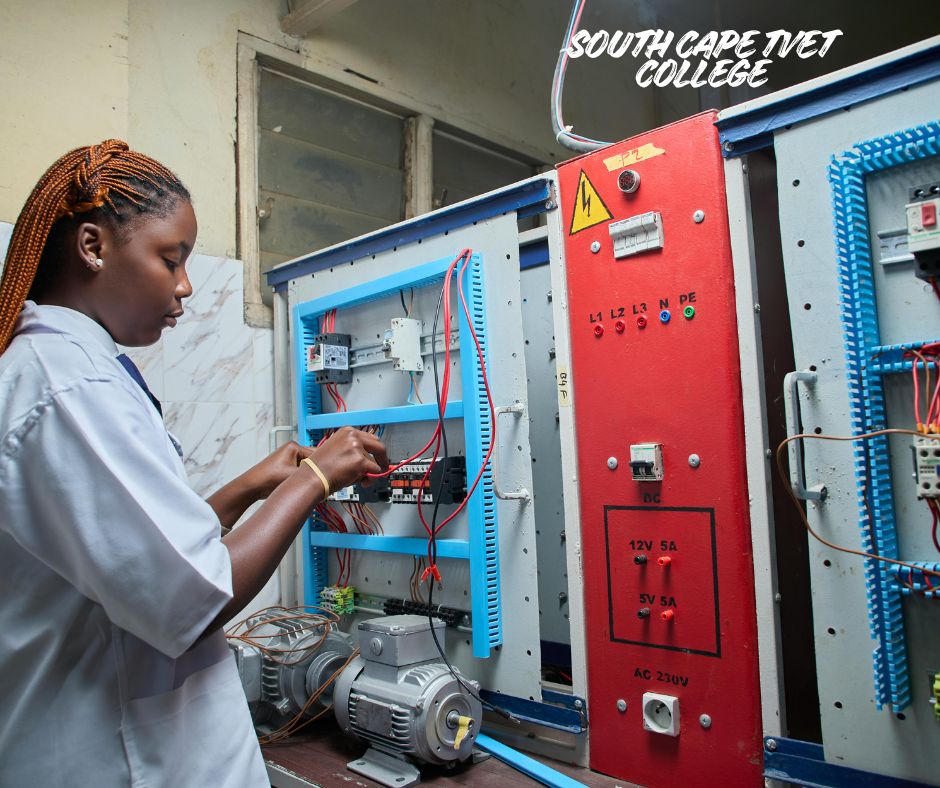
South Cape TVET College operates six campuses across the Western Cape, delivering National Certificate Vocational (NCV) qualifications, Report 191 programmes (N1–N6), and occupational certificates aligned to industry requirements.
The institution serves the Garden Route, Central Karoo and Kannaland districts with vocational education that combines classroom theory, practical workshops, and Work Integrated Learning placements.
Prospective students access online applications, campus information, programme details, and NSFAS funding guidance through the official college portal and published resources.
Table of Contents
About South Cape TVET College
The college merged in 2000 from four technical institutes to create a unified vocational education provider registered with the Department of Higher Education and Training. South Cape TVET College combines the former George Technical College (founded in 1968), Oudtshoorn Technical College (founded in 1981), South Cape Technical Institute and Mossel Bay Technical College into a single institution. The college migrated to DHET administration between April 2014 and April 2016, adopting national TVET policies and procedures for curriculum delivery and quality assurance.
The college serves a catchment area of 80,822 square kilometers, the largest of six TVET colleges in the Western Cape. Six campuses provide regional access: George (with the central office), Mossel Bay, Oudtshoorn, Beaufort West, Hessequa (Riversdale) and Bitou (Plettenberg Bay). Senior management coordinates operations centrally from George, while campus managers oversee local programme delivery, student services and industry partnerships.
Vision: To be a Technical and Vocational Education and Training institution of first choice leading Education and Skills development.
Mission: Committed to holistic student development by providing responsive, quality education and training leading to employment, self-employment and higher education.
Core values include leadership, people-centered service, integrity, courage, inclusivity and creativity. The college prioritizes student outcomes through employer engagement, WIL coordination and curriculum alignment with SETA standards and regional skills demands.
South Cape TVET College Campuses and Contact Details
Six campuses deliver programmes across the Garden Route, Central Karoo and Kannaland districts, each offering specialized programmes based on regional industry needs and infrastructure capacity. Campus locations, contact numbers and programme offerings vary by site. Prospective students should confirm programme availability at their preferred campus before applying to ensure the qualification runs at that location.
George Campus
George Campus operates as the main site with the central office coordinating institutional management and senior leadership. Established in 1968 as George Technical Institute, the campus moved to its current premises at 46 Hibernia Street, George in 1987. A new wing added in 1996 expanded classroom capacity and administration facilities.
Address: 46 Hibernia Street, George, 6530
Phone: 044 874 2360
Email: george@sccollege.co.za
Campus Manager: Ms Vernalda Hartnick
Programmes offered:
- NCV Level 2–4: Office Administration
- Report 191 N4–N6: Business Management, Educare, Human Resource Management, Management Assistant, Marketing Management, Public Management, Tourism Management
- National Introductory Certificate (bridging programme)
The campus maintains workshops, computer laboratories and business simulation spaces for practical assessments. George Campus serves as a regional hub for business studies and office administration pathways with strong employer links in the Garden Route business sector.
Mossel Bay Campus
Mossel Bay Campus specializes in engineering, technical trades and artisan development with dedicated workshops for electrical, mechanical, plumbing and welding instruction. The campus began in 1993 as a satellite of Oudtshoorn Technical College and expanded infrastructure through industry partnerships. PetroSA donated a computer center and electronics workshop; additional workshop facilities support boilermaking, fitting and NATED engineering streams.
Address: c/o Essenhout & Kreupelhout Street, Heiderand, Mossel Bay, 6500
Phone: 044 693 2613
Email: mosselbay@sccollege.co.za
Campus Manager: Mr Whaleed Abdullah
Programmes offered:
- NCV Level 2–4: Electrical Infrastructure Construction, Engineering & Related Design, Tourism
- Report 191 N1–N3: Boilermaking, Electrical Engineering, Fitting and Turning, Instrumentation
- Report 191 N4–N6: Educare, Human Resource Management, Public Management
- Centre of Specialisation: Bricklaying (DHET-designated)
Mossel Bay Campus functions as the primary engineering campus with large-scale workshop capacity for practical training. Students complete theory modules on-campus and practical assessments in fully equipped workshops under qualified instructors.
Oudtshoorn Campus
Oudtshoorn Campus focuses on hospitality, catering and tourism programmes with industry-standard kitchens and service training facilities. The campus operates from the former Commercial High School building and includes Foster’s Manor Guest House for hospitality practical training.
Address: Adderley Street, Oudtshoorn, 6620
Phone: 044 272 2110
Email: oudtshoorn@sccollege.co.za
Campus Manager: Ms Thabisa La Fleur
Programmes offered:
- NCV Level 2–4: Hospitality, Safety in Society
- Report 191 N4–N6: Educare, Human Resource Management, Hospitality and Catering Services, Public Management, Tourism Management
- National Introductory Certificate
The campus maintains partnerships with local hospitality employers for WIL placements in hotels, guesthouses and catering operations. Training kitchens meet industry hygiene and safety standards for food preparation and service assessments.
Beaufort West Campus
Beaufort West Campus serves the Central Karoo as a declared nodal area for skills development and community upliftment. Located 260 kilometers from the central office, the campus delivers programmes targeting local employment needs and entrepreneurship.
Address: c/o van Schalkwyk & de Vries Streets, Rustdene, Beaufort West, 6970
Phone: 023 449 1140
Email: beaufort@sccollege.co.za
Acting Campus Manager: Ms Linda Khoza
Programmes offered:
- NCV Level 2–4: Office Administration
- Report 191 N4–N6: Educare, Human Resource Management, Public Management
- National Introductory Certificate
Beaufort West Campus emphasizes employability and self-employment pathways through business and administration training. The campus responds to regional skills gaps with programmes supporting small-enterprise development and public-sector employment.
Hessequa Campus
Hessequa Campus operates in Riversdale through partnerships between the college, local authorities and provincial government. The campus delivers learnerships, skills programmes and Report 191 qualifications aligned to regional employer requirements.
Address: Varkevisser Street, Riversdale, 6500
Phone: 028 713 4775
Email: hessequa@sccollege.co.za
Campus Manager: Mr Gilbert Hartley
Programmes offered:
- Report 191 N4–N6: Human Resource Management
- National Introductory Certificate
- Skills programmes and learnerships (variable, SETA-funded)
Hostel accommodation supports students from surrounding rural areas who meet eligibility criteria. The campus coordinates closely with local SETAs for learnership placements and occupational certificates.
Bitou Campus
Bitou Campus serves Plettenberg Bay and the Bitou Municipality with programmes targeting tourism, hospitality and office administration sectors. The campus expanded facilities in recent years with new classrooms and a training kitchen to support hospitality instruction.
Address: Hillview, Kwanonkuthula, Plettenberg Bay, 6600
Phone: 044 533 2388
Email: bitou@sccollege.co.za
Campus Manager: Mr Chumani Webber
Programmes offered:
- NCV Level 2–4: Office Administration
- Report 191 N4–N6: Human Resource Management, Tourism Management
- National Introductory Certificate
The campus partners with local tourism operators, accommodation providers and service businesses for WIL placements and employer engagement. Programmes align with Garden Route tourism economy requirements and seasonal employment patterns.
| Campus | City | Phone | Key Programmes |
|---|---|---|---|
| George | George | 044 874 2360 | Business Studies, Office Administration |
| Mossel Bay | Mossel Bay | 044 693 2613 | Engineering, Electrical Trades |
| Oudtshoorn | Oudtshoorn | 044 272 2110 | Hospitality, Catering, Tourism |
| Beaufort West | Beaufort West | 023 449 1140 | Office Administration, Educare |
| Hessequa | Riversdale | 028 713 4775 | Human Resource Management |
| Bitou | Plettenberg Bay | 044 533 2388 | Tourism, Office Administration |
Operating hours for most campuses: Monday to Thursday 08:00–15:00, Friday 08:00–13:00. Prospective students should confirm programme availability and schedule campus visits by calling the campus contact number directly.
South Cape TVET College Courses, Programmes and Qualifications Offered
The college delivers three qualification pathways: National Certificate Vocational (NCV) Levels 2 to 4, Report 191 programmes (N1–N3 and N4–N6), and occupational certificates aligned to QCTO standards. Programmes integrate theory, practical workshops and workplace learning to meet SAQA and DHET accreditation requirements. Each qualification specifies entry requirements, duration, assessment methods and progression routes to employment or further study.
National Certificate Vocational (NCV) Programmes Level 2–4
NCV qualifications provide an alternative to academic matric with vocational focus, combining fundamental subjects (English, Mathematics or Mathematical Literacy, Life Orientation) with four specialized vocational subjects per level. NCV runs over three years (Level 2, Level 3, Level 4) with each level equivalent to one school grade (Grades 10, 11, 12 respectively). Successful completion of Level 4 enables articulation to Higher Certificate (NQF Level 5), National Diploma (NQF Level 6) or Bachelor’s Degree (NQF Level 7) at universities or universities of technology.
Entry requirements for NCV Level 2:
- Grade 9 pass certificate or equivalent qualification
- Minimum 40% in Mathematics, English, Life Orientation and one additional subject, OR
- ABET Level 4 certificate
Duration: Three years full-time (one year per level)
Assessment: Formative assessments (classwork, tests, assignments), summative examinations (ICASS—Internal Continuous Assessment), practical demonstrations, portfolio evidence
NCV programmes available:
Office Administration Level 2–4
Office Administration prepares students for secretarial, administrative and clerical roles across all business sectors. Vocational subjects include Business Practice, Office Practice, Office Data Processing and New Venture Creation. Students develop keyboarding skills, business communication, computer literacy (Microsoft Office suite), filing systems and reception procedures.
Career pathways: Administrative officer, bookkeeper, personal assistant, company secretary, human resource clerk, legal secretary, freight forwarder, hospital administrator
Campuses: Beaufort West, Bitou, George, Mossel Bay, Oudtshoorn, Hessequa
Electrical Infrastructure Construction Level 2–4
Electrical Infrastructure Construction covers heavy-current overhead power lines, domestic and industrial electrical installations, and light-current systems including digital electronics and instrumentation. Vocational subjects include Electrical Principles and Practice, Workshop Practice (Level 2) or Electrical Workmanship (Levels 3–4), Electronic Control and Digital Electronics, and Electrical Systems and Construction.
Career pathways: Electrician, construction electrician, industrial engineering technician, sound technology, theatre technician, process control, digital electronics, instrumentation
Campus: Mossel Bay (only campus offering this programme)
Engineering & Related Design Level 2–4
Engineering & Related Design introduces students to manufacturing, fabrication, extraction and assembly processes with focus on mechanical engineering principles and automotive systems. Vocational subjects include Engineering Fundamentals (Level 2), Engineering Technology, Engineering Systems, Automotive Repair and Maintenance (all levels), Engineering Practice and Maintenance (Level 3), Materials Technology, Engineering Graphics and Design (CAD) (Level 3), Engineering Processes, Professional Engineering Practice, Applied Engineering Technology (Level 4).
Career pathways: Manufacturing and industrial engineering, metallurgical engineering, boilermaking, automotive repair and maintenance, aerospace engineering, tool making, fitting and machining, welding
Campus: Mossel Bay (only campus offering this programme)
Hospitality Level 2–4
Hospitality NCV trains students in food preparation, client service, accommodation operations and hospitality management for hotel, restaurant, guesthouse and catering sectors. Vocational subjects include Hospitality Generics, Food Preparation, Client Services and Human Relations, Hospitality Services. Practical modules cover food hygiene, menu planning, cooking techniques, food and beverage service, accommodation housekeeping and event coordination.
Career pathways: Housekeeping supervisor, hotel management, events management, food and beverage management, waitron, bartender, accommodation services
Campus: Oudtshoorn (only campus offering this programme)
Note: The kitchens used for hospitality instruction are not Kosher or Halaal compliant. Products and ingredients used in training kitchens do not meet Halaal or Kosher certification standards.
Tourism Level 2–4
Tourism NCV prepares students for careers in travel services, tour operations, guiding, accommodation and tourism information roles. Vocational subjects include Science of Tourism, Client Service and Human Relations, Sustainable Tourism, Tourism Operations. Curriculum covers travel products, destination geography, tourism economics, conservation principles, customer service, travel documentation and tour planning.
Career pathways: Conference and events planner, tourism development officer, transportation manager, travel counselor, game ranger, adventure guide, safari operator, entrepreneur
Campuses: Bitou, George, Mossel Bay
Safety in Society Level 2–4
Safety in Society trains students for public safety, law enforcement and correctional services roles through instruction in policing, criminal law, governance and criminal justice systems. Vocational subjects include Introduction to Governance (Level 2) or Governance (Levels 3–4), Introduction to Law (Level 2) or Criminal Law (Level 3) or Law of Procedures and Evidence (Level 4), Principles of Criminal Justice (Level 2) or Criminal Justice Structures and Mandates (Level 3) or Criminal Justice Process (Level 4), Introduction to Policing Practices (Level 2) or Theory of Policing Practices (Level 3) or Applied Policing (Level 4).
Career pathways: South African Police Service, Metro Police, Traffic Police, Military Police, South African Defense Force, security services, intelligence services, legal assistance, correctional services
Campuses: George, Oudtshoorn
Report 191 Business Studies (N4–N6)
Report 191 Business Studies programmes target post-matric students for business, administration, hospitality and public-sector careers. Students complete theory at N4, N5 and N6 levels over 18 months, then acquire 18 months of relevant practical work experience to qualify for the National N Diploma. Programmes emphasize self-employment readiness and practical workplace competencies.
Entry requirements for N4:
- Grade 12 (National Senior Certificate) or NCV Level 4 certificate
- Minimum 40% for English
- Overall average 40% excluding Life Orientation
Duration: Three years total (18 months theory across N4, N5, N6 plus 18 months workplace experience)
Assessment: Trimester-based modules, formative tests, summative examinations, practical projects, workplace logbooks
Report 191 N4–N6 programmes available:
Business Management N4–N6
Business Management develops entrepreneurship skills, business planning, sales management and organizational operations. Subjects include Introductory Accounting (N4), Management Communication (N4), Computer Practice (all levels), Entrepreneurship and Business Management (all levels), Public Relations (N5–N6), Sales Management (N5–N6).
Career pathways: Entrepreneur, sales representative, bookkeeper, administrative roles
Campus: George
Educare N4–N6
Educare equips students with skills to work with children aged 0 to 4 years, operate crèches and manage early childhood development centers. Subjects include Education (N4), Child Health (N4), Educare Didactics Theory and Practical (all levels), Daycare Personnel Development (N4), Educational Psychology (N5–N6), Business Management and Entrepreneurship (N5), Daycare Communication (N5–N6), Daycare Management (N6).
Career pathways: Grade R assistant, crèche manager, au pair, early childhood facilitator, center manager
Campuses: Beaufort West, George, Mossel Bay, Oudtshoorn
Hospitality and Catering Services N4–N6
Hospitality and Catering Services prepares students for professional roles in hotels, restaurants, guesthouses and catering operations. Subjects include Nutrition and Menu Planning (N4), Sanitation and Safety (N4), Catering Theory and Practical (all levels), Applied Management (all levels), Food and Beverage Service (N5), Business Management (N5), Human Relations (N6), Computer Practice (N4).
Career pathways: Hotel and guesthouse management, restaurant management, tasting room management, food services management, food and beverage management, function catering, test kitchen staff, events management, entrepreneur
Campus: Oudtshoorn
Note: The kitchens used for hospitality instruction are not Kosher or Halaal compliant.
Human Resource Management N4–N6
Human Resource Management trains students in personnel functions, recruitment, training, labor relations and workplace management. Subjects include Personnel Management (all levels), Management Communication (N4), Computer Practice (all levels), Entrepreneurship and Business Management (N4), Personnel Training (N5–N6), Labour Relations (N5–N6).
Career pathways: Human resource assistant, administrative assistant, entrepreneur
Campuses: Beaufort West, Bitou, George, Hessequa, Mossel Bay, Oudtshoorn
Management Assistant N4–N6
Management Assistant develops secretarial and office management competencies for executive support roles. Entry requirement includes Computer Applications Technology (CAT) subject completion. Subjects include Information Processing (all levels), Computer Practice (all levels), Communication (all levels), Office Practice (all levels). Focus areas: typing speed and accuracy, business communication, meeting management, office technology.
Career pathways: Executive assistant, private secretary, office manager, front desk reception, administrative clerk
Campuses: Beaufort West, Bitou, George, Hessequa, Mossel Bay, Oudtshoorn
Marketing Management N4–N6
Marketing Management covers marketing principles, consumer behavior, sales management, market research and promotional campaigns. Subjects include Marketing Management (all levels), Management Communication (N4), Computer Practice (all levels), Entrepreneurship and Business Management (N4–N5), Sales Management (N5–N6), Marketing Research (N6), Marketing Communication (N6).
Career pathways: Marketing coordinator, sales representative, market researcher, advertising specialist, branding consultant, distribution manager, entrepreneur
Campuses: Beaufort West, George
Public Management N4–N6
Public Management prepares students for administrative and management roles in government departments and municipalities. Subjects include Computer Practice (all levels), Public Administration (N4–N6), Management Communication (N4), Introductory Accounting (N4), Municipal Administration (N5–N6), Public Finance (N5), Public Law (N6).
Career pathways: Municipal worker, government employee at local, provincial or national level
Campuses: Online Distance Learning available; on-campus at Beaufort West, Bitou, George, Hessequa, Mossel Bay, Oudtshoorn
Tourism Management N4–N6
Tourism Management trains travel consultants, tour operators and tourism service providers. Entry requirement: Grade 12 with minimum 50% average. Subjects include Travel Services (all levels), Tourist Destinations (N4–N6), Tourism Communication (N4–N5), Travel Office Procedures (all levels), Hotel Reception (N6).
Career pathways: Travel agent, guesthouse manager, hotel reception, tour operator consultant, airport staff, event organizer, entrepreneur
Campuses: Bitou, George, Oudtshoorn
Report 191 Engineering Studies (N1–N3)
Report 191 Engineering N1–N3 programmes address artisan skills shortages with affordable study pathways to trade qualifications. Students completing N1–N3 certificates with two years of workplace experience in the same trade can register to write trade tests and qualify as artisans.
Entry requirements:
- N1: Grade 9 pass with minimum 40% in Mathematics, OR Grade 12 without Mathematics and Physical Science
- N2: N1 certificate OR Grade 12 with minimum 40% for Mathematics and Physical Science
- N3: N2 certificate with at least three of four subjects passed
Duration: Each level requires four subjects and runs for 10 weeks per trimester. Enrollments occur every trimester (three intakes per year).
Assessment: Formative tests, assignments, summative examinations per subject
Report 191 N1–N3 programmes available:
Boilermaking N1–N3
Boilermaking covers metal fabrication, structural steel work, plating, welding and assembly techniques. Subjects include Metalworkers Theory (N1), Plater’s Theory (N2), Mechano Technology (N3), Plating and Structural Steel Drawing (all levels), Engineering Science (all levels), Mathematics (all levels).
Career pathways: Manufacturing and industrial engineering, metallurgical engineering, boilermaking, automotive repair and maintenance, aerospace engineering, tool making, fitting and machining, welding
Campus: Mossel Bay
Electrical Engineering Studies N1–N3
Electrical Engineering Studies prepares students for electrician, technician and electrical artisan roles in domestic, commercial and industrial electrical systems. Subjects include Electrical Trade Theory (N1–N2), Electro-Technology (N3), Industrial Electronics (all levels), Engineering Science (all levels), Mathematics (all levels).
Career pathways: Production section head, foreman, electrical artisan, electrical technician
Campus: Mossel Bay
Fitting and Turning N1–N3
Fitting and Turning teaches machinery maintenance, component fitting, blueprint reading and machine operation for manufacturing and maintenance roles. Subjects include Fitting and Machining Theory (N1–N2), Mechano-Technology (N3), Engineering Drawing (all levels), Engineering Science (all levels), Mathematics (all levels).
Career pathways: Manufacturing and industrial engineering, metallurgical engineering, boilermaking, automotive repair and maintenance, aerospace engineering, tool making, fitting and machining, welding
Campus: Mossel Bay
Instrumentation N1–N3
Instrumentation covers measurement systems, control instruments, electrical control systems and process monitoring for industrial applications. Subjects include Industrial Electronics (all levels), Electrical Trade Theory (N1), Instrumentation Trade Theory (N2), Electro-Technology (N3), Engineering Science (all levels), Mathematics (all levels).
Career pathways: Manufacturing and industrial engineering, metallurgical engineering, boilermaking, automotive repair and maintenance, aerospace engineering, tool making, fitting and machining, welding, electrical engineering
Campus: Mossel Bay
National Introductory Certificate
The National Introductory Certificate bridges students into N4–N6 programmes when academic entry requirements are not met. The certificate prepares students for Report 191 N4 business studies through foundational modules.
Entry requirements: Students who do not meet direct entry requirements for N4 programmes
Duration: One year
Subjects: Introductory Entrepreneurship N4, Introductory Communication N4, Introductory Computer Practice N4, Introductory Accounting N4
Campuses: Beaufort West, Bitou, George, Hessequa, Mossel Bay, Oudtshoorn
Pre-Vocational Learning Programme (PLP)
Pre-Vocational Learning Programme provides foundational academic upgrading for students who do not meet NCV entry criteria. The one-year programme improves marks and bridges academic gaps before entry into vocational or occupational programmes.
Subjects: Foundational Mathematics, Foundational Science, Foundational English, Foundational Life Skills and Technology
Occupational Programmes
Occupational programmes deliver job-specific training through skills programmes, learnerships and apprenticeships for rapid employment entry. Programmes vary by SETA funding, employer partnerships and regional skills needs. Current occupational offerings include:
- ECD Development Practitioner
- Computer Technician
- Cook
- Management Assistant (occupational level)
- Bookkeeper
- Office Administration (occupational level)
- Conference and Events Organiser
- Tourism Information Officer
- Automotive Motor Mechanic
- Boilermaker (occupational level)
- Bricklayer (Centre of Specialisation at Mossel Bay)
- Electrician (apprenticeship pathway)
Occupational programme availability changes annually based on SETA approvals and employer demand. Prospective students should monitor the college website news section and social media channels for announcements of new occupational programme intakes.
How to Apply: Online Application Process for 2026
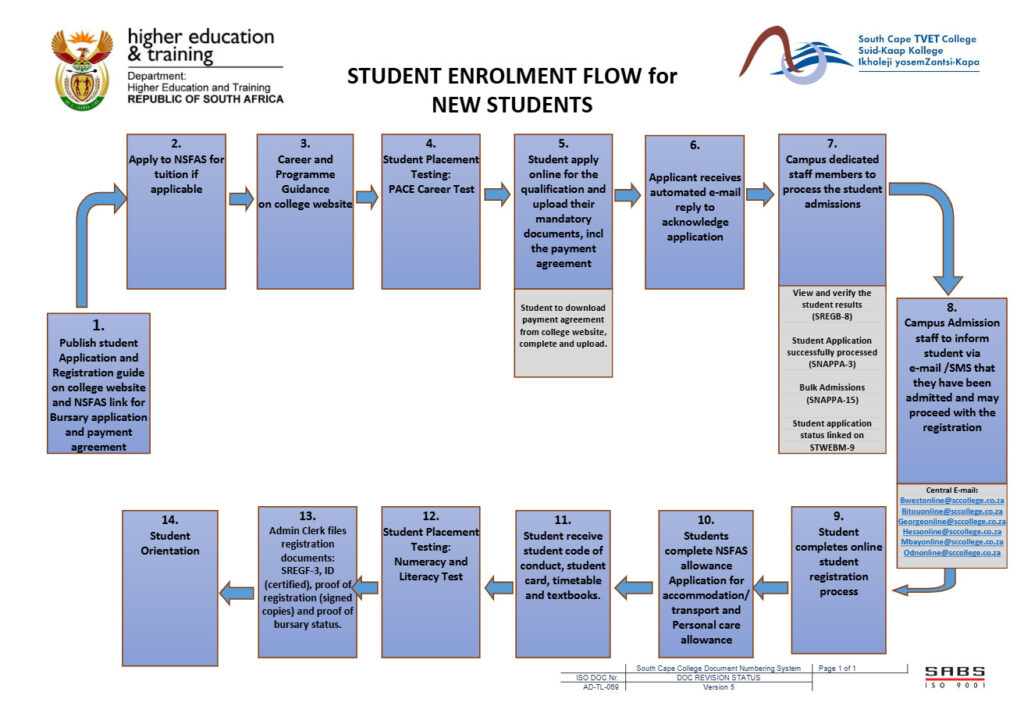
Prospective students apply online through the Coltech Student Portal by creating an account, uploading certified documents and submitting the application form. The application system operates year-round with specific intake periods for different programmes. Applicants receive a unique student number upon submission and can track application status through the portal.
Step 1: Prepare Required Documents
Certified copies of three documents must be prepared before starting the online application:
- Identity Document or Smart ID Card (both sides) – for applicants under 16, certified birth certificate or passport
- Highest school grade passed – most recent academic results showing final marks and grade completion
- Proof of residential address – utility bill, municipal account or lease agreement in applicant’s name, or sworn affidavit if documents are in another person’s name
Certification requirements: Documents must be certified by a South African Police Service officer, commissioner of oaths, attorney, justice of the peace or bank official. Certification stamps must include the certifier’s signature, stamp and date. Certified documents must not be older than six months from the date of application.
Digital preparation: Scan each document separately as a PDF file. Name files clearly (example: “Surname_Name_ID_2026.pdf”). Compress large files to ensure upload speed. Keep file sizes under 5MB per document.
Step 2: Access the Application Portal
Visit the official South Cape TVET College website at sccollege.co.za and click “Apply for 2026” or navigate directly to the Coltech Student Portal.
- Click “Register an Account” if applying for the first time
- Provide a valid, active email address that will receive all correspondence
- Create a secure password following the system requirements
- Accept the Protection of Personal Information Act (POPIA) consent clause
Important: Email addresses cannot be changed after account creation without contacting the campus directly. Use a personal email address that the applicant checks regularly.
Step 3: Complete the Application Form
The application form requires four sections of information:
- Personal details: Full name as per ID, date of birth, ID number, gender, home language, contact number
- Next of kin: Emergency contact name, relationship, contact number
- Academic history: Highest grade completed, year completed, school name
- Programme selection: Preferred campus, programme choice, intake year
Read each section carefully and provide accurate information. The system may time out after 20 minutes of inactivity; complete all sections before uploading documents.
Step 4: Upload Certified Documents
Upload the three required certified documents in PDF format:
- Click “Upload Documents” in the application portal
- Select document type from the dropdown menu
- Choose the scanned file from your device
- Confirm upload completion for each document
- Review the document list to ensure all three documents appear as uploaded
Incomplete applications: Applications submitted without all three certified documents will be marked “Only some documents submitted” and will not be processed. Log back into the portal under “Student Administration” then “Upload Documents” to complete the submission.
Step 5: Submit Application and Receive Student Number
Click “Accept Application” to finalize submission. The system generates a unique student number immediately and sends a confirmation email with the student number and application reference. Save this email for all future correspondence.
Application acknowledgment: Applicants receive an automated email reply acknowledging receipt of the application. Processing times vary by programme and intake period. High-demand programmes process applications within 10 to 15 working days during peak periods.
Step 6: Check Application Status
Log in to the Student i-Enabler portal using the student number and five-digit PIN provided in the confirmation email.
- Go to www.sccollege.co.za and click “Student i-Enabler Login.”
- Enter student number and five-digit PIN
- Click “Student Enquiry” then “Academic Admission Status.”
Application status meanings:
- Application without status: Application submitted but not yet processed by admissions staff
- Only some documents submitted: Missing documents or documents not certified or older than six months. Upload outstanding documents via “Student Administration” > “Upload Documents.”
- Provisionally accepted: Application meets initial criteria; awaiting final academic results to confirm entry requirements
- Admitted academically: Entry requirements met; student must proceed to registration at the selected campus
- Project enrollment target reached: Programme at the selected campus is full; applicant may apply to another campus or consider alternative programmes
- Not in catchment area: Application unsuccessful in current round; applicant resides outside primary catchment area. May be considered in later rounds, or can attend another college
Step 7: Respond to Admission Notification
Campus admission staff send email or SMS notification when applications are processed. Admitted students receive instructions to complete online registration, attend placement testing,, and prepare for orientation.
Placement testing: Students complete numeracy and literacy placement tests through the PACE Career Test system. Test results inform academic support planning and module placement where applicable.
Step 8: Complete Online Registration
Admitted students must complete online registration by the published deadline to secure enrollment.
- Log in to the Student i-Enabler portal
- Click “Student Administration” then “Online Registration”
- Confirm programme details and campus assignment
- Accept the Student Code of Conduct
- Complete payment arrangement or upload NSFAS approval documentation
Registration materials provided: Student card, timetable, textbook list, orientation schedule
Step 9: Apply for Second-Choice Programme (if needed)
Applicants who applied for one programme can add a second-choice application through the portal:
- Log into Student i-Enabler with student number and PIN
- Click “Returning Student Application” then “Show Academic Applications”
- Click “Add New Qualification”
- Complete programme selection and submit
Note: Second-choice applications do not require re-uploading documents if original documents are on file and current.
Important Application Notes
Email address changes: Contact the campus directly with full name and student number to request email or contact detail changes. The Communications team cannot process contact detail changes.
Forgotten PIN: Click “Forgot PIN” on the Student i-Enabler login page. The PIN will be sent to the registered email address.
Application support: For technical issues, email communications@sccollege.co.za with student number as reference. For campus-specific questions, call the campus directly:
- Bitou: 044 533 2388 / 044 518 0066
- Beaufort West: 083 460 0963 / 023 449 1140
- George: 044 874 2360
- Hessequa: 028 713 4775
- Mossel Bay: 044 693 2613 / 044 693 3089
- Oudtshoorn: 044 272 2110
Operating hours: Monday to Thursday 08:00–15:00, Friday 08:00–13:00
South Cape TVET College Fees and Payment Information 2026
Tuition fees vary by programme type with separate fee structures for NCV, Report 191 and occupational qualifications. Fees cover tuition, prescribed learning materials, facility usage and assessment costs. Registration fees and payment deadlines apply per academic year. NSFAS-funded students do not pay registration fees upfront; the college invoices NSFAS directly upon disbursement approval.
Fee Schedule 2026
| Programme Type | Programme | Annual Fee (ZAR) |
|---|---|---|
| NCV Level 2–4 | Office Administration | 10,885 |
| Electrical Infrastructure Construction | 16,705 | |
| Tourism | 15,850 | |
| Safety in Society | 11,144 | |
| Report 191 N4–N6 | Human Resource Management | 3,302 |
| Management Assistant | 3,302 | |
| Public Management | 3,302 | |
| Business Management | 3,302 | |
| Tourism Management | 7,259 | |
| Hospitality & Catering Services | 7,450 | |
| Occupational Certificates | ECD Development Practitioner | 10,181 |
| Computer Technician | 12,596 | |
| Cook | 26,964 | |
| Management Assistant (Occupational) | 9,406 | |
| Bookkeeper | 11,791 | |
| Office Administration (Occupational) | 9,566 | |
| Conference and Events Organiser | 20,772 | |
| Tourism Information Officer | 12,305 | |
| Automotive Motor Mechanic | 10,738 | |
| Boilermaker | 14,404 | |
| Bricklayer | 10,437 | |
| Electrician | 13,911 | |
| Exam Fees | Exam Only | 150 |
Correspondence | 700 | | Residence Fees | Per annum (subject to NSFAS maximum) | 42,640 |
Note: Fees are subject to change without prior notice. Contact the campus finance office for the most current fee schedule and banking details.
Payment Options
Self-funded students can pay via electronic transfer, debit/credit card, or approved installment arrangements. The college provides banking details on fee invoices and the official website. Payment codes must be included on all transfers to ensure correct allocation to student accounts.
Payment plans: Contact the campus finance office to request installment agreements. Payment plans require approval and may include deposit requirements. Submit payment plan requests at least 10 working days before registration deadlines.
Proof of payment: Retain all payment receipts, bank transaction confirmations, and NSFAS disbursement notices. Upload proof of payment through the Student i-Enabler portal or submit it to the campus finance office during registration.
Electronic payment processing: Payments take 72 hours to reflect on student accounts during peak registration periods. Contact the finance office with invoice reference numbers if payments do not reflect after three working days.
NSFAS Funding and Bursary Information
NSFAS (National Student Financial Aid Scheme) provides tuition, learning materials, and allowances for eligible TVET college students. Applicants must apply to NSFAS separately through the NSFAS online portal at www.nsfas.org.za. NSFAS determines eligibility based on household income, academic results, and vulnerability criteria.
NSFAS application requirements:
- Own phone number and active email address
- Copy of ID or birth certificate
- ID copies of parents, guardians, or spouse
- Proof of household income or one year’s IRP5 documents
- Parents, guardians or spouse proof of income
- SASSA grant recipients do not require income proof
- Applicants with disabilities submit completed Disability Annexure A Form
- Vulnerable children submit Vulnerable Child Declaration and Consent Form
NSFAS coverage for TVET students:
- Full tuition fees
- Registration fees
- Learning materials
- Transport allowance (not accommodation allowance)
- Personal care allowance
Important: NSFAS-funded students at South Cape TVET College receive transport allowances, not accommodation allowances. Students must arrange private accommodation and budget transport costs accordingly.
NSFAS application timeline: Apply to NSFAS as early as possible, ideally before submitting the college application. NSFAS processing takes 4 to 8 weeks. Applicants must complete the college application separately; NSFAS approval does not constitute college admission.
NSFAS status checks: Log in to the NSFAS portal at www.nsfas.org.za to check application status. Contact the campus bursary officer for assistance with NSFAS queries, appeals, and allowance applications.
Bursary officer contact: Call the campus main number and request a connection to the bursary officer. Provide the student number and NSFAS reference number for faster assistance.
Payment Agreement and Financial Holds
All students must complete a payment agreement as part of the registration process. Download the payment agreement form from the college website, complete and sign the document, and upload it through the application portal or submit it during in-person registration.
Financial holds: Unpaid fees result in financial holds that block access to timetables, examination entry, and student resources. Clear financial holds by submitting proof of payment or NSFAS approval documentation to the campus finance office.
Refund policy: Contact the campus finance office for refund policy details and withdrawal procedures. Refunds follow DHET guidelines and may be subject to administrative fees.
Contact for Fee Queries
Campus finance offices handle billing, payment arrangements, NSFAS coordination, and account statements. Call the campus main number and request a connection to the finance office. Provide the student number and invoice reference for all queries.
For detailed fee breakdowns, invoice requests, or payment plan applications, visit the campus finance office during operating hours or email the campus main address with “FINANCE QUERY” in the subject line.
Student Support Services and Campus Life
All campuses provide student support officers, academic tutoring, counseling services and student representative councils (SRC) to support holistic student development. Support services assist with academic performance, personal challenges, career planning and campus integration throughout the student lifecycle.
Student Support Officers
Student and Academic Support Officers operate at each campus delivering orientation, counseling, academic tutoring and referrals to external support services. Officers coordinate student wellness programs, study skills workshops and intervention for students experiencing academic or personal difficulties.
Services include:
- Individual counseling for mental health, stress management and personal challenges
- Academic tutoring in mathematics, languages and technical subjects
- Study skills workshops covering time management, note-taking and exam preparation
- Referral pathways to external mental health services, substance abuse support and crisis intervention
- Disability accommodations and learning support plans for students with documented disabilities
- Financial counseling on NSFAS processes, budget planning and emergency funding options
Access support services: Contact the Student Support Officer at your campus by visiting the student services office or calling the campus main number. Appointments can be scheduled in advance or accessed during drop-in hours published on campus notice boards.
Academic Support and Tutoring
Academic support includes scheduled tutoring sessions, supplementary instruction and peer-learning groups for high-risk subjects. Mathematics, engineering science and language modules receive dedicated tutoring hours each week. Tutors are senior students, alumni or contracted subject specialists.
Tutoring access: Check campus timetables for drop-in tutoring hours per subject. Group tutoring sessions run in the afternoons and evenings; individual appointments can be requested through the Student Support Officer.
Exam preparation workshops: The college runs intensive revision workshops in the two weeks before summative examinations. Workshops cover exam technique, past paper practice and concept review for high-failure-rate modules.
Counseling and Wellness Services
Counseling services provide confidential mental health support, crisis intervention and wellness programming. Trained counselors assist students experiencing anxiety, depression, relationship challenges, substance use concerns and trauma.
Session availability: Counseling appointments are scheduled through the Student Support Officer. Emergency walk-in sessions are available during office hours for urgent situations. For after-hours crises, counselors provide referral contact details for provincial mental health crisis lines.
Referral services: Counselors connect students to external psychologists, social workers, substance abuse treatment programs and community health clinics where ongoing care is required. The college maintains partnerships with Western Cape Department of Health facilities for student referrals.
Student Representative Council (SRC)
Student-elected SRC members represent student interests, facilitate communication between students and management, and organize campus events and activities. SRC elections occur annually with students voting for representatives from each programme and campus.
SRC responsibilities:
- Advocate for student needs and concerns to campus management
- Organize orientation activities, social events and awareness campaigns
- Represent students on college governance committees
- Assist with resolving student grievances and policy questions
- Coordinate volunteer projects and community engagement activities
Leadership criteria: SRC candidates must demonstrate leadership, accountability, reliability and commitment to student welfare. Nomination and election processes follow published timelines each academic year.
Career Services and Work Integrated Learning (WIL) Coordination
Career services coordinate WIL placements, employer engagement, CV workshops and job-readiness training. WIL coordinators maintain employer databases, negotiate placement agreements and monitor student progress during workplace learning periods.
Career development support:
- CV and cover letter writing workshops
- Interview preparation and mock interviews
- Employer information sessions and campus recruitment events
- Industry mentorship programmes linking students with working professionals
- Job vacancy listings and application support
- Entrepreneurship workshops for students pursuing self-employment
WIL placement process: Students receive WIL placement guidelines during orientation. Placement coordinators match students to employers based on programme requirements, student location and employer capacity. Students sign learner agreements specifying learning outcomes, duration, supervision and assessment criteria.
Employer partnerships: The college partners with businesses across construction, hospitality, manufacturing, retail, tourism, information technology and public-sector organizations. Employers provide workplace supervisors, assessment opportunities and potential post-graduation employment for successful students.
Accommodation Guidance
Most campuses do not have on-campus hostel accommodation. Campus residence or accommodation managers maintain lists of vetted private accommodation providers including boarding houses, shared flats and homestays near campus locations.
Accommodation costs: Private accommodation is self-funded as NSFAS provides transport allowances (not accommodation allowances) to TVET students. Costs vary by location and accommodation type. Students should budget R2,000 to R4,500 per month for private accommodation.
Finding accommodation: Contact the campus accommodation manager for current accommodation listings, landlord contact details and advice on lease agreements. Visit accommodation options before signing leases; verify proximity to campus and public transport access.
Hessequa Campus hostel: Hessequa Campus offers limited hostel accommodation for students meeting eligibility criteria. Contact the campus manager to inquire about hostel availability, costs and application procedures.
Accommodation contacts: Call the campus main number and request connection to the accommodation or residence manager. Provide programme name and expected start date when inquiring.
Student Conduct and Campus Safety
All students agree to the Student Code of Conduct during registration. The code specifies expected behavior, prohibited activities, disciplinary procedures and student rights.
Key conduct rules:
- Obscene language, sexual harassment and discrimination are prohibited
- Smoking only in designated outdoor areas (smoking inside buildings is illegal)
- Cellular phones and communication devices prohibited during classes and examinations
- Alcohol, illegal drugs and weapons prohibited on college property
- Gambling, fighting and theft result in disciplinary action or suspension
- Vandalism and property damage incur financial liability and disciplinary consequences
Serious offenses resulting in suspension or expulsion: Assault, dishonesty during examinations, theft, drug or alcohol use on campus, possession of weapons, inciting violence, sexual or racial harassment.
Safety reporting: Report safety concerns, harassment, theft or emergency situations to campus security or the Campus Manager immediately. After-hours emergencies should be reported to campus security hotlines listed on student cards and campus notice boards.
Campus security: Campuses maintain security personnel during operating hours and after-hours for evening classes. CCTV coverage varies by campus. Students should report suspicious activity and secure personal belongings in lockers or designated storage areas.
Orientation and Onboarding
New student orientation occurs at the start of each academic year and introduces students to campus facilities, academic expectations, support services and student policies. Orientation attendance is mandatory for all first-year students.
Orientation content:
- Campus tour and facility introductions (libraries, computer labs, workshops, cafeterias)
- Academic expectations and assessment policies
- Student Code of Conduct review
- Timetable distribution and class scheduling
- Textbook collection and learning material orientation
- Student card activation and IT system access
- Introduction to Student Support Officers and Counseling Services
- SRC introductions and student activities overview
Orientation schedule: Admitted students receive orientation dates and times via email and SMS. Orientation typically runs for two to three days before the start of lectures.
South Cape TVET College Frequently Asked Questions
What kind of college is South Cape TVET College?
South Cape TVET College is a public vocational education institution registered with the Department of Higher Education and Training (DHET). The college delivers National Qualifications Framework-aligned programmes in technical, business, hospitality, and occupational fields.
What is the medium of instruction?
The official language of teaching and learning is English. All prescribed textbooks and learning materials are in English. Students of all language backgrounds are welcome to enroll.
What is a National Certificate Vocational (NCV) qualification?
NCV is a three-year vocational alternative to academic matric, covering Levels 2 to 4 (equivalent to Grades 10, 11, and 12). Students combine fundamental subjects (English, Mathematics or Mathematical Literacy, Life Orientation) with specialized vocational subjects in fields such as engineering, office administration, hospitality, tourism, and safety. Successful completion of NCV Level 4 enables articulation to Higher Certificate, National Diploma, or Bachelor’s Degree programmes at universities or universities of technology.
Can I apply with Grade 11 results?
Yes, NCV Level 2 accepts applicants who passed Grade 9 with a minimum 40% in Mathematics, English, Life Orientation, and one additional subject. Report 191 N4 programmes require Grade 12 or NCV Level 4 completion. Check specific programme entry requirements before applying.
How do I apply for accommodation?
Contact the campus accommodation or residence manager for private accommodation listings near your campus. Most campuses do not have on-campus hostels. Accommodation costs are self-funded as NSFAS provides transport allowances (not accommodation allowances) for TVET students. Hessequa Campus offers limited hostel accommodation for eligible students.
Does NSFAS fund TVET students at South Cape TVET College?
Yes, eligible students receive NSFAS funding covering tuition, registration, learning materials, transport allowance and personal care allowance. Apply to NSFAS at www.nsfas.org.za separately from the college application. NSFAS determines eligibility based on household income and vulnerability criteria. Contact the campus bursary officer for NSFAS application guidance and status queries.
How do I check my application status?
Log in to the Student i-Enabler portal at www.sccollege.co.za using your student number and five-digit PIN. Click “Student Enquiry” then “Academic Admission Status” to view application progress. Status updates include: application without status (not yet processed), only some documents submitted (missing or uncertified documents), provisionally accepted (awaiting final results), admitted academically (entry requirements met, proceed to registration), project enrollment target reached (programme full), not in catchment area (outside primary service region).
What if I forgot my PIN?
Click “Forgot PIN” on the Student i-Enabler login page. The five-digit PIN will be sent to the email address registered during the application. If the email address is no longer accessible, contact the campus with your full name and student number to request a PIN reset.
Can I complete or upgrade my Grade 12 at the college?
No, South Cape TVET College does not offer matric subject rewrites or Grade 12 completion. Students seeking matric subject upgrades should contact local community education centers or distance learning providers. NCV Level 2–4 provides an alternative vocational pathway equivalent to Grades 10–12 for students who did not complete academic matric.
How much are TVET college fees at South Cape in 2026?
NCV programme fees range from R10,885 (Office Administration) to R16,705 (Electrical Infrastructure Construction). Report 191 N4–N6 business studies fees range from R3,302 to R7,450. Occupational certificate fees range from R9,406 to R26,964. Exam-only fees are R150. Refer to the fee schedule table for specific programme costs. NSFAS covers full tuition for eligible students.
What documents do I need to apply?
ertified documents must be signed by a commissioner of oaths, police officer, attorney or bank official. Certifications must not be older than six months. Scan documents as separate PDF files before starting the online application.
What programmes does South Cape TVET College offer near George?
George Campus offers NCV Office Administration Level 2–4 and Report 191 N4–N6 in Business Management, Educare, Human Resource Management, Management Assistant, Marketing Management, Public Management and Tourism Management. George also offers the National Introductory Certificate bridging programme. For engineering and technical trades, students should consider Mossel Bay Campus.
When do South Cape applications open and close for 2026?
Application periods vary by programme and intake cycle. The online application portal operates year-round with specific deadlines published for each intake. Monitor the college website and campus announcements for intake opening and closing dates. Apply early for high-demand programmes to secure placement.
Can I apply to more than one programme at the same time?
Yes, applicants can add a second-choice programme through the Student i-Enabler portal after submitting the initial application. Log in with your student number and PIN, click “Returning Student Application” then “Show Academic Applications,” and select “Add New Qualification” to submit a second choice.
What if my ID is lost, damaged, or stolen?
Request a Temporary Identification Certificate (TIC) from Home Affairs. The TIC is an official document valid for three months and accepted for college applications. Provide a certified TIC instead of the ID when uploading application documents.
Who do I contact if I didn’t get a response on my application?
Contact the campus directly by phone or email communications@sccollege.co.za with your student number as reference. Campus contact numbers: Bitou 044 533 2388, Beaufort West 023 449 1140, George 044 874 2360, Hessequa 028 713 4775, Mossel Bay 044 693 2613, Oudtshoorn 044 272 2110. Operating hours Monday to Thursday 08:00–15:00, Friday 08:00–13:00.
Apply Now for 2026 Intake
Start your application online today through the Coltech Student Portal. Prepare certified documents, create your account, select your campus and programme, and submit your application to receive your student number. Track your application status through the Student i-Enabler portal and respond promptly to admission notifications.
Download the 2026 Prospectus: Visit www.sccollege.co.za to download the full prospectus with detailed programme descriptions, module lists, campus information, and admission requirements.
Book a Campus Tour: Contact your preferred campus directly to schedule a visit, view facilities, and speak with programme coordinators. Campus tours provide opportunities to ask questions, explore workshops, and meet current students.
Apply for NSFAS Funding: Visit www.nsfas.org.za to apply for financial aid. Complete the NSFAS application before or alongside your college application to ensure funding is in place before registration deadlines.
Contact Admissions for Support: Email communications@sccollege.co.za or call your preferred campus for application assistance, programme guidance, and document certification queries.
Operating Hours: Monday to Thursday 08:00–15:00, Friday 08:00–13:00
Follow South Cape TVET College: Stay updated on intake dates, programme announcements, and campus events by following the college on social media platforms and subscribing to the newsletter on the official website.
Secure your place at South Cape TVET College for 2026 and activate your future through quality vocational education, industry partnerships, and career-focused training. Apply today.
Leave a Reply