
The National Student Financial Aid Scheme (NSFAS) is a government entity established under the Department of Higher Education and Training to provide financial support to students from low-income households.
Created through the NSFAS Act (Act 56 of 1999), the scheme helps thousands of South African students access post-school education at public universities and TVET colleges each year.
Education remains one of the most powerful tools for breaking the cycle of poverty. The scheme currently supports approximately 744,924 students annually—475,610 at universities and 269,314 at TVET colleges.
With government allocations of R48.7 billion for the 2025/26 period, the scheme plays a central role in making higher education accessible to those who need it most.
Table of Contents
NSFAS Key Statistics and Impact
Understanding the scale and reach of the National Student Financial Aid Scheme helps put its importance into perspective.
These statistics reveal the massive role the scheme plays in South African higher education.
Student Funding Statistics (2025/26)
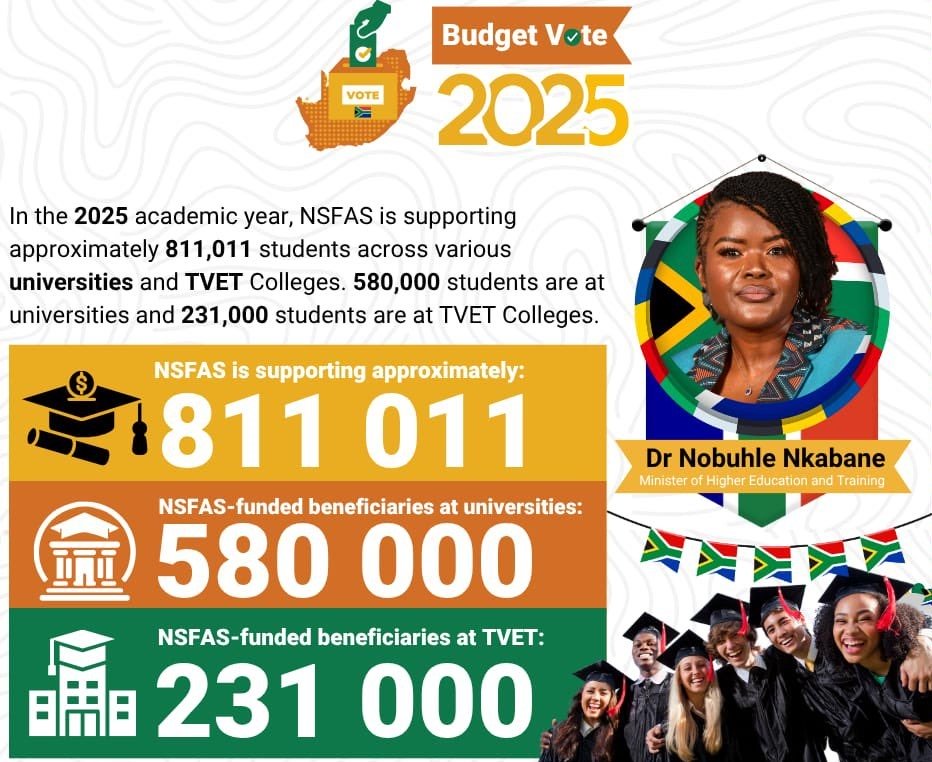
Current Beneficiaries: In the 2025 academic year, NSFAS is supporting approximately 811,011 students across various universities and TVET Colleges. Of these, university students number 580,000, while TVET students total 231,000.
Provisional Funding for 2025: The scheme has provisionally funded more than 600,000 eligible students at various universities for the 2025 academic year, with more than 200,000 students already fully funded.
Provincial Application Distribution (2025):
The provincial distribution of applications reveals that some provinces have a higher demand for funding than others:
| Province | Applications Received |
|---|---|
| KwaZulu-Natal | 109,026 (highest) |
| Gauteng | 31,491 |
| Eastern Cape | 13,478 |
| Mpumalanga | 10,704 |
| Northern Cape | 849 (lowest) |
SASSA Grant Recipients: 202,044 SASSA Beneficiaries have been provisionally approved, demonstrating the scheme’s commitment to helping the country’s most financially vulnerable students.
NSFAS Budget and Financial Growth
Historical Growth: Student funding through the National Student Financial Scheme (NSFAS) has grown since 1991 from disbursing R21.4 million to R54 billion.
Recent Five-Year Impact: Between 2019 and 2024, NSFAS disbursed R244 billion, benefiting 4,695,757 students in both universities and TVET colleges.
Current and Future Budgets:
- 2024/25: R48.7 billion allocated
- 2025/26: R51 billion
- 2026/27: R53.4 billion
2025 Disbursements to Date: About R48.4 billion has been allocated for learning in the 2025 academic year. Of that, about R5.9 billion has already been disbursed to universities, representing about 15% of the allocation, while an additional R751 million has been disbursed to the TVET colleges.
NSFAS Gender Distribution
The scheme has made significant progress in gender equity. The NSFAS Annual Report for the 2025 fiscal year says that the program helped 419,953 students, 64% of whom were women and 42% of whom were men. This is a big change from years past, when more men than women received NSFAS funding.
Missing Middle Loan Scheme
The government has committed R3 billion over a three-year period through the National Skills Fund to assist students from middle-income families who fall outside the traditional bursary criteria but still struggle to afford higher education.
Cost Per Student
Average Funding Per Student: The average cost per student funded by the scheme reflects the comprehensive support provided:
- Amounts vary significantly based on accommodation type and institution
- University students typically receive higher total funding due to accommodation costs
- TVET students receive tailored support based on urban, peri-urban, or rural location
NSFAS Application Processing Statistics
Real-Time Decisions: 30% (276,748) of the applicants have received a real-time decision when applying through the myNSFAS Portal.
This represents a significant improvement in processing efficiency, allowing students to know their funding status immediately upon application submission.
Historical Context: From TEFSA to NSFAS
The scheme has a long history of supporting South African students:
- 1991: Started as TEFSA (Tertiary Education Fund of South Africa)
- 1999: Transformed into NSFAS through Act 56 of 1999
- 2000: All TEFSA loan accounts transferred to NSFAS
- 2018: Shift from loans to bursaries for eligible students
- 2024: Introduction of the missing middle loan scheme
The NSFAS Funding Challenge
Despite substantial budget allocations, demand continues to outpace available resources. While this is not sufficient to meet the growing demand for access to higher education, we continue to seek efficient ways of allocating limited resources to ensure that no deserving learner is left behind.
The scheme balances its mission to provide access with the reality of limited government resources, making efficient allocation and fraud prevention critical priorities.
NSFAS Eligibility Criteria and Conditions for Financial Aid
Understanding the NSFAS eligibility criteria helps you determine whether to apply and what documents you’ll need.
Basic Eligibility Requirements
You qualify for NSFAS bursary funding if you meet all of these criteria:
- Citizenship: You must be a South African citizen
- Income Threshold: Your combined household income must not exceed R350,000 per year
- SASSA Grant Recipients: All students whose families receive SASSA grants automatically qualify
- Students with Disabilities: Combined household income must not exceed R600,000 per year
- Continuing Students: Students who started before 2018 qualify if their household income doesn’t exceed R122,000 per year
Who Should NOT Apply
The scheme does not fund:
- Students who have already completed a previous qualification
- Applicants whose combined household income exceeds R350,000 annually (or R600,000 for students with disabilities)
- Students already receiving funding who meet academic requirements (you’re automatically funded for continuing years)
What NSFAS Covers: Allowances and Support
The bursary scheme covers multiple costs associated with studying. Amounts vary between universities and TVET colleges.
University Student Allowances (2025/26)
| Actual costs charged by the university (private accommodation capped at residence rates) | Annual Amount |
|---|---|
| Tuition Fees | Actual costs charged by the university (private accommodation capped at residence rates) |
| Accommodation | Actual costs charged by university (private accommodation capped at residence rates) |
| Living Allowance | R15,000 per year |
| Book Allowance | R5,200 per year |
| Transport (up to 40km) | R7,500 per year |
| Personal Care/Incidental | R2,900 per year (for students in catered residences) |
TVET College Student Allowances
| Expense Category | Annual Amount |
|---|---|
| Tuition Fees | Full coverage |
| Accommodation (Urban) | R24,000 per year |
| Accommodation (Peri-urban) | R18,900 per year |
| Accommodation (Rural) | R15,750 per year |
| Transport (up to 40km) | R7,350 per year |
| Personal Care/Incidental | R2,900 per year |
These allowances help cover essential costs so students can focus on their studies rather than financial stress.
How to Apply for NSFAS 2027: Step-by-Step Application Process
The application process happens entirely online through the myNSFAS portal. Applications for 2026 funding officially closed on Friday, November 15, 2025.
Creating Your myNSFAS Account
- Visit the official NSFAS website at www.nsfas.org.za
- Click on “myNSFAS portal.”
- Select “Create Account”
- Use your South African ID number as your username
- Create a secure password
- Verify your cellphone number and email address
NSFAS Required Documents for Your Application
Prepare these documents before starting your application:
- Identity Documents: Your South African ID or birth certificate, plus parent/guardian/spouse ID copies
- Proof of Income: Recent payslips, pension statements, or other income documentation
- Smart Card: Both sides, if you have a South African smart ID
- Disability Documentation: Completed Disability Annexure A form (if applicable)
- NSFAS Consent Form: Downloaded from the portal and completed
- Declaration Forms: As required based on your circumstances
Important: The scheme does not accept affidavits or driver’s licenses as proof of identity.
NSFAS Application Status: What Each Status Means
Understanding your NSFAS Application Status reduces anxiety and helps you know what action to take next.
Common Application Statuses Explained
Application Submitted: Your application has been received and is queued for processing. No action needed at this stage.
Under Review/Verification: Your application is being checked against eligibility criteria. Documents are being verified with the Department of Home Affairs, SARS, and other databases.
Provisionally Funded: This is positive news—you’ve passed initial eligibility checks. However, funding is not yet final. You must:
- Upload any missing documents within 30 days
- Confirm your registration at your chosen institution
- Wait for final funding confirmation
Funded: Congratulations! Your funding has been approved. The scheme will pay your tuition directly to your institution and disburse allowances according to the payment schedule.
Registered: Your institution has confirmed your registration details. Payments should begin according to the disbursement calendar.
Not Funded/Rejected: Your application did not meet eligibility requirements. Check the reason provided and consider the appeals process if applicable.
Checking Your Application Status
Results for 2026 applications began being communicated on Sunday, December 15, 2025.
- Log in to your myNSFAS account
- Navigate to “Track Funding Progress”
- View your current status and any outstanding requirements
- Check regularly for updates, especially between December and February
NSFAS Payment Dates and Disbursement Schedule 2026
One of the most common questions students ask relates to payment timing. Understanding the disbursement process helps you plan your finances.
How NSFAS Payments Work
The scheme follows a structured payment process:
For Tuition: Funds are paid directly to your university or TVET college. You won’t receive this money—it goes straight to cover your registration and course fees.
For Allowances: Money for accommodation, transport, books, and living expenses is typically:
- Paid to your institution (who then pays you), OR
- Paid directly to your personal bank account
Important: Payment timing depends on your institution submitting accurate registration data to NSFAS.
Expected Payment Timeline for 2026
Based on historical patterns and the 2025/26 disbursement calendar:
- First Payments: Typically occur 4-6 weeks after registration confirmation
- Subsequent Payments: Made monthly according to the academic calendar
- Accommodation: Usually paid at the beginning of each semester or term
The scheme aims to make 95% of disbursements to fully funded students according to the published disbursement calendar.
NSFAS Appeals Process: What to Do If You’re Rejected
If your application was unsuccessful, you have the right to appeal the decision within 30 days of receiving your results. Check out Other Bursaries Like NSFAS.
When You Can Appeal
Valid grounds for NSFAS Appeal include:
- Incorrect assessment of your household income
- Missing or incorrectly processed documents
- Changed family circumstances (retrenchment, death, divorce)
- Academic performance affected by documented extenuating circumstances
- Administrative errors in processing your application
How to Submit an Appeal
- Log in to myNSFAS: Access your portal within 30 days of the rejection notification
- Check Rejection Reason: Understand why your application was unsuccessful
- Gather Supporting Documents: Collect evidence that addresses the rejection reason
- Submit Formal Appeal: Use the appeals section in your portal
- Include All Evidence: Upload clear copies of supporting documentation
Appeals Deadlines for 2026
- Main Application Cycle: Appeals must be submitted by Saturday, January 31, 2026
- TVET Walk-in Applicants: Appeals deadline is Saturday, March 15, 2026
The scheme aims to finalize:
- 80% of valid appeals by the stipulated deadline in 2025/26
- 85% by the deadline in 2026/27
- 90% by the deadline in 2027/28
Student Accommodation Through NSFAS
Finding safe, affordable accommodation is crucial for student success. The scheme has implemented an accommodation support system known as NSFAS Accommodation.
For Students Seeking Accommodation
Accredited Properties Only: The scheme only pays for accommodation that meets accreditation standards. To find approved accommodation:
- Log in to your myNSFAS account
- Browse the list of accredited properties near your institution
- Apply for your preferred accommodation
- Receive confirmation via email or SMS
Critical Warning: If you live in unaccredited accommodation without permission from both NSFAS and your institution, you will not receive accommodation allowances.
For Accommodation Providers
Property owners who want to accommodate funded students must register through the official portal:
- Create an account on the Accommodation Provider portal
- Add property details and upload images
- Submit required documentation (proof of ownership)
- Pay for the number of beds you’re registering
- Pass inspection and grading for compliance with minimum standards
The scheme offers three-year contracts with annual reviews for registered providers, ensuring guaranteed income and supporting student education.
Missing Middle Loan Scheme: Funding for Working-Class Families
In 2024, the scheme introduced a loan program for students from families who earn above the bursary threshold but still struggle to afford higher education.
Who Qualifies for the Missing Middle Loan
The loan scheme targets students from households with a combined annual income between R350,000 and R600,000. With government allocation of R3.8 billion distributed over four years (R950 million annually), this program addresses the gap for approximately 11% of South African households.
Key Differences Between Bursaries and Loans
Bursaries:
- Do not require repayment if academic requirements are met
- Available for household income under R350,000 (R600,000 for students with disabilities)
Loans:
- Require repayment after graduation
- Target the “missing middle” income bracket
- Interest rates and terms are determined by the approved loan management strategy
A comprehensive Loan Management Strategy is being developed and will be approved by January 31, 2026.
NSFAS Academic Requirements: The N+ Rule
To maintain NSFAS funding, continuing students must meet both academic progression and time requirements.
Academic Progress Requirements
Students must pass a certain percentage of enrolled modules each year. Specific requirements are detailed in the eligibility criteria and conditions for financial aid, which the Board submits to the Minister for concurrence.
The N+ Time Limit Explained
N+ Rule: You can be funded for the minimum duration of your qualification (N) plus one or two additional years, depending on your circumstances.
Example:
- A three-year degree (N=3) can be funded for up to 4 years (N+1) or 5 years (N+2)
- If you started a degree in 2022, you must complete it by 2026 (for N+1) to maintain funding eligibility
Important for Changing Qualifications: If you switch programs or move from TVET to university, previously funded years may count toward your N+ limit.
Common NSFAS Problems and How to Solve Them
Based on student experiences across South Africa, here are the most frequent issues and their solutions.
Problem 1: Provisionally Funded Status Not Changing
Why This Happens: Your institution hasn’t submitted registration data, or there are unresolved verification issues.
What To Do:
- Check for missing document requests in your portal
- Confirm you’ve registered at your institution
- Verify your institution has submitted your registration details
- Contact your campus financial aid office, not the central NSFAS line
Problem 2: Cannot Upload Documents
Common Causes: File size too large, wrong format, or browser issues.
Solutions:
- Use PDF format for documents
- Compress files to under 5MB
- Use Google Chrome or Firefox browsers
- Clear browser cache and try again
- Use a different device if problems persist
Problem 3: Payment Delays
What’s Usually Happening: Registration data issues, banking detail verification pending, or institutional processing delays.
Action Steps:
- Verify your banking details are correctly saved in myNSFAS
- Confirm your institution received and processed your registration
- Check the official disbursement calendar for expected payment dates
- Contact your campus bursary office first—they have direct communication channels
- Keep records of all communications and reference numbers
Problem 4: Unable to Contact NSFAS
Reality Check: The central call center (08000 67327) is often overwhelmed with calls.
Better Contact Methods:
- Campus Financial Aid Office: Your first and best contact point
- myNSFAS Portal Messages: Log queries through your account
- WhatsApp: +27 63 093 5671
- Email: info@nsfas.org.za (allow 5-7 business days for response)
- Social Media: @myNSFAS on Twitter, Facebook, and Instagram
NSFAS Fraud Prevention: Protecting Your Information
The scheme has zero tolerance for fraud, bribery, and corruption. Protecting your information protects your future.
Official Communication Channels Only
NSFAS Will Never:
- Ask for your password via phone or email
- Request payment for application processing
- Demand money for accommodation placement
- Ask you to share banking details via SMS or email
Warning Signs of Fraud
Be cautious of:
- Messages claiming to be from “NSFAS Attorneys” offering settlement discounts
- Anyone requesting payment to guarantee funding
- Accommodation providers demanding fees from funded students
- Requests for personal information from unverified sources
Reporting Fraud
If you encounter suspicious activity:
- Ethics Hotline: speakup@nsfas.org.za
- Document everything: save messages, take screenshots
- Report to your institution’s financial aid office
- Never make payments into accounts not verified as official NSFAS accounts
Verified External Debt Collectors
The scheme only uses these authorized debt collection agencies:
- Khumalo Masondo
- Morkalio
- NICS
- Ncube
- Qlink
Any other entity claiming to collect on behalf of NSFAS is fraudulent.
NSFAS Loan Repayment: What Happens After Graduation
For students who received loans (primarily those who studied before 2018 or are part of the missing middle loan scheme), understanding repayment obligations is essential.
When Repayment Begins
Loan repayment typically starts:
- When you begin earning above a certain threshold
- Usually, within 6-12 months after completing or discontinuing studies
How Repayments Are Collected
The scheme has several mechanisms:
- Employer Deductions: Direct deductions from your salary
- Direct Debit Orders: Automatic monthly payments from your bank account
- Manual Payments: EFT payments you make directly
Important for Former Borrowers
You are required to:
- Keep NSFAS informed of your employment status and income level
- Update your contact details regularly
- Report changes in circumstances that affect your ability to pay
The scheme recovered R200 million in the 2025/26 period, with targets increasing to R250 million (2026/27) and R300 million (2027/28).
Recent Changes and Updates to NSFAS
The scheme undergoes continuous improvement to serve students better. Here are significant recent developments.
New Leadership and Governance (2025)
On Tuesday, February 18, 2025, Minister of Higher Education and Training Dr. Nobuhle Nkabane appointed a new Board led by Chairperson Dr. Karen Stander.
This appointment marks a strategic shift toward:
- Improved governance and accountability
- Enhanced digital transformation
- Stronger stakeholder partnerships
- Student-centered service delivery
Digital Transformation Strategy
An organizational ICT digital transformation strategy is being developed for approval by Monday, September 30, 2025. This strategy will address:
- Implementation of Enterprise Resource Planning (ERP) solutions
- Customer Relationship Management (CRM) systems
- Cloud infrastructure and cybersecurity improvements
- Blockchain integration for transparent transactions
- AI-powered data management
Accommodation Transition Framework
A transitional framework for transferring student accommodation management back to institutions is under development, with approval expected by Monday, November 30, 2025. This addresses challenges identified in the pilot accommodation project.
How to Stay Updated on NSFAS Information
Accurate, timely information is crucial for successful funding applications and maintenance.
Official Information Sources
Primary Portal: www.nsfas.org.za
- Check your myNSFAS account daily during application periods
- Enable portal notifications
- Save important messages and confirmations
Social Media Channels:
- Facebook: National Student Financial Aid Scheme
- Twitter/X: @myNSFAS
- Instagram: @myNSFAS
Contact Methods by Query Type
Application and Status Queries:
- Toll-Free: 08000 67327
- Email: info@nsfas.org.za
- WhatsApp: +27 63 093 5671
- USSD: 12067327#
Payment and Balance Queries:
- Toll-Free: 08000 67327
- Email: collections@nsfas.org.za
Media Inquiries:
- Email: media@nsfas.org.za
Outreach and Events:
- Email: outreach@nsfas.org.za
Frequently Asked Questions About NSFAS
When do applications open for 2027 funding?
Application dates are typically announced in August or September of the previous year. Based on historical patterns, applications for 2027 likely opened in early September 2026 and closed mid-November 2026. Check out the NSFAS 2027 Application Opening Date.
Can I receive funding if I’m studying part-time?
The scheme primarily funds full-time students enrolled at public universities and TVET colleges. Part-time study funding is limited and depends on specific circumstances outlined in the eligibility criteria.
What happens if I fail some modules?
You can maintain funding if you pass the minimum percentage of modules required by the academic progression policy. Failing too many modules may result in losing funding. Academic requirements are assessed annually.
Can I change my course or institution while funded?
Changing courses or institutions while receiving funding is possible but complex. Factors considered include:
Whether both qualifications are approved for funding
Your N+ remaining years
Academic progression requirements
Whether the new institution participates in the scheme
Contact your campus financial aid office before making changes.
Do I need to reapply every year?
No. If you’re a continuing student who maintains academic eligibility, you’re automatically assessed for funding each year. You only apply once unless you:
Take a gap year
Change institution types (TVET to university or vice versa)
Switch to a different qualification
Previously lost funding and are reapplying
Resources for NSFAS Applicants and Beneficiaries
Downloadable Forms and Documents
All forms are available on the official portal:
- NSFAS Consent Form 2026
- Declaration Form (for applicants 34 and younger)
- Disability Annexure A Form
- Vulnerable Child Declaration Form
Support Services
Career Assessment: The scheme provides access to career assessment tools to help you make informed study decisions. Access these through the official website.
Email Account Creation: If you need help creating an email address (required for applications), video tutorials are available on the website.
Understanding Your Rights
As a funded student, you have rights:
- To have accurate, timely information about your funding status
- To appeal decisions you believe are incorrect
- To privacy and protection of your personal information (POPIA compliance)
- To report fraud or unethical behavior without fear
The Future of NSFAS: Strategic Direction 2025-2030
Understanding where the scheme is heading helps you plan your educational journey.
Strategic Focus Areas
The scheme’s five-year strategic plan emphasizes:
Institutional Integrity: Building a student-centric organization that earns stakeholder trust through transparency and accountability.
Financial Sustainability: Diversifying funding sources beyond government appropriations, including partnerships with SETAs, private funders, and philanthropic organizations.
Organizational Capability: Investing in modern ICT systems, skilled personnel, and efficient processes to serve more students effectively.
Expanded Access: Working toward funding 499,390 university students and 281,514 TVET students by 2026/27.
Addressing the “Missing Middle”
The loan scheme for working-class families represents a significant policy shift. Over the medium term, this program aims to:
- Reduce the number of students who cannot access higher education
- Provide sustainable repayment models linked to post-graduation income
- Close the gap between bursary eligibility and full-cost fees
Making NSFAS Work for You
The National Student Financial Aid Scheme opens doors to higher education for hundreds of thousands of South African students each year. While the system has challenges—from application complexities to payment delays—understanding how it works puts you in control of your educational future.
Key Takeaways:
- Apply Early: Don’t wait until the last day of the application period
- Keep Documents Ready: Have all required documents prepared before starting
- Check Your Portal Daily: Especially during application and registration periods
- Use Campus Resources First: Your institution’s financial aid office is your best support
- Protect Your Information: Never share passwords or pay anyone claiming to represent NSFAS
- Understand Academic Requirements: Know the N+ rules and progression requirements
- Appeal if Necessary: Don’t accept a rejection if you believe it’s incorrect—use the appeals process
- Maintain Communication: Keep your contact details updated and respond to requests promptly
Remember: Education is your constitutional right. The scheme exists to help you access that right. While the process can be frustrating, thousands of students successfully navigate it each year—and you can too.
For the most current information, always verify details on the official NSFAS website at www.nsfas.org.za or contact the toll-free helpline at 08000 67327.
Leave a Reply