Author: eriq elikplim

  • Montgomery College Academic Calendar 2026: Important Dates

    Montgomery College Academic Calendar 2026: Important Dates

    The Montgomery College academic calendar for 2026 operates across three semesters—Spring 2026 (beginning Monday, January 26, 2026), Summer 2026 (beginning Monday, May 26, 2026), and Fall 2026 (beginning Monday, August 31, 2026)—with classes offered at three campuses in Rockville, Germantown, and Takoma Park/Silver Spring, Maryland.

    Montgomery College Maryland serves 55,000 students annually through a hybrid academic structure combining 15-week full-term semesters with accelerated 7-week sessions and 13-week classes.

    The 2026 calendar includes specific registration deadlines, holiday closures, financial aid dates, and commencement ceremonies across all three Montgomery County campuses.

    Table of Contents

    Montgomery College Academic Calendar Spring 2026

    Spring 2026 classes begin Monday, January 26, 2026, with the semester ending Friday, May 22, 2026.

    The Spring 2026 semester operates across multiple session formats to accommodate 17,780 students enrolled at Montgomery College Maryland.

    Full-term classes run 15 weeks while accelerated options include 13-week sessions starting Monday, February 9, 2026, and 7-week sessions beginning Monday, March 30, 2026.

    Spring 2026 Registration and Application Deadlines

    Deadline TypeDateDetails
    Priority RegistrationMonday, October 27, 2025Current students with priority status
    General RegistrationMonday, November 3, 2025Open to all eligible students
    Priority Admissions ApplicationMonday, December 1, 2025Students new to college
    Transcript Submission for Transfer CreditSaturday, November 1, 2025Must reach Office of Records & Registration
    Disability Support Services RequestMonday, December 1, 2025Required documentation deadline
    Senior Citizen Tuition Waiver BeginsThursday, January 22, 2026Available to eligible Maryland residents age 60+

    Montgomery College Maryland accepts applications through multiple channels including the MyMC student portal and Workday Student system.

    New international students holding F-1 or M-1 visas must apply for Form I-20 by Thursday, October 1, 2025, while students changing status from B-2 or F-2 to F-1 face a Monday, September 1, 2025 priority deadline.

    Spring 2026 Important Academic Dates

    Spring semester classes begin Monday, January 26, 2026 across all three Montgomery College campuses.

    Weekend classes start Friday, January 31, 2026. Students must verify specific add/drop deadlines through their MyMC class schedule between Monday, January 26, 2026 and Saturday, January 31, 2026, as refund eligibility and withdrawal rules vary by course section and Part-of-Term designation.

    Academic MilestoneDateCampus Applicability
    Classes BeginMonday, January 26, 2026Rockville, Germantown, Takoma Park/Silver Spring
    Weekend Classes BeginFriday, January 31, 2026All campuses
    13-Week Session StartsMonday, February 9, 2026All campuses
    Major Declaration/Update DeadlineFriday, February 6, 2026Required for degree-seeking students
    Graduation Application DeadlineSunday, February 15, 2026Spring 2026 commencement candidates
    Midterm ExamsMonday, March 9 – Friday, March 13, 2026Schedule varies by instructor
    Spring BreakMonday, March 16 – Sunday, March 22, 2026No classes for students or faculty
    College Closed (Spring Break)Friday, March 20 – Sunday, March 22, 2026Administrative offices closed
    Midterm Grades DueWednesday, March 25, 2026Faculty submission deadline 11:59 PM
    Seven Week Classes BeginMonday, March 30, 2026Part-of-Term accelerated format
    Final Exam WeekMonday, May 11 – Sunday, May 17, 2026See exam schedule matrix below
    Final Grades DueWednesday, May 20, 2026Faculty submission deadline
    Official End of Spring SemesterFriday, May 22, 2026Marks end of 2025-2026 academic year
    Commencement CeremoniesThursday, May 21 – Friday, May 22, 2026Celebrating Spring 2026 graduates

    Montgomery College observes Monday, January 19, 2026 as Dr. Martin Luther King, Jr. holiday with all campuses and administrative offices closed.

    Montgomery College Spring 2026 Financial Aid Deadlines

    Students must complete the Free Application for Federal Student Aid (FAFSA) by Sunday, March 1, 2026 to qualify for Maryland state scholarships.

    Financial aid disbursements for Spring 2026 begin Thursday, February 19, 2026, with subsequent weekly disbursements every Thursday through Thursday, May 14, 2026. Students requesting Foster Care Waivers or disability waivers must submit FAFSA by Sunday, March 1, 2026.

    Financial Aid CategoryDeadlineProcessing Notes
    FAFSA for State ScholarshipsSunday, March 1, 2026Maryland state aid eligibility cutoff
    Dream Act Affidavit SubmissionFriday, February 13, 2026Office of Records & Registration
    Maryland Dream Act Paperwork (Priority)Friday, January 9, 2026Earlier submission recommended
    Health Workforce Shortage FormsFriday, February 13, 2026Winter/Spring 2026 applicants
    Disability Waiver FormsFriday, February 13, 2026Requires FAFSA completion by March 1
    Loan Certification DeadlineFriday, May 1, 2026All required loan steps completed
    SAP Appeal (Associate Degree)Sunday, November 30, 2025Satisfactory Academic Progress review

    Spring 2026 book vouchers become available Tuesday, January 20, 2026 for in-person bookstore purchases through Friday, February 13, 2026.

    Online book voucher purchases must be completed by Tuesday, February 10, 2026. Book vouchers process automatically for eligible students based on remaining financial aid after tuition and fee payment.

    Spring 2026 Final Exam Schedule

    Final exams occur Monday, May 11, 2026 through Sunday, May 17, 2026 based on regular class meeting day and start time.

    Montgomery College Maryland assigns final exam times using a standardized matrix that matches regular class schedules. Students find their exam schedule by identifying the day(s) their class meets and the class start time, then locating the intersection point in the matrix below.

    Example: A class meeting only on Monday beginning at 4:30 PM holds its final exam Monday, May 11, 2026 from 5:00 PM – 7:00 PM.

    Class Start TimeMonday/Wednesday/FridayMonday & WednesdayTuesday & ThursdayMonday OnlyTuesday OnlyWednesday OnlyThursday OnlyFriday Only
    6:00-7:29 AMMay 15, 7-9 AMMay 15, 7-9 AMMay 15, 7-9 AMMay 15, 7-9 AMMay 15, 7-9 AMMay 15, 7-9 AMMay 15, 7-9 AMMay 15, 7-9 AM
    7:30-8:54 AMMay 11, 8-10 AMMay 11, 8-10 AMMay 12, 8-10 AMMay 11, 8-10 AMMay 12, 8-10 AMMay 13, 8-10 AMMay 14, 8-10 AMMay 15, 8-10 AM
    8:55-9:54 AMMay 13, 8-10 AMMay 13, 8-10 AMMay 14, 8-10 AMMay 11, 8-10 AMMay 12, 8-10 AMMay 13, 8-10 AMMay 14, 8-10 AMMay 15, 8-10 AM
    9:55-10:54 AMMay 11, 10:14 AM-12:14 PMMay 11, 10:14 AM-12:14 PMMay 12, 10:14 AM-12:14 PMMay 11, 10:14 AM-12:14 PMMay 12, 10:14 AM-12:14 PMMay 13, 10:14 AM-12:14 PMMay 14, 10:14 AM-12:14 PMMay 15, 10:14 AM-12:14 PM
    10:55-11:54 AMMay 13, 10:14 AM-12:14 PMMay 13, 10:14 AM-12:14 PMMay 14, 10:14 AM-12:14 PMMay 11, 10:14 AM-12:14 PMMay 12, 10:14 AM-12:14 PMMay 13, 10:14 AM-12:14 PMMay 14, 10:14 AM-12:14 PMMay 15, 10:14 AM-12:14 PM
    11:55 AM-12:54 PMMay 11, 12:30-2:30 PMMay 11, 12:30-2:30 PMMay 12, 12:30-2:30 PMMay 11, 12:30-2:30 PMMay 12, 12:30-2:30 PMMay 13, 12:30-2:30 PMMay 14, 12:30-2:30 PMMay 15, 12:30-2:30 PM
    12:55-1:54 PMMay 13, 12:30-2:30 PMMay 13, 12:30-2:30 PMMay 14, 12:30-2:30 PMMay 11, 12:30-2:30 PMMay 12, 12:30-2:30 PMMay 13, 12:30-2:30 PMMay 14, 12:30-2:30 PMMay 15, 12:30-2:30 PM
    1:55-2:54 PMMay 11, 2:45-4:45 PMMay 11, 2:45-4:45 PMMay 12, 2:45-4:45 PMMay 11, 2:45-4:45 PMMay 12, 2:45-4:45 PMMay 13, 2:45-4:45 PMMay 14, 2:45-4:45 PMMay 15, 2:45-4:45 PM
    2:55-4:29 PMMay 13, 2:45-4:45 PMMay 13, 2:45-4:45 PMMay 14, 2:45-4:45 PMMay 11, 2:45-4:45 PMMay 12, 2:45-4:45 PMMay 13, 2:45-4:45 PMMay 14, 2:45-4:45 PMMay 15, 2:45-4:45 PM
    4:30-5:59 PMMay 11, 5-7 PMMay 11, 5-7 PMMay 12, 5-7 PMMay 11, 5-7 PMMay 12, 5-7 PMMay 13, 5-7 PMMay 14, 5-7 PMMay 15, 5-7 PM
    6:00-7:19 PMMay 13, 7:14-9:14 PMMay 13, 7:14-9:14 PMMay 14, 7:14-9:14 PMMay 11, 7:14-9:14 PMMay 12, 7:14-9:14 PMMay 13, 7:14-9:14 PMMay 14, 7:14-9:14 PMMay 15, 7:14-9:14 PM
    7:20-9:29 PMMay 11, 7:14-9:14 PMMay 11, 7:14-9:14 PMMay 12, 7:14-9:14 PMMay 11, 7:14-9:14 PMMay 12, 7:14-9:14 PMMay 13, 7:14-9:14 PMMay 14, 7:14-9:14 PMMay 15, 7:14-9:14 PM

    Special Final Exam Exceptions:

    1. Part-of-Term 3 classes ending during final exam week hold exams on the last class meeting day with regular attendance during exam week.
    2. Classes with lecture and laboratory components follow the lecture time period for final exam scheduling.
    3. Saturday and Sunday classes meet at regular start times Saturday, May 16, 2026 and Sunday, May 17, 2026 for two-hour exam periods.
    4. CHEM 131 sections follow campus-specific schedules: Rockville day sections Tuesday, May 12, 2026, 2:45-4:45 PM; Rockville evening/Saturday sections Tuesday, May 12, 2026, 6:00-8:00 PM; Takoma Park day sections Tuesday, May 12, 2026, 2:45-4:45 PM; Takoma Park evening/Saturday sections Tuesday, May 12, 2026, 6:00-8:00 PM.

    Spring 2026 Seven-Week Session Dates

    Montgomery College offers accelerated 7-week classes beginning Monday, March 30, 2026 within the Spring 2026 semester.

    Seven-week sessions compress standard coursework into intensive formats allowing students to complete courses faster. Students may enroll in both full-semester and 7-week courses simultaneously depending on program requirements and academic standing. Specific add/drop deadlines differ from full-semester courses and appear in MyMC student portals.

    Montgomery College Academic Calendar Summer 2026

    Summer 2026 registration begins Monday, April 6, 2026 with classes starting Monday, May 26, 2026.

    Montgomery College Maryland operates three distinct summer sessions: Summer Session I (beginning Monday, May 26, 2026), Midsummer Session (beginning Monday, June 15, 2026), and Summer Session II (beginning Monday, July 6, 2026). The official summer academic period ends Friday, August 21, 2026.

    Summer 2026 Registration and Key Dates

    Summer Session MilestoneDateSession Applicability
    Class Schedule AvailableMonday, March 23, 2026All summer sessions viewable
    Registration OpensMonday, April 6, 2026Summer I, Midsummer, Summer II
    Transcript Submission DeadlineWednesday, April 1, 2026Transfer credit evaluation
    FAFSA Deadline (Disability Waivers)Wednesday, April 1, 2026Required for aid eligibility
    Disability Support Services RequestFriday, May 1, 2026Summer I session only
    Senior Citizen Waiver Begins (Summer I)Thursday, May 21, 2026Age 60+ Maryland residents
    Memorial Day Holiday (Closed)Monday, May 25, 2026All campuses and offices
    Summer Sessions BeginMonday, May 26, 2026Official start of summer term
    Summer I Classes BeginMonday, May 26, 2026First session starts
    Graduation Application DeadlineMonday, June 1, 2026Summer 2026 completion candidates
    Major Declaration Deadline (Summer I)Friday, June 5, 2026Required for degree programs
    Midsummer Classes BeginMonday, June 15, 2026Mid-length accelerated session
    Juneteenth Holiday (Closed)Friday, June 19, 2026Federal holiday observance
    Senior Citizen Waiver Begins (Summer II)Thursday, July 2, 2026Second session registration
    Independence Day Holiday (Closed)Friday, July 3, 2026Observed day before July 4
    Summer II Classes BeginMonday, July 6, 2026Second session starts
    Final Grades Due (Summer I)Wednesday, July 8, 2026Faculty submission deadline
    Major Declaration Deadline (Summer II)Friday, July 17, 2026Second session students
    Summer Sessions EndFriday, August 21, 2026Official conclusion all sessions
    Final Grades Due (Summer II)Wednesday, August 26, 2026Faculty submission deadline

    Summer 2026 book vouchers become available Monday, May 18, 2026 for in-person purchases through Friday, May 29, 2026. Online book voucher purchases must complete by Tuesday, May 26, 2026. The loan certification deadline for Summer 2026 falls on Thursday, August 7, 2026, requiring completion of all loan steps by this date.

    Understanding Montgomery College’s Summer Session Structure

    Montgomery College Maryland divides summer into three overlapping sessions accommodating different learning speeds and schedules. Summer Session I runs approximately 8 weeks, Midsummer Session operates as an intensive shorter format, and Summer Session II provides another 8-week option.

    Students can take courses across multiple sessions to accelerate degree completion or fulfill prerequisite requirements before fall enrollment.

    Montgomery College Academic Calendar Fall 2026

    Fall 2026 priority registration begins Monday, April 27, 2026 with classes starting Monday, August 31, 2026.

    The Fall 2026 semester represents the beginning of the 2026-2027 academic year at Montgomery College Maryland. Faculty professional week occurs Monday, August 24, 2026 before student classes commence. The semester officially ends Sunday, December 20, 2026 following final exams.

    Fall 2026 Registration Timeline and Application Deadlines

    Deadline CategoryDateDetails
    Health Sciences ApplicationSunday, March 1, 2026Competitive program deadline
    Nursing/Health Science ApplicationWednesday, April 1, 2026All health-related programs
    Class Schedule AvailableMonday, April 13, 2026Fall 2026 course listings published
    Priority Registration BeginsMonday, April 27, 2026Current students with priority status
    General Registration OpensMonday, May 4, 2026All eligible students may register

    Montgomery College Maryland requires health science program applications months in advance due to competitive enrollment caps and clinical placement coordination. Students planning to enter nursing, radiologic technology, or other health professions programs must submit applications by designated deadlines to receive consideration for Fall 2026 admission.

    Fall 2026 Semester Important Dates

    Fall semester classes begin Monday, August 31, 2026 with first seven-week session starting simultaneously.

    Montgomery College Maryland operates Fall 2026 with staggered start dates across different session formats. Weekend classes begin Saturday, September 12, 2026 and Sunday, September 13, 2026 depending on course scheduling.

    The 13-week accelerated session starts Monday, September 14, 2026, while second seven-week classes begin Wednesday, October 28, 2026.

    Fall 2026 MilestoneDateCampus Coverage
    Fall Classes BeginMonday, August 31, 2026Rockville, Germantown, Takoma Park/Silver Spring
    First Seven-Week Session BeginsMonday, August 31, 2026Part-of-Term accelerated format
    Labor Day Holiday (Closed)Monday, September 7, 2026All campuses and offices
    Weekend Classes BeginSaturday, September 12 – Sunday, September 13, 2026Schedule varies by course
    13-Week Session BeginsMonday, September 14, 2026Mid-length term format
    MC Day (No Classes)Tuesday, October 20, 2026Non-instructional faculty duty day
    Second Seven-Week Session BeginsWednesday, October 28, 2026Part-of-Term accelerated format
    Fall Break (Closed)Wednesday, November 25 – Sunday, November 29, 2026Thanksgiving holiday closure
    Final Exam WeekMonday, December 14 – Sunday, December 20, 2026Exam schedules posted by instructors
    Official End of Fall SemesterSunday, December 20, 2026Concludes Fall 2026 term
    Non-Instructional Faculty DaysMonday, December 21 – Wednesday, December 23, 2026Students not on campus
    Winter Break (Closed)Wednesday, December 24, 2026 – Thursday, January 1, 2027Extended holiday closure

    MC Day on Tuesday, October 20, 2026 represents a non-instructional duty day for faculty. Students do not attend classes while faculty engage in professional development, curriculum planning, and administrative responsibilities. This date differs from standard holiday closures since faculty remain on duty.

    Fall 2026 Financial Aid and Book Voucher Schedule

    First Fall 2026 financial aid disbursement occurs Thursday, September 25, 2025 for students enrolled in Fall 2025 semester. Subsequent disbursements process weekly every Thursday through Thursday, December 11, 2025. Students must complete loan certification by Friday, December 5, 2025 to receive federal loan funding for Fall 2025.

    Fall 2025 book vouchers become available in-person Monday, August 25, 2025 through Friday, September 19, 2025. Online book voucher purchases must complete by Tuesday, September 16, 2025. The Satisfactory Academic Progress appeal deadline for associate degree students falls on Tuesday, September 30, 2025, while certificate program students must submit appeals by Sunday, November 30, 2025.

    Montgomery College Academic Calendar 2026: Understanding Part-of-Term Sessions

    Montgomery College Maryland operates Part-of-Term sessions including 15-week full semesters, 13-week classes, and 7-week accelerated sessions.

    Part-of-Term designations identify course length and start dates within standard semesters. Students accessing MyMC portals see course codes indicating session length: full 15-week terms, 13-week sessions starting after the semester begins, first 7-week sessions starting with the semester, and second 7-week sessions starting mid-semester.

    Seven-Week Session Benefits and Structure

    Seven-week accelerated courses compress standard 15-week content into intensive formats requiring approximately double the weekly time commitment. Students complete courses in half the time of traditional formats, allowing flexibility to:

    • Fulfill prerequisites faster before subsequent course enrollment
    • Accelerate degree completion by taking multiple 7-week sessions per semester
    • Balance work schedules with shorter course commitments
    • Focus intensively on challenging subjects without competing coursework

    First seven-week sessions align with semester start dates (Monday, January 26, 2026 for Spring 2026; Monday, August 31, 2026 for Fall 2026). Second seven-week sessions begin mid-semester (Monday, March 30, 2026 for Spring 2026; Wednesday, October 28, 2026 for Fall 2026).

    Thirteen-Week Session Scheduling

    Thirteen-week classes begin after full-semester courses start, providing alternative scheduling for students with conflicts during the first weeks of the term. Spring 2026 thirteen-week classes begin Monday, February 9, 2026 (two weeks after the Monday, January 26, 2026 semester start). Fall 2026 thirteen-week classes begin Monday, September 14, 2026 (two weeks after the Monday, August 31, 2026 semester start).

    Students selecting 13-week courses receive the same credit hours as 15-week equivalents but attend compressed schedules over a shorter timeframe. Add/drop deadlines, tuition refund policies, and withdrawal rules differ for 13-week sessions compared to full-semester courses.

    Montgomery College Campus Locations and Contact Information

    Montgomery College Maryland operates three campuses in Montgomery County: Rockville Campus at 51 Mannakee Street, Rockville, MD 20850; Germantown Campus at 20200 Observation Drive, Germantown, MD 20876; and Takoma Park/Silver Spring Campus at 7600 Takoma Avenue, Takoma Park, MD 20912.

    Rockville Campus

    The Rockville Campus serves as Montgomery College Maryland’s largest location and administrative headquarters. Students access the Office of Records & Registration (Raptor Central) for academic calendar questions, transcript requests, and enrollment verification at 240-567-5000 or registrars@montgomerycollege.edu.

    Germantown Campus

    Located in upper Montgomery County, the Germantown Campus provides convenient access for students in northwestern Maryland. Campus-specific programs include specialized health sciences facilities and expanded parking options compared to the Rockville location.

    Takoma Park/Silver Spring Campus

    The Takoma Park/Silver Spring Campus serves students in southeastern Montgomery County with proximity to Washington D.C. Metro stations. This location offers specialized programs in arts, humanities, and social sciences alongside general education courses.

    Academic Calendar Applicability Across Campuses

    Montgomery College academic calendar dates apply uniformly across all three campuses. Registration deadlines, semester start dates, holiday closures, and final exam periods remain consistent regardless of campus enrollment. Students may take courses at multiple campuses within the same semester depending on course availability and personal scheduling preferences.

    Montgomery College vs Montgomery County Public Schools Calendar 2026

    Montgomery College Maryland operates as a community college with the academic calendar described above, while Montgomery County Public Schools (MCPS) operates a separate K-12 school system with different calendar dates.

    Montgomery County Public Schools begins the 2026-2027 school year Monday, August 18, 2026, nearly two weeks before Montgomery College’s Monday, August 31, 2026 fall semester start. Parents and guardians searching for “Montgomery County 2026 calendar” should verify whether they need the community college schedule or the K-12 public school calendar.

    MCPS serves approximately 160,000 students in elementary, middle, and high schools throughout Montgomery County, Maryland. Montgomery College serves 55,000 credit and noncredit students annually in post-secondary education programs. The two institutions operate independently despite serving the same geographic area.

    How to Access the Montgomery College Academic Calendar Through MyMC and Workday

    Students access personalized academic calendars through the MyMC portal and Workday Student system.

    MyMC provides individual class schedules showing specific add/drop deadlines, withdrawal dates, and tuition refund eligibility periods based on enrolled courses. Students log into MyMC using their Montgomery College credentials to view:

    • Individualized course schedules with meeting times and locations
    • Specific deadlines for adding, dropping, or withdrawing from each course
    • Tuition payment deadlines and refund eligibility windows
    • Financial aid disbursement status and book voucher availability
    • Final exam schedules once published by instructors

    Workday Student integrates with MyMC for registration, grade viewing, and academic planning. The Workday system manages enrollment transactions, waitlist processing, and prerequisite verification during registration periods.

    Montgomery College Academic Calendar 2026-2027 Fall Semester Planning

    The Fall 2026 semester belongs to the 2026-2027 academic year, distinct from Spring 2026 which concludes the 2025-2026 academic year.

    Students planning enrollment across calendar year 2026 must understand that “Montgomery College 2026 calendar” references two different academic years:

    • Spring 2026 (January 26 – May 22, 2026): Concludes the 2025-2026 academic year
    • Fall 2026 (August 31 – December 20, 2026): Begins the 2026-2027 academic year

    Academic transcripts, financial aid awards, and degree progress tracking organize by academic year rather than calendar year. Students graduating in Spring 2026 receive diplomas dated 2026 despite beginning their final year in Fall 2025.

    Montgomery College Commencement 2026 Dates

    Montgomery College holds Spring 2026 commencement ceremonies Thursday, May 21, 2026 and Friday, May 22, 2026.

    Graduation application deadlines require submission by Sunday, February 15, 2026 for Spring 2026 completion candidates and Monday, June 1, 2026 for Summer 2026 completion candidates. Students must apply for graduation even if all degree requirements complete, as diplomas do not automatically generate.

    Commencement ceremonies occur after final grades submit and degree audits complete. Students completing requirements in Spring 2026 participate in May 2026 ceremonies, while Summer 2026 graduates typically join the following year’s commencement unless special arrangements occur.

    Montgomery College Holiday Closures 2026

    Montgomery College Maryland observes the following holidays with campus closures in 2026:

    HolidayDateAcademic Impact
    Dr. Martin Luther King, Jr. DayMonday, January 19, 2026Spring semester not yet started
    Spring BreakFriday, March 20 – Sunday, March 22, 2026Offices closed (students/faculty off full week)
    Memorial DayMonday, May 25, 2026Day before Summer I session starts
    JuneteenthFriday, June 19, 2026During Summer I session
    Independence Day (Observed)Friday, July 3, 2026Between Summer I and Summer II sessions
    Labor DayMonday, September 7, 2026First week of Fall semester
    Thanksgiving BreakWednesday, November 25 – Sunday, November 29, 2026Extended closure during Fall semester
    Winter BreakWednesday, December 24, 2026 – Thursday, January 1, 2027After Fall semester ends

    Students must note that MC Day (Tuesday, October 20, 2026) cancels classes but does not close the college. Faculty remain on duty while students do not attend classes.

    Transfer Student Calendar Considerations at Montgomery College Maryland

    Montgomery College maintains articulation agreements with University of Maryland (UMD), University of Maryland Global Campus (UMGC), and Universities at Shady Grove (USG) for seamless transfer pathways.

    Transfer students must plan Montgomery College academic calendar dates around four-year institution application deadlines. University of Maryland typically requires transfer applications by March 1 for fall admission and October 1 for spring admission. Students completing associate degrees at Montgomery College should:

    1. Submit transcripts to Montgomery College by designated deadlines (Monday, November 1, 2025 for Spring 2026; Wednesday, April 1, 2026 for Summer 2026)
    2. Apply for graduation one semester before degree completion
    3. Request official transcripts sent to transfer institutions after final grades post
    4. Verify transfer credit acceptance through university articulation databases

    Montgomery College ranks as the #1 community college in Maryland and #17 nationally according to WalletHub 2025 rankings, strengthening transfer student competitiveness for selective four-year programs.

    Frequently Asked Questions Montgomery College Academic Calendar 2026

    When does Montgomery College Spring 2026 start?

    Spring 2026 classes begin Monday, January 26, 2026 at all three Montgomery College Maryland campuses.

    What is Montgomery College spring break 2026?

    Spring break occurs Monday, March 16, 2026 through Sunday, March 22, 2026 with offices closed Friday, March 20 through Sunday, March 22, 2026.

    When is Montgomery College Fall 2026 registration?

    Fall 2026 priority registration begins Monday, April 27, 2026 with general registration opening Monday, May 4, 2026.

    Does Montgomery College have 7-week classes?

    Montgomery College offers accelerated 7-week sessions within standard semesters, with first sessions starting with the semester and second sessions beginning mid-semester.

    When is Montgomery College closed for Labor Day 2026?

    Montgomery College observes Labor Day closure on Monday, September 7, 2026.

    What is the difference between Montgomery College and Montgomery County Public Schools?

    Montgomery College operates as a community college serving post-secondary students, while Montgomery County Public Schools operates K-12 education with different calendar dates.

    How do I find my specific class deadlines at Montgomery College?

    Students access personalized add/drop/withdrawal deadlines through MyMC class schedules, as dates vary by Part-of-Term designation.

    When is Montgomery College graduation 2026?

    Spring 2026 commencement ceremonies occur Thursday, May 21, 2026 and Friday, May 22, 2026.

    What is MC Day at Montgomery College?

    MC Day (Tuesday, October 20, 2026) designates a non-instructional duty day when students do not attend classes but faculty remain on duty.

    How many students attend Montgomery College Maryland?

    Montgomery College serves approximately 55,000 credit and noncredit students annually with 17,780 enrolled in degree and certificate programs.

    The Montgomery College academic calendar for 2026 provides structured semester schedules accommodating diverse student needs through full-term, 13-week, and 7-week session formats across three Maryland campuses in Rockville, Germantown, and Takoma Park/Silver Spring. For more on the Montgomery College academic calendar 2026, visit the Montgomery College Calendar Website.

  • Waterberg TVET College: Online Application, Courses, Campuses & NSFAS Bursaries 2026

    Waterberg TVET College: Online Application, Courses, Campuses & NSFAS Bursaries 2026

    Waterberg TVET College delivers accredited National Certificate Vocational (NCV) and Report 191 technical programmes across four campuses in Limpopo Province.

    The college operates under the Department of Higher Education and Training (DHET) and provides qualifications registered on the National Qualifications Framework (NQF).

    Students access theoretical instruction, practical workshop training, and Work Integrated Learning (WIL) placements through programmes in engineering, business studies, hospitality, agriculture, and information technology.

    Table of Contents

    What Is Waterberg TVET College?

    Waterberg TVET College is a public further education and training institution established under the FET Act No. 98 of 1998. The college holds registration with the Limpopo Department of Education (EMIS number 991102502) and operates as a deemed-accredited provider under Umalusi quality assurance standards.

    The institution delivers three qualification types: NCV Levels 2–4 (vocational certificates), Report 191 programmes (N1–N6 technical certificates), and occupational skills programmes aligned with Sector Education and Training Authority (SETA) requirements.

    Regulatory Framework and Accreditation

    The college maintains accreditation through Umalusi, the quality assurance body responsible for general and further education training institutions in South Africa.

    All programme offerings undergo moderation and assessment verification processes to meet DHET compliance standards. Students receive NQF-registered certificates upon successful completion of formative assessments, summative examinations, and required workplace learning hours.

    Student Capacity and Demographics

    As of Wednesday, January 21, 2026, the college serves 9,800 enrolled students across its four training centers. The student population consists of 65% learners from surrounding mining and agricultural sectors, with 78% originating from rural villages within a 50-kilometer radius of campus locations. First-generation tertiary students represent 62% of total enrollment.

    Waterberg TVET College Campuses and Contact Details

    The college operates four main training centers with designated programme specializations and administrative functions. Each campus maintains separate contact points for admissions inquiries, registration procedures, and academic support services.

    Campus NameLocationPrimary FocusContact InformationOperating Hours
    Business Studies CentreMahwelerengBusiness management, office administration, financeTel: 015-483-2441/5 / mahwelereng@waterbergcollege.co.zaMon–Thu: 07:30–16:00 / Fri: 07:30–14:00
    Engineering and Skills Training CentreLebowakgomoEngineering design, civil construction, electrical infrastructureTel: 015-633-6772/0 / lebowakgomo@waterbergcollege.co.zaMon–Thu: 07:30–16:00 / Fri: 07:30–14:00
    IT and Computer Science CentreMokopane (Central Office)Information technology, hospitality, tourism, primary agricultureTel: 015-483-0090/1 / mokopane@waterbergcollege.co.zaMon–Thu: 07:30–16:00 / Fri: 07:30–14:00
    Thabazimbi CampusThabazimbiEducation development, technical trades, office administrationTel: 014-880-0222 / thabdata@waterbergcollege.co.zaMon–Thu: 07:30–16:00 / Fri: 07:30–14:00

    The central administration office is located at Postnet Suite #59, Corner Totius and Hooge Street, Private Bag X2449, Mokopane, 0600. General inquiries can be directed to marketing@waterbergcollege.co.za or the main switchboard at 015-492-9000.

    Specialized Training Facilities

    The college maintains dedicated training infrastructure across campuses:

    Hotel School (Mokopane): Operational since Monday, January 10, 2011, the facility includes industry-standard training kitchens, a 48-seater auditorium, two boardrooms, bed-and-breakfast accommodation, and a licensed restaurant. Students complete practical modules in food preparation, laundry services, bedroom servicing, waitering, and reception management.

    Simulation Centre (Business Studies Centre): This facility replicates actual business operations without real-money transactions. Students process orders, generate salary slips, manage accounts, and handle taxation submissions (PAYE and UIF) in a controlled environment. The center develops skills in teamwork, crisis management, decision-making, and communication.

    Mechanical Workshop (Engineering and Skills Training Centre): Fully equipped for NCV Engineering Related Design programmes, the workshop supports modules in automotive repair and maintenance. Students perform engine diagnostics, wheel balancing, vehicle lifting procedures, battery servicing, and scheduled maintenance tasks.

    Waterberg TVET College Courses Offered in 2026

    The college delivers 37 registered programmes across NCV and Report 191 qualification frameworks, with additional occupational certificates for workplace-specific skills. Programme selection varies by campus location and available infrastructure.

    NCV Programmes (Levels 2–4)

    National Certificate Vocational qualifications span three sequential levels, with each level requiring approximately one academic year of full-time study. Students complete theoretical modules, practical assessments, and workplace learning components at each level.

    IT and Computer Science Centre (Mokopane)

    Hospitality: Level 2, Level 3, Level 4

    • Core modules include food preparation, accommodation services, food and beverage service, and hospitality supervision
    • WIL placement hours: 240 hours minimum per level
    • Equipment requirements: Chef uniform, safety shoes, hospitality toolkit

    Information Technology and Computer Science: Level 2, Level 3, Level 4

    • Core modules cover systems development, computer hardware, network administration, and IT support
    • Assessment methods include portfolio evidence, practical demonstrations, and written examinations
    • Laboratory access: 40 workstations with industry-standard software

    Primary Agriculture: Level 2, Level 3, Level 4

    • Modules encompass crop production, animal production, agricultural management, and agribusiness
    • Practical training at Rooywal Farm training site
    • Entry requirement: Interest in the agricultural sector employment

    Tourism: Level 2, Level 3, Level 4

    • Content includes sustainable tourism, tour operations, tourist destinations, and tourism communication
    • Hotel School integration for practical hospitality modules
    • Industry placement opportunities with regional tourism operators

    Business Studies Centre (Mahwelereng)

    Finance, Economics, and Accounting: Level 2, Level 3, Level 4

    • Modules address financial accounting, management accounting, economics, and mathematical literacy
    • Simulation Centre practical training in bookkeeping and financial statement preparation

    Office Administration: Level 2, Level 3, Level 4

    • Content covers office practice, communication, computer applications, and business organization
    • Work readiness preparation through Simulation Centre operations

    Primary Health: Level 2, Level 3, Level 4

    • Modules include basic anatomy, primary health care, health promotion, and patient care
    • Clinical placement coordination with regional health facilities

    Safety in Society: Level 2, Level 3, Level 4

    • Programme content addresses community safety, law enforcement, security operations, and emergency response
    • Partnerships with local security and emergency services providers

    Engineering and Skills Training Centre (Lebowakgomo)

    Civil Engineering and Building Construction: Level 2, Level 3, Level 4

    • Core modules cover construction technology, building drawing, construction science, and site management
    • Workshop training in concrete work, bricklaying, and structural systems

    Electrical Infrastructure Construction: Level 2, Level 3, Level 4

    • Content includes electrical systems, wiring installation, power distribution, and electrical safety
    • Practical training with industry-standard electrical equipment and tools

    Engineering and Related Design: Level 2, Level 3, Level 4

    • Modules encompass mechanical systems, engineering drawing, manufacturing processes, and automotive technology
    • Mechanical workshop access for hands-on competency development

    Thabazimbi Campus

    Education and Development: Level 2, Level 3, Level 4

    • The programme addresses early childhood development, education support, learner development, and teaching practice
    • School placement arrangements for practical teaching experience

    The campus also offers Electrical Infrastructure Construction, Engineering and Related Design, Office Administration, and Tourism programmes identical to those delivered at other centers.

    Report 191 (NATED) Programmes

    NATED qualifications follow the N-level progression system, with students advancing from N1 through N3 (foundational technical education) to N4–N6 (advanced technical certification). Entry requirements vary by N-level, with N4 programmes typically requiring Grade 12 completion.

    IT and Computer Science Centre

    Tourism: N4, N5, N6

    • Subject combinations include Tourism Operations, Tour Planning, Tourism Communication, and Sustainable Tourism
    • Programme duration: Three semesters for full N4–N6 completion (part-time options available)

    Business Studies Centre

    Business Management: N4, N5, N6 (Phased Out)

    • Current students complete remaining levels; no new N4 enrollments accepted
    • Modules cover business communication, entrepreneurship, and management principles

    Management Assistant: N4, N5, N6 (Phased Out at Business Studies Centre)

    • Subjects include office practice, communication, computer practice, and management functions

    Engineering and Skills Training Centre

    Engineering Studies – Civil Engineering: N4

    • Technical subject content: Engineering Drawing, Engineering Science, Mathematics N4, and Mechanotechnology
    • Practical components completed in construction workshops

    Thabazimbi Campus

    Engineering Studies – Millwright: N1, N2, N3 (Phased Out)

    • Existing students complete qualifications; new enrollments redirected to alternative engineering streams

    Management Assistant: N4, N5, N6

    • Active programme with subject content matching Business Studies Centre offerings
    • Local business partnerships for workplace learning placements

    Occupational and Skills Programmes

    The college delivers short-course qualifications and learnerships developed in partnership with sector education authorities. Programme durations range from 6 weeks to 24 months, depending on credit requirements and assessment schedules.

    Recent occupational programme examples from college vacancy advertisements include:

    • ETDP SETA Internships: 24-month duration, R3,500 monthly stipend, workplace mentorship included
    • Artisan Skills Development: Trade-specific technical training with SETA certification
    • Computer Literacy Short Courses: Modular programmes for workplace digital skills
    • Industry-Specific Skills Updates: Customized training for employer-sponsored learners

    How to Apply to Waterberg TVET College Online in 2026

    Applications are submitted through the college’s online student portal at wbtvetcollege.co.za/application, with all documentation uploaded in PDF format during the application process. The system operates on a first-time applicant model; students who skip a trimester, semester, or year must reapply as new candidates.

    Application Period and Closing Dates

    NCV Level 2 applications open Thursday, August 1, 2026, and close Friday, September 30, 2026. Other programme types and levels maintain separate intake calendars published on the college website. Late applications receive consideration only if space remains available after the primary intake processing concludes.

    Step-by-Step Online Application Process

    Step 1: Create Portal Account

    Visit wbtvetcollege.co.za/application and select “First Time Here?” to register a new account. Provide a valid email address and cellphone number; these credentials grant access to application tracking and student portal services throughout enrollment.

    Choose a username and password that remain memorable, as these credentials are required for application status checks, career guidance screening, and placement assessment access. If login credentials are lost, use the “Returning User” button to reset and recover access.

    Step 2: Complete Career Guidance Exploration (Compulsory)

    The portal requires completion of career guidance screening before programme selection. Navigate to the “Pre-Entry Information” folder and complete all assessment batteries provided. Each assessment concludes with a “Finish” button that saves progress.

    The screening process generates personalized career recommendations based on aptitude, interests, and academic strengths. While recommendations guide programme selection, applicants retain the right to choose any programme regardless of screening outcomes. A signed acknowledgment confirms programme choice when selections differ from recommended pathways.

    Career guidance reports remain accessible for download and review throughout the application period.

    Step 3: Complete Placement Assessment (Compulsory)

    Log in to the student profile and complete literacy, numeracy, and course selection assessments. This placement screening does not function as a pass-fail test; results inform academic support planning and course placement decisions.

    Assessment results contribute to student success planning but do not determine admission eligibility. Complete assessments independently without assistance; inaccurate data leads to inappropriate support recommendations and potential academic difficulties.

    Step 4: Submit Online Application and Upload Documents

    Complete all application form sections with accurate personal details, including ID number, home address, and previous educational qualifications. Select the preferred campus and programme, confirming that the chosen programme operates at the selected campus location.

    Upload certified documents in PDF format when prompted:

    • Certified ID or passport: All pages if using a passport
    • Latest academic results: Grade 9, 10, 11, or 12 statement of results, or highest completed qualification certificate
    • Proof of residence: Municipal account, affidavit, or lease agreement

    Certification requirements: Documents must bear a Commissioner of Oaths stamp and signature. Scanned files should not exceed the portal’s maximum file size; compress large PDFs if system errors occur.

    Step 5: Final Submission

    Review all entered information for accuracy before clicking the final “Submit” button. Incomplete applications cannot be processed; the portal displays warnings if required fields or documents are missing.

    Upon successful submission, the system generates an application reference number. Record this number for status tracking and future correspondence with admissions offices.

    Document Requirements and Formatting Guidelines

    All uploaded documents must meet these specifications:

    Document TypeFormatCertificationFile Naming Convention
    Identity DocumentPDFCommissioner of Oaths stamp requiredSurname_ID_2026.pdf
    Academic ResultsPDFSchool stamp or Commissioner certificationSurname_Grade12_2026.pdf
    Proof of ResidencePDFMunicipal account acceptable without certification; affidavits require the Commissioner’s stampSurname_Residence_2026.pdf

    File size limits apply; compress documents exceeding 2MB to ensure successful upload. If portal errors occur, capture screenshots showing error messages, application reference numbers, and timestamps for troubleshooting support.

    Application Status Tracking

    Access the online status-check tool at waterbergcollege.co.za using the application reference number provided at submission. Status updates appear only after the intake closing date; the college processes all applications within the advertised period before communicating outcomes.

    Successful applicants receive SMS or email notifications inviting them to register. These communications include registration dates, required documents for in-person registration, and fee payment instructions.

    Recognition of Prior Learning (RPL) Applications

    Applicants with relevant work experience may request a credit evaluation for modules matching documented competencies. Submit employment letters, task descriptions, and portfolio evidence with the initial application. The admissions office schedules credit-evaluation meetings to assess prior learning against programme module requirements.

    International Student Applications

    Non-South African citizens must upload passport copies (all pages), equivalent qualification evaluation statements, and proof of study permit status. The college requires a SAQA foreign qualification evaluation for entry-level determination. International applicants contact the admissions office for specific documentation requirements before submitting applications.

    Waterberg TVET College Fees and NSFAS Bursaries 2026

    Programme fees vary by qualification type and campus location, with detailed fee schedules published annually in downloadable fee memos on the college website. The institution accepts NSFAS applications and maintains additional bursary options for qualifying students.

    Fee Structure Overview

    The college categorizes fees across three programme types:

    NCV Programme Fees: Full-year tuition covers all level modules, assessment fees, and prescribed learning materials. Example fee components include registration, tuition per module, examination fees, and resource levies.

    Report 191 (NATED) Programme Fees: Fees apply per N-level, with separate charges for N1–N3 foundational levels and N4–N6 advanced technical levels. Costs include subject enrollment fees, examination fees, and practical module charges.

    Occupational Programme Fees: Short course fees depend on programme duration and credit values. SETA-sponsored programmes may have reduced fees or full employer-sponsored funding.

    The 2024 Programme Fees document (signed November 14, 2023) provides historical reference; confirm current 2026 fees through the official website or campus finance offices before payment.

    Registration Fee Requirements

    The college charges 30% of the total programme tuition fees as a registration fee payable during the enrollment process. This deposit secures placement and allows access to timetables, student portal services, and campus facilities. Registration fees apply toward total programme costs; they are not additional charges beyond tuition.

    NSFAS Funding for TVET Students

    The National Student Financial Aid Scheme (NSFAS) provides bursary funding for eligible South African students enrolled at public TVET colleges. NSFAS covers tuition fees, learning materials, accommodation allowances, and transport costs for approved applicants meeting financial need criteria.

    NSFAS Application Process

    1. Apply Online: Visit www.nsfas.org.za to create an account and complete the NSFAS bursary application. Applications for the 2026 academic year close according to NSFAS-published deadlines (typically October–November of the preceding year).
    2. Upload Supporting Documents: NSFAS requires certified ID copies, proof of household income, proof of residence, and academic results. Vulnerable groups (SASSA grant recipients, orphans) submit additional documentation for qualification verification.
    3. Complete NSFAS Verification: NSFAS conducts income verification and sends applicants instructions for document submission through the NSFAS portal. Respond to all verification requests within specified timeframes to avoid application rejection.
    4. Present NSFAS Approval at College Registration: Bring the NSFAS funding approval letter to Waterberg TVET College during registration. The finance office processes NSFAS registrations and confirms funding coverage with NSFAS directly.

    Students with pending NSFAS applications at registration may qualify for conditional enrollment pending final NSFAS approval. Consult the campus finance office for hold procedures and provisional timetable access during funding verification periods.

    Alternative Bursary Options

    The college administers internal bursaries for students ineligible for NSFAS funding:

    DHET TVET College Bursaries: Available to NCV and Report 191 students meeting academic performance standards and demonstrating financial need. Application procedures are communicated during registration periods.

    College Bursaries: Reserved for international students, occupational programme enrollees, and South African students with good academic standing who do not qualify for DHET bursaries. Awards are made according to the College Bursary and Administration Policy.

    Contact the campus bursary office for eligibility criteria, application deadlines, and required documentation for alternative funding sources.

    Payment Methods and Procedures

    The finance office accepts electronic fund transfers, card payments, and approved installment plans. All payments must reference student invoice numbers to ensure correct account allocation.

    Banking Details for Electronic Transfers: Bank details appear on invoice statements issued during registration. Include student number and invoice reference in payment descriptions. Electronic payments take up to 72 hours to reflect on student accounts; retain payment confirmation receipts for reconciliation disputes.

    Installment Payment Plans: Students unable to pay full tuition upfront may apply for payment plans through the campus finance office. Approved plans divide tuition into monthly installments with specified due dates. Financial holds apply to student accounts with overdue installments, blocking exam access and certificate issuance until accounts clear.

    Fee Dispute Resolution

    Students disputing fee charges or payment allocations should contact the campus finance office with invoice references and proof of payment. The office issues corrected statements after verification and provides formal letters for sponsor or employer confirmation when required.

    Financial holds preventing timetable access or resource use require clearance through the finance office. Supply invoice numbers, payment proof, and contact information to expedite hold removal.

    Waterberg TVET College Admission Requirements by Programme

    Entry requirements vary by qualification type and NQF level, with specific academic prerequisites outlined for each programme category. Applicants must meet the minimum criteria to qualify for programme enrollment.

    NCV Programme Entry Requirements

    NCV LevelAcademic RequirementMinimum APS ScoreAdditional Requirements
    Level 2Grade 9 passNoneAge 16 or older
    Level 3NCV Level 2 certificate or Grade 10 passNoneProgression from Level 2 requires 40% average across all modules
    Level 4NCV Level 3 certificate or Grade 11 passNoneProgression from Level 3 requires 40% average across all modules

    Engineering-Specific NCV Requirements:

    • NCV Engineering and Related Design, Electrical Infrastructure Construction, Civil Engineering and Building Construction: Grade 9/10/11/12 pass with Mathematics and Physical Science
    • Minimum APS Score: 26 for direct entry to Level 2

    Report 191 (NATED) Entry Requirements

    N-LevelAcademic RequirementSubject PrerequisitesMinimum APS Score
    N1Grade 12 with Mathematics and Physical Science (for Engineering)Mathematics, Physical Science22 (Engineering Studies)
    N4Grade 12 certificateNone for Business Studies22 (Business Studies and Management Assistant)

    Business Studies N4 Requirements:

    • Grade 12 completion
    • No specific subject prerequisites
    • Minimum APS Score: 22 for Business Management and Management Assistant programmes

    APS Score Calculation

    The Admission Point Score (APS) is calculated from Grade 12 subject results using this conversion:

    PercentageAPS Points
    80–100%7
    70–79%6
    60–69%5
    50–59%4
    40–49%3
    30–39%2
    0–29%1

    Calculate APS by converting six subject percentages to points and adding the total. Life Orientation counts as a full subject for APS calculations.

    Occupational Programme Requirements

    Short courses and learnerships maintain varied entry criteria depending on programme content and industry requirements. Common prerequisites include:

    • Learnerships: Grade 12 or equivalent qualification; employment or placement guarantee
    • Artisan Skills: Grade 9 or N3 technical certificate; mathematical literacy competency
    • SETA-Sponsored Internships: Programme-specific requirements detailed in vacancy advertisements

    Consult individual programme pages or contact campus coordinators for detailed occupational programme entry requirements.

    Medical and Physical Requirements

    Certain programmes require medical clearance:

    • Hospitality and Primary Health: Medical certificates confirming fitness for food handling or patient care
    • Engineering and Construction: Physical fitness assessment for workshop safety
    • Agriculture: Tetanus vaccination records and allergy declarations

    Medical requirement notifications appear during the application process; complete required examinations before registration dates.

    Work Integrated Learning and Industry Partnerships

    All NCV programmes require a minimum workplace learning hours ranging from 240 to 360 hours, depending on level and programme type. WIL placements provide supervised on-the-job training where students apply theoretical knowledge in actual work environments.

    WIL Placement Requirements

    Each programme specifies WIL duration and workplace assessment criteria:

    Hospitality NCV: Students complete WIL at the college’s Hotel School, regional hotels, restaurants, or catering operations. Practical modules include food preparation shifts, accommodation service rotations, reception duties, and food and beverage service practice. Workplace supervisors complete assessment forms confirming competency achievement in required tasks.

    Engineering NCV: WIL placements occur at construction sites, manufacturing facilities, electrical contractors, or automotive workshops. Students maintain logbooks documenting daily tasks, supervisor feedback, and competency evidence. Assessment includes supervisor interviews, portfolio submissions, and practical demonstrations.

    Business Studies NCV: Simulation Centre training provides controlled workplace experience, supplemented by placements at local businesses, government offices, or financial institutions. Students document administrative procedures, customer service interactions, and office system operations.

    Agriculture NCV: Rooywal Farm serves as the primary WIL site, with additional placements at commercial farms, agricultural cooperatives, and agribusiness operations. Practical training covers crop management cycles, animal husbandry, agricultural equipment operation, and farm record-keeping systems.

    Employer Partnership Network

    The college maintains formal partnerships with regional employers providing WIL placements and potential graduate employment:

    Mining Sector: Anglo American (Modimolle operations), Exxaro Resources (Lephalale operations), Rio Tinto (Mokopane facilities)

    Agricultural Sector: Senwes grain processing facilities, Tiger Brands food safety operations, commercial farms in the Waterberg region

    Hospitality and Tourism: Regional hotels, guest houses, restaurants, and tourism operators in Limpopo Province

    Construction and Engineering: Local contractors, municipal infrastructure projects, manufacturing plants

    Employers sign learner agreements specifying WIL duration, supervision arrangements, workplace assessment responsibilities, and health and safety compliance. The careers office coordinates placement logistics, conducts employer site visits, and manages assessment documentation.

    Career Services and Job Placement Support

    The Student Support Services Unit provides career guidance, CV preparation workshops, interview skills training, and employer networking events. Services include:

    Career Development Workshops: Semester-based sessions covering CV writing, cover letter preparation, LinkedIn profile optimization, and job search strategies

    Employer Panels: Quarterly events bringing industry representatives to campus for sector insights, recruitment information, and networking opportunities

    Job Placement Database: Maintained by the careers office, listing current vacancies from partner employers and SETA-sponsored opportunities

    Portfolio Preparation Support: Guidance on compiling workplace evidence, reference letters, and competency certification required for job applications

    Students access career services by contacting the Student Support Services Unit at their respective campus. Appointment booking information appears on the campus pages of the college website.

    Student Support Services and Campus Resources

    The Student Support Services Unit operates across all four campuses, providing counseling, academic support, health referrals, and financial aid assistance. Services address student wellbeing, academic development, and barriers to successful programme completion.

    Counseling and Personal Support

    Professional counselors schedule individual sessions addressing:

    • Academic stress management
    • Personal and family challenges affecting studies
    • Mental health support and referrals to external professionals
    • Career guidance and programme selection assistance
    • Conflict resolution and peer relationship support

    Counseling services maintain confidentiality according to professional ethics standards. Students book appointments through campus Student Support offices or request drop-in consultations during published hours.

    Academic Support and Tutoring

    The college provides academic development services, including:

    Study Skills Workshops: Term-based sessions covering time management, note-taking strategies, examination preparation techniques, and assignment planning

    Peer Tutoring Programme: Senior students provide subject-specific tutoring in mathematics, science, languages, and technical modules. Tutoring schedules appear on campus notice boards.

    Academic Writing Support: Assistance with report writing, research methodology, referencing systems, and academic integrity requirements

    Exam Preparation Sessions: Pre-examination review workshops covering module content, past paper analysis, and test-taking strategies

    Students requiring intensive academic support or accommodation for learning difficulties contact Student Support Services for assessment and intervention planning.

    Accommodation and Housing Guidance

    The Engineering and Skills Training Centre (Lebowakgomo) offers on-campus residence accommodation for enrolled students. Other campuses maintain lists of vetted private accommodation providers near campus locations.

    Accommodation services include:

    • Residence Applications: Submit housing applications through the Student Support offices during the application period
    • Private Accommodation Lists: Vetted landlords, boarding houses, and shared housing options with verified safety credentials
    • Accommodation Inspections: Student Support staff conduct periodic inspections of listed private accommodation for safety and habitability standards
    • Tenancy Agreement Guidance: Review of lease terms, deposit requirements, and tenant rights before signing agreements

    Students experiencing accommodation difficulties or unsafe housing conditions report concerns to Student Support for intervention and alternative arrangements.

    Health and Safety Services

    Campus health and safety provisions include:

    Emergency Response: Campus security maintains 24-hour contact numbers for medical emergencies, safety incidents, and crime reporting. Emergency contact information appears on student ID cards and campus notice boards.

    First Aid Facilities: Each campus maintains first aid rooms staffed during operational hours. Serious medical incidents receive ambulance dispatch coordination.

    Safety Protocols: Campus codes of conduct outline prohibited behaviors, visitor policies, and security procedures. Students receive safety orientation during registration.

    Disability Support: Students requiring mobility assistance, assistive technology, or academic accommodations for disabilities register with Student Support Services. Assessment determines reasonable accommodation provisions.

    Financial Aid Office

    The Financial Aid Office, located within Student Support Services, assists with:

    • NSFAS application procedures and verification requirements
    • College bursary applications and eligibility assessments
    • Payment plan arrangements and installment agreement setup
    • Financial literacy workshops on budgeting, banking, and debt management
    • Emergency financial assistance for students facing temporary hardship

    Students contact the Financial Aid Office for funding-related questions, NSFAS status checks, and financial clearance documentation.

    Frequently Asked Questions About Waterberg TVET College

    How do I apply to Waterberg TVET College?

    Apply online through the college portal at www.wbtvetcollege.co.za/application by creating an account, completing career guidance screening, uploading certified documents in PDF format, and submitting the final application before the closing date. NCV Level 2 applications open Thursday, August 1, 2026, and close Friday, September 30, 2026.

    What documents are required for the Waterberg TVET College application?

    Required documents include a certified ID or passport, latest academic results (Grade 9–12 statement or highest qualification), and proof of residence. All documents must be uploaded in PDF format with Commissioner of Oaths certification stamps where required.

    Which campuses does Waterberg TVET College operate?

    The college operates four campuses: Business Studies Centre (Mahwelereng), Engineering and Skills Training Centre (Lebowakgomo), IT and Computer Science Centre (Mokopane), and Thabazimbi Campus. Contact details and programme offerings appear on each campus page of the official website.

    Does Waterberg TVET College accept NSFAS?

    Yes, Waterberg TVET College accepts NSFAS funding for eligible South African students. Apply directly to NSFAS at www.nsfas.org.za and present the NSFAS approval letter during college registration to process bursary coverage.

    How do I check my Waterberg TVET College application status?

    Use the online status-check tool at waterbergcollege.co.za with your application reference number. Status updates appear after the intake closing date when the college completes application processing.

    Can I apply with Grade 11 results?

    Yes, some NCV programmes accept Grade 11 completion for entry to Level 2 or Level 3. Check specific programme entry requirements on course pages; engineering programmes may require Mathematics and Physical Science subjects.

    Are part-time or blended study options available?

    Selected N4–N6 and occupational programmes offer part-time or blended delivery modes. Delivery options appear on individual programme pages; confirm timetable arrangements with campus coordinators before enrollment.

    What fees apply at Waterberg TVET College?

    Fees vary by programme type and include 30% registration fee plus the remaining tuition payable during enrollment. Download the official fee memo from the college website or contact campus finance offices for the current 2026 fee schedules.

    How long are Waterberg TVET College internships?

    Internship durations vary by programme and SETA sponsor; for example, ETDP SETA internships advertised in June 2025 specified a 24-month duration with R3,500 monthly stipends. Check the college vacancies page for current internship opportunities and terms.

    Where can I get student support at Waterberg TVET College?

    Contact the Student Support Services Unit at your campus for counseling, academic support, disability accommodations, and financial aid assistance. Appointment booking information and office hours appear on the campus pages of the college website.

    Next Steps: Applying to Waterberg TVET College in 2026

    Begin the application process by visiting www.wbtvetcollege.co.za/application to create a student portal account and explore programme options through the career guidance screening. Complete all three application steps—career exploration, placement assessment, and document upload—before the Friday, September 30, 2026 closing date for NCV Level 2 intake.

    Download the college prospectus and current fee memo from the official website at www.waterbergcollege.co.za to review detailed programme descriptions, module lists, and cost structures before submitting applications. Contact campus admissions offices using the phone numbers and email addresses listed above for programme-specific questions, campus tour arrangements, or application troubleshooting.

    Apply to NSFAS immediately at www.nsfas.org.za if you require financial assistance. NSFAS applications for the 2026 academic year close according to NSFAS deadlines (typically three to four months before registration dates); early submission ensures verification completion before college enrollment begins.

    Monitor application status through the portal status-check tool using your application reference number. Successful applicants receive SMS or email notifications after the intake closing date with registration instructions, required documents for in-person enrollment, and fee payment deadlines.

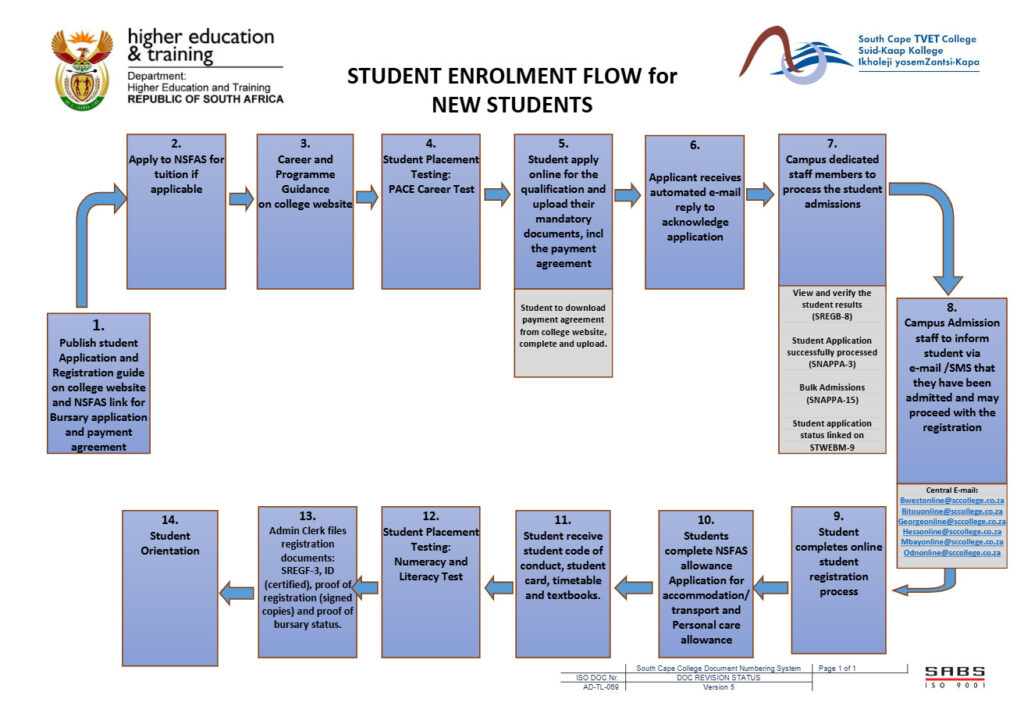
  • South Cape TVET College: Application, Campuses & Courses 2026

    South Cape TVET College: Application, Campuses & Courses 2026

    South Cape TVET College operates six campuses across the Western Cape, delivering National Certificate Vocational (NCV) qualifications, Report 191 programmes (N1–N6), and occupational certificates aligned to industry requirements.

    The institution serves the Garden Route, Central Karoo and Kannaland districts with vocational education that combines classroom theory, practical workshops, and Work Integrated Learning placements.

    Prospective students access online applications, campus information, programme details, and NSFAS funding guidance through the official college portal and published resources.

    Table of Contents

    About South Cape TVET College

    The college merged in 2000 from four technical institutes to create a unified vocational education provider registered with the Department of Higher Education and Training. South Cape TVET College combines the former George Technical College (founded in 1968), Oudtshoorn Technical College (founded in 1981), South Cape Technical Institute and Mossel Bay Technical College into a single institution. The college migrated to DHET administration between April 2014 and April 2016, adopting national TVET policies and procedures for curriculum delivery and quality assurance.

    The college serves a catchment area of 80,822 square kilometers, the largest of six TVET colleges in the Western Cape. Six campuses provide regional access: George (with the central office), Mossel Bay, Oudtshoorn, Beaufort West, Hessequa (Riversdale) and Bitou (Plettenberg Bay). Senior management coordinates operations centrally from George, while campus managers oversee local programme delivery, student services and industry partnerships.

    Vision: To be a Technical and Vocational Education and Training institution of first choice leading Education and Skills development.

    Mission: Committed to holistic student development by providing responsive, quality education and training leading to employment, self-employment and higher education.

    Core values include leadership, people-centered service, integrity, courage, inclusivity and creativity. The college prioritizes student outcomes through employer engagement, WIL coordination and curriculum alignment with SETA standards and regional skills demands.

    South Cape TVET College Campuses and Contact Details

    Six campuses deliver programmes across the Garden Route, Central Karoo and Kannaland districts, each offering specialized programmes based on regional industry needs and infrastructure capacity. Campus locations, contact numbers and programme offerings vary by site. Prospective students should confirm programme availability at their preferred campus before applying to ensure the qualification runs at that location.

    George Campus

    George Campus operates as the main site with the central office coordinating institutional management and senior leadership. Established in 1968 as George Technical Institute, the campus moved to its current premises at 46 Hibernia Street, George in 1987. A new wing added in 1996 expanded classroom capacity and administration facilities.

    Address: 46 Hibernia Street, George, 6530
    Phone: 044 874 2360
    Email: george@sccollege.co.za
    Campus Manager: Ms Vernalda Hartnick

    Programmes offered:

    • NCV Level 2–4: Office Administration
    • Report 191 N4–N6: Business Management, Educare, Human Resource Management, Management Assistant, Marketing Management, Public Management, Tourism Management
    • National Introductory Certificate (bridging programme)

    The campus maintains workshops, computer laboratories and business simulation spaces for practical assessments. George Campus serves as a regional hub for business studies and office administration pathways with strong employer links in the Garden Route business sector.

    Mossel Bay Campus

    Mossel Bay Campus specializes in engineering, technical trades and artisan development with dedicated workshops for electrical, mechanical, plumbing and welding instruction. The campus began in 1993 as a satellite of Oudtshoorn Technical College and expanded infrastructure through industry partnerships. PetroSA donated a computer center and electronics workshop; additional workshop facilities support boilermaking, fitting and NATED engineering streams.

    Address: c/o Essenhout & Kreupelhout Street, Heiderand, Mossel Bay, 6500
    Phone: 044 693 2613
    Email: mosselbay@sccollege.co.za
    Campus Manager: Mr Whaleed Abdullah

    Programmes offered:

    • NCV Level 2–4: Electrical Infrastructure Construction, Engineering & Related Design, Tourism
    • Report 191 N1–N3: Boilermaking, Electrical Engineering, Fitting and Turning, Instrumentation
    • Report 191 N4–N6: Educare, Human Resource Management, Public Management
    • Centre of Specialisation: Bricklaying (DHET-designated)

    Mossel Bay Campus functions as the primary engineering campus with large-scale workshop capacity for practical training. Students complete theory modules on-campus and practical assessments in fully equipped workshops under qualified instructors.

    Oudtshoorn Campus

    Oudtshoorn Campus focuses on hospitality, catering and tourism programmes with industry-standard kitchens and service training facilities. The campus operates from the former Commercial High School building and includes Foster’s Manor Guest House for hospitality practical training.

    Address: Adderley Street, Oudtshoorn, 6620
    Phone: 044 272 2110
    Email: oudtshoorn@sccollege.co.za
    Campus Manager: Ms Thabisa La Fleur

    Programmes offered:

    • NCV Level 2–4: Hospitality, Safety in Society
    • Report 191 N4–N6: Educare, Human Resource Management, Hospitality and Catering Services, Public Management, Tourism Management
    • National Introductory Certificate

    The campus maintains partnerships with local hospitality employers for WIL placements in hotels, guesthouses and catering operations. Training kitchens meet industry hygiene and safety standards for food preparation and service assessments.

    Beaufort West Campus

    Beaufort West Campus serves the Central Karoo as a declared nodal area for skills development and community upliftment. Located 260 kilometers from the central office, the campus delivers programmes targeting local employment needs and entrepreneurship.

    Address: c/o van Schalkwyk & de Vries Streets, Rustdene, Beaufort West, 6970
    Phone: 023 449 1140
    Email: beaufort@sccollege.co.za
    Acting Campus Manager: Ms Linda Khoza

    Programmes offered:

    • NCV Level 2–4: Office Administration
    • Report 191 N4–N6: Educare, Human Resource Management, Public Management
    • National Introductory Certificate

    Beaufort West Campus emphasizes employability and self-employment pathways through business and administration training. The campus responds to regional skills gaps with programmes supporting small-enterprise development and public-sector employment.

    Hessequa Campus

    Hessequa Campus operates in Riversdale through partnerships between the college, local authorities and provincial government. The campus delivers learnerships, skills programmes and Report 191 qualifications aligned to regional employer requirements.

    Address: Varkevisser Street, Riversdale, 6500
    Phone: 028 713 4775
    Email: hessequa@sccollege.co.za
    Campus Manager: Mr Gilbert Hartley

    Programmes offered:

    • Report 191 N4–N6: Human Resource Management
    • National Introductory Certificate
    • Skills programmes and learnerships (variable, SETA-funded)

    Hostel accommodation supports students from surrounding rural areas who meet eligibility criteria. The campus coordinates closely with local SETAs for learnership placements and occupational certificates.

    Bitou Campus

    Bitou Campus serves Plettenberg Bay and the Bitou Municipality with programmes targeting tourism, hospitality and office administration sectors. The campus expanded facilities in recent years with new classrooms and a training kitchen to support hospitality instruction.

    Address: Hillview, Kwanonkuthula, Plettenberg Bay, 6600
    Phone: 044 533 2388
    Email: bitou@sccollege.co.za
    Campus Manager: Mr Chumani Webber

    Programmes offered:

    • NCV Level 2–4: Office Administration
    • Report 191 N4–N6: Human Resource Management, Tourism Management
    • National Introductory Certificate

    The campus partners with local tourism operators, accommodation providers and service businesses for WIL placements and employer engagement. Programmes align with Garden Route tourism economy requirements and seasonal employment patterns.

    CampusCityPhoneKey Programmes
    GeorgeGeorge044 874 2360Business Studies, Office Administration
    Mossel BayMossel Bay044 693 2613Engineering, Electrical Trades
    OudtshoornOudtshoorn044 272 2110Hospitality, Catering, Tourism
    Beaufort WestBeaufort West023 449 1140Office Administration, Educare
    HessequaRiversdale028 713 4775Human Resource Management
    BitouPlettenberg Bay044 533 2388Tourism, Office Administration

    Operating hours for most campuses: Monday to Thursday 08:00–15:00, Friday 08:00–13:00. Prospective students should confirm programme availability and schedule campus visits by calling the campus contact number directly.

    South Cape TVET College Courses, Programmes and Qualifications Offered

    The college delivers three qualification pathways: National Certificate Vocational (NCV) Levels 2 to 4, Report 191 programmes (N1–N3 and N4–N6), and occupational certificates aligned to QCTO standards. Programmes integrate theory, practical workshops and workplace learning to meet SAQA and DHET accreditation requirements. Each qualification specifies entry requirements, duration, assessment methods and progression routes to employment or further study.

    National Certificate Vocational (NCV) Programmes Level 2–4

    NCV qualifications provide an alternative to academic matric with vocational focus, combining fundamental subjects (English, Mathematics or Mathematical Literacy, Life Orientation) with four specialized vocational subjects per level. NCV runs over three years (Level 2, Level 3, Level 4) with each level equivalent to one school grade (Grades 10, 11, 12 respectively). Successful completion of Level 4 enables articulation to Higher Certificate (NQF Level 5), National Diploma (NQF Level 6) or Bachelor’s Degree (NQF Level 7) at universities or universities of technology.

    Entry requirements for NCV Level 2:

    • Grade 9 pass certificate or equivalent qualification
    • Minimum 40% in Mathematics, English, Life Orientation and one additional subject, OR
    • ABET Level 4 certificate

    Duration: Three years full-time (one year per level)

    Assessment: Formative assessments (classwork, tests, assignments), summative examinations (ICASS—Internal Continuous Assessment), practical demonstrations, portfolio evidence

    NCV programmes available:

    Office Administration Level 2–4

    Office Administration prepares students for secretarial, administrative and clerical roles across all business sectors. Vocational subjects include Business Practice, Office Practice, Office Data Processing and New Venture Creation. Students develop keyboarding skills, business communication, computer literacy (Microsoft Office suite), filing systems and reception procedures.

    Career pathways: Administrative officer, bookkeeper, personal assistant, company secretary, human resource clerk, legal secretary, freight forwarder, hospital administrator

    Campuses: Beaufort West, Bitou, George, Mossel Bay, Oudtshoorn, Hessequa

    Electrical Infrastructure Construction Level 2–4

    Electrical Infrastructure Construction covers heavy-current overhead power lines, domestic and industrial electrical installations, and light-current systems including digital electronics and instrumentation. Vocational subjects include Electrical Principles and Practice, Workshop Practice (Level 2) or Electrical Workmanship (Levels 3–4), Electronic Control and Digital Electronics, and Electrical Systems and Construction.

    Career pathways: Electrician, construction electrician, industrial engineering technician, sound technology, theatre technician, process control, digital electronics, instrumentation

    Campus: Mossel Bay (only campus offering this programme)

    Engineering & Related Design introduces students to manufacturing, fabrication, extraction and assembly processes with focus on mechanical engineering principles and automotive systems. Vocational subjects include Engineering Fundamentals (Level 2), Engineering Technology, Engineering Systems, Automotive Repair and Maintenance (all levels), Engineering Practice and Maintenance (Level 3), Materials Technology, Engineering Graphics and Design (CAD) (Level 3), Engineering Processes, Professional Engineering Practice, Applied Engineering Technology (Level 4).

    Career pathways: Manufacturing and industrial engineering, metallurgical engineering, boilermaking, automotive repair and maintenance, aerospace engineering, tool making, fitting and machining, welding

    Campus: Mossel Bay (only campus offering this programme)

    Hospitality Level 2–4

    Hospitality NCV trains students in food preparation, client service, accommodation operations and hospitality management for hotel, restaurant, guesthouse and catering sectors. Vocational subjects include Hospitality Generics, Food Preparation, Client Services and Human Relations, Hospitality Services. Practical modules cover food hygiene, menu planning, cooking techniques, food and beverage service, accommodation housekeeping and event coordination.

    Career pathways: Housekeeping supervisor, hotel management, events management, food and beverage management, waitron, bartender, accommodation services

    Campus: Oudtshoorn (only campus offering this programme)

    Note: The kitchens used for hospitality instruction are not Kosher or Halaal compliant. Products and ingredients used in training kitchens do not meet Halaal or Kosher certification standards.

    Tourism Level 2–4

    Tourism NCV prepares students for careers in travel services, tour operations, guiding, accommodation and tourism information roles. Vocational subjects include Science of Tourism, Client Service and Human Relations, Sustainable Tourism, Tourism Operations. Curriculum covers travel products, destination geography, tourism economics, conservation principles, customer service, travel documentation and tour planning.

    Career pathways: Conference and events planner, tourism development officer, transportation manager, travel counselor, game ranger, adventure guide, safari operator, entrepreneur

    Campuses: Bitou, George, Mossel Bay

    Safety in Society Level 2–4

    Safety in Society trains students for public safety, law enforcement and correctional services roles through instruction in policing, criminal law, governance and criminal justice systems. Vocational subjects include Introduction to Governance (Level 2) or Governance (Levels 3–4), Introduction to Law (Level 2) or Criminal Law (Level 3) or Law of Procedures and Evidence (Level 4), Principles of Criminal Justice (Level 2) or Criminal Justice Structures and Mandates (Level 3) or Criminal Justice Process (Level 4), Introduction to Policing Practices (Level 2) or Theory of Policing Practices (Level 3) or Applied Policing (Level 4).

    Career pathways: South African Police Service, Metro Police, Traffic Police, Military Police, South African Defense Force, security services, intelligence services, legal assistance, correctional services

    Campuses: George, Oudtshoorn

    Report 191 Business Studies (N4–N6)

    Report 191 Business Studies programmes target post-matric students for business, administration, hospitality and public-sector careers. Students complete theory at N4, N5 and N6 levels over 18 months, then acquire 18 months of relevant practical work experience to qualify for the National N Diploma. Programmes emphasize self-employment readiness and practical workplace competencies.

    Entry requirements for N4:

    • Grade 12 (National Senior Certificate) or NCV Level 4 certificate
    • Minimum 40% for English
    • Overall average 40% excluding Life Orientation

    Duration: Three years total (18 months theory across N4, N5, N6 plus 18 months workplace experience)

    Assessment: Trimester-based modules, formative tests, summative examinations, practical projects, workplace logbooks

    Report 191 N4–N6 programmes available:

    Business Management N4–N6

    Business Management develops entrepreneurship skills, business planning, sales management and organizational operations. Subjects include Introductory Accounting (N4), Management Communication (N4), Computer Practice (all levels), Entrepreneurship and Business Management (all levels), Public Relations (N5–N6), Sales Management (N5–N6).

    Career pathways: Entrepreneur, sales representative, bookkeeper, administrative roles

    Campus: George

    Educare N4–N6

    Educare equips students with skills to work with children aged 0 to 4 years, operate crèches and manage early childhood development centers. Subjects include Education (N4), Child Health (N4), Educare Didactics Theory and Practical (all levels), Daycare Personnel Development (N4), Educational Psychology (N5–N6), Business Management and Entrepreneurship (N5), Daycare Communication (N5–N6), Daycare Management (N6).

    Career pathways: Grade R assistant, crèche manager, au pair, early childhood facilitator, center manager

    Campuses: Beaufort West, George, Mossel Bay, Oudtshoorn

    Hospitality and Catering Services N4–N6

    Hospitality and Catering Services prepares students for professional roles in hotels, restaurants, guesthouses and catering operations. Subjects include Nutrition and Menu Planning (N4), Sanitation and Safety (N4), Catering Theory and Practical (all levels), Applied Management (all levels), Food and Beverage Service (N5), Business Management (N5), Human Relations (N6), Computer Practice (N4).

    Career pathways: Hotel and guesthouse management, restaurant management, tasting room management, food services management, food and beverage management, function catering, test kitchen staff, events management, entrepreneur

    Campus: Oudtshoorn

    Note: The kitchens used for hospitality instruction are not Kosher or Halaal compliant.

    Human Resource Management N4–N6

    Human Resource Management trains students in personnel functions, recruitment, training, labor relations and workplace management. Subjects include Personnel Management (all levels), Management Communication (N4), Computer Practice (all levels), Entrepreneurship and Business Management (N4), Personnel Training (N5–N6), Labour Relations (N5–N6).

    Career pathways: Human resource assistant, administrative assistant, entrepreneur

    Campuses: Beaufort West, Bitou, George, Hessequa, Mossel Bay, Oudtshoorn

    Management Assistant N4–N6

    Management Assistant develops secretarial and office management competencies for executive support roles. Entry requirement includes Computer Applications Technology (CAT) subject completion. Subjects include Information Processing (all levels), Computer Practice (all levels), Communication (all levels), Office Practice (all levels). Focus areas: typing speed and accuracy, business communication, meeting management, office technology.

    Career pathways: Executive assistant, private secretary, office manager, front desk reception, administrative clerk

    Campuses: Beaufort West, Bitou, George, Hessequa, Mossel Bay, Oudtshoorn

    Marketing Management N4–N6

    Marketing Management covers marketing principles, consumer behavior, sales management, market research and promotional campaigns. Subjects include Marketing Management (all levels), Management Communication (N4), Computer Practice (all levels), Entrepreneurship and Business Management (N4–N5), Sales Management (N5–N6), Marketing Research (N6), Marketing Communication (N6).

    Career pathways: Marketing coordinator, sales representative, market researcher, advertising specialist, branding consultant, distribution manager, entrepreneur

    Campuses: Beaufort West, George

    Public Management N4–N6

    Public Management prepares students for administrative and management roles in government departments and municipalities. Subjects include Computer Practice (all levels), Public Administration (N4–N6), Management Communication (N4), Introductory Accounting (N4), Municipal Administration (N5–N6), Public Finance (N5), Public Law (N6).

    Career pathways: Municipal worker, government employee at local, provincial or national level

    Campuses: Online Distance Learning available; on-campus at Beaufort West, Bitou, George, Hessequa, Mossel Bay, Oudtshoorn

    Tourism Management N4–N6

    Tourism Management trains travel consultants, tour operators and tourism service providers. Entry requirement: Grade 12 with minimum 50% average. Subjects include Travel Services (all levels), Tourist Destinations (N4–N6), Tourism Communication (N4–N5), Travel Office Procedures (all levels), Hotel Reception (N6).

    Career pathways: Travel agent, guesthouse manager, hotel reception, tour operator consultant, airport staff, event organizer, entrepreneur

    Campuses: Bitou, George, Oudtshoorn

    Report 191 Engineering Studies (N1–N3)

    Report 191 Engineering N1–N3 programmes address artisan skills shortages with affordable study pathways to trade qualifications. Students completing N1–N3 certificates with two years of workplace experience in the same trade can register to write trade tests and qualify as artisans.

    Entry requirements:

    • N1: Grade 9 pass with minimum 40% in Mathematics, OR Grade 12 without Mathematics and Physical Science
    • N2: N1 certificate OR Grade 12 with minimum 40% for Mathematics and Physical Science
    • N3: N2 certificate with at least three of four subjects passed

    Duration: Each level requires four subjects and runs for 10 weeks per trimester. Enrollments occur every trimester (three intakes per year).

    Assessment: Formative tests, assignments, summative examinations per subject

    Report 191 N1–N3 programmes available:

    Boilermaking N1–N3

    Boilermaking covers metal fabrication, structural steel work, plating, welding and assembly techniques. Subjects include Metalworkers Theory (N1), Plater’s Theory (N2), Mechano Technology (N3), Plating and Structural Steel Drawing (all levels), Engineering Science (all levels), Mathematics (all levels).

    Career pathways: Manufacturing and industrial engineering, metallurgical engineering, boilermaking, automotive repair and maintenance, aerospace engineering, tool making, fitting and machining, welding

    Campus: Mossel Bay

    Electrical Engineering Studies N1–N3

    Electrical Engineering Studies prepares students for electrician, technician and electrical artisan roles in domestic, commercial and industrial electrical systems. Subjects include Electrical Trade Theory (N1–N2), Electro-Technology (N3), Industrial Electronics (all levels), Engineering Science (all levels), Mathematics (all levels).

    Career pathways: Production section head, foreman, electrical artisan, electrical technician

    Campus: Mossel Bay

    Fitting and Turning N1–N3

    Fitting and Turning teaches machinery maintenance, component fitting, blueprint reading and machine operation for manufacturing and maintenance roles. Subjects include Fitting and Machining Theory (N1–N2), Mechano-Technology (N3), Engineering Drawing (all levels), Engineering Science (all levels), Mathematics (all levels).

    Career pathways: Manufacturing and industrial engineering, metallurgical engineering, boilermaking, automotive repair and maintenance, aerospace engineering, tool making, fitting and machining, welding

    Campus: Mossel Bay

    Instrumentation N1–N3

    Instrumentation covers measurement systems, control instruments, electrical control systems and process monitoring for industrial applications. Subjects include Industrial Electronics (all levels), Electrical Trade Theory (N1), Instrumentation Trade Theory (N2), Electro-Technology (N3), Engineering Science (all levels), Mathematics (all levels).

    Career pathways: Manufacturing and industrial engineering, metallurgical engineering, boilermaking, automotive repair and maintenance, aerospace engineering, tool making, fitting and machining, welding, electrical engineering

    Campus: Mossel Bay

    National Introductory Certificate

    The National Introductory Certificate bridges students into N4–N6 programmes when academic entry requirements are not met. The certificate prepares students for Report 191 N4 business studies through foundational modules.

    Entry requirements: Students who do not meet direct entry requirements for N4 programmes

    Duration: One year

    Subjects: Introductory Entrepreneurship N4, Introductory Communication N4, Introductory Computer Practice N4, Introductory Accounting N4

    Campuses: Beaufort West, Bitou, George, Hessequa, Mossel Bay, Oudtshoorn

    Pre-Vocational Learning Programme (PLP)

    Pre-Vocational Learning Programme provides foundational academic upgrading for students who do not meet NCV entry criteria. The one-year programme improves marks and bridges academic gaps before entry into vocational or occupational programmes.

    Subjects: Foundational Mathematics, Foundational Science, Foundational English, Foundational Life Skills and Technology

    Occupational Programmes

    Occupational programmes deliver job-specific training through skills programmes, learnerships and apprenticeships for rapid employment entry. Programmes vary by SETA funding, employer partnerships and regional skills needs. Current occupational offerings include:

    • ECD Development Practitioner
    • Computer Technician
    • Cook
    • Management Assistant (occupational level)
    • Bookkeeper
    • Office Administration (occupational level)
    • Conference and Events Organiser
    • Tourism Information Officer
    • Automotive Motor Mechanic
    • Boilermaker (occupational level)
    • Bricklayer (Centre of Specialisation at Mossel Bay)
    • Electrician (apprenticeship pathway)

    Occupational programme availability changes annually based on SETA approvals and employer demand. Prospective students should monitor the college website news section and social media channels for announcements of new occupational programme intakes.

    How to Apply: Online Application Process for 2026

    Prospective students apply online through the Coltech Student Portal by creating an account, uploading certified documents and submitting the application form. The application system operates year-round with specific intake periods for different programmes. Applicants receive a unique student number upon submission and can track application status through the portal.

    south cape tvet college online application process.
    south cape tvet college online application process.

    Step 1: Prepare Required Documents

    Certified copies of three documents must be prepared before starting the online application:

    1. Identity Document or Smart ID Card (both sides) – for applicants under 16, certified birth certificate or passport
    2. Highest school grade passed – most recent academic results showing final marks and grade completion
    3. Proof of residential address – utility bill, municipal account or lease agreement in applicant’s name, or sworn affidavit if documents are in another person’s name

    Certification requirements: Documents must be certified by a South African Police Service officer, commissioner of oaths, attorney, justice of the peace or bank official. Certification stamps must include the certifier’s signature, stamp and date. Certified documents must not be older than six months from the date of application.

    Digital preparation: Scan each document separately as a PDF file. Name files clearly (example: “Surname_Name_ID_2026.pdf”). Compress large files to ensure upload speed. Keep file sizes under 5MB per document.

    Step 2: Access the Application Portal

    Visit the official South Cape TVET College website at sccollege.co.za and click “Apply for 2026” or navigate directly to the Coltech Student Portal.

    1. Click “Register an Account” if applying for the first time
    2. Provide a valid, active email address that will receive all correspondence
    3. Create a secure password following the system requirements
    4. Accept the Protection of Personal Information Act (POPIA) consent clause

    Important: Email addresses cannot be changed after account creation without contacting the campus directly. Use a personal email address that the applicant checks regularly.

    Step 3: Complete the Application Form

    The application form requires four sections of information:

    1. Personal details: Full name as per ID, date of birth, ID number, gender, home language, contact number
    2. Next of kin: Emergency contact name, relationship, contact number
    3. Academic history: Highest grade completed, year completed, school name
    4. Programme selection: Preferred campus, programme choice, intake year

    Read each section carefully and provide accurate information. The system may time out after 20 minutes of inactivity; complete all sections before uploading documents.

    Step 4: Upload Certified Documents

    Upload the three required certified documents in PDF format:

    1. Click “Upload Documents” in the application portal
    2. Select document type from the dropdown menu
    3. Choose the scanned file from your device
    4. Confirm upload completion for each document
    5. Review the document list to ensure all three documents appear as uploaded

    Incomplete applications: Applications submitted without all three certified documents will be marked “Only some documents submitted” and will not be processed. Log back into the portal under “Student Administration” then “Upload Documents” to complete the submission.

    Step 5: Submit Application and Receive Student Number

    Click “Accept Application” to finalize submission. The system generates a unique student number immediately and sends a confirmation email with the student number and application reference. Save this email for all future correspondence.

    Application acknowledgment: Applicants receive an automated email reply acknowledging receipt of the application. Processing times vary by programme and intake period. High-demand programmes process applications within 10 to 15 working days during peak periods.

    Step 6: Check Application Status

    Log in to the Student i-Enabler portal using the student number and five-digit PIN provided in the confirmation email.

    1. Go to www.sccollege.co.za and click “Student i-Enabler Login.”
    2. Enter student number and five-digit PIN
    3. Click “Student Enquiry” then “Academic Admission Status.”

    Application status meanings:

    • Application without status: Application submitted but not yet processed by admissions staff
    • Only some documents submitted: Missing documents or documents not certified or older than six months. Upload outstanding documents via “Student Administration” > “Upload Documents.”
    • Provisionally accepted: Application meets initial criteria; awaiting final academic results to confirm entry requirements
    • Admitted academically: Entry requirements met; student must proceed to registration at the selected campus
    • Project enrollment target reached: Programme at the selected campus is full; applicant may apply to another campus or consider alternative programmes
    • Not in catchment area: Application unsuccessful in current round; applicant resides outside primary catchment area. May be considered in later rounds, or can attend another college

    Step 7: Respond to Admission Notification

    Campus admission staff send email or SMS notification when applications are processed. Admitted students receive instructions to complete online registration, attend placement testing,, and prepare for orientation.

    Placement testing: Students complete numeracy and literacy placement tests through the PACE Career Test system. Test results inform academic support planning and module placement where applicable.

    Step 8: Complete Online Registration

    Admitted students must complete online registration by the published deadline to secure enrollment.

    1. Log in to the Student i-Enabler portal
    2. Click “Student Administration” then “Online Registration”
    3. Confirm programme details and campus assignment
    4. Accept the Student Code of Conduct
    5. Complete payment arrangement or upload NSFAS approval documentation

    Registration materials provided: Student card, timetable, textbook list, orientation schedule

    Step 9: Apply for Second-Choice Programme (if needed)

    Applicants who applied for one programme can add a second-choice application through the portal:

    1. Log into Student i-Enabler with student number and PIN
    2. Click “Returning Student Application” then “Show Academic Applications”
    3. Click “Add New Qualification”
    4. Complete programme selection and submit

    Note: Second-choice applications do not require re-uploading documents if original documents are on file and current.

    Important Application Notes

    Email address changes: Contact the campus directly with full name and student number to request email or contact detail changes. The Communications team cannot process contact detail changes.

    Forgotten PIN: Click “Forgot PIN” on the Student i-Enabler login page. The PIN will be sent to the registered email address.

    Application support: For technical issues, email communications@sccollege.co.za with student number as reference. For campus-specific questions, call the campus directly:

    • Bitou: 044 533 2388 / 044 518 0066
    • Beaufort West: 083 460 0963 / 023 449 1140
    • George: 044 874 2360
    • Hessequa: 028 713 4775
    • Mossel Bay: 044 693 2613 / 044 693 3089
    • Oudtshoorn: 044 272 2110

    Operating hours: Monday to Thursday 08:00–15:00, Friday 08:00–13:00

    South Cape TVET College Fees and Payment Information 2026

    Tuition fees vary by programme type with separate fee structures for NCV, Report 191 and occupational qualifications. Fees cover tuition, prescribed learning materials, facility usage and assessment costs. Registration fees and payment deadlines apply per academic year. NSFAS-funded students do not pay registration fees upfront; the college invoices NSFAS directly upon disbursement approval.

    Fee Schedule 2026

    Programme TypeProgrammeAnnual Fee (ZAR)
    NCV Level 2–4Office Administration10,885
    Electrical Infrastructure Construction16,705
    Tourism15,850
    Safety in Society11,144
    Report 191 N4–N6Human Resource Management3,302
    Management Assistant3,302
    Public Management3,302
    Business Management3,302
    Tourism Management7,259
    Hospitality & Catering Services7,450
    Occupational CertificatesECD Development Practitioner10,181
    Computer Technician12,596
    Cook26,964
    Management Assistant (Occupational)9,406
    Bookkeeper11,791
    Office Administration (Occupational)9,566
    Conference and Events Organiser20,772
    Tourism Information Officer12,305
    Automotive Motor Mechanic10,738
    Boilermaker14,404
    Bricklayer10,437
    Electrician13,911
    Exam FeesExam Only150

    Correspondence | 700 | | Residence Fees | Per annum (subject to NSFAS maximum) | 42,640 |

    Note: Fees are subject to change without prior notice. Contact the campus finance office for the most current fee schedule and banking details.

    Payment Options

    Self-funded students can pay via electronic transfer, debit/credit card, or approved installment arrangements. The college provides banking details on fee invoices and the official website. Payment codes must be included on all transfers to ensure correct allocation to student accounts.

    Payment plans: Contact the campus finance office to request installment agreements. Payment plans require approval and may include deposit requirements. Submit payment plan requests at least 10 working days before registration deadlines.

    Proof of payment: Retain all payment receipts, bank transaction confirmations, and NSFAS disbursement notices. Upload proof of payment through the Student i-Enabler portal or submit it to the campus finance office during registration.

    Electronic payment processing: Payments take 72 hours to reflect on student accounts during peak registration periods. Contact the finance office with invoice reference numbers if payments do not reflect after three working days.

    NSFAS Funding and Bursary Information

    NSFAS (National Student Financial Aid Scheme) provides tuition, learning materials, and allowances for eligible TVET college students. Applicants must apply to NSFAS separately through the NSFAS online portal at www.nsfas.org.za. NSFAS determines eligibility based on household income, academic results, and vulnerability criteria.

    NSFAS application requirements:

    • Own phone number and active email address
    • Copy of ID or birth certificate
    • ID copies of parents, guardians, or spouse
    • Proof of household income or one year’s IRP5 documents
    • Parents, guardians or spouse proof of income
    • SASSA grant recipients do not require income proof
    • Applicants with disabilities submit completed Disability Annexure A Form
    • Vulnerable children submit Vulnerable Child Declaration and Consent Form

    NSFAS coverage for TVET students:

    • Full tuition fees
    • Registration fees
    • Learning materials
    • Transport allowance (not accommodation allowance)
    • Personal care allowance

    Important: NSFAS-funded students at South Cape TVET College receive transport allowances, not accommodation allowances. Students must arrange private accommodation and budget transport costs accordingly.

    NSFAS application timeline: Apply to NSFAS as early as possible, ideally before submitting the college application. NSFAS processing takes 4 to 8 weeks. Applicants must complete the college application separately; NSFAS approval does not constitute college admission.

    NSFAS status checks: Log in to the NSFAS portal at www.nsfas.org.za to check application status. Contact the campus bursary officer for assistance with NSFAS queries, appeals, and allowance applications.

    Bursary officer contact: Call the campus main number and request a connection to the bursary officer. Provide the student number and NSFAS reference number for faster assistance.

    Payment Agreement and Financial Holds

    All students must complete a payment agreement as part of the registration process. Download the payment agreement form from the college website, complete and sign the document, and upload it through the application portal or submit it during in-person registration.

    Financial holds: Unpaid fees result in financial holds that block access to timetables, examination entry, and student resources. Clear financial holds by submitting proof of payment or NSFAS approval documentation to the campus finance office.

    Refund policy: Contact the campus finance office for refund policy details and withdrawal procedures. Refunds follow DHET guidelines and may be subject to administrative fees.

    Contact for Fee Queries

    Campus finance offices handle billing, payment arrangements, NSFAS coordination, and account statements. Call the campus main number and request a connection to the finance office. Provide the student number and invoice reference for all queries.

    For detailed fee breakdowns, invoice requests, or payment plan applications, visit the campus finance office during operating hours or email the campus main address with “FINANCE QUERY” in the subject line.

    Student Support Services and Campus Life

    All campuses provide student support officers, academic tutoring, counseling services and student representative councils (SRC) to support holistic student development. Support services assist with academic performance, personal challenges, career planning and campus integration throughout the student lifecycle.

    Student Support Officers

    Student and Academic Support Officers operate at each campus delivering orientation, counseling, academic tutoring and referrals to external support services. Officers coordinate student wellness programs, study skills workshops and intervention for students experiencing academic or personal difficulties.

    Services include:

    • Individual counseling for mental health, stress management and personal challenges
    • Academic tutoring in mathematics, languages and technical subjects
    • Study skills workshops covering time management, note-taking and exam preparation
    • Referral pathways to external mental health services, substance abuse support and crisis intervention
    • Disability accommodations and learning support plans for students with documented disabilities
    • Financial counseling on NSFAS processes, budget planning and emergency funding options

    Access support services: Contact the Student Support Officer at your campus by visiting the student services office or calling the campus main number. Appointments can be scheduled in advance or accessed during drop-in hours published on campus notice boards.

    Academic Support and Tutoring

    Academic support includes scheduled tutoring sessions, supplementary instruction and peer-learning groups for high-risk subjects. Mathematics, engineering science and language modules receive dedicated tutoring hours each week. Tutors are senior students, alumni or contracted subject specialists.

    Tutoring access: Check campus timetables for drop-in tutoring hours per subject. Group tutoring sessions run in the afternoons and evenings; individual appointments can be requested through the Student Support Officer.

    Exam preparation workshops: The college runs intensive revision workshops in the two weeks before summative examinations. Workshops cover exam technique, past paper practice and concept review for high-failure-rate modules.

    Counseling and Wellness Services

    Counseling services provide confidential mental health support, crisis intervention and wellness programming. Trained counselors assist students experiencing anxiety, depression, relationship challenges, substance use concerns and trauma.

    Session availability: Counseling appointments are scheduled through the Student Support Officer. Emergency walk-in sessions are available during office hours for urgent situations. For after-hours crises, counselors provide referral contact details for provincial mental health crisis lines.

    Referral services: Counselors connect students to external psychologists, social workers, substance abuse treatment programs and community health clinics where ongoing care is required. The college maintains partnerships with Western Cape Department of Health facilities for student referrals.

    Student Representative Council (SRC)

    Student-elected SRC members represent student interests, facilitate communication between students and management, and organize campus events and activities. SRC elections occur annually with students voting for representatives from each programme and campus.

    SRC responsibilities:

    • Advocate for student needs and concerns to campus management
    • Organize orientation activities, social events and awareness campaigns
    • Represent students on college governance committees
    • Assist with resolving student grievances and policy questions
    • Coordinate volunteer projects and community engagement activities

    Leadership criteria: SRC candidates must demonstrate leadership, accountability, reliability and commitment to student welfare. Nomination and election processes follow published timelines each academic year.

    Career Services and Work Integrated Learning (WIL) Coordination

    Career services coordinate WIL placements, employer engagement, CV workshops and job-readiness training. WIL coordinators maintain employer databases, negotiate placement agreements and monitor student progress during workplace learning periods.

    Career development support:

    • CV and cover letter writing workshops
    • Interview preparation and mock interviews
    • Employer information sessions and campus recruitment events
    • Industry mentorship programmes linking students with working professionals
    • Job vacancy listings and application support
    • Entrepreneurship workshops for students pursuing self-employment

    WIL placement process: Students receive WIL placement guidelines during orientation. Placement coordinators match students to employers based on programme requirements, student location and employer capacity. Students sign learner agreements specifying learning outcomes, duration, supervision and assessment criteria.

    Employer partnerships: The college partners with businesses across construction, hospitality, manufacturing, retail, tourism, information technology and public-sector organizations. Employers provide workplace supervisors, assessment opportunities and potential post-graduation employment for successful students.

    Accommodation Guidance

    Most campuses do not have on-campus hostel accommodation. Campus residence or accommodation managers maintain lists of vetted private accommodation providers including boarding houses, shared flats and homestays near campus locations.

    Accommodation costs: Private accommodation is self-funded as NSFAS provides transport allowances (not accommodation allowances) to TVET students. Costs vary by location and accommodation type. Students should budget R2,000 to R4,500 per month for private accommodation.

    Finding accommodation: Contact the campus accommodation manager for current accommodation listings, landlord contact details and advice on lease agreements. Visit accommodation options before signing leases; verify proximity to campus and public transport access.

    Hessequa Campus hostel: Hessequa Campus offers limited hostel accommodation for students meeting eligibility criteria. Contact the campus manager to inquire about hostel availability, costs and application procedures.

    Accommodation contacts: Call the campus main number and request connection to the accommodation or residence manager. Provide programme name and expected start date when inquiring.

    Student Conduct and Campus Safety

    All students agree to the Student Code of Conduct during registration. The code specifies expected behavior, prohibited activities, disciplinary procedures and student rights.

    Key conduct rules:

    • Obscene language, sexual harassment and discrimination are prohibited
    • Smoking only in designated outdoor areas (smoking inside buildings is illegal)
    • Cellular phones and communication devices prohibited during classes and examinations
    • Alcohol, illegal drugs and weapons prohibited on college property
    • Gambling, fighting and theft result in disciplinary action or suspension
    • Vandalism and property damage incur financial liability and disciplinary consequences

    Serious offenses resulting in suspension or expulsion: Assault, dishonesty during examinations, theft, drug or alcohol use on campus, possession of weapons, inciting violence, sexual or racial harassment.

    Safety reporting: Report safety concerns, harassment, theft or emergency situations to campus security or the Campus Manager immediately. After-hours emergencies should be reported to campus security hotlines listed on student cards and campus notice boards.

    Campus security: Campuses maintain security personnel during operating hours and after-hours for evening classes. CCTV coverage varies by campus. Students should report suspicious activity and secure personal belongings in lockers or designated storage areas.

    Orientation and Onboarding

    New student orientation occurs at the start of each academic year and introduces students to campus facilities, academic expectations, support services and student policies. Orientation attendance is mandatory for all first-year students.

    Orientation content:

    • Campus tour and facility introductions (libraries, computer labs, workshops, cafeterias)
    • Academic expectations and assessment policies
    • Student Code of Conduct review
    • Timetable distribution and class scheduling
    • Textbook collection and learning material orientation
    • Student card activation and IT system access
    • Introduction to Student Support Officers and Counseling Services
    • SRC introductions and student activities overview

    Orientation schedule: Admitted students receive orientation dates and times via email and SMS. Orientation typically runs for two to three days before the start of lectures.

    South Cape TVET College Frequently Asked Questions

    What kind of college is South Cape TVET College?

    South Cape TVET College is a public vocational education institution registered with the Department of Higher Education and Training (DHET). The college delivers National Qualifications Framework-aligned programmes in technical, business, hospitality, and occupational fields.

    What is the medium of instruction?

    The official language of teaching and learning is English. All prescribed textbooks and learning materials are in English. Students of all language backgrounds are welcome to enroll.

    What is a National Certificate Vocational (NCV) qualification?

    NCV is a three-year vocational alternative to academic matric, covering Levels 2 to 4 (equivalent to Grades 10, 11, and 12). Students combine fundamental subjects (English, Mathematics or Mathematical Literacy, Life Orientation) with specialized vocational subjects in fields such as engineering, office administration, hospitality, tourism, and safety. Successful completion of NCV Level 4 enables articulation to Higher Certificate, National Diploma, or Bachelor’s Degree programmes at universities or universities of technology.

    Can I apply with Grade 11 results?

    Yes, NCV Level 2 accepts applicants who passed Grade 9 with a minimum 40% in Mathematics, English, Life Orientation, and one additional subject. Report 191 N4 programmes require Grade 12 or NCV Level 4 completion. Check specific programme entry requirements before applying.

    How do I apply for accommodation?

    Contact the campus accommodation or residence manager for private accommodation listings near your campus. Most campuses do not have on-campus hostels. Accommodation costs are self-funded as NSFAS provides transport allowances (not accommodation allowances) for TVET students. Hessequa Campus offers limited hostel accommodation for eligible students.

    Does NSFAS fund TVET students at South Cape TVET College?

    Yes, eligible students receive NSFAS funding covering tuition, registration, learning materials, transport allowance and personal care allowance. Apply to NSFAS at www.nsfas.org.za separately from the college application. NSFAS determines eligibility based on household income and vulnerability criteria. Contact the campus bursary officer for NSFAS application guidance and status queries.

    How do I check my application status?

    Log in to the Student i-Enabler portal at www.sccollege.co.za using your student number and five-digit PIN. Click “Student Enquiry” then “Academic Admission Status” to view application progress. Status updates include: application without status (not yet processed), only some documents submitted (missing or uncertified documents), provisionally accepted (awaiting final results), admitted academically (entry requirements met, proceed to registration), project enrollment target reached (programme full), not in catchment area (outside primary service region).

    What if I forgot my PIN?

    Click “Forgot PIN” on the Student i-Enabler login page. The five-digit PIN will be sent to the email address registered during the application. If the email address is no longer accessible, contact the campus with your full name and student number to request a PIN reset.

    Can I complete or upgrade my Grade 12 at the college?

    No, South Cape TVET College does not offer matric subject rewrites or Grade 12 completion. Students seeking matric subject upgrades should contact local community education centers or distance learning providers. NCV Level 2–4 provides an alternative vocational pathway equivalent to Grades 10–12 for students who did not complete academic matric.

    How much are TVET college fees at South Cape in 2026?

    NCV programme fees range from R10,885 (Office Administration) to R16,705 (Electrical Infrastructure Construction). Report 191 N4–N6 business studies fees range from R3,302 to R7,450. Occupational certificate fees range from R9,406 to R26,964. Exam-only fees are R150. Refer to the fee schedule table for specific programme costs. NSFAS covers full tuition for eligible students.

    What documents do I need to apply?

    ertified documents must be signed by a commissioner of oaths, police officer, attorney or bank official. Certifications must not be older than six months. Scan documents as separate PDF files before starting the online application.

    What programmes does South Cape TVET College offer near George?

    George Campus offers NCV Office Administration Level 2–4 and Report 191 N4–N6 in Business Management, Educare, Human Resource Management, Management Assistant, Marketing Management, Public Management and Tourism Management. George also offers the National Introductory Certificate bridging programme. For engineering and technical trades, students should consider Mossel Bay Campus.

    When do South Cape applications open and close for 2026?

    Application periods vary by programme and intake cycle. The online application portal operates year-round with specific deadlines published for each intake. Monitor the college website and campus announcements for intake opening and closing dates. Apply early for high-demand programmes to secure placement.

    Can I apply to more than one programme at the same time?

    Yes, applicants can add a second-choice programme through the Student i-Enabler portal after submitting the initial application. Log in with your student number and PIN, click “Returning Student Application” then “Show Academic Applications,” and select “Add New Qualification” to submit a second choice.

    What if my ID is lost, damaged, or stolen?

    Request a Temporary Identification Certificate (TIC) from Home Affairs. The TIC is an official document valid for three months and accepted for college applications. Provide a certified TIC instead of the ID when uploading application documents.

    Who do I contact if I didn’t get a response on my application?

    Contact the campus directly by phone or email communications@sccollege.co.za with your student number as reference. Campus contact numbers: Bitou 044 533 2388, Beaufort West 023 449 1140, George 044 874 2360, Hessequa 028 713 4775, Mossel Bay 044 693 2613, Oudtshoorn 044 272 2110. Operating hours Monday to Thursday 08:00–15:00, Friday 08:00–13:00.

    Apply Now for 2026 Intake

    Start your application online today through the Coltech Student Portal. Prepare certified documents, create your account, select your campus and programme, and submit your application to receive your student number. Track your application status through the Student i-Enabler portal and respond promptly to admission notifications.

    Download the 2026 Prospectus: Visit www.sccollege.co.za to download the full prospectus with detailed programme descriptions, module lists, campus information, and admission requirements.

    Book a Campus Tour: Contact your preferred campus directly to schedule a visit, view facilities, and speak with programme coordinators. Campus tours provide opportunities to ask questions, explore workshops, and meet current students.

    Apply for NSFAS Funding: Visit www.nsfas.org.za to apply for financial aid. Complete the NSFAS application before or alongside your college application to ensure funding is in place before registration deadlines.

    Contact Admissions for Support: Email communications@sccollege.co.za or call your preferred campus for application assistance, programme guidance, and document certification queries.

    Operating Hours: Monday to Thursday 08:00–15:00, Friday 08:00–13:00

    Follow South Cape TVET College: Stay updated on intake dates, programme announcements, and campus events by following the college on social media platforms and subscribing to the newsletter on the official website.

    Secure your place at South Cape TVET College for 2026 and activate your future through quality vocational education, industry partnerships, and career-focused training. Apply today.

  • iEnabler Login: How to Apply & Student Portal Guide 2026

    iEnabler Login: How to Apply & Student Portal Guide 2026

    iEnabler is the web-based student portal used by South African universities and TVET colleges for online applications, document uploads, course registration, and results access.

    Developed by Adapt IT as part of the ITS Integrator suite, the system centralizes student services across multiple campuses and academic periods.

    This guide provides step-by-step instructions for South African students accessing institutional portals in 2026. It covers account creation, login procedures, document submission, application tracking, and troubleshooting for common errors.

    Table of Contents

    What is iEnabler?

    iEnabler is student self-service software that enables online application submission, document uploads, course registration, and academic record access at South African higher education institutions.

    The platform operates as a web interface to the ITS Integrator database, which stores student records, financial accounts, qualifications, and module data.

    The system manages four primary data domains:

    1. Personal entities: Student records, identification numbers, contact details, and next-of-kin information
    2. Academic entities: Qualifications, subjects, modules, NQF levels, prerequisites, and academic periods
    3. Financial entities: Student accounts, NSFAS funding agreements, bursary records, and fee structures
    4. Administrative entities: Applications, registrations, results, and assessment records

    Institutions configure portal settings to match local requirements. Configuration options include intake deadlines, required document categories, file format specifications, and size limits. Most South African instances accept PDF and JPG files between 2 MB and 10 MB per upload.

    The platform validates student credentials using unique identifiers (student number or ID number) paired with a PIN. Role-based access control ensures students view only their own financial statements and academic records.

    South African Institutions Using iEnabler in 2026

    Twenty-three universities and TVET colleges in South Africa operate institutional instances of the portal for student services. The table below lists confirmed deployments with direct login URLs verified.

    Universities Using iEnabler

    InstitutionAcronymInstitution TypeiEnabler Portal URLAccess Notes
    Tshwane University of TechnologyTUTUniversity of Technologyhttps://ienabler.tut.ac.za/pls/prodi41/w99pkg.mi_loginDirect iEnabler instance
    Vaal University of TechnologyVUTUniversity of Technologyhttps://ienablerprod.vut.ac.za/pls/prodi41/w99pkg.mi_loginProduction instance
    University of Fort HareUFHTraditional Universityhttps://ienabler.ufh.ac.za/pls/prodi41/w99pkg.mi_loginDirect iEnabler instance
    Sol Plaatje UniversitySPUTraditional Universityhttps://ienabler.spu.ac.za/pls/prodi41/w99pkg.mi_loginDirect iEnabler instance
    University of MpumalangaUMPTraditional Universityhttps://ienabler.ump.ac.za/pls/prodi41/w99pkg.mi_loginDirect iEnabler instance
    University of JohannesburgUJTraditional Universityhttps://ienabler.uj.ac.za/pls/prodi41/w99pkg.mi_loginDirect iEnabler instance
    University of ZululandUNIZULUTraditional Universityhttps://jasper.unizulu.ac.za/pls/prodi41/w99pkg.mi_loginCustom domain (Jasper)
    University of LimpopoULTraditional Universityhttps://ulc-prod-webserver.ul.ac.za/pls/prodi41/w99pkg.mi_loginProduction webserver instance
    University of VendaUNIVENTraditional Universityhttps://univenierp01.univen.ac.za/pls/prodi41/w99pkg.mi_loginERP-integrated instance
    Sefako Makgatho Health Sciences UniversitySMUHealth Sciences Universityhttps://ienabler.smu.ac.za/pls/prodi41/w99pkg.mi_loginDirect iEnabler instance
    Durban University of TechnologyDUTUniversity of Technologyhttps://mercury.dut.ac.za/pls/prodi41/w99pkg.mi_loginCustom domain (Mercury)
    Central University of TechnologyCUTUniversity of Technologyhttps://enroll.cut.ac.za/pls/prodi41/w99pkg.mi_loginEnrollment-focused domain
    Cape Peninsula University of TechnologyCPUTUniversity of Technologyhttps://alecto.cput.ac.za/pls/prodi41/w99pkg.mi_loginCustom domain (Alecto)
    Mangosuthu University of TechnologyMUTUniversity of TechnologyVia https://www.mut.ac.za/student-portal/Accessible through main portal
    University of KwaZulu-NatalUKZNTraditional Universityhttps://sciman.ukzn.ac.zaCustom system (SCIMAN)

    TVET Colleges Using iEnabler

    College NameAcronymProvinceiEnabler Portal URLCommon Features
    Coastal KZN TVET CollegeKZNTVETKwaZulu-Natalhttps://ienabler.kzntvet.edu.za/pls/prodi41/w99pkg.mi_loginApplications, results, financial statements, residence applications
    Ekurhuleni West TVET CollegeEWCGautenghttps://ienabler.ewc.edu.za/pls/prodi41/w99pkg.mi_loginFull self-service, online applications, document uploads
    Ekurhuleni East TVET CollegeEECGautenghttps://ienabler.eec.edu.za/pls/prodi41/w99pkg.mi_loginStudent registration, biographical updates, exam results
    Central Johannesburg TVET CollegeCJCGautenghttps://ienabler.cjc.edu.za/pls/prodi41/w99pkg.mi_loginStudent self-service, registration, status tracking
    South West Gauteng TVET CollegeSWGCGautenghttps://ienabler.swgc.co.za/pls/prodi41/w99pkg.mi_loginOnline registration, academic records, account management
    Tshwane North TVET CollegeTNCGautenghttps://ienabler.tnc.edu.za/pls/prodi41/w99pkg.mi_loginApplication processing, graduation information, results
    Northlink CollegeNLCWestern Capehttps://ienabler.northlink.co.za/pls/prodi41/w99pkg.mi_login?numtype=SStudent number-based access (numtype=S parameter)
    West Coast TVET CollegeWCTCWestern Capehttps://ienabler.westcoastcollege.co.za/pls/prodi41/w99pkg.mi_loginFull student portal, applications, financial statements
    Port Elizabeth TVET CollegePECEastern Capehttps://ienabler.pec.edu.za/pls/prodi41/w99pkg.mi_loginOnline registration, student account management, results
    Buffalo City TVET CollegeBCTCEastern CapeBCollege Student PortalOnline applications, exam results, financial statements
    Ingwe TVET CollegeITCKwaZulu-NatalStudent PortalFull self-service for new and returning students
    Orbit TVET CollegeOTCNorthern CapeOrbit College Student PortalRegistration, biographical updates, academic records
    Vhembe TVET CollegeVTCLimpopoVhembe Student PortalOnline application, student profile management

    Key Portal Functions by User Type

    User TypeAvailable FunctionsExamples
    Prospective StudentsView internal marks, check final examination results, and print proof of registrationSubmit ID copy, latest results, proof of residence; track Submitted/Provisionally Accepted status
    Registered StudentsView account balance, check NSFAS funding status, and download fee statementsMonitor outstanding fees, confirm bursary allocation, and print payment receipts
    All Students (Financial)Access semester marks, download registration confirmation, and view module selectionMonitor outstanding fees, confirm bursary allocation, print payment receipts
    All Students (Personal)Update contact details, change PIN, manage communication preferencesUpdate cell number, change email address, reset password

    Technical Access Requirements

    RequirementSpecificationNotes
    Student NumberBirth date (DDMMYYYY) or generic code provided by the collegeFirst-time users receive a number via email or SMS after the application
    Default PINInternet Explorer is not supportedMust be changed on first login for security
    Recommended BrowsersChrome 115+, Edge 115+, Firefox 115+, Safari 16+Clear the cache if experiencing session timeouts
    Mobile CompatibilityChrome for Android, Safari for iOSDesktop preferred for complex tasks like module registration
    Required SettingsJavaScript enabled, cookies allowed, pop-ups permitted for portal domainClear cache if experiencing session timeouts

    Important Notes

    1. Coltech Alternative: Some TVET colleges (e.g., Majuba TVET) use the Coltech system instead of iEnabler. Check the institutional website for “Student Portal” or “Online Application” links.
    2. URL Verification: Always access portals via official institutional domains listed above. Bookmark the correct URL after the first successful login to avoid phishing sites.
    3. Peak Period Access: Portal traffic increases during application periods (October–February) and registration periods (January, July). Access during off-peak hours (early morning, late evening) for faster performance.
    4. Support Channels: Contact campus IT helpdesk or admissions office if the portal URL does not work. Provide student number, error message, and browser details when requesting assistance.
    5. Data Updated: Institutions may update URLs—always check the official campus website if the link fails.

    Students should always access the portal using the official campus domain listed above. Bookmark the correct URL after the first successful login to avoid phishing sites.

    How to Create an Account and Log In

    Create a new account by visiting your institution’s portal, clicking Register or Create Account, entering your South African ID number or application reference, setting a 6-to-8-character PIN, and confirming via email. After account activation, log in using your ID number and PIN.

    Step-by-Step Account Creation

    1. Navigate to your institution’s official portal URL from the table above
    2. Select Register, Create Account, or New User (button text varies by campus)
    3. Enter your 13-digit South African ID number exactly as it appears on your identity document (remove spaces and dashes)
    4. Provide your full legal name, matching your ID document
    5. Enter a valid email address you check regularly (institutional email if already issued, otherwise personal email)
    6. Create a PIN between 6 and 8 characters, combining letters and numbers
    7. Confirm the PIN by entering it a second time
    8. Submit the registration form
    9. Check your email inbox (and spam folder) for an activation link within 10 to 30 minutes
    10. Click the activation link to verify your email address
    11. Return to the login page and sign in using your ID number and newly created PIN

    Important: Some institutions issue application numbers before ID-based access. If you have an application number from a previous paper or online application, use that number instead of your ID during initial registration. Contact campus admissions if unsure which identifier to use.

    Standard Login Procedure

    1. Open your institution’s portal URL in Chrome, Edge, Firefox, or Safari
    2. Locate the Student Login or Sign In section (usually top-right or center of page)
    3. Enter your student ID number, application number, or South African ID number in the username field
    4. Enter your PIN in the password field
    5. Click Login or Sign In
    6. After successful authentication, the portal displays your dashboard with Application Status, Document Upload, Registration, and Results sections

    If login fails after three attempts, wait 15 minutes before retrying (most systems temporarily lock accounts after multiple failed attempts). Use the Forgot PIN procedure below if you cannot remember your credentials.

    How to Reset Your PIN or Password

    Reset forgotten credentials by clicking Forgot PIN or Forgot Password on the login screen, entering your registered email address or ID number, and following the reset link sent to your email within 10 to 30 minutes. If no email arrives, check spam folders and contact the campus helpdesk with your ID and proof of identity.

    Reset Process

    1. On the login page, click Forgot PIN, Forgot Password, or Reset Password (exact text varies)
    2. Enter either your registered email address or your student ID number
    3. Click Submit or Send Reset Link
    4. Open your email inbox and locate the message from your institution’s IT services or admissions office
    5. Click the reset link (link typically expires after 24 hours)
    6. Enter your new PIN twice to confirm
    7. Return to the login page and sign in with new credentials

    If the reset email does not arrive:

    • Check spam, junk, and promotions folders
    • Verify the email address you provided matches the one registered during account creation
    • Wait 30 minutes (some institutions batch email processing)
    • Contact the campus helpdesk via phone or in-person visit with your ID document and application number

    Institutions may require manual verification for security. Keep your registered email address current by updating contact details in the portal’s Personal Information section after each successful login.

    iEnabler Document Upload: Requirements and Process

    Upload required documents by logging in, navigating to Document Upload or Supporting Documents, selecting the correct document category (ID, Matric certificate, proof of residence), attaching PDF or JPG files under the institution’s size limit, and clicking Upload. Save the upload reference number or confirmation message for tracking.

    Accepted File Formats and Size Limits

    South African institutions typically accept:

    • PDF (Portable Document Format) – preferred for multi-page documents
    • JPG or JPEG (Joint Photographic Experts Group) – used for scanned images
    • PNG (Portable Network Graphics) – accepted by some campuses

    File size limits range from 2 MB to 10 MB per document, depending on institutional configuration. Check your campus portal’s Document Upload page for exact specifications.

    Document Categories and Examples

    CategoryDescriptionExample Filenames
    South African IDCertified copy or clear scan of ID book/cardID_Sipho_Ngwenya.pdf
    Matric CertificateNSC results or Senior CertificateMatric_2023_Thandi_Mokoena.pdf
    Academic TranscriptPrevious tertiary results if applying with creditsTranscript_UNISA_2022.pdf
    Proof of ResidenceMunicipal account, lease agreement, affidavitResidence_Proof_Durban.pdf
    NSFAS ConfirmationBursary approval letter or funding agreementNSFAS_Approval_2025.pdf

    Step-by-Step Upload Instructions

    1. Log in to your student portal
    2. Click Document Upload, Supporting Documents, or My Documents
    3. Review the list of required documents for your qualification or application type
    4. Select the document category from the dropdown menu (e.g., “South African ID Document”)
    5. Click Choose File or Browse
    6. Navigate to the saved document on your computer or phone
    7. Select the file and click Open
    8. Verify the filename appears in the upload field
    9. Click Upload or Submit Document
    10. Wait for the confirmation message or reference number (appears within 5 to 30 seconds)
    11. Record the reference number in a safe place or take a screenshot
    12. Repeat steps 4 through 11 for each additional required document

    Mobile upload tips:

    • Use Wi-Fi instead of mobile data to avoid timeouts and reduce data costs
    • Compress images before uploading (many phone camera apps create files over 10 MB)
    • If upload fails on mobile, switch to a desktop computer or campus computer lab
    • Disable battery-saving mode during upload to prevent session interruption

    File Rejected: Common Causes and Fixes

    Error MessageCauseSolution
    File size too largeDocument exceeds institutional limit (e.g., 15 MB file when limit is 5 MB)Compress PDF using online tools or scan at lower resolution (150–300 DPI instead of 600 DPI)
    Invalid file typeDelete the previous upload if allowed, or contact helpdesk to replaceConvert file to PDF using free converters or phone PDF apps
    Document already uploadedSame category submission existsRetry using a wired connection or campus Wi-Fi; upload one file at a time
    Connection timeoutSlow or unstable network during uploadRetry using wired connection or campus Wi-Fi; upload one file at a time

    Always rename files clearly before uploading. Use format: DocumentType_YourName.pdf (example: ID_Lerato_Dlamini.pdf). Avoid special characters, spaces, or symbols in filenames.

    How to Check Application Status on iEnabler

    View application status by logging in, selecting Application Tracker, My Applications, or Application Status, and reviewing the status label assigned to your submission. Status options include Submitted, Provisionally Accepted, Awaiting Documents, Documents Under Review, and Rejected.

    Understanding Status Labels

    StatusMeaningRequired Action
    SubmittedApplication received and queued for reviewNo action; wait for admissions review (typically 7–21 days)
    Provisionally AcceptedConditional acceptance pending final documents or paymentUpload outstanding documents and confirm registration
    Awaiting DocumentsMissing required files or documents not verifiedCheck Document Upload section, submit missing files, email admissions
    Documents Under ReviewAll documents received; admissions team verifying authenticityNo action; verification takes 5–14 days depending on peak periods
    Rejected / Not AdmittedApplication declined due to unmet requirementsReview rejection reason, appeal if eligible, or apply for alternative qualification

    Step-by-Step Status Check

    1. Log in to your portal
    2. Navigate to Application Tracker, My Applications, or Application Status (menu location varies by institution)
    3. Locate your current application by year and qualification (e.g., “N6 Electrical Engineering 2026”)
    4. Note the status label and any accompanying messages or instructions
    5. If status shows Awaiting Documents, click View Required Documents or Outstanding Items
    6. Upload missing files immediately via Document Upload section
    7. After uploading, send email notification to admissions office with your application number and upload confirmation reference
    8. Check status again after 3–5 business days

    Printing proof of application:

    Most portals include a Print Receipt or Download Confirmation button next to each application. Click this button to save a PDF confirmation including:

    • Application number
    • Submission date and time
    • Qualification applied for
    • Current status
    • Documents submitted

    Save this PDF for appeals, bursary applications, or campus visit verification.

    Course Registration and Module Selection

    Register for courses by logging in, navigating to Registration or Module Selection, choosing your qualification (NCV, NATED, Diploma, Degree), selecting required modules based on your programme curriculum, submitting the registration form, and saving the confirmation receipt. Verify selected modules match NQF requirements before final submission.

    Registration Process for TVET Programmes

    TVET colleges typically offer NCV (National Certificate Vocational) and NATED (N1–N6) qualifications. Module selection depends on programme level and semester.

    Example: NATED N4 Electrical Engineering Registration

    1. Log in and select Registration or Course Registration
    2. Choose NATED as qualification type
    3. Select N4 level
    4. Pick programme: Electrical Engineering
    5. System displays required subjects:
      • Engineering Mathematics N4
      • Engineering Science N4
      • Industrial Electronics N4
      • Electrical Trade Theory N4
    6. Confirm all four subjects are selected
    7. Click Submit Registration
    8. Download registration confirmation and fee statement
    9. Proceed to payment (bursary, NSFAS, or self-funded)

    Registration Process for University Programmes

    University students select modules based on degree requirements, semester, and year of study.

    Example: First-Year Diploma Registration

    1. Navigate to Module Registration or Course Selection
    2. Select year of study: First Year
    3. Choose semester: Semester 1 2026
    4. System displays core modules and electives
    5. Select all compulsory modules (usually 4–6 per semester)
    6. Choose elective modules if required by programme
    7. Verify total credits match minimum requirement (typically 60 credits per semester)
    8. Click Submit or Finalize Registration
    9. Print registration confirmation showing module codes, credits, and timetable links

    NSFAS-funded students: Confirm bursary approval appears in Financial Statement section before finalizing registration. Contact financial aid office if funding status shows Pending or Not Approved.

    How to Access Results and Academic Records

    Access examination results and academic transcripts by logging in, selecting Results, Examination Results, or Academic Record, choosing the relevant academic year and semester, and viewing or downloading your statement. Final results typically publish 4–8 weeks after examination period ends.

    Viewing Results

    1. Log in to portal
    2. Click Results, Examination Results, or My Results
    3. Select academic year (e.g., 2025, 2026)
    4. Choose semester or trimester
    5. View module-by-module results including:
      • Module code and name
      • Credits
      • Mark or grade (percentage, symbol, or pass/fail)
      • Status (Pass, Fail, Supplementary Required, Deferred)
    6. Check overall GPA or average if displayed

    Downloading official transcripts:

    1. Navigate to Academic Record or Download Transcript
    2. Select record type: Interim Statement or Full Academic Transcript
    3. Click Generate PDF or Download
    4. Save PDF to secure location
    5. Print certified copies through campus registry office if required for job applications or further study

    Results are typically “enabled” (made visible) on specific release dates announced by academic administration. If results do not appear on the expected date, contact your department or faculty office.

    Troubleshooting Common Portal Errors

    Resolve login failures, session timeouts, upload errors, and portal unavailability by clearing browser cache, using supported browsers, compressing files, and providing detailed error information to helpdesk. Most issues resolve through basic browser maintenance and file format verification.

    Session Timeout Errors

    Cause: Portal automatically logs out users after 15–30 minutes of inactivity to protect account security.

    Solutions:

    • Close all browser tabs except the portal tab
    • Disable browser extensions or add-ons that might interfere with session cookies
    • Enable cookies and JavaScript in browser settings
    • Avoid using in-app browsers (Facebook, Instagram browsers); open portal in full Chrome, Edge, or Firefox
    • Clear browser cache: Settings > Privacy > Clear Browsing Data > Select “Cookies and other site data” and “Cached images and files”
    • Log in again and complete tasks within 15 minutes

    Invalid Credentials or Login Failures

    Cause: Incorrect ID format, forgotten PIN, or account locked after multiple failed attempts.

    Solutions:

    • Verify ID number contains exactly 13 digits with no spaces or dashes
    • Remove leading zeros if system rejects ID
    • Check Caps Lock is off when entering PIN
    • Use Forgot PIN function to reset credentials
    • Wait 15 minutes if account locked, then retry
    • Contact helpdesk with ID document and application number if problem persists

    File Upload Failures

    Common upload errors and fixes:

    ErrorCauseFix
    Upload failedFile too largeCompress PDF or reduce image resolution to under 5 MB
    Invalid formatWrong file type (e.g., HEIC, BMP)Convert to PDF using online converter or phone app
    Connection resetNetwork interruptionSwitch to stable Wi-Fi or wired connection; retry upload
    File already existsDocument category previously uploadedDelete old file if allowed, or contact helpdesk to replace

    General upload best practices:

    • Upload one file at a time instead of multiple simultaneous uploads
    • Rename files using simple text: ID_FirstName_LastName.pdf
    • Scan documents at 150–300 DPI resolution (not 600+ DPI)
    • Use PDF format for multi-page documents instead of multiple JPG files
    • Test upload on desktop if mobile repeatedly fails

    Portal Unreachable or Down

    Cause: Server maintenance, network issues, or peak traffic overload.

    Solutions:

    • Check institution’s website or social media for maintenance announcements
    • Try accessing portal at off-peak hours (early morning, late evening)
    • Clear DNS cache: Command Prompt > type ipconfig /flushdns > press Enter (Windows) or Terminal > type sudo dscacheutil -flushcache (Mac)
    • Test connection by visiting other websites to confirm internet works
    • Use mobile data instead of campus Wi-Fi if campus network is congested
    • Contact IT helpdesk to report downtime with screenshot and exact error message

    Error Code Reference

    Some institutions display numeric error codes. Common codes:

    • Error 404: Page not found – verify URL is correct; try removing extra characters
    • Error 500: Internal server error – wait 30 minutes and retry; report to IT if persists
    • Error 403: Access forbidden – clear cookies; log out completely and log in again

    When contacting helpdesk, always include:

    1. Full name and student/application number
    2. Exact error message (copy-paste text or screenshot)
    3. Browser name and version (e.g., Chrome 120, Edge 119)
    4. Device type (Windows PC, Mac, Android phone, iPhone)
    5. Date and time error occurred
    6. Steps you took before error appeared

    Browser and Mobile Compatibility

    Use the latest version of Chrome, Edge, Firefox, or Safari with cookies and JavaScript enabled for optimal portal performance. Avoid outdated browsers (Internet Explorer) and in-app browsers that block session cookies.

    Desktop:

    • Chrome 115+ or Edge 115+ (Windows, Mac, Linux)
    • Firefox 115+ (Windows, Mac, Linux)
    • Safari 16+ (Mac only)

    Mobile:

    • Chrome for Android (latest version)
    • Safari for iOS (latest version)
    • Avoid Samsung Internet, Opera Mini, or UC Browser (limited compatibility)

    Required settings:

    1. Enable JavaScript: Settings > Privacy and Security > Site Settings > JavaScript > Allowed
    2. Enable Cookies: Settings > Privacy and Security > Cookies > Allow all cookies (or allow for your institution’s domain)
    3. Disable pop-up blocker for portal domain: Settings > Privacy and Security > Pop-ups and redirects > Add institution URL to exceptions
    4. Clear cache weekly: Settings > Privacy and Security > Clear browsing data

    Mobile Upload Guidelines

    Data and connectivity:

    South African mobile data costs affect portal usage. Follow these practices:

    • Use campus Wi-Fi for large file uploads (academic transcripts, multi-page documents)
    • Schedule uploads during off-peak hours (after 8:00 PM) when mobile data bundles are cheaper
    • Compress images before uploading: Use phone apps like PDF Compressor or Adobe Scan to reduce file size from 10 MB to 2 MB
    • Disable auto-play videos and images in mobile browser settings to save data while navigating portal

    Mobile-specific settings:

    • Set camera resolution to Medium (not High or Ultra) when scanning documents
    • Use portrait orientation for ID documents and landscape for certificates
    • Ensure adequate phone storage (at least 500 MB free) before uploading
    • Disable battery-saving mode during uploads (can interrupt connection)
    • Close background apps to free RAM and improve browser performance

    Timeout prevention on mobile:

    • Complete one section at a time (upload all documents, then register modules separately)
    • Do not switch between apps while portal session is active
    • If form has multiple pages, save progress at each page if option available
    • Use desktop for complex tasks like module registration with 10+ selections

    Coltech vs iEnabler: Complete Comparison for South African Students 2026

    Coltech and iEnabler are separate student portal systems used by South African TVET colleges and universities for online applications, document uploads, and registration. Both platforms provide similar core functions but differ in vendor, deployment structure, institutional footprint, and technical architecture.

    This comparison helps students identify which system their institution uses and understand the differences in access patterns, support resources, and functionality.

    Quick Identification: Which Portal Does Your Institution Use?

    Check your institution’s admissions page or application link to determine your portal system.

    If You See This URL PatternYou Are UsingExample Institutions
    admissionportal.coltech.co.zaColtechSouth Cape TVET, Capricorn TVET
    [institution].coltech.co.zaColtechmajuba.coltech.co.za, capricorn.coltech.co.za
    ienabler.[institution].ac.zaiEnablerienabler.ufh.ac.za, ienabler.tut.ac.za
    [custom].ac.za/pls/prodi41/iEnablerenroll.cut.ac.za, mercury.dut.ac.za

    Side-by-Side Feature Comparison

    FeatureColtechiEnabler (ITS Student iEnabler)
    Vendor/ProviderColtech (coltech.co.za, coltechit.com, admissionportal.coltech.co.za)ITS Tertiary Software (Adapt IT) – long history in higher education administration
    Primary Customer BaseTVET colleges and select HEIs in South AfricaUniversities and TVET colleges across South Africa and Africa
    Deployment ModelCentralized multi-institution hosting (one Coltech portal serves multiple colleges)Instance-per-institution model (each campus has dedicated subdomain or hostname)
    Typical URL Structureadmissionportal.coltech.co.za/[college] OR [college].coltech.co.zaienabler.[institution].ac.za OR custom hostname with /pls/prodi41/ path
    Account CreationID/passport number, email address, PIN/password setupStudent ID or application number, email address, 6–8 character PIN
    Authentication MethodID/passport + password/PIN; “Forgot Password” reset via emailStudent ID + PIN; “Forgot PIN” reset via email or helpdesk verification
    Document UploadSupports PDF, JPG, PNG; institution sets size limits (typically 2–10 MB)Supports PDF, JPG, PNG; institution sets size limits (typically 2–10 MB)
    File ValidationReal-time validation for file type and size; rejection messages shownReal-time validation for file type and size; rejection messages shown
    Application StatusesPending Verification, Provisionally Accepted, Outstanding Documents, RegisteredSubmitted, Provisionally Accepted, Awaiting Documents, Documents Under Review, Rejected
    Registration FunctionsPrimarily admission and application workflows; some colleges include course registrationFull admission and post-admission workflows including module selection, course registration, fee statements
    Results AccessLimited; some institutions enable results viewingStandard feature; students access exam results, transcripts, academic records
    Financial IntegrationAccount balance viewing; NSFAS status integration varies by institutionComplete financial module: account balance, NSFAS agreements, fee structures, payment tracking
    Institutional BrandingCollege-specific pages, logos, and status labels within Coltech frameworkFull institutional customization of forms, statuses, upload rules, and interface elements
    Mobile CompatibilityResponsive design; works on mobile browsersResponsive design; desktop preferred for complex tasks
    Support ResourcesInstitution helpdesk, college-published PDF guides, video tutorials, status explanation pagesITS support documentation, institutional help pages, self-service guides, campus IT helpdesk
    Integration with Campus SystemsIntegrates with campus admissions, finance, and registration systemsDeep integration with ITS Integrator MIS backend (student records, financial accounts, academic data)
    Multi-Campus ManagementSingle Coltech portal can serve multiple campuses/collegesEach institution manages own instance with campus-specific configuration

    Institutional Footprint: Who Uses Which System?

    Coltech User Institutions

    InstitutionPortal URLProvince
    South Cape TVET Collegeadmissionportal.coltech.co.zaWestern Cape
    Capricorn TVET Collegecapricorn.coltech.co.zaLimpopo
    Majuba TVET Collegemajuba.coltech.co.zaKwaZulu-Natal
    Additional TVET CollegesVia admissionportal.coltech.co.zaVarious

    Note: Coltech serves primarily TVET colleges through centralized portal infrastructure. Students from multiple institutions may access admissionportal.coltech.co.za and select their specific college from a dropdown menu.

    iEnabler User Institutions

    Universities:

    • Tshwane University of Technology (TUT)
    • Vaal University of Technology (VUT)
    • University of Fort Hare (UFH)
    • Central University of Technology (CUT)
    • Durban University of Technology (DUT)
    • Sol Plaatje University (SPU)
    • University of Mpumalanga (UMP)
    • University of Johannesburg (UJ)
    • University of Zululand (UNIZULU)
    • Sefako Makgatho Health Sciences University (SMU)
    • Cape Peninsula University of Technology (CPUT)

    TVET Colleges:

    • Coastal KZN TVET College
    • Ekurhuleni West TVET College
    • Ekurhuleni East TVET College
    • Central Johannesburg TVET College
    • South West Gauteng TVET College
    • Tshwane North TVET College
    • Northlink College
    • West Coast TVET College
    • Port Elizabeth TVET College

    Core Functionality Comparison

    Account Creation and Authentication

    Coltech Process:

    1. Visit the institution’s admissions page or admissionportal.coltech.co.za
    2. Select New Applicant or Register
    3. Enter South African ID or passport number
    4. Provide email address and create password/PIN
    5. Verify email via confirmation link
    6. Log in using ID/passport and password

    iEnabler Process:

    1. Navigate to institution-specific iEnabler URL (e.g., ienabler.ufh.ac.za)
    2. Click Register or Create Account
    3. Enter student ID, application number, or South African ID
    4. Create a 6–8 character PIN
    5. Confirm via email activation link
    6. Log in using ID and PIN

    Key Difference: Coltech uses centralized authentication across multiple colleges; iEnabler uses institution-specific authentication tied to campus student records systems.

    Document Upload Workflows

    Coltech:

    • Upload categories: ID document, academic results, proof of residence, additional supporting documents
    • Status updates appear as: Outstanding Documents, Documents Received, Provisionally Accepted
    • Colleges publish specific upload guides with accepted formats and size limits
    • Students receive email notifications when the document status changes

    iEnabler:

    • Upload categories: South African ID, Matric certificate, academic transcript, NSFAS confirmation, proof of residence
    • Status updates appear as: Awaiting Documents, Documents Under Review, Provisionally Accepted
    • Institutions configure document categories and validation rules per campus requirements
    • Reference numbers generated after each successful upload

    Similarity: Both systems accept PDF, JPG, and PNG formats with file size limits between 2 MB and 10 MB per document (institution-specific). Both validate files in real-time and display rejection reasons.

    Application Status Tracking

    Coltech Status Labels:

    StatusMeaningStudent Action
    Pending VerificationApplication received; awaiting initial reviewNo action required; check status in 5–10 days
    Outstanding DocumentsMissing required filesUpload documents immediately via portal
    Provisionally AcceptedConditional acceptance pending document verification or paymentComplete outstanding requirements and await final confirmation
    RegisteredFull acceptance; student successfully enrolledProceed to registration, fee payment, and orientation

    iEnabler Status Labels:

    StatusMeaningStudent Action
    SubmittedApplication received and queuedWait 7–21 days for admissions review
    Awaiting DocumentsRequired files missing or not verifiedUpload documents and notify admissions
    Documents Under ReviewAll files received; verification in progressNo action; verification takes 5–14 days
    Provisionally AcceptedConditional acceptanceComplete registration and confirm funding
    Rejected / Not AdmittedApplication declinedReview rejection reason; appeal if eligible

    Key Difference: Status terminology varies, but workflows are functionally equivalent. Coltech uses business-friendly labels; iEnabler uses technical academic administration terminology.

    Registration and Course Selection

    Coltech:

    • Primarily focused on admissions and application intake
    • Some institutions extend the portal to include basic course registration
    • Students typically complete a detailed module selection through separate campus systems after admission
    • Registration confirmation generated as a PDF download

    iEnabler:

    • Full registration functionality, including module selection, prerequisite validation, and credit calculation
    • Students select NCV, NATED, Diploma, or Degree programmes directly in the portal
    • System validates module prerequisites and NQF level requirements automatically
    • Integration with campus timetabling and class allocation systems
    • Registration receipts include module codes, credits, timetable links, and fee statements

    Key Difference: iEnabler offers comprehensive post-admission academic management; Coltech focuses on pre-admission application workflows with limited post-admission functionality.

    Results and Academic Records Access

    Coltech:

    • Limited results functionality in most deployments
    • Some colleges enable basic grade viewing
    • Academic transcripts are typically requested through separate campus registry systems

    iEnabler:

    • Standard results module across all deployments
    • Students access semester results, exam marks, and cumulative GPA
    • Downloadable academic transcripts and statements
    • Results “enabled” (published) on institutional release dates
    • Historical academic record viewing for all completed terms

    Key Difference: iEnabler includes comprehensive academic record management as core functionality; Coltech requires separate systems for detailed academic history.

    Financial Management and NSFAS Integration

    Coltech:

    • Basic account balance viewing
    • NSFAS status integration varies by institution
    • Limited fee statement functionality
    • Payment tracking is typically handled through separate campus finance systems

    iEnabler:

    • Complete financial module integrated with the ITS Integrator backend
    • Detailed student account showing debits (tuition, fees) and credits (payments, bursaries)
    • NSFAS funding agreements are linked directly to student accounts
    • Fee structure displayed per module or qualification
    • Payment history and outstanding balance tracking
    • Integration with campus finance offices for real-time updates

    Key Difference: iEnabler provides enterprise-level financial management; Coltech offers basic account visibility with external system dependencies.

    Technical Architecture and Integration

    Coltech Technical Model

    Hosting: Centralized Software-as-a-Service (SaaS) model where Coltech hosts and maintains portal infrastructure

    Integration: APIs connect the Coltech portal to campus admissions databases and student information systems

    Customization: Institutions configure application forms, document categories, and status workflows through the Coltech admin interface

    Data Ownership: Student data replicated between Coltech servers and campus systems

    URL Pattern: admissionportal.coltech.co.za serves as a shared gateway; college-specific subdomains provide branding

    iEnabler Technical Model

    Hosting: Institution-hosted or cloud-hosted instances managed by campus IT departments

    Integration: Deep integration with the ITS Integrator MIS (Management Information System) backend, storing student records, financial accounts, qualifications, and module data

    Customization: Full institutional control over forms, validation rules, status labels, and workflows through ITS configuration

    Data Ownership: All student data resides in campus-controlled ITS database; portal serves as web interface layer

    URL Pattern: Each institution operates dedicated subdomain (ienabler.[institution].ac.za) or custom hostname

    Technical Components:

    • ITS Integrator Database: Relational database storing four entity domains (personal, academic, financial, administrative)
    • Web Interface Layer: Oracle PL/SQL-based web layer (common path: /pls/prodi41/w99pkg.mi_login)
    • Role-Based Access Control: A security layer ensuring students view only their own records
    • API Integration Points: Connections to NSFAS, banking systems, and external student services

    Support and Documentation Resources

    Coltech Support Model

    Primary Support: Institution admissions office and campus helpdesk

    Available Resources:

    • College-published applicant guides (PDF downloads)
    • Status explanation pages on institutional websites
    • Video tutorials (some colleges)
    • Email support through admissions offices
    • In-person assistance at campus application centers

    Vendor Support: Coltech provides backend support to institutional administrators; students contact campus staff for portal assistance

    iEnabler Support Model

    Primary Support: Campus IT helpdesk and student support centers

    Available Resources:

    • ITS product documentation and technical manuals
    • Institution-specific self-help pages (login, reset, upload guides)
    • Campus-published video tutorials
    • ITS knowledge base articles (accessible by institutional IT staff)
    • Email and phone support through campus channels
    • In-person assistance at campus computer labs

    Vendor Support: ITS provides technical support to institutional IT departments; students contact the campus helpdesk for portal issues

    Deployment Patterns: How Institutions Implement Each System

    Coltech Deployment Pattern

    Centralized Multi-Institution Model:

    1. Multiple colleges share admissionportal.coltech.co.za infrastructure
    2. Students select institution from dropdown menu on portal homepage
    3. College-specific branding and forms load after institution selection
    4. Single codebase serves all participating institutions
    5. Coltech manages hosting, security updates, and infrastructure maintenance
    6. Colleges configure admission cycles, document requirements, and status workflows through admin panel

    Advantages:

    • Lower IT infrastructure costs for colleges
    • Consistent user experience across institutions
    • Centralized maintenance and updates
    • Rapid deployment for new participating colleges

    Disadvantages:

    • Less flexibility for institution-specific customization
    • Dependence on vendor for system changes
    • Shared infrastructure may experience peak-period congestion

    iEnabler Deployment Pattern

    Instance-Per-Institution Model:

    1. Each institution hosts dedicated iEnabler instance on campus servers or cloud infrastructure
    2. Campus IT department manages server configuration, security, and updates
    3. Full control over customization, integration, and feature deployment
    4. Direct connection to campus ITS Integrator database
    5. Institution-specific URLs and branding
    6. Independent deployment schedules and maintenance windows

    Advantages:

    • Complete institutional control over system configuration
    • Deep integration with campus academic and financial systems
    • Customizable workflows matching institutional policies
    • No shared infrastructure congestion

    Disadvantages:

    • Higher IT infrastructure and staffing costs
    • Institution responsible for security updates and maintenance
    • Requires technical expertise to manage and customize

    Mobile Access and Browser Compatibility

    Coltech Mobile Experience

    Supported Devices:

    • Android smartphones and tablets (Chrome browser recommended)
    • iOS devices (Safari browser recommended)
    • Responsive design adapts to screen sizes

    Mobile-Specific Features:

    • Simplified navigation for smaller screens
    • Touch-optimized buttons and form fields
    • Camera integration for direct document capture and upload
    • Mobile-friendly status dashboards

    Limitations:

    • Document uploads over 5 MB may timeout on mobile networks
    • Complex forms may require horizontal scrolling on small screens
    • Some colleges recommend desktop for initial application submission

    iEnabler Mobile Experience

    Supported Devices:

    • Android and iOS devices with modern browsers
    • Responsive interface on most institutional deployments
    • Desktop strongly recommended for module registration and financial transactions

    Mobile-Specific Challenges:

    • Session timeouts more frequent on mobile due to connection interruptions
    • Multi-page forms may lose data if mobile browser backgrounds
    • File upload success rates lower on mobile (78–85%) versus desktop (94–98%)
    • Complex module selection interfaces difficult to navigate on small screens

    Recommended Approach:

    • Use mobile for: login, status checks, single document uploads under 5 MB
    • Use desktop for: initial applications, module registration, multiple document uploads, financial transactions

    Cost and Licensing Models

    Coltech Pricing Model

    Institutional Cost: Software-as-a-Service (SaaS) subscription pricing

    Student Cost: Free for students; institutions pay licensing fees

    Pricing Factors: Number of annual applications processed, storage allocation, support level, custom feature requests

    Payment Structure: Annual or multi-year contracts between Coltech and participating institutions

    iEnabler Pricing Model

    Institutional Cost: Perpetual license or subscription depending on deployment model

    Student Cost: Free for students; institutions pay licensing and maintenance fees

    Pricing Factors: Institution size (student population), number of modules deployed, integration complexity, hosting model (self-hosted vs. ITS-managed cloud)

    Payment Structure: Initial implementation fee plus annual maintenance and support contracts

    Additional Costs: Campus IT infrastructure (servers, bandwidth, security), staffing for system administration and maintenance

    Data Security and Privacy Compliance

    Coltech Security Measures

    • Encrypted data transmission (HTTPS/TLS)
    • Regular security audits by vendor
    • Compliance with South African Protection of Personal Information Act (POPIA)
    • Multi-factor authentication options (institution-dependent)
    • Automated backups and disaster recovery

    iEnabler Security Measures

    • Role-based access control (RBAC) limiting data visibility by user type
    • Encrypted communication between portal and database
    • Campus-controlled security policies and access rules
    • Compliance with POPIA and institutional data governance policies
    • Campus IT responsible for security updates, penetration testing, and audit compliance
    • Student data remains under institutional control (not shared with external vendor)

    Key Difference: Coltech stores student data on vendor servers with replications to campus systems; iEnabler stores all data on campus-controlled infrastructure with portal serving as interface layer.

    Choosing Between Coltech and iEnabler: Institutional Considerations

    Institutions considering Coltech typically prioritize:

    • Lower upfront IT infrastructure investment
    • Rapid deployment timelines (weeks vs. months)
    • Shared maintenance responsibility with vendor
    • Standardized admission workflows across multiple campuses
    • Limited internal IT capacity or expertise

    Institutions considering iEnabler typically prioritize:

    • Complete control over data and system configuration
    • Deep integration with existing campus MIS and ERP systems
    • Comprehensive academic and financial management beyond admissions
    • Customizable workflows matching institutional policies
    • Long-term strategic control over student information systems

    Frequently Asked Questions

    What is the ITS Integrator system?

    ITS Integrator is the backend database platform that stores student records, financial accounts, academic results, and administrative data for iEnabler portal access. Developed by Adapt IT, the system manages relational data across personal entities (students, staff), academic entities (qualifications, modules), financial entities (accounts, NSFAS agreements), and administrative entities (applications, registrations).

    How long does application review take?

    Admissions teams typically review applications within 7 to 21 business days after submission. Processing time increases during peak intake periods (October through February for most institutions). Applications missing required documents remain in Awaiting Documents status until files are uploaded and verified.

    Can I register for modules without NSFAS approval?

    No – students relying on NSFAS funding must wait for bursary approval before finalizing module registration. The portal links student accounts to funding agreements; registration submission without approved funding may result in blocked access or automatic deregistration. Contact financial aid office if funding status shows Pending beyond expected approval dates.

    What if my uploaded document is rejected?

    Rejected documents require re-upload after addressing the rejection reason (wrong format, poor quality, or expired document). Log in, navigate to Document Upload, check rejection notes, correct the issue, and resubmit. Common rejection causes include:

    • Unreadable scans (too dark, blurry, or cropped)
    • Expired documents (ID older than 10 years, certificates older than institutional limit)
    • Incorrect file type (HEIC, BMP instead of PDF or JPG)
    • Wrong category selection (uploaded Matric under ID category)

    How do I appeal a rejected application?

    Submit appeals through formal institutional appeals process, not via portal. Most campuses require:

    1. Written appeal letter explaining grounds for reconsideration
    2. Supporting documents (improved Matric results, medical certificates)
    3. Submission to admissions office within 14–30 days of rejection notice

    Check campus website for Appeals Policy and deadlines. Portal status typically does not change during appeal review; final decision arrives via email or postal mail.

    Is mobile upload as reliable as desktop?

    Mobile uploads succeed at lower rates than desktop due to connection instability, file size handling, and browser limitations. Statistics from institutional IT departments indicate:

    • Desktop upload success rate: 94–98%
    • Mobile upload success rate: 78–85%

    Recommendations:

    • Use mobile for single-file uploads under 5 MB (ID, proof of residence)
    • Use desktop for multi-page documents over 5 MB (academic transcripts, Matric certificates)
    • Switch to desktop if mobile upload fails twice

    Can I change module selection after registration?

    Module changes require Add/Drop process during designated change periods (typically first 2 weeks of semester). Log in during change period, navigate to Module Registration, select Add or Drop options, and submit revised selection. Late changes after deadline require head of department approval and may incur administrative fees.

    Where do I find my student number?

    Student numbers appear on registration confirmation, fee statements, and student ID cards issued after first registration. If not yet registered, use application number or South African ID number to log in. Student number typically follows format: YearOfEntry + Sequential Number (e.g., 2026123456).


    Contact and Support Resources

    Contact campus admissions office, IT helpdesk, or student support center for unresolved portal issues. Provide full name, ID or application number, exact error message, screenshot, and detailed description when requesting assistance.

    General Helpdesk Contacts

    Most institutions offer multiple support channels:

    • Email: admissions@[institution].ac.za or studentIT@[institution].ac.za
    • Phone: Campus switchboard > request Admissions or IT Support extension
    • In-person: Visit admissions office during business hours (Monday–Friday, 8:00 AM–4:00 PM)
    • Self-service knowledge base: Many campuses publish PDF guides accessible via institution website

    Before contacting helpdesk:

    1. Clear browser cache and retry
    2. Test login on different device or browser
    3. Review FAQ section above
    4. Check institution website for maintenance announcements
    5. Gather all relevant information (application number, error screenshots, dates)

    What to include in support email:

    Subject: iEnabler Portal Issue – [Your Application Number]
    
    Full Name: [Your legal name]
    ID Number: [13-digit SA ID]
    Application/Student Number: [If applicable]
    Contact Number: [Cell number]
    Email: [Email on file]
    
    Issue Description:
    [Describe problem in 2-3 sentences]
    
    Error Message:
    [Copy exact text or attach screenshot]
    
    Browser and Device:
    [Example: Chrome 120 on Windows 11 laptop]
    
    Date and Time:
    [Example: Monday, January 13, 2025, 2:30 PM]
    
    Steps Already Taken:
    [Example: Cleared cache, tried different browser, reset PIN]
    

    Response time ranges from 24 hours (email) to immediate (phone during office hours). Escalate to campus registrar if IT helpdesk cannot resolve access issues within 3 business days.


    Key Takeaways for Successful Portal Use

    Success with institutional portals requires accurate credentials, compatible browsers, properly formatted documents, and regular status monitoring. Students who bookmark official URLs, compress files before upload, enable cookies and JavaScript, and contact support early when errors occur experience fewer application delays.

    Remember:

    • Always access portal via official campus domain (not third-party links)
    • Keep registered email address current for password resets and status updates
    • Upload documents immediately after application submission (do not wait for reminders)
    • Check application status every 5–7 days during review period
    • Save all confirmation numbers and receipts as PDF
    • Complete registration within designated periods to avoid late fees
    • Contact helpdesk with specific details rather than generic “not working” messages

    Follow institutional announcements via website, email, and social media for intake deadlines, maintenance schedules, and process updates. Plan portal tasks during off-peak hours when servers experience lower traffic.

  • NQF Level 10 in South Africa: Doctoral Qualification Framework, Requirements, and Career Pathways

    NQF Level 10 in South Africa: Doctoral Qualification Framework, Requirements, and Career Pathways

    NQF Level 10 is the highest qualification level on South Africa’s National Qualifications Framework and applies exclusively to doctoral degrees that require original research contributions.

    This level represents the apex of academic achievement within the framework administered by the South African Qualifications Authority (SAQA) and governed by the Higher Education Qualifications Sub-Framework (HEQSF) under the Council on Higher Education (CHE).

    Doctoral qualifications at NQF Level 10 require candidates to produce original research that advances knowledge in a specific field.

    The most common qualification is the Doctor of Philosophy (PhD), though professional doctorates such as the Doctor of Business Administration (DBA) and Doctor of Education (EdD) also fall under this classification.

    Entry into NQF Level 10 requires completion of a Master’s degree at NQF Level 9, typically with a research component scoring 65% or higher.

    The framework positions NQF Level 10 above all other qualification levels in South Africa. Level 7 encompasses Bachelor’s degrees, Level 8 includes Honours degrees and Postgraduate Diplomas, and Level 9 covers Master’s degrees. NQF Level 10 stands alone as the terminal credential, distinguished by its emphasis on independent research capability and scholarly leadership.

    SAQA’s level descriptors specify that NQF Level 10 graduates must demonstrate theoretical innovation, intellectual integrity, full responsibility for independent research, and the capacity to contribute to the frontiers of their field.

    These descriptors form the basis for quality assurance across all South African universities offering doctoral programs.

    Table of Contents

    Understanding the National Qualifications Framework Levels

    The National Qualifications Framework is a ten-level classification system that organizes all South African qualifications by complexity, learning outcomes, and depth of knowledge. The framework enables consistent comparison across education sectors and supports both local and international credential recognition.

    How the NQF Framework Is Structured

    The NQF spans from Level 1 to Level 10, with each level representing increased cognitive demand and autonomy. Levels 1 through 4 cover basic education and vocational training. Levels 5 and 6 encompass Further Education and Training (FET) certificates and National Diplomas. Levels 7 through 10 constitute higher education qualifications.

    Higher education levels break down as follows:

    • NQF Level 7: Bachelor’s degrees requiring 360 to 480 credits over three to four years
    • NQF Level 8: Honours degrees and Postgraduate Diplomas requiring 120 credits beyond a Bachelor’s degree
    • NQF Level 9: Master’s degrees requiring 180 credits beyond an Honours degree
    • NQF Level 10: Doctoral degrees requiring 360 credits focused on original research

    NQF Level 10 Compared to NQF Level 9

    NQF Level 10 differs from Level 9 by requiring original research that generates new knowledge rather than advanced application of existing knowledge.

    A Master’s degree at Level 9 demonstrates research competence through a dissertation that typically synthesizes existing literature and applies established methodologies.

    A doctoral degree at Level 10 demands theoretical innovation, methodological advancement, or empirical discoveries that contribute original insights to a discipline.

    The HEQSF specifies that Level 9 qualifications develop “specialized knowledge” and “research capability,” while Level 10 qualifications require “highly specialized knowledge” and “the creation of new knowledge through original research.”

    This distinction appears in thesis examination criteria, where doctoral examiners assess whether the work makes a sufficient original contribution to warrant the degree.

    Research at NQF Level 10 must address a defined research problem, apply rigorous methodologies appropriate to the discipline, and produce findings suitable for peer review in academic journals or scholarly books.

    Universities enforce these standards through examination processes involving at least two external examiners who are recognized experts in the candidate’s field.

    Doctoral Qualifications at NQF Level 10

    All doctoral qualifications in South Africa are classified at NQF Level 10, including research-focused PhDs and practice-oriented professional doctorates. SAQA recognizes three main types of doctoral credentials at this level.

    Research Doctorates (PhD and DPhil)

    Research doctorates focus entirely on producing original research documented in a doctoral thesis. The Doctor of Philosophy (PhD) and Doctor of Philosophy (DPhil) are equivalent designations used by different South African universities. These qualifications contain minimal or no coursework beyond research methodology training in the first year.

    Common research doctorate programs include:

    • PhD in Engineering Sciences at Stellenbosch University
    • PhD in Education at the University of the Witwatersrand
    • DPhil in Law at the University of Pretoria
    • PhD in Biological Sciences at the University of Cape Town

    Assessment centers on a thesis typically ranging from 60,000 to 100,000 words, depending on disciplinary conventions. Examination involves at least two external examiners who independently evaluate whether the research meets NQF Level 10 standards. Some universities require a viva voce (oral examination) where candidates defend their research before an examination panel.

    Professional Doctorates

    Professional doctorates integrate advanced research with professional practice in fields such as business, education, and public administration. These qualifications maintain the same NQF Level 10 research standards as traditional PhDs but apply scholarly inquiry to real-world organizational or professional contexts.

    Recognized professional doctorates include:

    • Doctor of Business Administration (DBA) at the University of Johannesburg
    • Doctor of Public Administration (DPA) at the University of South Africa
    • Doctor of Education (EdD) at North-West University
    • Doctor of Engineering (EngD) at the University of KwaZulu-Natal

    Professional doctorates often include structured coursework in advanced research methods and professional theory during the first 12 to 18 months, followed by independent research leading to a thesis. The research component addresses practical problems in professional settings while maintaining academic rigor and contributing to both theoretical and applied knowledge.

    Higher Doctorates and Honorary Degrees

    Higher doctorates recognize sustained scholarly achievement beyond a PhD through a substantial body of published research. Examples include the Doctor of Science (DSc), Doctor of Laws (LLD), and Doctor of Literature (DLitt). South African universities award these qualifications based on peer-reviewed publications, books, and recognized contributions to a discipline over many years.

    Honorary doctorates recognize exceptional achievement in fields such as public service, arts, or humanitarian work. While honorary degrees carry the title “Doctor,” they do not meet SAQA’s NQF Level 10 learning outcomes and are not registered as formal qualifications on the National Qualifications Framework.

    Credit Requirements and Learning Outcomes for NQF Level 10

    NQF Level 10 qualifications carry a benchmark of 360 credits, representing approximately 3,600 notional learning hours focused on advanced research. SAQA defines one credit as 10 notional hours of learning, which includes research activity, writing, data collection, analysis, literature review, and thesis preparation.

    Credit Allocation in Doctoral Programs

    The 360-credit requirement for NQF Level 10 reflects the research intensity and duration of doctoral studies. Unlike undergraduate and Master’s qualifications, where credits are distributed across multiple modules, doctoral credits are typically allocated to a single research project documented in the thesis.

    Some universities structure doctoral programs with initial coursework credits:

    Program ComponentCreditsDuration
    Research methodology modules30-60 creditsFirst 6-12 months
    Doctoral thesis research300-330 credits2-5 years
    Total360 credits3-6 years

    The majority of credits remain allocated to independent research regardless of program structure. SAQA requires that all 360 credits meet Level 10 learning outcomes, distinguishing doctoral work from Master’s research at Level 9.

    Exit-Level Outcomes at NQF Level 10

    SAQA’s level descriptors specify that NQF Level 10 graduates must demonstrate independent research capability, mastery of research methodologies, and original contribution to knowledge in their field. These exit-level outcomes appear in the HEQSF policy document published by the Department of Higher Education and Training (DHET) in August 2013.

    Specific exit-level outcomes include:

    1. Scope of Knowledge: Demonstrate understanding at the most advanced frontier of a field of knowledge and an area of professional practice
    2. Knowledge Literacy: Challenge current research and scholarship through the development of new concepts, processes, or methodologies
    3. Method and Procedure: Design and apply appropriate research methodologies to investigate complex theoretical and practical problems
    4. Problem Solving: Identify, formulate, and solve complex problems that contribute to new insights and professional advancement
    5. Ethics and Professional Practice: Operate independently and ethically within the relevant codes of conduct and practice
    6. Accessing, Processing, and Managing Information: Independently design, undertake, and present research that contributes to professional practice
    7. Producing and Communicating Information: Generate and communicate new knowledge through publication in peer-reviewed outlets
    8. Context and Systems: Demonstrate systemic understanding of the field and ability to position one’s research within national and international contexts
    9. Management of Learning: Take complete responsibility for managing one’s own learning and professional development
    10. Accountability: Accept accountability for determining and achieving personal and group outcomes while contributing to scholarly communities

    These outcomes guide thesis examination, with examiners assessing whether candidates have met Level 10 standards across all descriptor categories.

    Thesis Requirements and Examination

    Doctoral candidates submit a thesis demonstrating original research that advances knowledge in their discipline. Thesis length varies by field, with sciences typically requiring 60,000 to 80,000 words and humanities often extending to 80,000 to 100,000 words. Some universities accept theses in publication formats where candidates compile three to five peer-reviewed journal articles with linking commentary.

    Examination involves:

    • At least two external examiners appointed from universities other than the candidate’s institution
    • Independent examiner reports assessing originality, methodology, contribution to knowledge, and scholarly writing
    • Possible revisions ranging from minor corrections to substantial rewriting
    • Viva voce examination at some institutions, where candidates defend their research orally

    The CHE’s 2016 research impact assessment framework encourages universities to evaluate the potential impact of doctoral research beyond academic circles, though examination criteria still center on scholarly contribution and methodological rigor.

    Entry Requirements for NQF Level 10 Programs

    Admission to NQF Level 10 requires a completed Master’s degree at NQF Level 9 with demonstrated research competence, typically evidenced by a research dissertation scoring 65% or higher. Universities assess both academic performance and research readiness when evaluating doctoral applications.

    Academic Prerequisites

    Applicants must hold a Master’s degree from a SAQA-recognized institution or provide evidence of an equivalent qualification. The Master’s degree must include a substantial research component, usually constituting at least 50% of the qualification. Coursework-only Master’s degrees generally do not provide sufficient research preparation for doctoral study.

    Minimum academic performance standards include:

    • Master’s dissertation or thesis mark of 65% to 70% or higher
    • Overall Master’s qualification average of 60% to 65% or higher
    • Evidence of research methodology training
    • Demonstrated ability to work independently

    Some universities consider exceptional candidates with Honours degrees (NQF Level 8) if they possess extensive research experience or have published peer-reviewed research. These cases require special motivation and approval from faculty research committees.

    Research Proposal Requirements

    All doctoral applications require a research proposal outlining the intended research problem, theoretical framework, methodology, and expected contribution to knowledge. Proposals typically range from 3,000 to 5,000 words and demonstrate the candidate’s understanding of the field and research design capability.

    Essential proposal components include:

    1. Research Problem: A clear statement of the research question or hypothesis addressing a gap in existing knowledge
    2. Literature Review: Synthesis of current scholarship demonstrating familiarity with the field and identifying research opportunities
    3. Theoretical Framework: Explanation of the conceptual lens guiding the research design and analysis
    4. Methodology: Detailed description of research methods, data collection procedures, and analytical approaches appropriate to the discipline
    5. Ethical Considerations: Discussion of ethical issues and how the research will comply with university and national ethics standards
    6. Timeline: Realistic schedule outlining research phases and expected completion dates
    7. References: Bibliography demonstrating engagement with current scholarly literature

    Universities evaluate proposals on research feasibility, originality, methodological soundness, and alignment with available supervisory expertise. Weak proposals receive rejection even if applicants meet academic prerequisites.

    Supervisor Availability and Institutional Capacity

    Doctoral admission depends on the availability of qualified supervisors with expertise in the proposed research area. SAQA and CHE regulations require doctoral supervisors to hold doctoral degrees themselves and demonstrate active research engagement through recent publications or funded research projects.

    Universities assess institutional capacity to support the proposed research, including:

    • Laboratory facilities for experimental sciences
    • Access to research sites or archives
    • Funding for fieldwork or data collection
    • Library resources and database subscriptions
    • Technical support for specialized research methods

    Applicants should identify potential supervisors before applying and confirm their willingness to supervise the proposed research. Many universities require a supervisor’s sign-off as part of the application process.

    Funding Sources and Financial Support for NQF Level 10 Studies

    Doctoral funding in South Africa comes from national research councils, university bursaries, international scholarships, and increasingly from industry partnerships tied to critical skills development. Financial support varies significantly by discipline, with priority given to fields aligned with national development priorities.

    National Research Foundation Funding

    The National Research Foundation (NRF) provides the largest source of doctoral funding in South Africa through several scholarship programs. The NRF allocated approximately R1.8 billion to postgraduate and postdoctoral funding in the 2024-2025 financial year.

    Key NRF funding programs include:

    Scarce Skills Scholarships: Target doctoral research in critical skills areas, including artificial intelligence, green hydrogen, genomics, data science, and renewable energy. Awards range from R120,000 to R150,000 per year for up to four years. The NRF prioritized these fields following the December 2025 update to DHET’s Critical Skills List.

    Equity Scholarships: Support historically disadvantaged students pursuing doctoral research across all disciplines. Awards provide R90,000 to R110,000 per year with priority for Black African, Coloured, and Indian students, as well as students with disabilities.

    Thuthuka Grants: Fund doctoral researchers at historically disadvantaged institutions to strengthen research capacity at these universities. Awards provide R100,000 per year plus research support funding.

    NRF funding applications typically open in March each year, with announcements in August or September. Success rates vary by program and discipline, ranging from 15% to 35% depending on available funding and application quality.

    University Doctoral Bursaries

    South African universities offer institutional bursaries funded through research grants, donor contributions, and operating budgets. Bursary amounts and availability vary considerably across institutions.

    Examples of university funding include:

    • University of Cape Town: Doctoral Research Scholarships providing R90,000 to R120,000 per year for up to three years
    • Stellenbosch University: Vice-Chancellor’s Doctoral Scholarships offering R110,000 per year with additional research support
    • University of the Witwatersrand: Postgraduate Merit Awards ranging from R70,000 to R100,000 per year
    • University of Pretoria: Doctoral Bursaries providing R80,000 to R120,000 depending on academic performance

    Most university bursaries require full-time enrollment and maintain minimum progress standards, including annual progress reports and completion of required research milestones.

    International and Corporate Funding

    International scholarship programs provide additional funding sources for South African doctoral candidates:

    DAAD (German Academic Exchange Service): Offers scholarships for research in Germany or joint South African-German doctoral programs, providing €1,200 to €1,400 per month plus travel and research allowances.

    Commonwealth Scholarships: Fund doctoral research at United Kingdom universities for students from Commonwealth countries, including South Africa, covering full fees plus living expenses.

    Mandela Rhodes Scholarships: Provide R150,000 per year for leadership-focused doctoral research with mentorship and networking opportunities.

    Corporate-funded doctoral programs have expanded significantly since 2024, with companies sponsoring research aligned with business needs:

    • MTN sponsors doctoral research in telecommunications and artificial intelligence
    • Sasol funds doctoral research in chemical engineering and sustainable chemistry
    • Eskom supports doctoral research in electrical grid technology and renewable energy integration
    • Anglo American sponsors mining technology and minerals processing research

    These industry partnerships typically require 50% co-funding from the company and often include placement opportunities or research site access.

    Tuition Fees and Cost of Study

    Doctoral tuition fees at South African universities range from R20,000 to R65,000 per year for South African citizens and permanent residents. International students typically pay higher fees ranging from R40,000 to R100,000 per year, depending on the institution and field of study.

    UniversitySouth African Students (Annual)International Students (Annual)
    University of Cape TownR35,000 – R45,000R55,000 – R85,000
    University of the WitwatersrandR30,000 – R40,000R60,000 – R90,000
    Stellenbosch UniversityR28,000 – R38,000R50,000 – R80,000
    University of PretoriaR25,000 – R35,000R45,000 – R75,000
    University of South AfricaR20,000 – R30,000R40,000 – R60,000

    Additional research costs, including fieldwork, laboratory materials, conference attendance, and research equipment, vary widely by discipline. Science and engineering doctoral research may require R50,000 to R200,000 in research expenses over the degree duration, while humanities and social science research typically costs R20,000 to R80,000.

    Time to Completion and Funding Duration

    Most South African doctoral candidates complete NQF Level 10 qualifications within three to six years of full-time study. The HEQSF specifies a minimum duration of two years for doctoral degrees, though most universities require at least three years of registration before thesis submission.

    Funding typically covers three to four years, creating financial pressure for students who require longer completion times. The 2025 DHET Skills Report found that the median completion time for doctoral degrees in South Africa was 4.8 years, with significant variation across disciplines:

    • Natural sciences: 4.2 years median
    • Engineering: 4.5 years median
    • Health sciences: 4.8 years median
    • Humanities: 5.4 years median
    • Social sciences: 5.2 years median

    Delayed completion often results from inadequate supervision, scope changes, data collection challenges, or funding interruptions. Universities increasingly monitor completion rates and provide structured support, including writing retreats, peer review groups, and thesis completion workshops.

    International Equivalence and Recognition of NQF Level 10

    NQF Level 10 is internationally equivalent to doctoral qualifications in major higher education systems, including the United Kingdom, the United States, the European Union, and Australia.

    SAQA maintains equivalence frameworks supporting global academic and professional mobility for South African doctoral graduates.

    Global Qualification Framework Comparisons

    International equivalence enables South African doctoral graduates to compete for postdoctoral positions, academic appointments, and research roles worldwide. SAQA aligns NQF Level 10 with international frameworks through bilateral agreements and participation in global qualification networks.

    Country/RegionEquivalent LevelQualification Framework
    United KingdomLevel 8Framework for Higher Education Qualifications (FHEQ)
    European UnionLevel 8European Qualifications Framework (EQF)
    United StatesDoctoral DegreeCarnegie Classification (no numbered levels)
    AustraliaLevel 10Australian Qualifications Framework (AQF)
    New ZealandLevel 10New Zealand Qualifications Framework (NZQF)

    These equivalencies reflect shared characteristics, including original research requirements, thesis examination by external experts, and demonstration of independent research capability. Employers and universities in these countries generally recognize South African doctoral degrees without requiring additional qualifications.

    SAQA Verification for International Recognition

    SAQA provides official verification services for South African qualifications presented to foreign employers, universities, or professional bodies. The SAQA NQF Register contains all registered qualifications and enables third parties to confirm that a doctoral degree meets NQF Level 10 standards.

    SAQA’s blockchain-based verification system launched in March 2025 and reduced credential fraud by 98%, according to SAQA’s June 2025 impact report. Employers and institutions worldwide can verify South African qualifications through the online portal at saqa.org.za/verification with 24-hour turnaround times.

    International applicants to South African doctoral programs must obtain an SAQA evaluation of foreign qualifications to establish equivalence. SAQA assesses the level, credits, and learning outcomes of international degrees to determine if they meet entry requirements for NQF Level 10 programs.

    Recognition of Prior Learning for NQF Level 10

    Some universities offer Recognition of Prior Learning (RPL) pathways, allowing experienced professionals to access NQF Level 10 programs without traditional Master’s degrees. RPL assesses whether candidates possess equivalent knowledge and research competence through professional experience, publications, or other achievements.

    RPL for doctoral admission typically requires:

    • At least 15 years of senior professional experience in a relevant field
    • Published research in peer-reviewed outlets or equivalent professional contributions
    • Portfolio demonstrating research capability and advanced expertise
    • Comprehensive assessment, including interviews and examination of professional work

    The University of South Africa and several other institutions have expanded RPL pathways for professional doctorates following DHET guidelines published in November 2024. These pathways particularly target senior executives seeking a Doctor of Business Administration or similar professional doctorates.

    Career Outcomes and Professional Impact of NQF Level 10

    Graduates of NQF Level 10 qualifications qualify for senior research positions, academic leadership roles, and advanced professional appointments across public and private sectors. The 2025 DHET Skills Report documented substantial salary premiums and career advancement for doctoral degree holders.

    Academic and Research Career Pathways

    Doctoral qualifications provide essential credentials for university faculty positions and research leadership roles. The CHE requires all South African universities to maintain minimum proportions of doctoral-qualified academic staff, creating sustained demand for PhD graduates in higher education.

    Common academic positions for NQF Level 10 graduates include:

    Lecturer: Entry-level academic position requiring a doctoral degree at most research-intensive universities. Annual salaries range from R450,000 to R650,000 depending on institution and experience.

    Senior Lecturer: Mid-career academic position combining teaching, research, and postgraduate supervision. Salaries range from R650,000 to R850,000 annually.

    Associate Professor: Senior academic position requiring sustained research output and an established supervisory track record. Compensation ranges from R850,000 to R1,200,000 per year.

    Full Professor: Top academic rank requiring national or international research recognition, usually measured through NRF rating or equivalent peer recognition. Salaries range from R1,400,000 to R2,500,000 annually at major research universities.

    Research positions outside universities include:

    • Research fellows at the Council for Scientific and Industrial Research (CSIR) earning R550,000 to R900,000 annually
    • Senior researchers at the Human Sciences Research Council (HSRC) with salaries from R600,000 to R950,000
    • Principal investigators at medical research institutes earning R700,000 to R1,200,000
    • Research directors at science councils and government research entities earning R1,100,000 to R1,800,000

    Industry and Professional Sector Roles

    Doctoral degree holders increasingly work in industry research and development, strategic analysis, and senior management positions. The 2025 Stats SA Earnings Survey found that workers with NQF Level 10 qualifications earned a median salary of R1,850,000, representing a 62% premium over NQF Level 9 (Master’s degree) holders who earned a median of R1,140,000.

    Industry positions for doctoral graduates include:

    Research and Development: Chemical companies such as Sasol employ doctoral chemists and engineers as principal scientists with salaries from R1,200,000 to R2,200,000. Mining companies, including Anglo American and Harmony Gold, hire doctoral geologists and engineers as chief scientists earning R1,400,000 to R2,500,000.

    Data Science and Analytics: Telecommunications companies, including MTN and Vodacom, recruit doctoral graduates in computer science and statistics for advanced analytics roles paying R1,100,000 to R1,900,000 annually.

    Consulting and Strategy: Management consulting firms increasingly value doctoral qualifications for complex problem-solving and research-based consulting. Senior consultants with doctorates earn R1,300,000 to R2,200,000 at firms such as McKinsey, BCG, and Deloitte.

    Public Sector and Policy Roles

    Government departments and regulatory bodies require doctoral expertise for policy development, program evaluation, and strategic planning:

    National Treasury: Employs doctoral economists and policy analysts in positions earning R850,000 to R1,500,000 annually

    Department of Health: Hires doctoral public health specialists and epidemiologists with salaries from R750,000 to R1,400,000

    South African Reserve Bank: Recruits doctoral economists for research and monetary policy roles, paying R900,000 to R1,700,000

    Regulatory Bodies: Entities, including the Financial Sector Conduct Authority and National Energy Regulator, employ doctoral specialists earning R800,000 to R1,500,000

    The Senior Management Service (SMS) in national and provincial government requires doctoral qualifications for certain director and chief director positions at salary levels 13 and 14, which range from R1,200,000 to R2,100,000 annually.

    Frequently Asked Questions About NQF Level 10 in South Africa

    What qualifications are classified at NQF Level 10?

    All doctoral degrees, including PhD, DPhil, and professional doctorates such as DBA and EdD, are classified at NQF Level 10. SAQA registers only qualifications meeting the doctoral-level learning outcomes specified in the HEQSF framework.

    How many credits does an NQF Level 10 qualification require?

    NQF Level 10 qualifications require a minimum of 360 credits, representing approximately 3,600 notional learning hours. All credits must meet Level 10 learning outcomes focused on original research and independent scholarship.

    What is the difference between NQF Level 9 and Level 10?

    NQF Level 9 (Master’s degree) requires advanced application of existing knowledge, while NQF Level 10 (doctoral degree) requires original research generating new knowledge. Level 10 demands theoretical innovation and scholarly contribution beyond Level 9’s research competence.

    Can international students enroll in NQF Level 10 programs?

    Yes, international students can enroll in South African doctoral programs, subject to admission requirements and study permit regulations. SAQA must evaluate foreign qualifications to confirm equivalence to NQF Level 9 for entry purposes.

    How long does it take to complete an NQF Level 10 qualification?

    Most doctoral candidates complete NQF Level 10 qualifications in three to six years of full-time study. The HEQSF requires a minimum duration of two years, though median completion time across South African universities is 4.8 years according to 2025 DHET data.

    Is NRF funding available for all doctoral students?

    NRF funding is competitive and not available to all doctoral students. Funding prioritizes critical skills areas, including artificial intelligence, green energy, and genomics, with success rates ranging from 15% to 35% depending on program and discipline.

    What is NQF Level 10 equivalent to internationally?

    NQF Level 10 equals Level 8 on the European Qualifications Framework and United Kingdom FHEQ, doctoral degrees in the United States, and Level 10 on the Australian Qualifications Framework. These equivalencies reflect shared doctoral standards across major higher education systems.

    Do all NQF Level 10 programs require a thesis?

    Yes, all NQF Level 10 qualifications require a doctoral thesis or equivalent scholarly output demonstrating original research. Some programs accept these by publication formats comprising multiple peer-reviewed articles with linking commentary.

    Can I pursue NQF Level 10 part-time?

    Most South African universities offer part-time doctoral enrollment, allowing four to eight years for completion. Part-time candidates typically receive less financial support and must demonstrate the capacity to maintain research momentum while managing work commitments.

    What supervision requirements apply to NQF Level 10 studies?

    Doctoral candidates must work under the supervision of at least one qualified supervisor holding a doctoral degree and demonstrating active research engagement. Many universities require co-supervision arrangements, providing candidates with multiple supervisory perspectives and expertise areas.

    Resources for NQF Level 10 Applicants and Researchers

    Prospective doctoral candidates should consult official regulatory sources and university program information when researching NQF Level 10 opportunities. The following resources provide authoritative information on qualifications, funding, and application processes.

    Official Regulatory Bodies

    South African Qualifications Authority (SAQA): Maintains the NQF Register of all registered qualifications and provides verification services at saqa.org.za. The SAQA website includes level descriptors, qualification search tools, and foreign qualification evaluation procedures.

    Council on Higher Education (CHE): Oversees quality assurance for higher education and publishes research standards at che.ac.za. The CHE website provides access to the HEQSF policy framework and doctoral program accreditation information.

    Department of Higher Education and Training (DHET): Publishes policy documents, including the Critical Skills List identifying priority research areas at dhet.gov.za. The department’s website includes funding announcements and higher education statistics.

    Funding and Scholarship Information

    National Research Foundation: Provides comprehensive information on doctoral scholarships and application procedures at nrf.ac.za. The NRF online system enables scholarship applications and tracks funding disbursements.

    DAAD South Africa: Offers information on German academic exchange programs and research funding at daad.de/southafrica. The website includes scholarship databases and application guidelines for joint South African-German doctoral programs.

    University Doctoral Programs

    Major research universities maintain dedicated doctoral program websites with information on admission requirements, research areas, supervisory expertise, and funding opportunities:

    • University of Cape Town
    • University of the Witwatersrand:
    • Stellenbosch University
    • University of Pretoria
    • University of South Africa

    These institutional websites provide discipline-specific program details, supervisor directories, and application forms for doctoral study.

  • NQF Level 9 in South Africa: Master’s Degree Requirements, Credits, and Career Pathways

    NQF Level 9 in South Africa: Master’s Degree Requirements, Credits, and Career Pathways

    NQF Level 9 is the South African qualification level for Master’s degrees. This level represents advanced specialist knowledge, independent research capability, and readiness for doctoral study or senior professional roles.

    The Council on Higher Education defines Level 9 through the Higher Education Qualifications Sub-Framework, which sets minimum credit requirements and learning outcomes for all Master’s programmes in the country.

    Table of Contents

    Understanding NQF Level 9: The Master’s Degree Framework

    NQF Level 9 denotes a Master’s degree on South Africa’s National Qualifications Framework. The framework positions Master’s qualifications between Level 8 (Honours degrees and Postgraduate Diplomas) and Level 10 (Doctoral degrees). The South African Qualifications Authority registers all Level 9 qualifications and maintains the national database of accredited programmes.

    The Higher Education Qualifications Sub-Framework requires Master’s programmes to develop intellectual independence, advanced research methodology skills, and specialized problem-solving abilities. Graduates demonstrate the capability to conduct original research, analyze complex theoretical problems, and contribute new knowledge to their field.

    NQF Level Positioning in Higher Education

    NQF LevelQualification TypeMinimum Total CreditsTypical Duration
    Level 7Bachelor’s degree360-4803-4 years
    Level 8Honours degree or PGDip1201 year
    Level 9Master’s degree1801-2 years
    Level 10Doctoral degree3603-4 years

    The Department of Higher Education and Training maintains oversight of all Level 9 programmes through institutional audits and quality assurance processes. Universities submit programme specifications to the Council on Higher Education for approval before enrolling students.

    Credit Requirements for NQF Level 9 Qualifications

    Master’s degrees require a minimum of 180 credits total. The Higher Education Qualifications Sub-Framework specifies that at least 120 credits must be allocated at Level 9, where institutions define module levels. One credit represents 10 notional hours of learning, making a 180-credit Master’s equivalent to 1,800 hours of study.

    Credit Allocation Across Master’s Types

    Research Master’s programmes typically allocate 120-180 credits to the dissertation component. The dissertation represents original research conducted under supervision, with findings presented in a 15,000-25,000-word thesis. Universities require candidates to defend their research through an oral examination.

    Structured Master’s programmes combine taught modules with a research component. Common allocations include 60-90 credits for coursework and 60-120 credits for a mini-dissertation or research project. Coursework covers advanced theoretical frameworks, research methodology, and specialized subject knowledge.

    Professional Master’s programmes emphasize applied practice and technical expertise. These programmes typically allocate 90-120 credits to coursework and 60-90 credits to an applied research project, professional portfolio, or technical report. Professional bodies often set additional requirements for accreditation.

    Programme TypeCoursework CreditsResearch CreditsTotal Credits
    Research Master’s0-60120-180180
    Structured Master’s60-9060-120180
    Professional Master’s90-12060-90180

    The South African Qualifications Authority validates credit allocations through the national qualifications database. Each registered qualification includes a SAQA ID number, credit breakdown, and exit level outcomes.

    Types of Master’s Degrees at NQF Level 9

    Master’s degrees fall into three categories: research, structured, and professional. Each type serves different career pathways and learning objectives while meeting the same Level 9 standards.

    Research Master’s Degrees

    Research Master’s programmes center on independent investigation and thesis production. Candidates work with supervisors to design original research, collect and analyze data, and present findings through a dissertation. The thesis demonstrates advanced research skills, critical analysis, and a contribution to knowledge.

    Universities offering research Master’s include the University of Cape Town, University of the Witwatersrand, Stellenbosch University, and the University of Pretoria. Common research Master’s qualifications include Master of Arts, Master of Science, Master of Commerce, and Master of Philosophy.

    Research outputs include peer-reviewed publications, conference presentations, and technical reports. Many candidates publish at least one journal article from their dissertation research. The 2025 Council on Higher Education quality audit found that 68% of research Master’s graduates produced at least one publication during their studies.

    Structured Master’s Degrees

    Structured Master’s programs combine coursework with a smaller research component. These programmes prepare graduates for applied research roles, senior management positions, or doctoral study. Coursework develops theoretical knowledge and methodological skills, while the research project applies these skills to a focused investigation.

    Typical module combinations include advanced research methods, specialist subject modules, and elective courses. The research component usually takes the form of a mini-dissertation of 10,000-15,000 words or an applied project with a written report.

    The University of South Africa, North-West University, and Cape Peninsula University of Technology offer extensive structured Master’s portfolios. These programmes serve working professionals through part-time and distance learning modes.

    Professional Master’s Degrees

    Professional Master’s develop advanced practice skills for specific industries or professions. Programmes emphasize applied competence, leadership development, and technical expertise. Research components focus on solving practical problems or improving professional practice.

    The Master of Business Administration represents the most common professional Master’s in South Africa. As of January 2026, 42 institutions offer MBA programmes registered at NQF Level 9. Other professional Master’s include Master of Education, Master of Engineering, Master of Laws, and Master of Public Health.

    Professional bodies set additional accreditation standards for some programmes. The Engineering Council of South Africa, South African Council for Educators, and Health Professions Council of South Africa maintain registers of accredited professional Master’s programmes.

    Admission Requirements for NQF Level 9 Programmes

    Entry to Master’s programmes typically requires an NQF Level 8 qualification. The standard pathway includes completion of an Honours degree or Postgraduate Diploma with a minimum academic average. Universities set specific threshold requirements for each programme.

    Standard Entry Pathways

    Honours degrees serve as the primary qualification for Master’s entry. Most universities require a minimum weighted average of 60% in the Honours year, though competitive programmes set higher thresholds. The Faculty of Science at the University of Cape Town requires 65% for research Master’s entry, while the Wits Business School requires 70% for MBA admission.

    Postgraduate Diplomas provide an alternative Level 8 qualification. These 120-credit programmes develop research skills and subject knowledge equivalent to an Honours degree. Graduates with a PGDip and appropriate academic performance gain access to Master’s study.

    Research Master’s programmes require the submission of a research proposal during the application. Proposals outline the research problem, theoretical framework, methodology, and expected contribution. Universities evaluate proposals for feasibility, originality, and alignment with supervisory expertise.

    Alternative Entry Routes

    Recognition of Prior Learning enables Master’s entry for experienced professionals. RPL processes assess competence through portfolio evaluation, interviews, and sometimes written assessments. Candidates demonstrate knowledge and skills equivalent to a Level 8 qualification through documented work experience and professional achievements.

    Four-year professional Bachelor’s degrees occasionally permit direct Master’s entry. The Engineering Council of South Africa recognizes certain BEng programmes as equivalent to Level 8 for Master’s admission purposes. Universities evaluate each application individually and may require bridging modules.

    International qualifications require SAQA evaluation for formal recognition. The South African Qualifications Authority assesses foreign degrees and issues statements of comparability to NQF levels. Processing typically takes 15-20 working days as of January 2026.

    Programme-Specific Requirements

    Master’s ProgrammeMinimum Entry LevelTypical Average RequiredAdditional Requirements
    MA/MSc (Research)Honours degree (Level 8)60-65%Research proposal, supervisor confirmation
    MBAHonours/PGDip (Level 8)65-70%Teaching registration, 2 years of experience
    MEdHonours degree in Education60%Teaching registration, 2 years experience
    MEngBEng (Honours)65%Professional registration or progress toward registration

    The Department of Higher Education and Training regulates admission through the Higher Education Qualifications Sub-Framework policy. Institutions must publish admission requirements and apply them consistently.

    Career Outcomes and Professional Recognition for NQF Level 9 Graduates

    Master’s degree holders qualify for senior specialist and management roles. The 2025 Statistics South Africa earnings data show that Level 9 graduates earn 35-55% more than Level 8 graduates across sectors.

    Salary Benchmarks by Sector

    SectorLevel 8 Average SalaryLevel 9 Average SalaryPremium
    Higher EducationR 620,000R 940,00052%
    Financial ServicesR 780,000R 1,150,00047%
    EngineeringR 720,000R 1,080,00050%
    Information TechnologyR 850,000R 1,320,00055%
    Public SectorR 580,000R 820,00041%

    These figures represent median annual salaries for full-time employees as of December 2025. Regional variations exist, with Gauteng and Western Cape offering higher compensation than other provinces.

    Professional Designations

    Professional bodies recognize Level 9 qualifications for advanced registration categories. The Engineering Council of South Africa requires a Master’s degree for Professional Engineer registration in most disciplines. The South African Council for Educators recognizes Master’s degrees for advanced educator positions and salary progression.

    Senior management positions frequently specify NQF Level 9 as a minimum requirement. The 2026 Public Service Regulations require Level 9 qualifications for Director-level appointments. Corporate sector job postings increasingly specify Master’s degrees for roles such as Senior Data Scientist, Research Manager, and Policy Analyst.

    Progression to Doctoral Study

    Master’s degrees provide the foundation for doctoral programmes. Universities require a research Master’s or a structured Master’s with a substantial research component for PhD admission. The National Research Foundation prioritizes scholarship funding for Master’s graduates with strong research outputs.

    The 2025 Council on Higher Education report shows that 42% of research Master’s graduates continue to doctoral study within three years of completion. This percentage increases to 68% for graduates with published research outputs.

    SAQA Evaluation Process for Foreign Qualifications

    The South African Qualifications Authority evaluates foreign Master’s degrees for equivalence to NQF Level 9. This formal recognition enables university admission, employment verification, and immigration applications within South Africa.

    Step-by-Step Evaluation Process

    Step 1: Create an account on the SAQA online portal at saqa.org.za. Complete the application form for Certificate of Evaluation, selecting “foreign qualification evaluation” as the service type.

    Step 2: Prepare certified true copies of all academic documents. Requirements include degree certificates, full academic transcripts showing modules and grades, and curriculum documents describing programme content. Certification must come from a Commissioner of Oaths, a notary public, or a South African embassy.

    Step 3: Arrange certified translations for documents not in English. SAQA maintains a list of approved translation services. Translations must include translator credentials and certification.

    Step 4: Pay the evaluation fee through the SAQA portal. As of January 2026, the standard evaluation fee is R 2,850 for one qualification. Express service costs R 4,275 and reduces processing time from 20 working days to 10 working days.

    Step 5: Submit documents through the online portal. SAQA sends automated confirmation emails at each processing stage. Applicants track their application status through the client dashboard.

    SAQA verification includes authentication of the issuing institution, comparison of learning outcomes to South African standards, and assessment of credit volume. The blockchain verification system introduced in October 2025 reduced average processing time from 21 working days to 3 working days for qualifications from partner institutions.

    Common Processing Issues

    Missing documentation causes 64% of SAQA evaluation delays. Applicants must submit complete academic transcripts showing all modules, credits, and grades. Partial transcripts or degree certificates without supporting documentation trigger requests for additional information.

    External verification processes add processing time when SAQA cannot confirm institutional accreditation through existing databases. Applicants from countries without formal recognition agreements should expect 25-30 working-day processing times.

    The SAQA Authentication Services portal provides real-time status updates and document checklists. The digital verification system accepts scanned documents up to 5MB per file in PDF format.

    International Qualification Comparisons

    Direct label-to-label comparisons across national frameworks prove unreliable. The Australian Qualifications Framework, United Kingdom Regulated Qualifications Framework, and European Qualifications Framework use different numbering systems and level descriptors. SAQA evaluation provides the only formal mechanism for determining South African equivalence.

    Framework Mapping Challenges

    The Australian AQF numbers Master’s degrees as Level 9, creating apparent alignment with South African NQF Level 9. However, AQF Level 8 Graduate Certificates and Graduate Diplomas represent postgraduate qualifications without South African equivalents. Direct comparison without SAQA evaluation leads to incorrect assumptions.

    The United Kingdom RQF places Master’s degrees at Level 7, using a 1-8 scale instead of South Africa’s 1-10 scale. UK Master’s programmes typically require 180 credits on the European Credit Transfer System, equivalent to 90 ECTS credits or approximately 180 South African credits after conversion.

    The Bologna Process influences European Master’s programmes, establishing minimum standards of 60-120 ECTS credits (120-240 South African credits). South African universities participate in international mobility programmes through bilateral agreements that specify credit conversion rates.

    Practical Evaluation Examples

    A UK Master’s degree in Engineering from an accredited institution typically receives NQF Level 9 recognition through SAQA evaluation. Required documentation includes the degree certificate, full transcript, programme specification showing learning outcomes, and evidence of institutional accreditation by the UK Quality Assurance Agency.

    An American Master of Science from a regionally accredited university undergoes evaluation against South African credit and outcome standards. SAQA assesses semester hours against the notional learning hour framework, typically recognizing 30-36 semester hours as equivalent to 180 South African credits.

    Applicants should verify source institution accreditation before beginning the SAQA evaluation. The SAQA database includes pre-evaluated qualifications from frequently assessed institutions, potentially accelerating processing.

    NQF Level 9 Requirements for Immigration and Employment

    Immigration authorities and employers use Level 9 qualifications to assess specialist competence. The Department of Home Affairs Critical Skills List includes multiple occupations requiring Master’s degrees for work visa eligibility.

    Work Visa Applications

    The South African Critical Skills List 2026 specifies NQF Level 9 qualifications for 87 occupations. These include Engineering Manager, ICT Security Specialist, University Lecturer, and Medical Specialist positions. Applicants must submit SAQA evaluations with visa applications to demonstrate qualification recognition.

    The points-based system for General Work Visas allocates higher scores to Level 9 qualifications. As of January 2026, a Master’s degree earns 30 points compared to 20 points for an Honours degree. Total points determine visa eligibility and processing priority.

    Professional body registration strengthens visa applications for regulated occupations. The Engineering Council of South Africa, Health Professions Council of South Africa, and South African Council for Natural Scientific Professions issue registration certificates that accompany visa documentation.

    Employment Verification

    Employers request SAQA statements to verify foreign qualifications. The 2025 employment survey by the South African Board for People Practices found that 78% of large employers require SAQA evaluation for candidates with foreign Master’s degrees. This requirement applies particularly in regulated sectors such as education, engineering, and healthcare.

    Human resources departments use SAQA ID numbers to verify South African qualifications. Each registered qualification receives a unique identifier accessible through the national learners’ records database. Employers confirm qualification authenticity and credit values through the SAQA website.

    CV Presentation for NQF Level 9 Qualifications

    List qualifications with NQF level, total credits, and research focus. Effective CV entries include institution name, degree title, specialization, and a brief project description. Example format:

    “Master of Science in Renewable Energy (NQF Level 9), 180 credits
    University of Cape Town, January 2024
    Thesis: Solar Panel Efficiency Optimization in Sub-Saharan Climates
    Supervisor: Professor K. Mbatha”

    Include SAQA ID numbers for South African qualifications and SAQA evaluation reference numbers for foreign qualifications. This information enables rapid verification and demonstrates transparency.

    Choosing Between Research and Structured Master’s Programmes

    Select a research Master’s for doctoral preparation and academic careers. Research programmes develop advanced investigation skills, theoretical expertise, and publication experience necessary for PhD study. The dissertation represents substantial original research comparable to early-stage doctoral work.

    Choose a structured or professional Master’s for applied roles and industry careers. These programmes balance theoretical knowledge with practical application, preparing graduates for senior specialist and management positions. The shorter research component reduces total study time while maintaining Level 9 standards.

    Decision Framework

    FactorResearch Master’sStructured/Professional Master’s
    Primary goalAcademic career or PhDIndustry advancement or professional practice
    Research intensity120-180 credits dissertation60-90 credits mini-dissertation or project
    Typical duration2 years full-time1-2 years full-time
    Output format10,000-15,000-word project report10,000-15,000 word project report
    Publication expectation1-2 journal articlesProfessional reports or case studies
    PhD readinessDirect progressionMay require additional research training

    The National Research Foundation scholarship programmes prioritize research Master’s candidates for doctoral funding. The 2026 NRF allocation shows that 84% of PhD scholarships were awarded to candidates completing research Master’s programmes compared to 16% from structured programmes.

    Programme Selection Criteria

    Evaluate supervisor availability and research alignment for research Master’s. Universities publish supervisor profiles showing research interests, current supervision load, and publication records. Strong supervisor-candidate alignment increases completion rates and research output quality.

    Assess career outcomes and industry connections for professional Master’s. Programmes with active industry partnerships provide networking opportunities, internship placements, and exposure to current practice. The 2025 Graduate Destination Survey shows that 72% of professional Master’s graduates secure employment within three months of completion.

    Part-time and distance learning options enable working professionals to complete Master’s degrees. The University of South Africa, North-West University, and University of Pretoria offer distance Master’s programmes across multiple disciplines. Part-time study extends programme duration to 2-4 years while maintaining the 180-credit requirement.

    Frequently Asked Questions About NQF Level 9

    What is NQF Level 9 in South Africa?

    NQF Level 9 is the qualification level for Master’s degrees. This level represents advanced specialist knowledge, independent research capability, and preparation for doctoral study or senior professional roles.

    How many credits does a Master’s degree require?

    A Master’s degree requires a minimum of 180 credits total. The Higher Education Qualifications Sub-Framework specifies that at least 120 credits should be allocated at Level 9, where module levels are defined.

    Is an MBA an NQF Level 9 qualification?

    Most MBA programmes in South Africa are registered at NQF Level 9. As of January 2026, 42 institutions offer Level 9 MBA programmes. Verify the specific programme registration through the university website and the SAQA database.

    Can I pursue a Master’s degree without an Honours degree?

    Some universities accept alternative Level 8 qualifications or Recognition of Prior Learning. Standard entry requires an Honours degree or Postgraduate Diploma, but four-year professional Bachelor’s degrees may enable direct entry in specific fields. Institutions evaluate each application individually.

    How do I get a foreign Master’s degree recognized as NQF Level 9?

    Submit certified documents to the South African Qualifications Authority for evaluation. Required documents include degree certificates, full academic transcripts, and certified translations for non-English documents. SAQA issues a Certificate of Evaluation confirming the South African equivalent level.

    Does an NQF Level 9 qualification help with immigration points?

    Master’s degrees support applications for Critical Skills Work Visas and earn higher points in the General Work Visa system. As of January 2026, Level 9 qualifications earn 30 points compared to 20 points for Level 8. Attach SAQA evaluation statements to visa applications.

    What is the difference between research and structured Master’s programmes?

    Research Master’s programmes focus on independent investigation and thesis production, allocating 120-180 credits to dissertation work. Structured Master’s combines coursework with a smaller research component, typically 60-90 credits for a mini-dissertation or applied project. Both types meet Level 9 standards.

    How long does a Master’s degree take to complete?

    Full-time research Master’s programmes typically require 2 years. Structured and professional Master’s programmes usually take 1-2 years full-time. Part-time study extends duration to 2-4 years depending on programme structure and credit load per semester.

    Next Steps for NQF Level 9 Qualification Verification and Application

    Verify programme details through the SAQA qualification search and institutional websites. Each registered qualification includes a SAQA ID number, credit breakdown, and exit level outcomes. The Council on Higher Education maintains lists of accredited programmes and institutions.

    Action Checklist

    1. Search SAQA database: Enter qualification name or SAQA ID number at allqs.saqa.org.za to confirm Level 9 registration, credit requirements, and accreditation status.

    2. Download HEQSF documentation: Review the Higher Education Qualifications Sub-Framework PDF from che.ac.za for complete Level 9 descriptors, credit minima, and learning outcome specifications.

    3. Request SAQA evaluation for foreign qualifications: Prepare certified academic documents, arrange translations, and submit applications through the SAQA online portal. Allow 3-20 working days for processing, depending on institution verification requirements.

    4. Confirm university admission requirements: Review programme pages for specific entry thresholds, research proposal requirements, and application deadlines. Contact admissions offices for clarification on Recognition of Prior Learning or alternative entry pathways.

    5. Assess funding opportunities: Investigate National Research Foundation scholarships, university bursaries, and employer-sponsored study programmes. The NRF opens scholarship applications in February each year for the following academic year.

    Primary Reference Sources

    The Council on Higher Education publishes the Higher Education Qualifications Sub-Framework, defining all Level 9 requirements at che.ac.za. The South African Qualifications Authority maintains the national qualifications database and foreign evaluation services at saqa.org.za. The Department of Higher Education and Training provides policy documents and institutional registers at dhet.gov.za.

    University programme pages confirm SAQA registration numbers, credit allocations, module descriptions, and admission criteria. The SAQA Authentication Services portal at authenticationservices.saqa.org.za enables document verification and application tracking for foreign qualification evaluations.

    Professional bodies, including the Engineering Council of South Africa, South African Council for Educators, and Health Professions Council of South Africa, maintain registers of accredited programmes and professional registration requirements relevant to Level 9 qualifications.

  • NQF Level 8 in South Africa: Honours Degrees, Postgraduate Diplomas, Credits & Career Progression

    NQF Level 8 in South Africa: Honours Degrees, Postgraduate Diplomas, Credits & Career Progression

    NQF Level 8 is the postgraduate qualification level in South Africa’s National Qualifications Framework that includes honours degrees and postgraduate diplomas.

    This level sits between bachelor’s degrees (Level 7) and master’s degrees (Level 9) under the Higher Education Qualifications Sub-Framework administered by the Council on Higher Education and the South African Qualifications Authority.

    The qualification level indicates advanced specialist knowledge with independent research capability. Students at this level demonstrate critical engagement with complex theoretical concepts and methodological approaches.

    The Council on Higher Education defines Level 8 as requiring intellectual independence, advanced analytical skills, and the ability to conduct supervised research.

    NQF Level 8 qualifications typically require 120 to 132 credits for completion. The credit volume represents approximately one year of full-time study.

    Institutions registered with the Department of Higher Education and Training offer these programmes across disciplines, including commerce, science, humanities, engineering, and education.

    The South African Qualifications Authority maintains the official register of all Level 8 qualifications. Each registered programme receives a unique SAQA identification number. Students can verify programme registration and level classification through the SAQA national qualifications database at allqs.saqa.org.za.

    Table of Contents

    Where Level 8 Fits in South Africa’s Education Framework

    Level 8 occupies the postgraduate band between undergraduate bachelor degrees and research-intensive master’s programmes. The National Qualifications Framework spans ten levels, with higher education qualifications positioned at Levels 5 through 10.

    NQF LevelQualification TypeCreditsStudy Duration
    5Higher Certificate1201 year full-time
    6Diploma; Advanced Certificate240–3602–3 years full-time
    7Bachelor Degree; Advanced Diploma360–4803–4 years full-time
    8Honours Degree; Postgraduate Diploma120–1321 year full-time
    9Master’s Degree180–2401–2 years full-time
    10Doctoral Degree3603–4 years full-time

    The Department of Higher Education and Training published the Higher Education Qualifications Sub-Framework in October 2013. This framework establishes level descriptors that define learning outcomes, complexity, and autonomy expectations for each qualification level.

    Level 8 requires demonstration of specialized knowledge in a field of learning. Students must show advanced understanding of research methodologies, critical evaluation of scholarly literature, and the ability to apply theoretical frameworks to practical problems. The Council on Higher Education specifies that Level 8 graduates should engage with current research and contribute new insights through supervised research projects.

    Public universities, including the University of Cape Town, Stellenbosch University, and the University of the Witwatersrand, offer Level 8 programmes across multiple faculties. Private higher education institutions such as Regenesys Business School, MANCOSA, and Regent Business School also provide accredited Level 8 qualifications in business, management, and professional fields.

    Qualifications Classified as NQF Level 8

    Honours degrees and postgraduate diplomas constitute the primary qualification types at Level 8. The South African Qualifications Authority registers both qualification types with identical level classification but different structural emphases.

    Honours Degree at NQF Level 8

    An honours degree is a Level 8 qualification combining advanced coursework with supervised research methodology training. The qualification builds specialist knowledge beyond bachelor-level studies and prepares students for master’s degree progression.

    Honours programmes typically allocate 120 credits across coursework modules and a research component. The research element usually requires 30 to 50 credits, representing a supervised research project, mini-dissertation, or extended essay. Research outputs typically range from 10,000 to 20,000 words, depending on discipline and institutional requirements.

    The University of South Africa offers a Bachelor of Commerce Honours in Financial Management (SAQA ID 90095) with 120 credits at Level 8. The programme includes modules in advanced financial management, research methodology, and a supervised research project. Students complete the qualification in one year of full-time study or two years part-time.

    Stellenbosch University provides an Honours Bachelor of Science in Computer Science (SAQA ID 95363) requiring 128 credits. The programme combines advanced theoretical modules with practical research training. Students engage with current research literature and conduct original research under faculty supervision.

    The University of Cape Town’s Bachelor of Social Science Honours in Psychology (SAQA ID 7685) requires 120 credits, including coursework in advanced psychological theory, quantitative and qualitative research methods, and a research project. The qualification prepares graduates for professional registration pathways and master’s degree studies.

    Postgraduate Diploma at NQF Level 8

    A postgraduate diploma provides professional or vocational specialization through coursework without the extensive research component of an honours degree. The qualification suits professionals seeking advanced skills for immediate workplace application.

    Postgraduate diploma programmes typically allocate 120 to 132 credits primarily to coursework modules. Some programmes include a smaller applied project or workplace-based assessment rather than academic research. The emphasis falls on developing professional competencies and the practical application of theoretical knowledge.

    The University of Pretoria offers a Postgraduate Diploma in Business Administration (SAQA ID 97827) with 120 credits focused on management theory, strategic planning, and organizational leadership. The programme targets working professionals and includes evening or weekend delivery options.

    MANCOSA provides a Postgraduate Diploma in Education (SAQA ID 48869), preparing educators for advanced teaching roles. The 120-credit programme covers curriculum development, educational psychology, and assessment strategies without requiring a research dissertation.

    The University of the Witwatersrand’s Postgraduate Diploma in Management (SAQA ID 50180) develops strategic management capabilities through case study analysis, business simulations, and applied projects. Graduates demonstrate readiness for senior management positions in corporate and public sector organizations.

    Professional Qualifications at NQF Level 8

    Some professional qualifications registered by the Quality Council for Trades and Occupations and professional councils are also classified at Level 8. These qualifications integrate theoretical knowledge with workplace competencies for specific occupations.

    Professional bachelor’s degrees in fields such as law, engineering, and health sciences may span multiple NQF levels. The Bachelor of Laws (LLB) is registered as a 480-credit qualification covering Levels 7 and 8. Students completing the LLB achieve Level 8 exit outcomes upon graduation.

    Professional teaching qualifications, including the Postgraduate Certificate in Education (PGCE), operate at Level 7 or 8, depending on structure. The four-year Bachelor of Education Honours degree achieves Level 8 classification through integration of advanced pedagogical theory and supervised teaching practice.

    Occupational certificates in technical fields such as project management, quality assurance, and information technology may be registered at Level 8 when demonstrating equivalent complexity and learning outcomes. The Quality Council for Trades and Occupations maintains the register of occupational qualifications with level descriptors available at qcto.org.za.

    Credits, Learning Volume and Level Descriptors: Understanding NQF Level 8 Requirements

    Level 8 requires advanced specialist knowledge, critical analysis capability, and supervised research competence across 120 to 132 credits of learning volume. The Higher Education Qualifications Sub-Framework defines specific learning outcomes and cognitive demands for this qualification level.

    Key Level Descriptors for NQF Level 8

    Level 8 graduates demonstrate mastery of specialized theoretical knowledge and the ability to conduct research under supervision. The Council on Higher Education specifies four core descriptor categories: scope of knowledge, knowledge literacy, method and procedure, and problem-solving.

    The scope of the knowledge descriptor requires a detailed understanding of one or more specialized areas within a discipline. Students engage with current theoretical debates, research methodologies, and conceptual frameworks. Knowledge extends beyond foundational principles to include critical evaluation of competing theories and approaches.

    Knowledge literacy at Level 8 demands critical engagement with scholarly literature and research publications. Students identify knowledge gaps, evaluate research quality, and synthesize findings from multiple sources. The ability to distinguish between empirical evidence, theoretical claims, and methodological limitations characterizes Level 8 cognitive competence.

    Method and procedure requirements include mastery of appropriate research techniques and analytical tools. Students select and apply research methods suitable for specific research questions. This includes quantitative statistical analysis, qualitative data interpretation, or mixed-method approaches, depending on disciplinary conventions.

    Problem-solving descriptors emphasize independent application of knowledge to complex, unfamiliar situations. Level 8 graduates analyze multi-faceted problems, evaluate alternative solutions, and justify recommendations based on evidence. The ability to work independently with limited supervision distinguishes Level 8 from undergraduate levels.

    Credit Allocation and Learning Volume

    One credit represents ten notional hours of learning, including contact time, self-study, assessment preparation, and evaluation activities. A 120-credit honours degree requires 1,200 notional learning hours over one academic year of full-time study.

    Typical credit distributions for honours programmes allocate 80 to 90 credits to coursework modules and 30 to 40 credits to research components. Coursework modules develop theoretical knowledge and methodological skills. The research component applies these capabilities to an original research question under faculty supervision.

    The University of Johannesburg’s Bachelor of Commerce Honours in Accounting allocates 24 credits to Advanced Financial Accounting, 16 credits to Research Methodology, 16 credits to Advanced Taxation, and 48 credits to a research project. The total 120-credit structure balances theoretical depth with applied research training.

    Postgraduate diploma programmes distribute credits primarily across coursework modules. The Regent Business School Postgraduate Diploma in Business Management allocates 120 credits to eight 15-credit modules covering strategic management, financial management, marketing management, and organizational behavior. The programme includes an integrated business simulation project worth 30 credits rather than independent research.

    Some professional qualifications require higher credit volumes. The Bachelor of Engineering Honours degree may require 128 to 150 credits, including advanced engineering modules, design projects, and industry placement. The Bachelor of Laws (LLB) totals 480 credits but achieves Level 8 classification only upon completion of all four years, including advanced legal theory and research training.

    Practical Example: Honours Degree Structure

    A typical 120-credit honours in humanities includes 72 credits of coursework and 48 credits for a supervised research project. The coursework component develops advanced theoretical knowledge and research methodology skills. The research project demonstrates independent application of these capabilities.

    The University of Cape Town Bachelor of Arts Honours in History requires students to complete four 18-credit coursework modules and a 48-credit research essay. Coursework modules cover advanced historiography, archival research methods, thematic seminars, and research design. The research essay requires original archival research, critical engagement with scholarly debates, and a 15,000-word written output.

    Supervision ratios for honours research typically range from 1:8 to 1:12 students per supervisor, depending on institutional resources and discipline. Students meet supervisors regularly to discuss research progress, receive feedback on draft chapters, and refine research approaches. Assessment includes evaluation of research design, methodology application, critical analysis, and written communication.

    The North-West University Bachelor of Science Honours in Psychology allocates 32 credits to Research Methodology, 24 credits to Advanced Statistics, 24 credits to Psychopathology, and 40 credits to an empirical research project. Students collect primary data through surveys, experiments, or interviews, analyze findings using statistical software, and present results in a scientific report format.

    Pathways: How to Reach NQF Level 8 and Progress to Master’s Studies

    Entry to Level 8 requires completion of a bachelor degree (Level 7) and meeting programme-specific admission criteria. Progression to master’s programmes (Level 9) typically requires successful completion of Level 8 with specified minimum performance standards.

    From Bachelor Degree (NQF Level 7) to NQF Level 8

    Direct admission to honours or postgraduate diploma programmes requires a completed bachelor degree with minimum academic performance standards. Most universities specify a 60% to 65% average in final-year modules for admission to Level 8 programmes in the same field of study.

    The University of Pretoria requires a Bachelor of Commerce degree with 65% average for admission to BCom Honours programmes. Applicants must have completed specific prerequisite modules at the undergraduate level. For example, BCom Honours in Financial Management requires completion of Financial Management 3, Management Accounting 3, and Financial Accounting 3 at bachelor level.

    Cross-disciplinary admission allows bachelor graduates to enter Level 8 programmes in different fields when demonstrating relevant foundational knowledge. The University of the Witwatersrand admits Bachelor of Arts graduates to Postgraduate Diploma in Management programmes after completing prerequisite modules in business statistics and accounting principles.

    Recognition of Prior Learning provides an alternative pathway for applicants without formal bachelor degrees. The South African Qualifications Authority defines RPL as the assessment of knowledge and skills acquired through work experience, informal training, or life experience. Applicants submit portfolios documenting relevant competencies for evaluation against Level 7 exit outcomes.

    The University of South Africa accepts RPL applications for honours admission when applicants demonstrate Level 7 equivalent knowledge through professional certifications, workplace achievements, and self-directed learning. Assessment includes written examinations, portfolio reviews, and competency interviews. Successful RPL candidates receive exemption from undergraduate prerequisites and gain direct admission to Level 8 programmes.

    From NQF Level 8 to Master’s Degree (NQF Level 9)

    Admission to master’s programmes requires an honours degree or postgraduate diploma at Level 8 with specified minimum academic achievement. Universities typically require 60% to 65% average across Level 8 modules for master’s admission in the same discipline.

    The University of Cape Town requires honours graduates to achieve 65% average for admission to Master of Commerce programmes. Applicants submit research proposals outlining intended research topics, theoretical frameworks, and methodologies. Faculty committees evaluate proposal quality, feasibility, and alignment with supervisor expertise before granting admission.

    Some master’s programmes differentiate between research-based honours and coursework postgraduate diplomas. The University of Johannesburg requires research methodology training and completion of a research project at Level 8 for admission to the Master of Arts by research. Postgraduate diploma graduates may need to complete additional research training modules before commencing master’s research.

    Professional master’s programmes in business administration and management accept both honours degrees and postgraduate diplomas at Level 8. The Gordon Institute of Business Science admits applicants with a BCom Honours or Postgraduate Diploma in Management plus three years of professional work experience to the Master of Business Administration programme.

    Alternative Routes and Study Duration

    Bridging programmes and conversion modules enable cross-disciplinary progression and address prerequisite gaps. Part-time study options extend programme duration while accommodating employment commitments.

    The University of Stellenbosch offers bridging modules for bachelor graduates seeking honours admission in different disciplines. The Bachelor of Arts to BCom Honours bridging programme includes modules in financial accounting, economics, and quantitative methods. Students complete bridging modules in six months before commencing honours coursework.

    Typical full-time honours duration is one academic year (February to November) including examination periods. Part-time honours programmes extend over two years with reduced module loads per semester. The University of Pretoria offers part-time BCom Honours with students completing 60 credits per year over two academic years.

    Postgraduate diploma programmes follow similar duration patterns with one year full-time or two years part-time. Some professional postgraduate diplomas include workplace integration components, extending duration to 18 months. The Postgraduate Diploma in Education at Rhodes University includes a teaching practicum semester following coursework completion.

    Master’s programmes typically require one to two years of full-time study. Coursework master’s degrees allocate 180 credits, including taught modules and a research report. Research master’s degrees require 240 credits focused primarily on dissertation research under supervision. Part-time master’s study extends duration to two to four years, depending on research complexity and workplace commitments.

    Honours Degree vs Postgraduate Diploma: Choosing the Right NQF Level 8 Qualification

    The choice between honours and a postgraduate diploma depends on career goals, research interests, and intended further study pathways. Both qualifications achieve Level 8 classification but differ in research emphasis and professional focus.

    When to Choose an Honours Degree

    Honours degrees suit students planning master’s degree progression, academic careers, or research-intensive professional roles. The research training component develops skills required for doctoral studies and scholarly publication.

    Students intending doctoral study should complete honours degrees with substantial research projects. Universities require research methodology training and demonstrated research capability for admission to Doctor of Philosophy programmes. The honours research project provides evidence of research potential and helps students develop research questions for doctoral investigation.

    Academic career pathways in universities and research institutions favor honours qualifications. Lecturer positions typically require master’s degrees, with honours providing the foundation for postgraduate research. The Council on Higher Education requires academic staff to hold qualifications at least one level above the level they teach, making Level 8 honours essential for progression to Level 9 master’s studies.

    Research-focused professional roles in policy analysis, market research, and strategic consulting value research training. Honours graduates demonstrate the ability to design research studies, analyze complex data, and communicate findings to specialist audiences. The South African Revenue Service employs honours graduates in economic research units, analyzing tax policy impacts and revenue forecasting.

    When to Choose a Postgraduate Diploma at NQF Level 8

    Postgraduate diplomas suit professionals seeking advanced practical skills and immediate workplace application without extensive research requirements. The qualification provides specialist knowledge for career advancement in established professional fields.

    Education professionals pursuing senior teaching or management roles benefit from postgraduate diplomas in education leadership, curriculum development, or educational psychology. The Postgraduate Diploma in Education Management prepares teachers for principal and deputy principal positions. The qualification includes modules on school governance, financial management, and instructional leadership without requiring academic research dissertations.

    Business and management professionals use postgraduate diplomas to develop strategic capabilities and functional expertise. The Postgraduate Diploma in Project Management provides skills in project planning, risk management, and stakeholder engagement. Graduates apply learning directly to workplace projects and organizational challenges.

    Technical specialists in engineering, information technology, and health sciences use postgraduate diplomas for professional development. The Postgraduate Diploma in Information Systems develops advanced database management, systems analysis, and information security competencies. The qualification supports career progression to senior technical leadership roles.

    Some employers specify postgraduate diploma requirements for promotional opportunities. Government departments and state-owned enterprises include Level 8 postgraduate diplomas in competency frameworks for middle management positions. The qualification demonstrates commitment to professional development and readiness for expanded responsibilities.

    Employer Perspectives on NQF Level 8 Qualifications

    Employers interpret honours degrees as indicating research capability and analytical depth, while viewing postgraduate diplomas as demonstrating professional expertise and practical readiness. Recruitment decisions consider both qualification type and field of study relevance to job requirements.

    Corporate recruiters in financial services, consulting, and technology sectors value honours degrees for graduate trainee programmes. Investment banks, including Standard Bank and Nedbank, recruit BCom Honours graduates for analyst positions requiring financial modeling, data analysis, and strategic research capabilities.

    Public sector employers specify Level 8 qualifications for professional and management positions. The National Treasury employs honours graduates in economics and finance for budget analysis and fiscal policy research. The Department of Basic Education requires postgraduate diplomas in education for curriculum specialist and subject advisor positions.

    Professional councils use Level 8 qualifications as registration requirements. The South African Council for Planners requires a Postgraduate Diploma in Urban and Regional Planning or Planning Honours for registration as professional planners. The Health Professions Council of South Africa requires specific Level 8 qualifications for registration in psychology, dietetics, and other health professions.

    Curriculum vitae presentations should include qualification title, institution name, NQF level, total credits, and SAQA identification number. Example entry: “Bachelor of Commerce Honours in Marketing Management, University of Johannesburg, NQF Level 8, 120 credits, SAQA ID 90094, completed November 2025.” Research project titles and supervisor names add credibility for research-focused applications.

    International Equivalence and Foreign Qualification Recognition

    International qualification equivalence requires formal evaluation by the South African Qualifications Authority. Direct comparison of qualification titles between countries produces unreliable results due to different education system structures and nomenclature.

    SAQA Foreign Qualification Evaluation Process

    The South African Qualifications Authority provides official evaluations that determine NQF level equivalence for foreign qualifications. The evaluation process examines qualification purpose, entry requirements, content, assessment methods, and exit outcomes to establish South African framework alignment.

    Applicants submit certified copies of academic transcripts, degree certificates, and institutional accreditation documentation to SAQA. International qualifications from institutions outside South Africa require authentication through apostille certification or embassy verification, depending on the country of origin. Translation of documents in languages other than English requires certified translations by sworn translators.

    Evaluation fees as of January 2026 start at ZAR 1,640 for the first qualification, with additional fees for supplementary qualifications, urgent processing, and complex evaluations requiring external expertise. Payment must accompany submission, with processing times ranging from six to twelve weeks for standard evaluations.

    SAQA issues a Certificate of Evaluation stating the South African NQF level equivalent and qualification type. The certificate enables holders to apply for employment, professional registration, and further study in South Africa. Universities and professional councils accept SAQA evaluations as proof of qualification level for admission and registration purposes.

    The evaluation considers qualification duration, credit volume, and learning outcomes. A three-year bachelor’s degree from the United Kingdom typically evaluates to NQF Level 7. A one-year taught master’s degree from the United Kingdom may be evaluated to NQF Level 8 honours equivalent rather than Level 9 master’s equivalent, depending on the research component and total credits.

    Comparing International Frameworks

    The United Kingdom Regulated Qualifications Framework Level 8 does not correspond to the South African NQF Level 8. International qualification frameworks use different numbering systems and level descriptors, requiring careful comparison.

    United Kingdom RQF Level 6 corresponds to South African NQF Level 7 bachelor’s degrees. UK RQF Level 7, covering master’s degrees, corresponds to South African NQF Level 9. UK RQF Level 8 doctoral qualifications align with South African NQF Level 10. The offset numbering creates confusion, requiring a formal SAQA evaluation for definitive equivalence.

    Australian Qualifications Framework Level 8 includes honours degrees and postgraduate diplomas similar to South African NQF Level 8. The Australian Graduate Certificate (AQF Level 8) typically evaluates to the South African NQF Level 8 postgraduate diploma equivalent. The Australian Graduate Diploma (AQF Level 8) may evaluate to honours equivalent depending on the research component and credit volume.

    European Qualifications Framework Level 7 encompasses master’s degrees corresponding to South African NQF Level 9. European institutions award honours as integrated components of bachelor’s degrees rather than standalone qualifications. Students completing four-year integrated master’s programmes in Europe typically receive Level 9 equivalence in South Africa.

    United States education system does not include honours as a separate qualification level. Undergraduate honour societies recognize high-achieving bachelor students without additional qualification requirements. US master’s degrees typically evaluate to South African NQF Level 9, while US bachelor degrees evaluate to Level 7.

    Practical Steps for Foreign Graduates

    Foreign qualification holders requiring South African recognition should initiate SAQA evaluation early in employment or study applications. Processing timelines and document requirements demand advance planning.

    Step 1: Obtain certified copies of all academic transcripts and degree certificates from issuing institutions. Certification requires original document presentation to commissioners of oaths, notaries public, or designated institutional officials. Photocopies without certification will delay or invalidate applications.

    Step 2: Obtain apostille certification for qualifications from Hague Convention signatory countries or embassy authentication for non-signatory countries. The Department of International Relations and Cooperation provides guidance on authentication requirements by country at dirco.gov.za.

    Step 3: Arrange certified English translations for qualifications issued in other languages. The South African Translators Institute maintains a register of accredited translators at translators.org.za. Translations must include translator credentials and sworn affidavits.

    Step 4: Complete the SAQA online evaluation application at eservices.saqa.org.za, providing biographical details, qualification information, and intended use. Upload scanned copies of certified documents and proof of payment.

    Step 5: Monitor application status through the SAQA online portal. SAQA may request additional documentation or institutional verification during processing. Respond promptly to information requests to avoid delays.

    Step 6: Receive the Certificate of Evaluation and use it for university applications, employer verification, or professional council registration. Retain the original certificate, as SAQA does not issue replacement certificates without additional fees.

    How Employers and Recruiters Interpret NQF Level 8 Qualifications

    Employers view Level 8 qualifications as indicators of advanced specialist capability suitable for professional, managerial, and research positions. Recruitment practices vary by sector, with public sector employers emphasizing formal qualification levels while private sector employers balance qualifications with experience.

    Job Titles and Positions Requiring NQF Level 8

    Common positions specifying Level 8 requirements include project managers, research analysts, specialist consultants, senior educators, and middle management roles. Public sector job advertisements explicitly state NQF levels, while private sector roles describe qualification requirements descriptively.

    Government departments follow occupational frameworks linking positions to minimum NQF levels. The National Treasury employs Assistant Directors (Salary Level 9) requiring honours degrees or postgraduate diplomas at Level 8 plus two years of relevant experience. Chief Directors (Salary Level 13) require master’s degrees (Level 9) plus extensive management experience.

    Professional services firms, including auditing, legal, and consulting practices, recruit Level 8 graduates for analyst and associate positions. PricewaterhouseCoopers employs BCom Honours graduates in audit associate roles requiring financial analysis, risk assessment, and client engagement capabilities. Promotion to senior associate and manager levels requires professional qualifications and performance achievement.

    Research institutions and think tanks employ honours graduates in research officer and policy analyst positions. The Human Sciences Research Council recruits honours graduates in social sciences for data collection, analysis, and report writing. Progression to senior researcher positions requires master’s degrees and a publication track record.

    Manufacturing and engineering companies employ postgraduate diploma holders in specialist technical roles. The Postgraduate Diploma in Industrial Engineering supports positions in production planning, quality management, and operations optimization. Senior engineering positions typically require professional registration with the Engineering Council of South Africa.

    Curriculum Vitae and Professional Profile Recommendations

    List qualifications with complete details, including institution name, qualification title, NQF level, credit total, completion date, and SAQA identification number. Clarity reduces recruiter uncertainty and demonstrates understanding of qualification frameworks.

    Correct format example: “Bachelor of Science Honours in Computer Science, University of Pretoria, NQF Level 8, 128 credits, SAQA ID 95363, graduated November 2025. Research project: Machine Learning Applications in Financial Fraud Detection, supervised by Professor A. Mokoena.”

    Include research project titles and brief descriptions for honours degrees. Research topics demonstrate specialist knowledge areas and analytical capabilities. Example: “Research project examined predictive modeling techniques for credit default risk using ensemble learning algorithms. Analyzed dataset of 50,000 consumer credit accounts using Python and scikit-learn libraries.”

    Professional networking profiles on LinkedIn should include NQF level information in education sections. International recruiters and multinational corporations operating in South Africa understand NQF levels through professional exposure. Include links to SAQA qualification profiles for verification by international employers unfamiliar with South African frameworks.

    Portfolio documentation for professional registration should include SAQA evaluation certificates for foreign qualifications. Professional councils require proof of qualification level equivalence for registration purposes. The South African Council for Professional and Technical Surveyors requires Level 8 qualifications in geomatics for professional land surveyor registration.

    Frequently Asked Questions About NQF Level 8

    These questions address common information needs and support search engine visibility for voice search and featured snippets. Direct answers appear first, followed by supporting details and verification sources.

    What is an NQF Level 8 qualification in South Africa?

    An NQF Level 8 qualification is an honours degree or postgraduate diploma, indicating advanced specialist knowledge beyond bachelor level. The qualification sits between undergraduate bachelor degrees (Level 7) and master’s degrees (Level 9) in the National Qualifications Framework administered by the South African Qualifications Authority and Council on Higher Education.

    Level 8 requires demonstration of specialized theoretical understanding, research methodology competence, and critical analytical capability. Students engage with current scholarly literature, apply research techniques to original questions, and communicate findings through written reports or dissertations. The qualification prepares graduates for professional specialist roles or progression to master’s degree research.

    Is an honours degree the same as NQF Level 8?

    Most honours degrees are classified at NQF Level 8, but verification requires checking the specific programme registration on the SAQA database. The University of South Africa, University of Cape Town, and Stellenbosch University register honours programmes at Level 8 with 120 to 132 credits.

    Some integrated professional degrees, including the Bachelor of Laws (LLB) and Bachelor of Engineering, span multiple levels. The four-year LLB covers Levels 7 and 8 with Level 8 classification upon completion. Students should confirm programme level and SAQA identification number on institutional qualification descriptions or through SAQA qualification searches at allqs.saqa.org.za.

    How many credits is NQF Level 8?

    Typical Level 8 qualifications require 120 to 132 credits, representing one year of full-time study. Honours degrees usually specify 120 credits divided between coursework modules and research projects. Postgraduate diplomas allocate 120 to 132 credits primarily to coursework.

    Professional integrated degrees may use larger credit totals. The Bachelor of Engineering Honours includes 128 to 150 credits depending on programme structure and accreditation requirements. The Bachelor of Laws totals 480 credits across four years but achieves Level 8 only upon final year completion. Applicants should verify the exact credit requirements in the programme regulations and SAQA registrations.

    Can I apply to a Master’s degree with NQF Level 8?

    Yes, master’s programmes accept applicants with honours degrees or postgraduate diplomas at Level 8, subject to meeting admission requirements. Universities typically require 60% to 65% average across Level 8 modules for master’s admission in the same field.

    Research master’s programmes may differentiate between research-based honours and coursework postgraduate diplomas. The University of Johannesburg requires completion of a research project at Level 8 for admission to the Master of Arts by research. Applicants with coursework postgraduate diplomas may need additional research methodology training before commencing master’s research.

    Professional master’s programmes, including Master of Business Administration, accept both honours and postgraduate diplomas at Level 8. Admission requirements include minimum academic performance, relevant work experience, and sometimes Graduate Management Admission Test scores. Applicants should review specific programme admission criteria on university websites.

    How do I get my foreign degree recognized as NQF Level 8?

    Submit certified academic documents to the South African Qualifications Authority for formal foreign qualification evaluation. SAQA assesses qualification purpose, content, duration, and outcomes to determine NQF level equivalence.

    Required documents include certified copies of academic transcripts, degree certificates, institutional accreditation verification, and apostille or embassy authentication. Qualifications in languages other than English require certified translations. Applications proceed through the SAQA online portal at eservices.saqa.org.za with evaluation fees starting at ZAR 1,640 as of January 2026.

    Processing takes six to twelve weeks for standard evaluations. SAQA issues a Certificate of Evaluation stating the NQF level equivalent and qualification type. Universities, employers, and professional councils accept SAQA evaluations as official proof of qualification level for admission, employment, and registration purposes.

    Does NQF Level 8 affect visa or immigration points?

    Level 8 qualifications may contribute points in South African immigration assessments, but applicants must verify current regulations with the Department of Home Affairs. The Critical Skills Visa programme considers qualification levels alongside occupation demand and work experience.

    Immigration regulations change periodically, requiring verification of current requirements at dha.gov.za. SAQA evaluation certificates provide official qualification level documentation for visa applications. Professional qualifications require registration with relevant professional councils as additional evidence of competency.

    Applicants should consult immigration practitioners or Department of Home Affairs officials for guidance on specific visa categories and points calculations. The South African Qualifications Authority provides qualification evaluation services but does not determine immigration eligibility or points allocation.

    Resources and Next Steps for NQF Level 8 Information

    Use official government and education authority websites to verify qualifications, check programme accreditation, and access level descriptors. Primary authoritative sources include the South African Qualifications Authority, Council on Higher Education, Department of Higher Education and Training, and Quality Council for Trades and Occupations.

    South African Qualifications Authority (SAQA): Access the national qualifications database at allqs.saqa.org.za to search registered qualifications by SAQA identification number, qualification title, or institution. The database displays qualification level, credit total, purpose statement, and registration dates. Foreign qualification evaluation services operate through eservices.saqa.org.za with application procedures, fees, and required documents.

    Council on Higher Education: Download the Higher Education Qualifications Sub-Framework policy document from che.ac.za, showing detailed level descriptors for Levels 5 through 10. The framework defines learning outcomes, complexity, and autonomy expectations for each qualification level. Quality assurance reports on institutional accreditation status appear in the publications section.

    Department of Higher Education and Training: Access policy documents and institutional registers at dhet.gov.za. The National Qualifications Framework Act of 2008 and subsequent amendments establish the legal framework for qualification registration and quality assurance. Annual reports track higher education participation and qualification completion statistics.

    Quality Council for Trades and Occupations: Search occupational qualifications at qcto.org.za, including Level 8 occupational certificates in project management, information technology, and technical fields. Occupational qualifications integrate theoretical learning with workplace competencies assessed through practical demonstrations.

    University programme pages: Review detailed programme information on institutional websites, including Unisa (unisa.ac.za), University of Cape Town (uct.ac.za), Stellenbosch University (sun.ac.za), University of Johannesburg (uj.ac.za), and University of the Witwatersrand (wits.ac.za). Programme pages display entry requirements, module descriptions, credit allocations, and application procedures.

    Verify programme registration by searching the SAQA national qualifications database using programme name or SAQA identification number. Confirmation ensures qualification recognition by employers and professional councils.

    Download level descriptors from the Council on Higher Education’s Higher Education Qualifications Sub-Framework document. Level descriptors clarify learning outcome expectations and help compare programme depth across institutions.

    Request SAQA evaluation for foreign qualifications, including certified transcripts, degree certificates, and authentication documents. Apply six to twelve weeks before university application deadlines or employment start dates to accommodate processing timelines.

    Check professional council requirements for occupations requiring registration. The South African Council for Planners, the Engineering Council of South Africa, the Health Professions Council of South Africa, and other statutory councils specify minimum qualification levels for professional registration.

    Review admission requirements for intended master’s programmes, including minimum academic performance standards, research proposal expectations, and supervisor availability. Contact programme coordinators to clarify requirements and application procedures.

  • NQF Level 7 in South Africa: Courses, Degrees, & Advanced Diplomas 2026

    NQF Level 7 in South Africa: Courses, Degrees, & Advanced Diplomas 2026

    NQF Level 7 represents bachelor’s degrees, advanced diplomas, and postgraduate certificates within South Africa’s National Qualifications Framework. The South African Qualifications Authority manages this qualification tier, which requires 120 to 480 credits depending on the qualification type. NQF Level 7 sits between national diplomas at Level 6 and honours degrees at Level 8 in the framework hierarchy.

    The Department of Higher Education and Training recorded 187,340 students enrolled in SAQA-registered NQF Level 7 programs during the 2025 academic year.

    This level marks the transition from applied technical skills to comprehensive theoretical knowledge and professional autonomy. Graduates holding NQF Level 7 credentials qualify for professional registration with bodies including the Engineering Council of South Africa, South African Council for Educators, and South African Institute of Chartered Accountants.

    The Council on Higher Education maintains quality assurance standards across all NQF Level 7 offerings at both public and private institutions. Employer recognition varies significantly between bachelor’s degrees and advanced diplomas despite SAQA’s academic equivalence classification.

    This guide provides verified information about qualification types, entry requirements, salary benchmarks, progression pathways, and institutional verification processes using 2026 labor market data.

    Table of Contents

    What is NQF Level 7? SAQA Framework Position Explained

    NQF Level 7 designates qualifications that develop independent research capabilities, specialized knowledge, and professional judgment within South Africa’s 10-tier education framework. SAQA positions this level directly above national diplomas at Level 6 and below honours degrees at Level 8. The framework mandates that all Level 7 qualifications enable learners to apply theoretical principles to complex professional problems.

    Credit Requirements Across NQF Level 7 Qualifications

    SAQA requires different credit totals based on qualification type at Level 7:

    Qualification TypeMinimum CreditsTypical DurationLevel 7 Credits Required
    Bachelor’s Degree360 credits3 years full-time120 credits at Level 7
    Advanced Diploma120 credits1 year full-time120 credits at Level 7
    B-Tech Degree480 credits4 years total120 credits at Level 7
    Postgraduate Certificate120 credits1 year full-time120 credits at Level 7

    The Higher Education Qualifications Sub-Framework specifies that theoretical components must comprise at least 60% of the curriculum for all NQF Level 7 programs. Practical modules cannot exceed 40% of total credit allocation according to the SAQA policy document NQF-HEQSF-2023, published in March 2023. No legitimate institution delivers SAQA-registered NQF Level 7 qualifications in under two years for bachelor’s degrees or under one year for advanced diplomas.

    The Department of Higher Education and Training revoked accreditation for 17 private colleges during 2025 for advertising accelerated NQF Level 7 programs that violated minimum credit requirements. SAQA’s 2025 verification report documented that 92% of rejected foreign qualification evaluations claimed false equivalence to NQF Level 7.

    Regulatory Bodies Governing NQF Level 7 Standards

    The Council on Higher Education serves as the primary quality assurance body for all higher education qualifications at Level 7. CHE ensures that bachelor’s degrees at the University of Johannesburg maintain comparable standards to equivalent programs at the University of South Africa or Tshwane University of Technology. The council conducts institutional audits every five years and program accreditation reviews every six years.

    SAQA maintains the National Qualifications Framework Registry, which lists all registered qualifications with unique identification numbers. Every legitimate NQF Level 7 certificate must display this SAQA ID number. The registry updates in real-time at regqs.saqa.org.za, allowing students and employers to verify qualification status immediately.

    The Department of Higher Education and Training publishes an annual list of registered private higher education institutions authorized to offer NQF Level 7 programs. This list updates monthly on the DHET website at dhet.gov.za. Cross-referencing across these three official sources prevents enrollment in fraudulent programs.

    NQF Level 7 Qualification Types: Comprehensive Comparison

    Bachelor’s Degrees at NQF Level 7

    Bachelor’s degrees at NQF Level 7 require 360 credits comprising three years of full-time study with at least 120 credits at Level 7. Common bachelor’s degrees include Bachelor of Commerce, Bachelor of Science, Bachelor of Arts, and Bachelor of Technology programs. These qualifications provide broad theoretical foundations across disciplines, including business, science, humanities, and technology.

    The University of South Africa enrolled 82,450 students in bachelor’s degree programs at NQF Level 7 during the 2025 academic year. Tshwane University of Technology reported that 41% of its NQF Level 7 engineering graduates achieved ECSA registration as Professional Engineering Technologists within 18 months of graduation. Central University of Technology offers 23 SAQA-registered bachelor’s degrees at Level 7 across engineering, management, and health sciences.

    Bachelor of Technology qualifications represent a specific pathway requiring completion of a national diploma at Level 6, followed by additional theoretical modules. The Engineering Council of South Africa requires either a Bachelor of Engineering or Bachelor of Technology degree at NQF Level 7 for candidate registration as Professional Engineering Technologists. The council registered 4,287 new candidates holding BTech qualifications during 2025.

    Advanced Diploma at NQF Level 7: Employer Acceptance Analysis

    SAQA classifies advanced diplomas as academically equivalent to bachelor’s degrees at NQF Level 7, but professional registration bodies and employers apply different recognition standards. Advanced diplomas require 120 credits of specialized study completed in one year following a national diploma at Level 6. The Higher Education Qualifications Sub-Framework describes advanced diplomas as providing “specialized knowledge and skills in a particular professional field.”

    The 2026 PIVOTAL Skills Survey, conducted by the Services Sector Education and Training Authority, surveyed 1,847 employers across South Africa regarding NQF Level 7 credential acceptance:

    Industry SectorAccepts Advanced DiplomaRequires Bachelor’s DegreeNo Preference
    Financial Services52% (with FAIS license)38%10%
    Civil Engineering8%89%3%
    Human Resources68%24%8%
    Project Management71%22%7%
    Information Technology64%31%5%
    Public Administration43%52%5%

    The Engineering Council of South Africa explicitly requires bachelor’s degrees for Professional Engineering Technologist registration. Advanced diplomas at NQF Level 7 in engineering qualify graduates only for Candidate status, not full professional registration. The South African Institute of Chartered Accountants accepts advanced diplomas in accounting when combined with the Initial Test of Competence examination, according to SAICA regulations updated in January 2025.

    Banking institutions, including Standard Bank, Absa, and FirstRand Bank, accept advanced diplomas for associate analyst positions when candidates hold Financial Advisory and Intermediary Services licensing. The Financial Sector Conduct Authority requires NQF Level 7 qualifications for Category I FAIS representatives regardless of qualification type.

    Postgraduate Certificates at NQF Level 7

    Postgraduate certificates at NQF Level 7 require 120 credits and an existing bachelor’s degree for entry. These qualifications provide specialized professional training for career changers or skills upgrading without requiring a full honours degree commitment. The Postgraduate Certificate in Education represents the most common example, enabling bachelor’s degree holders to qualify for teaching registration with the South African Council for Educators.

    The Council on Higher Education guidelines specify that postgraduate certificates must include supervised practical components comprising at least 25% of total credits. The University of Johannesburg offers postgraduate certificates in Project Management, Business Management, and Education Leadership at NQF Level 7. Annual fees for these programs range from R28,500 at public universities to R47,200 at private institutions in 2026.

    Postgraduate certificates at NQF Level 7 do not articulate directly to master’s degrees at Level 9 according to the CHE progression framework rules published in July 2024. Graduates seeking master’s degree entry must complete honours degrees at NQF Level 8 first. The Department of Higher Education and Training recorded 14,683 postgraduate certificate enrollments at NQF Level 7 during 2025.

    NQF Level 7 Entry Requirements and Prerequisites

    Bachelor’s Degree Entry Requirements

    Candidates require a National Senior Certificate with Bachelor’s Pass endorsement to enter bachelor’s degree programs at NQF Level 7. The Department of Basic Education defines Bachelor’s Pass as achieving Level 4 or higher in four subjects with 40% minimum in the language of teaching and learning. Specific programs impose additional requirements beyond the minimum Bachelor’s Pass.

    University of Johannesburg requires 60% in Mathematics for Bachelor of Science programs and 55% in Accounting for Bachelor of Commerce in Accounting. The University of South Africa accepts National Senior Certificate holders with Diploma Pass endorsement into selected bachelor’s programs through extended curriculum pathways, adding one additional year. These extended programs deliver the same NQF Level 7 qualification with foundational support modules.

    Mature age entry provisions allow candidates aged 23 years or older without National Senior Certificates to enter bachelor’s programs through Recognition of Prior Learning assessments. Tshwane University of Technology admitted 847 mature-age students into NQF Level 7 bachelor’s programs during 2025 through RPL pathways.

    Advanced Diploma Entry Requirements

    Students must complete a national diploma at NQF Level 6 in a related field before entering advanced diploma programs at Level 7. The Higher Education Qualifications Sub-Framework requires that advanced diplomas build on existing diploma knowledge rather than provide entirely new fields of study. Minimum pass requirements vary by institution and program.

    Durban University of Technology requires 55% average across all National Diploma modules for entry into the Advanced Diploma in Engineering programs. The University of South Africa accepts national diploma graduates with 50% average into most Advanced Diploma programs at NQF Level 7. Private institutions, including Varsity College and MANCOSA, apply similar entry requirements ranging from 50% to 60%, depending on program demand.

    National Certificate Vocational Level 4 qualifications do not provide direct entry to advanced diplomas at NQF Level 7. Students holding NC(V) Level 4 must first complete bridging programs or additional modules to meet national diploma equivalence requirements established by the Council on Higher Education in March 2024.

    NQF Level 7 Salary Benchmarks by Industry and Region (2026)

    Median Salary Data for NQF Level 7 Graduates

    NQF Level 7 graduates earn median annual salaries of R412,000 according to Payscale’s South Africa Compensation Survey published in January 2026.

    Entry-level positions for recent graduates range from R287,000 to R365,000 annually, depending on industry sector and geographic location. Five years of experience increases median salaries to R589,000 for NQF Level 7 holders.

    Experience LevelGauteng MedianWestern Cape MedianKwaZulu-Natal Median
    0-2 yearsR342,000R298,000R276,000
    3-5 yearsR487,000R421,000R394,000
    6-10 yearsR673,000R582,000R541,000
    10+ yearsR891,000R764,000R708,000

    Gauteng-based employers pay 18.7% higher median salaries than Western Cape employers for equivalent NQF Level 7 positions, according to Department of Higher Education and Training graduate employment statistics from September 2025. KwaZulu-Natal salaries average 14.3% below Gauteng levels across all experience categories.

    Industry-Specific Salary Analysis

    Engineering fields offer the highest returns for NQF Level 7 qualifications due to professional registration requirements and critical skills shortages. The Engineering Council of South Africa registered Professional Engineering Technologists with BTech degrees earn median salaries of R761,539 during 2026. Project managers holding Advanced Diplomas in Project Management earn R520,000 median salaries in Cape Town and R612,000 in Johannesburg.

    Financial services roles requiring NQF Level 7 qualifications under the Financial Advisory and Intermediary Services Act show significant salary variation:

    Position TitleRequired QualificationMedian Salary (2026)
    Risk AnalystBachelor’s or Advanced DiplomaR485,000
    Compliance OfficerBachelor’s (preferred)R523,000
    Internal AuditorBachelor’s + CIA progressR567,000
    Financial PlannerBachelor’s or Advanced Diploma + CFPR612,000

    Human resources business partners with Advanced Diplomas in Human Resource Management at NQF Level 7 earn R468,000 median salaries according to the South African Board for People Practices salary survey from December 2025. Quality assurance managers in manufacturing sectors holding bachelor’s degrees earn R485,000 median compensation in Durban and R542,000 in Gauteng.

    The Information and Communications Technology sector shows 23% annual growth in job vacancies requiring NQF Level 7 qualifications, according to the Institute of Information Technology Professionals South Africa labor market report from November 2025. Software developers with bachelor’s degrees at NQF Level 7 earn entry-level salaries of R387,000, rising to R698,000 with five years’ experience.

    Public Sector vs Private College Salary Differentials

    Graduates from public universities earn 17.3% higher median salaries than private college graduates at equivalent NQF Level 7 positions. The Department of Higher Education and Training’s 2025 Graduate Destinations Survey tracked 34,782 NQF Level 7 graduates for three years post-graduation. Public university graduates reported median salaries of R456,000 compared to R389,000 for private institution graduates in similar roles.

    Employer perceptions favor public universities, including the University of South Africa, Tshwane University of Technology, Durban University of Technology, and University of Johannesburg, for technical positions. Private institutions, including MANCOSA, Regenesys Business School, and Varsity College, show stronger placement rates in business and management roles where employer brand recognition matters less than professional certifications.

    How to Verify Legitimate NQF Level 7 Institutions and Qualifications

    Three-Step SAQA Verification Process

    Students must verify institutional registration and qualification accreditation through three independent official sources before enrollment. The Department of Higher Education and Training prosecuted 84 enforcement actions against fraudulent colleges advertising fake NQF Level 7 programs during 2025. Unaccredited providers often demand full payment upfront before students can verify SAQA registration status.

    Step 1: Obtain the SAQA qualification ID number from the institution’s marketing materials or admissions office. Legitimate qualifications display unique identification numbers formatted as “12345” or “SAQA ID: 12345” on all official documents. Institutions refusing to provide SAQA ID numbers before enrollment require further investigation.

    Step 2: Verify the qualification in real-time through SAQA’s National Qualifications Framework Registry at regqs.saqa.org.za. Enter the qualification ID number and confirm that the qualification title, institution name, and NQF level match the advertised program exactly. The registry displays registration status as “Registered,” “Re-registered,” or “Deregistered.”

    Step 3: Cross-reference the institution against the Department of Higher Education and Training’s Register of Private Higher Education Institutions at www.dhet.gov.za/RegisterOfPrivateHigherEducationInstitutions. Public universities appear automatically as registered institutions. Private colleges must hold current registration certificates issued by the Department.

    Red Flags of Unaccredited Providers

    Fraudulent colleges display specific warning signs that distinguish them from legitimate SAQA-registered institutions. The Council on Higher Education de-registered 23 private providers during 2025 for violating quality assurance standards or operating without proper accreditation.

    Warning signs include:

    • Guaranteed employment upon graduation promises violate the Higher Education Act regulations
    • Completion timelines under two years for bachelor’s degrees breach the SAQA minimum credit requirements
    • International accreditation claims without SAQA registration indicate non-recognition in South Africa
    • Absence of SAQA ID numbers on certificates or marketing materials
    • Payment demands before the verification opportunity
    • Offices operating from residential addresses or shopping centers
    • Website domain registrations less than two years old
    • No physical campus addresses listed on official materials

    The South African Qualifications Authority requires all registered qualifications to display SAQA ID numbers prominently on certificates. Institutions claiming “SAQA registration in progress” for programs accepting current students operate illegally. The Department of Higher Education and Training updates its enforcement action list monthly, documenting institutions under investigation or prohibited from operating.

    Trusted Public and Private Institutions for NQF Level 7

    Public universities maintain the highest employer recognition rates for NQF Level 7 qualifications across all industry sectors. The Council on Higher Education’s 2025 institutional audit results rated all public universities as meeting quality assurance standards for NQF Level 7 program delivery. Private institutions require both SAQA qualification registration and DHET institutional registration to offer valid Level 7 programs.

    Public universities offering SAQA-registered NQF Level 7 programs include:

    InstitutionProgram ExamplesAnnual Fees (2026)NSFAS Eligible
    University of South AfricaBCom, BA, BSc (distance)R22,400 – R38,700Yes
    Tshwane University of TechnologyBTech Engineering, Advanced DiplomasR43,500 – R52,800Yes
    Durban University of TechnologyBTech, Advanced DiplomasR41,200 – R49,600Yes
    University of JohannesburgBCom, BSc, Advanced DiplomasR45,800 – R54,300Yes
    Central University of TechnologyBTech, Advanced DiplomasR39,700 – R47,900Yes

    Accredited private institutions with DHET registration:

    InstitutionProgram FocusAnnual Fees (2026)CHE Accredited
    MANCOSABCom, Business ManagementR68,200 – R74,500Yes
    Regenesys Business SchoolBusiness, ManagementR71,800 – R78,200Yes
    Varsity CollegeMultiple fieldsR84,500 – R92,300Yes
    Milpark EducationBusiness, BankingR58,700 – R65,400Yes

    The National Student Financial Aid Scheme funds NQF Level 7 studies only at public universities and selected private institutions with DHET-approved bursary agreements from January 2024 onward. Private college students must seek alternative funding through employer sponsorships, bank loans, or private bursaries.

    Recognition of Prior Learning Pathways to NQF Level 7

    RPL Entry Without Matriculation Certificates

    Recognition of Prior Learning enables entry to NQF Level 7 programs without National Senior Certificates through workplace experience assessment. SAQA defines RPL as “a process through which non-formal learning and informal learning are measured, mediated for recognition across different contexts, and certificated against the requirements for credit, access, inclusion or advancement in the formal education and training system.”

    Applicants require a minimum of five years of documented work experience in fields directly related to the target NQF Level 7 program. Tshwane University of Technology admitted 63 construction supervisors into its BTech in Construction Management through RPL assessments during 2025. The University of South Africa processed 287 RPL applications for bachelor’s degree programs at Level 7, approving 184 candidates who met evidence requirements.

    RPL Assessment Process and Requirements

    RPL candidates must compile portfolios demonstrating occupational competence equivalent to NQF Level 6 outcomes. Assessment portfolios include:

    • Detailed curriculum vitae documenting employment history
    • Certified copies of employment contracts and job descriptions
    • Supervisor testimonials on official company letterheads
    • Work samples demonstrating technical competence
    • Evidence of training courses, workshops, or professional development
    • Third-party verification letters from clients or industry partners

    Universities charge separate RPL assessment fees ranging from R3,500 to R8,200 per application. The Sector Education and Training Authorities fund 50% of RPL assessment costs for critical skills occupations through discretionary grant programs. The Manufacturing, Engineering and Related Services SETA allocated R12.4 million to RPL initiatives during the 2025/2026 financial year.

    Successful RPL candidates pay standard tuition fees but avoid bridging program costs that typically add R15,000 to R28,000 to total qualification expenses. All RPL entrants must complete SAQA-mandated academic literacy modules during their first semester regardless of work experience levels. These modules carry no additional fees beyond standard tuition.

    Professional Fields Excluding RPL Entry

    Medical, legal, and accounting professions prohibit RPL entry to NQF Level 7 qualifications due to statutory registration requirements. The Health Professions Council of South Africa requires National Senior Certificates with specific subject combinations for all healthcare professional programs. The Legal Practice Council mandates matriculation exemption for entry to legal qualifications at any NQF level.

    The South African Institute of Chartered Accountants does not recognize RPL pathways for entry to professional accounting programs leading to the CA(SA) designation. Candidates must hold National Senior Certificates with Mathematics at Level 5 or higher to enter BCom Accounting programs at NQF Level 7. The Engineering Council of South Africa accepts RPL for entry to engineering technology programs, but requires Mathematics and Physical Sciences at specific grade levels for Professional Engineering programs.

    Part-Time and Distance Learning Options at NQF Level 7

    NSFAS Funding for Part-Time Study

    The National Student Financial Aid Scheme funds part-time NQF Level 7 studies only at public universities from January 2024 onward. Previous NSFAS policies excluded part-time students from funding eligibility. The 2024 policy revision allows employed students earning under R350,000 annually to access partial funding for part-time bachelor’s degrees and advanced diplomas at Level 7.

    Part-time students receive funding for tuition fees only, excluding accommodation and living allowances. Maximum funding caps at 60% of total tuition costs for part-time enrollments.

    The University of South Africa processed 4,287 NSFAS applications for part-time NQF Level 7 programs during 2025, approving 2,841 candidates who met household income thresholds.

    Distance Learning Quality Requirements

    Distance learning NQF Level 7 programs must maintain SAQA-mandated contact sessions and supervised assessments. The Council on Higher Education specifies that distance programs include a minimum 20% contact time through face-to-face tutorials, practical sessions, or supervised examinations. Fully online qualifications without physical assessment components do not meet SAQA registration requirements.

    The University of South Africa offers distance BCom degrees at NQF Level 7, requiring three years of completion time on part-time schedules. Students attend compulsory contact sessions at regional learning centers for practical modules and supervised assessments. Bachelor of Science programs in fields requiring laboratory work mandate attendance at weekend practical sessions scheduled across academic semesters.

    The Council on Higher Education revoked accreditation for three private colleges offering “100% online” NQF Level 7 programs during 2025. These institutions advertised no-contact session requirements and unsupervised online examinations, violating CHE quality standards published in the Higher Education Quality Committee Framework of 2023.

    Employer Sponsorship for Part-Time Study

    Employer sponsorships cover 62% of part-time NQF Level 7 enrollments according to the 2026 Graduate Destinations Survey. Companies, including Sasol, Eskom, Transnet, and major banking institutions, fund employee development through study assistance policies. Typical employer sponsorship covers 75% to 100% of tuition fees, contingent on maintaining a minimum 60% academic performance.

    Study assistance agreements require employees to remain with sponsoring organizations for defined periods after graduation, typically two to three years. Early departure triggers repayment obligations calculated on sliding scales based on time served post-graduation. The Services Sector Education and Training Authority supplements employer contributions through Pivotal Program grants covering an additional 25% of tuition costs for skills priority occupations.

    NQF Level 7 to NQF Level 8: Progression Requirements

    Honours Degree Entry from Bachelor’s Degrees

    Bachelor’s degree graduates require a minimum 60% average across third-year modules to enter honours programs at NQF Level 8. The Council on Higher Education specifies that honours degrees represent the first qualification at NQF Level 8, requiring 120 credits of advanced study, including independent research components. Most South African universities complete honours programs in one year of full-time study.

    Competitive programs, including BCom Honours in Accounting, LLB, and BSc Honours in Psychology, require 65% to 70% averages for entry. The University of Johannesburg’s BCom Honours in Accounting program accepts approximately 180 students annually from over 650 applications. Applicants scoring below institutional thresholds may enter after completing prerequisite modules or gaining relevant work experience.

    Advanced Diploma to Honours Pathways

    Advanced diploma graduates cannot proceed directly to honours degrees at NQF Level 8 without completing additional undergraduate modules. The Higher Education Qualifications Sub-Framework prohibits direct articulation from advanced diplomas to honours programs because these represent different qualification pathways. Advanced diploma holders seeking honours entry must complete additional Level 7 modules totaling 240 credits beyond their existing 120 advanced diploma credits.

    This requirement effectively means advanced diploma graduates must complete two additional years of undergraduate study before honours entry, negating the time advantage of the advanced diploma pathway. The University of South Africa offers bridging programs allowing advanced diploma holders to complete missing bachelor’s degree modules through distance learning over 18 to 24 months.

    Professional qualifications at NQF Level 8, including the Postgraduate Diploma in Management and Postgraduate Diploma in Project Management, accept advanced diploma graduates without requiring additional undergraduate study. These professional postgraduate diplomas do not articulate to master’s degrees at Level 9 according to CHE regulations.

    Direct Master’s Degree Entry Requirements

    Master’s degrees at NQF Level 9 require honours degrees at Level 8 or four-year bachelor’s degrees at Level 8 for entry. Three-year bachelor’s degrees at NQF Level 7 do not provide direct entry to master’s programs regardless of academic performance. The Council on Higher Education defines master’s degrees as requiring demonstrated research capability developed through honours-level study.

    Professional bachelor’s degrees, including Bachelor of Engineering, LLB, and Bachelor of Architecture complete in four years at NQF Level 8, providing direct master’s degree entry. Graduates from these programs enter master’s programs without additional honours year requirements. The University of Pretoria, Stellenbosch University, and University of Cape Town offer direct master’s entry to BEng graduates achieving a minimum 65% averages.

    Professional Registration Requirements at NQF Level 7

    Engineering Council of South Africa (ECSA) Registration

    The Engineering Council of South Africa registers graduates holding BTech or BEng degrees at NQF Level 7 as Candidate Engineering Technologists. Full registration as Professional Engineering Technologists requires three years of supervised work experience following graduation. ECSA registered 4,287 new candidates with BTech qualifications during 2025, representing 62% of total candidate registrations.

    Advanced diplomas in engineering at NQF Level 7 do not qualify for ECSA registration as Candidate Engineering Technologists. These qualifications limit graduates to technician registration categories with lower professional status and compensation levels. The Engineering Council requires bachelor’s degrees specifically for progression to professional registration categories.

    Professional Engineering Technologists registered with ECSA earn median salaries of R761,539 according to the council’s 2026 remuneration survey. Registration enables independent professional practice, signing off on engineering designs, and supervisory roles over engineering teams. Government infrastructure projects mandate ECSA-registered professionals for all senior technical positions.

    South African Council for Educators (SACE) Requirements

    The South African Council for Educators requires either a Bachelor of Education degree or bachelor’s degrees combined with Postgraduate Certificates in Education for teacher registration. Both pathways qualify at NQF Level 7, though SACE expresses a preference for four-year Bachelor of Education degrees at Level 8 for senior phase and further education teaching positions.

    Generic bachelor’s degrees at NQF Level 7 without education components do not qualify for SACE registration. Graduates must complete a one-year Postgraduate Certificate in Education program at Level 7 following their initial degrees. The University of South Africa enrolled 3,847 students in PGCE programs during 2025. Stellenbosch University and the University of Cape Town completed PGCE programs accepting limited numbers of candidates annually through competitive selection.

    The Department of Basic Education mandates SACE registration for all educators employed at public schools, regardless of NQF qualification levels. Private schools increasingly require SACE registration for insurance and quality assurance purposes. SACE-registered educators earn government salary scales ranging from R257,000 for entry-level teachers to R687,000 for senior positions, according to the 2026 Public Service salary determination.

    Financial Services Registration (FAIS Act Compliance)

    The Financial Sector Conduct Authority requires NQF Level 7 qualifications for Financial Advisory and Intermediary Services Category I representatives. Acceptable qualifications include bachelor’s degrees or advanced diplomas in fields including financial planning, accounting, economics, or business management. The authority registered 18,947 new Category I representatives during 2025, with 73% holding bachelor’s degrees and 27% holding advanced diplomas.

    FAIS representatives must complete Regulatory Examinations in addition to NQF Level 7 qualifications. These examinations cover financial product knowledge, client advice processes, and ethical conduct standards. The Financial Planning Institute of Southern Africa administers these examinations four times annually. Pass rates averaged 67% during 2025 across all examination sessions.

    Certified Financial Planner designation requires a bachelor’s degree at NQF Level 7 plus completion of the CFP Professional Education Program. This advanced certification increases median salaries from R432,000 for basic FAIS representatives to R612,000 for CFP professionals, according to the Financial Planning Institute’s 2026 compensation research.

    Frequently Asked Questions About NQF Level 7

    Is an advanced diploma equal to a bachelor’s degree at NQF Level 7?

    SAQA classifies advanced diplomas and bachelor’s degrees as academically equivalent at Level 7, but professional registration bodies and employers apply different recognition standards. The Engineering Council of South Africa requires bachelor’s degrees for Professional Engineering Technologist registration, excluding advanced diploma holders. Financial sector employers accept advanced diplomas for FAIS-regulated positions when combined with regulatory examinations. Project management and human resources sectors show 68% employer acceptance of advanced diplomas according to the 2026 PIVOTAL Skills Survey data.

    What salary should I expect with an NQF Level 7 qualification?

    Entry-level NQF Level 7 graduates earn R287,000 to R365,000 annually, depending on industry sector and geographic location. Payscale’s January 2026 South Africa Compensation Survey reports median salaries of R342,000 in Gauteng and R298,000 in the Western Cape for recent graduates. Five years of experience increases median compensation to R589,000 nationally. ECSA-registered Professional Engineering Technologists earn R761,539 median salaries, representing the highest compensation category for NQF Level 7 qualifications.

    Can I get NQF Level 7 without matric?

    Recognition of Prior Learning pathways enable NQF Level 7 entry without National Senior Certificates for candidates with a minimum of five years’ documented work experience. Tshwane University of Technology admitted 63 construction supervisors through RPL during 2025. The University of South Africa approved 184 of 287 RPL applications for bachelor’s programs at Level 7. Medical, legal, and accounting professions exclude RPL entry due to statutory registration requirements from the Health Professions Council of South Africa, Legal Practice Council, and South African Institute of Chartered Accountants.

    How many credits does NQF Level 7 require?

    Bachelor’s degrees require 360 total credits with a minimum of 120 credits at Level 7, while advanced diplomas require 120 credits entirely at Level 7. The Higher Education Qualifications Sub-Framework specifies that theoretical components must comprise at least 60% of curriculum content. SAQA policy document NQF-HEQSF-2023 limits practical modules to a maximum 40% of credit allocation. Legitimate institutions cannot deliver bachelor’s degrees at NQF Level 7 in under three years full-time or advanced diplomas in under one year.

    Does NQF Level 7 qualify me for teaching?

    Only Bachelor of Education degrees or bachelor’s degrees combined with Postgraduate Certificates in Education qualify for teaching registration with the South African Council for Educators. Generic bachelor’s degrees at NQF Level 7 require additional PGCE completion for classroom teaching roles. The Department of Basic Education mandates SACE registration for all school educators, regardless of qualification or NQF level. PGCE programs require 120 credits at Level 7, including supervised teaching practice components comprising a minimum 25% of total credits.

    How do I verify that an NQF Level 7 qualification is legitimate?

    Verify qualifications through three independent sources: SAQA’s National Qualifications Framework Registry at regqs.saqa.org.za, the Department of Higher Education and Training’s Register of Private Higher Education Institutions, and relevant professional body requirements. Legitimate certificates display unique SAQA ID numbers formatted as five-digit codes. The Department revoked accreditation for 17 colleges during 2025 for fraudulent NQF Level 7 offerings. Cross-reference institutional status before payment to prevent enrollment in unaccredited programs.

    Can I progress from NQF Level 7 to a master’s degree?

    Three-year bachelor’s degrees at NQF Level 7 require completion of honours degrees at Level 8 before master’s degree entry. Advanced diploma graduates cannot proceed directly to honours programs without completing an additional 240 undergraduate credits. Four-year professional bachelor’s degrees, including BEng, LLB, and Bachelor of Architecture complete at NQF Level 8, providing direct master’s entry without honours requirements. The Council on Higher Education defines master’s degrees at Level 9 as requiring demonstrated research capability developed through honours-level study.

    Conclusion

    NQF Level 7 qualifications require rigorous verification through SAQA’s National Qualifications Framework Registry, the Department of Higher Education and Training’s institutional register, and relevant professional council requirements before enrollment.

    Engineering and accounting professions mandate bachelor’s degrees for full professional registration despite SAQA’s academic equivalence classification of advanced diplomas. Payscale data from January 2026 confirms Gauteng employers pay 18.7% higher median salaries than Western Cape employers for equivalent NQF Level 7 positions.

    Public universities deliver a stronger return on investment than private colleges, according to the Department of Higher Education and Training’s 2025 Graduate Destinations Survey, which shows a 17.3% salary premium for graduates of public institutions.

    Recognition of Prior Learning pathways are available for experienced professionals without matriculation certificates, who require a minimum of five years of documented work experience and comprehensive portfolio assessments. The medical, legal, and chartered accounting fields exclude RPL entry due to statutory registration requirements.

    Salary progression beyond entry-level NQF Level 7 positions requires either honours degrees at NQF Level 8 or professional certifications, including ECSA registration, CFP designation, or SAICA qualification pathways.

    The National Student Financial Aid Scheme funds part-time NQF Level 7 studies at public universities from January 2024 for employed students earning under R350,000 annually. Distance learning programs must maintain a minimum 20% contact time through supervised sessions to meet Council on Higher Education quality assurance standards.

    Verify all institutional claims through SAQA’s real-time registry at regqs.saqa.org.za before payment. The Department of Higher Education and Training updates its enforcement action list monthly at www.dhet.gov.za, documenting fraudulent providers and de-registered institutions. Strategic qualification selection demands evidence-based verification rather than institutional brand recognition to ensure career advancement and professional registration eligibility.

  • NQF Level 6 in South Africa: Courses & Advanced Certificates

    NQF Level 6 in South Africa: Courses & Advanced Certificates

    NQF Level 6 is a nationally recognised qualification level that includes national diplomas and advanced certificates registered on the South African National Qualifications Framework. The South African Qualifications Authority (SAQA) regulates this level, which sits between higher certificates at Level 5 and bachelor’s degrees at Level 7.

    This qualification level represents applied professional competence. Graduates demonstrate detailed technical knowledge and solve complex workplace problems. Employers commonly refer to NQF Level 6 as the “workplace ready” level because it provides the technical depth required for supervisory roles, mid-level management positions, and specialist technical functions.

    Level 6 qualifications prepare learners for direct employment in technical fields and structured progression to degree programmes through articulation agreements. The Council on Higher Education (CHE) and Quality Council for Trades and Occupations (QCTO) oversee quality assurance for these qualifications.

    All qualifications at this level require external accreditation, formal assessment, and registration with SAQA. Unregistered programmes carry no official recognition in South Africa.

    Table of Contents

    NQF Level 6 in the National Qualifications Framework

    NQF Level 6 represents intermediate to advanced post-school learning outcomes within South Africa’s 10-level qualifications framework. This positioning determines what learners can do after graduation and which further study options become available.

    Where NQF Level 6 Fits

    The National Qualifications Framework places Level 6 between foundational and advanced tertiary education:

    • NQF Level 5 (Higher Certificates) focuses on foundational applied skills in a specific field
    • NQF Level 6 (National Diplomas, Advanced Certificates) focuses on integrated technical competence and workplace application
    • NQF Level 7 (Bachelor’s Degrees, Advanced Diplomas) focuses on advanced theoretical knowledge and independent analysis

    This hierarchy explains why NQF Level 6 serves as a common entry point into degree programmes. Universities assess Level 6 graduates for admission to Level 7 qualifications through articulation pathways and credit transfer agreements.

    NQF Level 6 Meaning for Employment

    NQF Level 6 qualifications confirm that graduates can apply technical knowledge, manage processes, and solve complex problems within defined professional contexts. The Department of Higher Education and Training (DHET) describes this level as providing “detailed knowledge of one or more areas” combined with “procedural knowledge for technical competence.”

    Learners at this level demonstrate:

    • Technical competence in specialised fields
    • Ability to manage processes and supervise teams
    • Problem-solving skills using established methods
    • Application of theory in practical workplace contexts
    • Understanding of professional standards and regulations

    These outcomes align directly with employer requirements for technician roles, project coordinators, and junior management positions across engineering, business, information technology, and health sectors.

    NQF Level 6 Qualifications: Types and Examples

    NQF Level 6 includes three main qualification types: national diplomas, advanced certificates, and national N-diplomas. Each type serves different educational pathways and career objectives.

    National Diploma (NQF Level 6)

    A national diploma at NQF Level 6 is a comprehensive three-year qualification combining theoretical coursework with practical workplace training. Universities, universities of technology, and accredited private providers offer these qualifications.

    National diplomas typically include:

    • Structured theoretical modules across three years
    • Work-integrated learning components
    • Industry-based practical experience requirements
    • Formal examinations and continuous assessment
    • Registration with SAQA and quality assurance by CHE

    Common examples include:

    QualificationProvider ExampleDurationTotal Credits
    Diploma in Electrical EngineeringUniversity of South Africa3 years360 credits
    Diploma in Information TechnologyUniversity of South Africa3 years360 credits
    Diploma in Project ManagementMultiple providers3 years360 credits
    Diploma in Human Resource ManagementMultiple providers3 years360 credits
    Diploma in Accounting SciencesMultiple providers3 years360 credits

    Each qualification requires SAQA registration with a unique SAQA ID number. For example, the University of South Africa Diploma in Information Technology carries SAQA ID 98806 and requires 360 credits across 12 modules.

    Advanced Certificate (NQF Level 6)

    An advanced certificate at NQF Level 6 is a one-year qualification designed for learners who already hold an NQF Level 5 higher certificate and want to specialise further. These qualifications focus on applied professional skills within specific occupational fields.

    Advanced certificates typically include:

    • Specialised modules building on Level 5 knowledge
    • Occupational competencies for specific roles
    • Shorter completion time than national diplomas
    • Direct career application in technical fields
    • Professional body recognition for certain occupations

    Common examples include:

    QualificationFocus AreaDurationTotal Credits
    Advanced Certificate in Accounting SciencesFinancial accounting, tax1 year120 credits
    Advanced Certificate in Project ManagementProject coordination, planning1 year120 credits
    Advanced Certificate in Occupational Health and SafetyWorkplace safety compliance1 year120 credits
    Advanced Certificate in Wealth ManagementFinancial planning, investment1 year120 credits

    The University of South Africa offers the Advanced Certificate in Accounting Sciences (SAQA ID not specified in source materials), which allows graduates to register as accounting technicians with professional bodies such as the South African Institute of Professional Accountants (SAIPA).

    National N-Diploma (NQF Level 6)

    A national N-diploma is earned after completing N4, N5, and N6 certificates plus 18 to 24 months of verified workplace experience. This pathway combines technical college education with practical in-service training.

    The N-diploma structure includes:

    • N4 certificate (6 months, NQF Level 4)
    • N5 certificate (6 months, NQF Level 4)
    • N6 certificate (6 months, NQF Level 5)
    • In-service training (18-24 months)
    • Final qualification: National N-Diploma (NQF Level 6)

    Important distinction: The N6 certificate itself sits at NQF Level 5. The National N-Diploma only reaches NQF Level 6 after combining all three N-certificates with the required practical work experience. This distinction matters for job applications and further study requirements.

    Common N-diploma fields include:

    • Engineering disciplines (electrical, mechanical, civil)
    • Business management
    • Information technology
    • Tourism and hospitality
    • Building and construction

    TVET colleges (Technical and Vocational Education and Training) deliver the theoretical N4-N6 components, while employers or training centres provide the practical in-service training component.

    How Many Credits Is NQF Level 6?

    Most NQF Level 6 qualifications require 360 credits for national diplomas or 120 credits for advanced certificates. The South African credit system defines one credit as 10 notional learning hours, which includes contact time, self-study, and assessment preparation.

    National Diploma Credits

    A three-year national diploma at NQF Level 6 typically carries 360 credits, equal to 3,600 notional learning hours. This credit total breaks down into annual modules:

    • Year 1: 120 credits (12 modules × 10 credits, or variations)
    • Year 2: 120 credits
    • Year 3: 120 credits
    • Total: 360 credits

    The University of South Africa Diploma in Information Technology demonstrates this standard structure: 12 modules at 30 credits each, totalling 360 credits across three years. The Diploma in Electrical Engineering follows the same 360-credit model.

    Advanced Certificate Credits

    An advanced certificate at NQF Level 6 typically requires 120 credits, equal to 1,200 notional learning hours. This one-year qualification includes:

    • 4 to 6 modules
    • 20 to 30 credits per module
    • Formal examinations
    • Total: 120 credits

    The reduced credit requirement reflects the shorter duration and the assumption that learners already hold foundational knowledge from an NQF Level 5 qualification.

    Module Structure Examples

    InstitutionQualificationTotal CreditsModule Structure
    University of South AfricaDiploma in Information Technology360 credits12 modules × 30 credits
    University of South AfricaDiploma in Electrical Engineering360 credits12 modules × 30 credits
    Various providersAdvanced Certificate (typical)120 credits4-6 modules × 20-30 credits
    TVET collegesNational N-Diploma360+ creditsN4 + N5 + N6 + practical experience

    Credit Accumulation and Recognition of Prior Learning

    The credit system allows learners to accumulate credits over time and transfer credits between institutions. Recognition of Prior Learning (RPL) enables experienced workers to gain credits for workplace competencies, reducing the time required to complete qualifications.

    RPL applications require:

    • Documented evidence of work experience
    • Portfolio of workplace competencies
    • Assessment against qualification outcomes
    • Formal evaluation by accredited institutions

    Successful RPL applications can reduce the total credits required for completion, particularly for learners with extensive industry experience in fields such as engineering, accounting, or project management.

    Duration and Study Modes for NQF Level 6

    NQF Level 6 national diplomas typically take three years to complete full-time, while advanced certificates require one year. Part-time and distance learning options extend these timeframes based on learner pace and workload capacity.

    Full-Time Study

    Full-time study for an NQF Level 6 national diploma requires three academic years of structured coursework. This includes:

    • 30 to 35 contact hours per week
    • Scheduled lectures and tutorials
    • Laboratory or practical sessions
    • Work-integrated learning periods
    • Examinations twice per year

    Universities and universities of technology typically deliver full-time programmes. Learners attend campus-based classes and complete all requirements within the standard three-year period.

    Part-Time Study

    Part-time study extends the duration to four to five years for a national diploma. This mode suits employed learners or those with other commitments. Part-time structures include:

    • Evening classes or weekend sessions
    • Reduced module load per semester
    • Flexible assessment schedules
    • Extended completion timeframes

    Most institutions allow learners to spread 360 credits across four to five years rather than three, maintaining the same total learning hours but distributing them over a longer period.

    Distance Learning

    Distance learning programmes, offered primarily by the University of South Africa (Unisa), allow learners to complete NQF Level 6 qualifications remotely. Distance study requires:

    • Self-directed learning from study materials
    • Online or postal submission of assignments
    • Limited campus attendance for examinations
    • Completion timeframes of three to five years

    The University of South Africa delivers most NQF Level 6 diplomas through distance education. Learners receive study guides, access online resources, and attend examination centres twice per year. The flexibility supports working professionals but requires strong self-discipline.

    Blended Learning

    Blended learning combines online study with periodic face-to-face sessions. This hybrid model includes:

    • Online lectures and study materials
    • Virtual tutorials and discussion forums
    • Scheduled campus sessions for practical work
    • Workplace-based learning components

    Private providers and some universities of technology offer blended programmes, particularly for business and management qualifications such as project management and human resource management.

    Work-Integrated Learning Requirements

    Most NQF Level 6 national diplomas include mandatory work-integrated learning (WIL) components. These practical periods require:

    • 6 to 12 months of workplace experience
    • Employer verification of competencies
    • Completion of workplace logbooks
    • Integration of theory with practice

    Engineering diplomas typically require 6 months of practical training at an approved workplace. Business diplomas may require shorter internship periods. The work-integrated learning component counts toward the 360 total credits and must be completed before graduation.

    NQF Level 6 Courses: Fields and Subject Areas

    NQF Level 6 courses cover technical, business, health, and professional fields aligned with South African labour market needs. SAQA maintains a comprehensive register of all accredited qualifications and their specific learning outcomes.

    Business and Management Courses at NQF Level 6

    Business-focused NQF Level 6 qualifications develop supervisory, coordination, and management competencies for mid-level positions. These qualifications prepare graduates for roles in corporate environments, small businesses, and public sector organisations.

    Common business qualifications include:

    QualificationFocus AreaCareer Application
    Diploma in Project ManagementProject planning, coordination, stakeholder managementProject coordinator, project administrator
    Diploma in Human Resource ManagementRecruitment, training, employee relationsHR officer, training coordinator
    Diploma in Business ManagementOperations, marketing, financial managementSupervisor, junior manager
    Advanced Certificate in Wealth ManagementFinancial planning, investment productsFinancial advisor assistant
    Diploma in Accounting SciencesFinancial accounting, taxation, auditingAccounting technician, bookkeeper

    The Diploma in Project Management prepares learners to coordinate projects using established methodologies such as PMBOK (Project Management Body of Knowledge) and PRINCE2. Graduates typically work as project coordinators supporting senior project managers.

    Engineering and Technical Courses at NQF Level 6

    Technical NQF Level 6 qualifications focus on applied engineering competencies, equipment operation, and maintenance procedures. These qualifications align with professional registration requirements for engineering technicians.

    Common engineering qualifications include:

    QualificationFocus AreaCareer Application
    Diploma in Electrical EngineeringPower systems, control systems, electrical machinesElectrical technician, maintenance technician
    Diploma in Mechanical EngineeringThermodynamics, manufacturing, mechanical designMechanical technician, production supervisor
    Diploma in Civil EngineeringStructures, materials, surveying, constructionCivil engineering technician, site supervisor
    Diploma in Chemical EngineeringProcess engineering, quality controlProcess technician, quality inspector

    The University of South Africa Diploma in Electrical Engineering (SAQA ID 90138) includes modules such as power systems, electrical machines, control systems, and project work. Graduates qualify for registration as candidate engineering technicians with the Engineering Council of South Africa (ECSA).

    Information Technology Courses at NQF Level 6

    IT-focused NQF Level 6 qualifications develop technical support, systems development, and network administration competencies. These qualifications prepare learners for technical roles in corporate IT departments and technology service providers.

    Common IT qualifications include:

    QualificationFocus AreaCareer Application
    Diploma in Information TechnologyProgramming, databases, systems analysisSystems support technician, junior developer
    Diploma in Computer ScienceSoftware development, algorithms, data structuresSoftware developer, programmer
    Diploma in Network EngineeringNetwork design, administration, securityNetwork technician, systems administrator

    The University of South Africa Diploma in Information Technology (SAQA ID 98806) includes 360 credits across modules covering programming fundamentals, database management, web development, and systems analysis. Graduates work in IT support, software development, and technical coordination roles.

    Health, Safety, and Occupational Courses at NQF Level 6

    Professional NQF Level 6 qualifications in health and safety address compliance, risk management, and workplace protection. These qualifications prepare learners for specialist roles in occupational health, safety management, and environmental compliance.

    Common health and safety qualifications include:

    QualificationFocus AreaCareer Application
    Advanced Certificate in Occupational Health and SafetyHazard identification, risk assessment, complianceSafety officer, health and safety representative
    Diploma in Environmental HealthEnvironmental monitoring, pollution controlEnvironmental health practitioner
    Diploma in Emergency Medical CarePre-hospital emergency careParamedic, emergency care practitioner

    The Advanced Certificate in Occupational Health and Safety prepares graduates for registration as technical members (TechSAIOSH) with the South African Institute of Occupational Safety and Health (SAIOSH). Graduates conduct workplace inspections, compile safety reports, and ensure compliance with Occupational Health and Safety Act requirements.

    Tourism, Hospitality, and Services Courses at NQF Level 6

    Service sector NQF Level 6 qualifications develop operational management and customer service competencies. These qualifications suit learners pursuing supervisory roles in tourism, hospitality, retail, and service industries.

    Common service sector qualifications include:

    • Diploma in Tourism Management
    • Diploma in Hospitality Management
    • Diploma in Event Management
    • Diploma in Retail Business Management

    These qualifications typically include modules covering operations management, customer service, marketing, and financial management specific to service industries.

    Is NQF Level 6 a Diploma or a Degree?

    NQF Level 6 is a diploma-level qualification, not a degree. Bachelor’s degrees in South Africa are registered at NQF Level 7, one level above diplomas and advanced certificates.

    NQF Level 6 vs NQF Level 7: Key Differences

    The South African Qualifications Authority maintains clear distinctions between these levels:

    FeatureNQF Level 6 (Diploma)NQF Level 7 (Degree)
    Qualification typeNational Diploma, Advanced CertificateBachelor’s Degree, Advanced Diploma
    FocusApplied professional competenceTheoretical knowledge and independent analysis
    Duration3 years (diploma), 1 year (advanced certificate)3-4 years
    Credits360 (diploma), 120 (advanced certificate)360-480
    Research componentLimited or noneRequired capstone project or research module
    Typical rolesTechnician, coordinator, supervisorProfessional, specialist, analyst
    Further study accessCan articulate to NQF Level 7Can progress to Honours (NQF Level 8)

    The theoretical depth distinguishes degrees from diplomas. NQF Level 7 bachelor’s degrees require learners to engage with complex theoretical concepts, conduct independent research, and demonstrate advanced analytical skills. NQF Level 6 diplomas focus on applying established knowledge in workplace contexts.

    Why the Distinction Matters

    Understanding whether a qualification is a diploma or a degree affects employment opportunities, salary expectations, and further study options. Job advertisements in South Africa specify required NQF levels:

    • “Minimum requirement: NQF Level 6 Diploma” indicates acceptance of national diplomas
    • “Minimum requirement: Bachelor’s Degree (NQF Level 7)” excludes diploma holders
    • “NQF Level 6 or equivalent” may accept diplomas or degrees depending on context

    Salary surveys show that bachelor’s degree holders typically earn 15 to 25 percent more than diploma holders in the same field during the first five years of employment. This gap narrows with experience but remains significant for entry-level positions.

    Historical Context: Older Degree Classifications

    Some older degrees were classified at NQF Level 6 before the current 10-level framework was implemented. The National Qualifications Framework underwent significant revision, and all bachelor’s degrees now sit at Level 7 or above. Any qualification currently registered at Level 6 is a diploma or advanced certificate, not a degree.

    Learners holding older qualifications should verify their current NQF level through SAQA’s qualification register to avoid confusion during job applications or further study applications.

    NQF Level 6 Equivalent: South Africa and International Comparisons

    NQF Level 6 in South Africa is broadly equivalent to advanced diplomas and associate degrees in other countries, but exact equivalence depends on credential evaluation. International qualification frameworks use different naming conventions and credit systems.

    NQF Level 6 Equivalent in South Africa

    Within South Africa, NQF Level 6 replaced older N6 diploma structures and sits one level below bachelor’s degrees. Employers reference NQF Level 6 rather than the older “N6” terminology in current job requirements.

    The relationship between old and new systems:

    • Old N6 certificate = NQF Level 5 (theory component only)
    • Old National Diploma (N4 + N5 + N6 + practical) = NQF Level 6
    • Current National Diploma (3-year degree-equivalent) = NQF Level 6
    • Bachelor’s Degree = NQF Level 7

    Job seekers holding older National N-Diplomas should specify “National Diploma (NQF Level 6)” on CVs and job applications to align with current employer terminology.

    International NQF Level 6 Equivalence

    International equivalence varies by country and requires formal credential evaluation for official recognition. The table below shows typical equivalents:

    CountryQualifications FrameworkNQF Level 6 EquivalentTypical Qualification Name
    South AfricaNQF (National Qualifications Framework)Level 6National Diploma, Advanced Certificate
    United KingdomRQF (Regulated Qualifications Framework)Level 6Bachelor’s Degree (Ordinary), Graduate Diploma
    AustraliaAQF (Australian Qualifications Framework)Level 6Associate Degree, Advanced Diploma
    European UnionEQF (European Qualifications Framework)Level 5-6Short-cycle tertiary education
    United StatesNo direct frameworkApproximate equivalentAssociate Degree (2-year college)
    CanadaCMEC (various provincial frameworks)Approximate equivalentAdvanced Diploma, Associate Degree

    Important: These are approximate equivalents only. Formal recognition requires assessment by credential evaluation services such as:

    • South African Qualifications Authority (SAQA) for foreign qualifications assessed in South Africa
    • UK NARIC for qualifications assessed in the United Kingdom
    • World Education Services (WES) for North American assessments
    • Australian Education International (AEI) for Australian assessments

    RQF Level 6 (United Kingdom)

    The UK Regulated Qualifications Framework places bachelor’s degrees at Level 6, one classification higher than South Africa’s NQF system. A South African NQF Level 6 diploma typically equates to a UK Level 5 Higher National Diploma (HND) or Foundation Degree, not a full bachelor’s degree.

    UK visa applications requiring “RQF Level 6 or above” generally require qualifications assessed as equivalent to a UK bachelor’s degree. South African NQF Level 6 diploma holders may not meet this threshold without additional study or credential evaluation showing degree equivalence.

    AQF Level 6 (Australia)

    The Australian Qualifications Framework Level 6 includes Associate Degrees and Advanced Diplomas. South African NQF Level 6 national diplomas typically align with AQF Level 6 advanced diplomas in fields such as engineering, IT, and business.

    Australian skilled migration visas requiring “AQF Level 6 or equivalent” may accept South African NQF Level 6 qualifications after assessment by designated assessment bodies specific to each occupation.

    EQF Level 6 (European Union)

    The European Qualifications Framework Level 6 covers first-cycle degrees (bachelor’s level) and some advanced vocational qualifications. South African NQF Level 6 typically maps to EQF Level 5 (short-cycle tertiary) rather than Level 6.

    European study or work applications may require formal recognition through national credential evaluation centres in the destination country.

    Credential Evaluation for Immigration and Employment

    Learners planning international migration or employment should obtain a formal credential evaluation before applying for visas or jobs. This process includes:

    1. Gathering official transcripts and qualification certificates
    2. Submitting documents to recognised evaluation services
    3. Paying evaluation fees (typically ZAR 2,000 to ZAR 8,000)
    4. Receiving a formal equivalence statement
    5. Using the evaluation report for visa or employer requirements

    Immigration authorities and professional registration bodies do not accept informal equivalence comparisons. Only formal evaluations from approved agencies satisfy visa and employment requirements.

    What Can You Do With NQF Level 6? Career Paths and Job Opportunities

    NQF Level 6 qualifications prepare graduates for skilled technical roles, supervisory positions, and specialist functions across multiple sectors. The South African labour market recognises these qualifications for employment requiring applied professional competence.

    Common Job Roles for NQF Level 6 Graduates

    NQF Level 6 graduates typically enter technician, coordinator, and junior management positions. These roles require technical competence, process management, and problem-solving within established frameworks.

    Job TitleTypical SectorKey ResponsibilitiesIndicative Salary Range (2026)
    Engineering TechnicianManufacturing, construction, utilitiesEquipment maintenance, technical drawings, quality controlZAR 180,000 – ZAR 350,000 per year
    Project CoordinatorBusiness services, IT, constructionProject scheduling, resource coordination, progress reportingZAR 200,000 – ZAR 380,000 per year
    Safety OfficerMining, manufacturing, constructionWorkplace inspections, compliance reporting, hazard identificationZAR 220,000 – ZAR 400,000 per year
    IT Support SpecialistCorporate IT, technology servicesSystems support, troubleshooting, user trainingZAR 180,000 – ZAR 320,000 per year
    Accounting TechnicianAccounting firms, corporate financeFinancial records, tax preparation, payroll processingZAR 150,000 – ZAR 280,000 per year
    HR OfficerVarious sectorsRecruitment coordination, employee records, training administrationZAR 160,000 – ZAR 300,000 per year

    Salary ranges vary by sector, employer size, geographic location, and individual experience. Job boards such as Indeed and salary surveys such as those published by Salary Magazine provide current market data for specific positions.

    Employment Sectors for NQF Level 6 Holders

    NQF Level 6 graduates work across technical, professional, and service sectors. The qualification level suits roles requiring practical application rather than advanced research or strategic planning.

    Engineering and Manufacturing: NQF Level 6 engineering diplomas lead to positions such as electrical technician, mechanical technician, quality inspector, and production supervisor. Employers include manufacturing companies, engineering consultancies, utilities providers, and maintenance contractors.

    Information Technology: IT diplomas at NQF Level 6 prepare graduates for systems support, network administration, database management, and junior development roles. Employers include corporate IT departments, managed service providers, software companies, and telecommunications firms.

    Business and Management: Business-focused diplomas lead to coordinator and supervisory roles in operations, human resources, project management, and general administration. Employers span all sectors including retail, services, government, and non-profit organisations.

    Health and Safety: Occupational health and safety qualifications prepare graduates for safety officer positions in mining, construction, manufacturing, and other high-risk industries. Employers require compliance with Occupational Health and Safety Act regulations.

    Tourism and Hospitality: Service sector diplomas lead to supervisory roles in hotels, restaurants, travel agencies, event companies, and tourism operations. Positions include operations supervisor, front office manager, event coordinator, and tourism officer.

    Professional Registration and Membership

    Many NQF Level 6 qualifications provide pathways to professional registration as technicians or associate members. These registrations enhance employment prospects and salary levels.

    Engineering Council of South Africa (ECSA): Engineering diplomas at NQF Level 6 qualify graduates to register as Candidate Engineering Technicians. After gaining prescribed experience, candidates can register as Professional Engineering Technicians.

    South African Institute of Professional Accountants (SAIPA): NQF Level 6 accounting qualifications allow registration as Accounting Technician (AT(SA)). This professional designation confirms competence in financial accounting, tax, and bookkeeping.

    South African Institute of Occupational Safety and Health (SAIOSH): NQF Level 6 occupational health and safety qualifications enable registration as Technical Members (TechSAIOSH). This designation confirms competence in workplace safety management.

    South African Council for Educators (SACE): Certain NQF Level 6 education-focused qualifications allow provisional registration for specific teaching or training roles, particularly in TVET colleges and adult education centres.

    Career Progression From NQF Level 6 Positions

    NQF Level 6 graduates can advance through experience, further study, and professional development. Typical career progression includes:

    1. Entry level (0-2 years): Junior technician, assistant coordinator, trainee positions
    2. Intermediate level (2-5 years): Technician, coordinator, supervisor
    3. Senior level (5-10 years): Senior technician, senior coordinator, junior manager
    4. Management level (10+ years): Technical manager, operations manager, department head

    Advancement speed depends on sector dynamics, employer size, individual performance, and additional qualifications gained through further study or professional development.


    Progression After NQF Level 6: Further Study and Articulation

    NQF Level 6 qualifications provide structured pathways to NQF Level 7 bachelor’s degrees and advanced diplomas through articulation agreements and credit transfer. Progression depends on institutional policies, field of study alignment, and academic performance.

    From NQF Level 6 to NQF Level 7

    Graduates holding NQF Level 6 national diplomas can apply for admission to bachelor’s degree programmes at NQF Level 7. This progression typically requires:

    1. Meeting minimum academic performance criteria: Most universities require an average of 60% or higher across Level 6 modules
    2. Field alignment: The diploma field must relate to the degree programme
    3. Completing bridging modules: Some universities require additional modules to cover theoretical gaps
    4. Formal application: Submitting transcripts, certificates, and supporting documentation

    Articulation Pathways

    Articulation refers to formal agreements between institutions recognising prior learning and allowing credit transfer. Many universities of technology and traditional universities maintain articulation agreements with TVET colleges and other diploma providers.

    Example articulation pathway:

    • Complete National Diploma in Electrical Engineering (NQF Level 6, 360 credits)
    • Apply to Bachelor of Technology in Electrical Engineering (NQF Level 7)
    • Receive credit for diploma modules (typically 240-300 credits recognised)
    • Complete remaining degree requirements (60-120 additional credits)
    • Graduate with Bachelor of Technology degree

    Articulation agreements vary by institution. Learners should verify specific requirements directly with the receiving university before enrolling in diploma programmes.

    Bridging Programmes

    Bridging programmes provide the additional theoretical knowledge required for degree entry. These programmes typically include:

    • Advanced mathematics modules
    • Research methodology
    • Theoretical foundations in the discipline
    • Academic writing and communication

    Bridging programmes range from 60 to 120 credits and may extend total study time by 6 to 12 months. Universities of technology commonly offer bridging options for diploma graduates seeking degree access.

    Recognition of Prior Learning (RPL) for Further Study

    RPL allows experienced workers to gain formal recognition for workplace competencies when applying for further study. The process includes:

    1. Portfolio development: Compile evidence of work experience, competencies, and achievements
    2. Competency assessment: Submit portfolio to institutional RPL office
    3. Credit determination: Receive assessment of which qualification outcomes the experience satisfies
    4. Credit award: Receive credits toward the target qualification
    5. Complete remaining requirements: Study only outstanding modules

    Example RPL scenario: A project coordinator with an NQF Level 6 Diploma in Project Management and 5 years of experience applies for a Bachelor of Commerce in Project Management. The university assesses the diploma (240 credits recognised) and work experience (60 additional credits through RPL), leaving 60 credits to complete through formal study.

    RPL applications require substantial documentation including employer verification letters, performance appraisals, project reports, and detailed competency portfolios. Universities charge RPL assessment fees ranging from ZAR 1,500 to ZAR 5,000 per application.

    Advanced Diplomas at NQF Level 7

    Advanced Diplomas at NQF Level 7 provide an alternative progression pathway for diploma holders who want to deepen technical competence without completing a full bachelor’s degree. These qualifications typically require:

    • NQF Level 6 diploma as an entry requirement
    • 120 additional credits
    • 1 year full-time or 2 years part-time study
    • Advanced technical or professional competencies
    • No general education or theoretical research components

    Advanced diplomas suit learners focused on technical depth rather than academic or research pathways. They prepare graduates for senior technician or specialist roles.

    From NQF Level 6 to Honours and Postgraduate Study

    Progression from NQF Level 6 directly to honours programmes (NQF Level 8) is uncommon but possible through extended pathways. Typical routes include:

    1. Complete NQF Level 6 diploma
    2. Complete bridging programme or bachelor’s degree (NQF Level 7)
    3. Apply for honours programme (NQF Level 8)

    Some institutions allow high-achieving diploma graduates to enter honours programmes after completing prescribed additional modules. These pathways require exceptional academic performance (typically 70% average or higher) and strong institutional support.

    Where to Study NQF Level 6: Accredited Institutions and Providers

    NQF Level 6 qualifications are offered by universities, universities of technology, TVET colleges, and accredited private providers. All legitimate providers must hold registration with the Department of Higher Education and Training and accreditation from quality councils.

    Types of Accredited Providers

    Universities: Traditional universities offer selected NQF Level 6 advanced certificates and diplomas, particularly in business, education, and professional fields. Examples include the University of South Africa, which delivers multiple diplomas through distance education.

    Universities of Technology: Universities of technology focus on career-oriented diplomas combining theory with practical application. These institutions offer extensive NQF Level 6 programmes in engineering, IT, business, and applied sciences.

    TVET Colleges: Technical and Vocational Education and Training colleges deliver National N-Diplomas (the N4-N6 pathway plus practical training). TVET colleges operate in all provinces an provide accessible technical education.

    Private Providers: Accredited private colleges deliver NQF Level 6 qualifications in business, IT, project management, and other professional fields. Private providers require Council on Higher Education accreditation to offer degree-level qualifications.

    Verifying Provider Legitimacy

    Learners must verify institutional accreditation and qualification registration before enrolling. This verification protects against fraudulent providers and ensures employer recognition.

    Steps to verify legitimacy:

    1. Check DHET registration: Visit the Department of Higher Education and Training website and search the register of private providers
    2. Verify SAQA registration: Search the SAQA qualifications database (AllQS) using the SAQA ID number
    3. Confirm CHE or QCTO accreditation: Check which quality council accredits the specific programme
    4. Request proof from provider: Ask for accreditation certificates and SAQA registration documentation
    5. Verify with professional bodies: Contact relevant professional councils if the qualification claims to provide registration pathways

    Unregistered qualifications carry no official recognition. Employers and further study institutions will not accept unregistered credentials.

    Choosing Between Contact and Distance Learning

    Contact learning (campus-based) suits learners seeking structured environments, face-to-face interaction, and access to facilities. Contact programmes include:

    • Scheduled lectures and tutorials
    • Laboratory and workshop access
    • Immediate lecturer support
    • Structured study timetables
    • Campus resources and libraries

    Distance learning suits employed learners, those in remote areas, and self-directed students. Distance programmes include:

    • Flexible study schedules
    • Online or postal materials
    • Limited campus attendance
    • Self-paced progression
    • Lower total costs (no accommodation or daily transport)

    The University of South Africa dominates distance provision at NQF Level 6, offering diplomas across business, engineering, IT, and other fields. Learners receive study guides, access online platforms, and attend regional examination centres.

    Cost Considerations

    NQF Level 6 qualification costs vary by provider type, study mode, and field. Typical annual fees in 2026:

    Provider TypeAnnual Tuition RangeAdditional Costs
    TVET CollegesZAR 3,000 – ZAR 8,000Registration, examination, materials
    University of South Africa (distance)ZAR 20,000 – ZAR 35,000Registration, study materials, travel to exams
    Universities of Technology (contact)ZAR 30,000 – ZAR 50,000Registration, accommodation, transport, meals
    Private ProvidersZAR 35,000 – ZAR 65,000Registration, materials, assessments

    These figures represent tuition only. Total costs include registration fees, study materials, examination fees, accommodation (for contact students), transport, and living expenses.

    Financial Aid and Funding

    Several funding options support NQF Level 6 students:

    National Student Financial Aid Scheme (NSFAS): Provides loans and bursaries for students from households earning below specified income thresholds. NSFAS covers tuition, accommodation, meals, and transport at public institutions.

    Skills Education Training Authorities (SETAs): Sector-specific training authorities fund qualifications aligned with sector skills needs. Engineering diplomas may receive funding through the Manufacturing, Engineering and Related Services SETA (merSETA).

    Employer bursaries: Many employers fund employee studies in fields relevant to company operations. Employees typically sign retention agreements committing to continued service after graduation.

    Bank student loans: Commercial banks offer education loans with repayment commencing after qualification completion. Interest rates and terms vary by lender.

    Frequently Asked Questions About NQF Level 6

    What is NQF Level 6?

    NQF Level 6 is a nationally recognised qualification level that includes national diplomas and advanced certificates, positioned below bachelor’s degrees and above higher certificates. It represents applied professional competence in technical, business, and professional fields. Qualifications at this level require 120 to 360 credits and prepare graduates for technician, coordinator, and supervisory roles.

    Is NQF Level 6 a degree?

    No, NQF Level 6 is not a degree. Bachelor’s degrees in South Africa are registered at NQF Level 7. NQF Level 6 includes diplomas and advanced certificates that focus on applied professional competence rather than the theoretical depth required for degrees.

    How many credits is NQF Level 6?

    Most NQF Level 6 national diplomas require 360 credits, while advanced certificates require 120 credits. One credit equals 10 notional learning hours, meaning a 360-credit diploma represents 3,600 total learning hours including contact time, self-study, and assessment preparation.

    How long does NQF Level 6 take to complete?

    A national diploma at NQF Level 6 typically takes three years full-time or four to five years part-time. Advanced certificates require one year full-time. Distance learning options allow flexible completion over extended periods based on learner pace.

    What jobs can I get with NQF Level 6?

    NQF Level 6 qualifies graduates for technical, supervisory, and coordination roles including engineering technician, project coordinator, safety officer, IT support specialist, accounting technician, and HR officer. These positions typically offer starting salaries between ZAR 150,000 and ZAR 400,000 per year depending on sector and experience.

    Can I study further after NQF Level 6?

    Yes, NQF Level 6 allows progression to bachelor’s degrees at NQF Level 7 through articulation pathways, bridging programmes, or recognition of prior learning. Many universities accept diploma graduates for degree programmes with credit transfer for completed modules.

    What is the difference between NQF 6 and N6?

    The N6 certificate itself is NQF Level 5 (theory only). The National N-Diploma becomes NQF Level 6 only after combining N4, N5, and N6 certificates with 18 to 24 months of verified practical workplace experience. Employers reference NQF Level 6 in current job requirements rather than the older N6 terminology.

    Where can I study NQF Level 6?

    NQF Level 6 qualifications are offered by universities, universities of technology, TVET colleges, and accredited private providers. Learners must verify SAQA registration, provider accreditation, and qualification SAQA ID numbers before enrolling. The University of South Africa offers extensive distance options.

    QF Level 6 recognised internationally?

    NQF Level 6 qualifications are recognised in South Africa but require formal credential evaluation for international use. Equivalence varies by country. South African NQF Level 6 typically equates to advanced diplomas or associate degrees internationally, not bachelor’s degrees. Visa and employment applications abroad require assessment by recognised credential evaluation services.

    Can I get professional registration with NQF Level 6?

    Yes, many NQF Level 6 qualifications provide pathways to professional registration as technicians or associate members. Engineering diplomas lead to Engineering Council of South Africa registration as Engineering Technicians. Accounting diplomas allow South African Institute of Professional Accountants registration as Accounting Technicians. Occupational health and safety qualifications enable South African Institute of Occupational Safety and Health membership.

    Key Points About NQF Level 6 in South Africa

    NQF Level 6 represents a nationally regulated qualification level providing applied professional competencies and structured career progression across technical, business, and professional fields. The level includes national diplomas requiring 360 credits over three years and advanced certificates requiring 120 credits over one year.

    NQF Level 6 sits between higher certificates at Level 5 and bachelor’s degrees at Level 7 within the South African National Qualifications Framework. It focuses on workplace application rather than theoretical research, preparing graduates for technician, coordinator, and supervisory roles with starting salaries between ZAR 150,000 and ZAR 400,000 per year.

    The qualification level provides formal pathways to further study through articulation agreements, credit transfer, and recognition of prior learning. Many universities accept NQF Level 6 graduates into bachelor’s degree programmes after completion of bridging modules or additional requirements.

    All legitimate NQF Level 6 qualifications require registration with the South African Qualifications Authority, accreditation by the Council on Higher Education or Quality Council for Trades and Occupations, and delivery by approved institutions. Learners must verify SAQA registration and provider accreditation before enrolling to ensure employer recognition and further study access.

    The South African labour market recognises NQF Level 6 qualifications for employment requiring professional competence in engineering, information technology, business management, occupational health and safety, and other technical fields. Professional bodies such as the Engineering Council of South Africa, South African Institute of Professional Accountants, and South African Institute of Occupational Safety and Health provide registration pathways for qualifying graduates.

    NQF Level 6 remains a critical qualification level linking vocational technical education with academic advancement within South Africa’s integrated qualifications framework.

  • NQF Level 5 in South Africa: Courses & Qualifications 2026

    NQF Level 5 in South Africa: Courses & Qualifications 2026

    NQF Level 5 is a post-school qualification that provides applied technical knowledge and skills for paraprofessional work or progression to higher education.

    Level 5 sits within the Higher Education Qualifications Sub-Framework (HEQSF) and the Occupational Qualifications Sub-Framework (OQSF), both managed by the South African Qualifications Authority (SAQA).

    Typical Level 5 awards include Higher Certificates and National Certificates, most carrying 120 credits across 10 modules.

    This guide explains qualification types, credit structures, career outcomes, progression pathways, and accreditation requirements for NQF Level 5 in South Africa.

    Table of Contents

    What is NQF Level 5?

    NQF Level 5 represents the entry point into post-secondary education in South Africa, positioned between the National Senior Certificate (Level 4) and diplomas or bachelor’s degrees (Levels 6 and 7).

    The South African Qualifications Authority registers all Level 5 qualifications on the National Qualifications Framework and sets minimum standards for knowledge scope, problem-solving ability, and professional ethics.

    Level 5 qualifications prepare learners for junior supervisory roles through applied technical training. The Council on Higher Education (CHE) quality-assures academic Higher Certificates, while the Quality Council for Trades and Occupations (QCTO) oversees occupational certificates in trade and technical fields.

    Core Level 5 Descriptors

    SAQA requires Level 5 programmes to demonstrate:

    • Scope of knowledge: Operational understanding of one or more fields with basic theoretical concepts
    • Method and procedure: Ability to select and apply standard methods to solve well-defined problems
    • Problem-solving: Solutions drawn from a range of established procedures
    • Ethics and responsibility: Full accountability for own work and learning progress
    • Communication: Clear presentation of information to specialist and non-specialist audiences

    NQF Level 5 Qualification Types

    Level 5 offers three primary qualification types: Higher Certificates (academic pathway), National Certificates (vocational pathway), and Occupational Certificates (workplace-based training). Each type serves distinct purposes and leads to different career and study outcomes.

    Qualification TypePrimary FocusTypical DurationCredit LoadQuality Council
    Higher CertificateAcademic foundation for university progression1 year full-time120 creditsCHE
    National CertificateVocational skills for specific occupations1 year full-time120-130 creditsCHE or QCTO
    Occupational CertificatePractical workplace competencies in trades1-2 yearsVariableQCTO
    Advanced CertificateSpecialization after previous Level 4 or 51 year120 creditsCHE

    Higher Certificate

    A Higher Certificate provides foundational knowledge for learners planning to continue to diploma or degree studies. Universities and universities of technology offer Higher Certificates as bridging programmes.

    The University of South Africa (Unisa) structures its Higher Certificates as 10 modules of 12 credits each, totaling 120 credits. Common examples include Higher Certificate in Economic and Management Sciences (SAQA ID 90677) and Higher Certificate in Business Management (SAQA ID 71774).

    National Certificate

    National Certificates focus on occupational readiness through technical and vocational training. Examples include the National Certificate: Generic Management (SAQA ID 59201) and National Certificate: Banking (SAQA ID 61589, accredited by BANKSETA). Technical and Vocational Education and Training (TVET) colleges deliver many National Certificates alongside N4-N6 programmes.

    Occupational Certificate

    Occupational Certificates combine theoretical knowledge with structured workplace experience. The QCTO registers these qualifications and requires learners to complete knowledge modules, practical skills modules, and work experience modules. Examples include occupational certificates in Wealth Management and specific technical trades.

    How Many Credits is NQF Level 5?

    Most NQF Level 5 qualifications carry 120 credits, structured as 10 modules of 12 credits each. One credit represents 10 notional learning hours, meaning a 120-credit qualification requires 1,200 hours of study, including contact time, independent study, and assessment.

    Credit Calculation

    • 1 credit = 10 notional hours
    • 12-credit module = 120 notional hours
    • 120-credit qualification = 1,200 notional hours total
    • Full-time study typically covers 120 credits in 12 months

    Unisa publishes detailed credit and module information showing that Higher Certificates follow this 120-credit structure. Some specialized programmes may vary between 120 and 130 credits depending on field requirements and professional body standards.

    Module Structure Examples

    Higher Certificate in Economic and Management Sciences (120 credits):

    • Business Communication: 12 credits
    • Financial Accounting Fundamentals: 12 credits
    • Economics Principles: 12 credits
    • Business Management: 12 credits
    • Project Management: 12 credits
    • Additional elective modules: 60 credits

    National Certificate: Generic Management (120 credits):

    • Financial Management: 12 credits
    • People Management: 12 credits
    • Operations Management: 12 credits
    • Strategic Planning: 12 credits
    • Leadership Development: 12 credits
    • Industry-specific modules: 60 credits

    NQF Level 5 Entry Requirements

    Entry to NQF Level 5 programmes requires a National Senior Certificate (Matric) or equivalent Level 4 qualification. Specific subject requirements and achievement levels vary by programme type and field of study.

    Standard Entry Pathways

    Academic Higher Certificates typically require:

    • National Senior Certificate with minimum achievement rating
    • Specific subject passes (Mathematics, English, relevant field subjects)
    • Minimum Admission Points Score (APS) set by institution

    Vocational National Certificates accept:

    • National Senior Certificate
    • National Certificate Vocational (NCV) Level 4
    • NATED N3 certificate in relevant field

    Recognition of Prior Learning (RPL)

    Recognition of Prior Learning allows entry without formal qualifications through assessment of work experience and informal learning. The RPL process requires:

    1. Documentary evidence of relevant work experience (minimum 2-3 years in related field)
    2. Portfolio of learning demonstrating competencies
    3. RPL application form and supporting documents
    4. Assessment through written tests, interviews, or practical demonstrations
    5. Institutional review and credit determination

    RPL applicants must contact the provider’s admissions office for specific requirements, assessment schedules, and fee structures.

    Mature Age Entry

    Learners aged 23 years or older may qualify for alternative admission through:

    • Mature age exemption policies (vary by institution)
    • Bridging programmes offered by provider
    • Access courses designed for adult learners

    What is NQF Level 5 Equivalent To?

    NQF Level 5 in South Africa aligns with international qualification frameworks, though exact equivalence depends on country-specific structures and quality assurance processes. The table below shows functional comparisons.

    Country/RegionLevel 5 EquivalentQualification ExamplesTypical Duration
    South AfricaNQF Level 5Higher Certificate, National Certificate1 year (120 credits)
    United KingdomRQF Level 5Higher National Diploma (HND), Diploma of Higher Education (DipHE), Foundation Degree1-2 years
    AustraliaAQF Level 5Diploma1-2 years
    European UnionEQF Level 5Short-cycle tertiary qualification1-2 years
    IrelandNFQ Level 6Higher Certificate1-2 years
    United StatesAssociate DegreeAssociate of Arts (AA), Associate of Science (AS)2 years

    Important Equivalence Considerations

    International equivalence is functional, not automatic. Learners planning overseas study or migration must:

    • Obtain formal qualification evaluation from the receiving country’s recognition authority
    • Provide certified academic transcripts and qualification certificates
    • Complete additional bridging modules if gaps exist
    • Verify professional body recognition in regulated fields

    The South African Qualifications Authority issues verification letters confirming NQF level, credit load, and quality assurance status for international submissions.

    NQF Level 5 Courses in South Africa

    South African providers offer Level 5 qualifications across business, technology, healthcare, education, and specialized technical fields. Course availability varies by institution type and regional demand.

    Business and Management

    Generic Management Level 5 develops supervisory and junior management competencies. The National Certificate: Generic Management (SAQA ID 59201) covers financial management, people management, operations planning, and strategic awareness. Providers include TVET colleges, private training institutions, and corporate academies.

    Business Administration programmes prepare learners for administrative and support roles. Modules typically include business communication, office technology, records management, and customer relations.

    Wealth Management qualifications (SAQA ID registered) provide foundational knowledge for financial services roles. The Financial Planning Institute (FPI) recognizes approved Level 5 programmes as entry requirements for professional designations.

    Information Technology and Systems

    System Support NQF Level 5 trains technical support specialists. Curriculum covers hardware troubleshooting, software installation, network basics, and user support procedures.

    Systems Development Level 5 introduces programming concepts, database fundamentals, and software testing. Learners gain entry-level development skills for junior programmer or tester positions.

    Cybersecurity short courses at Level 5 cover information security principles, risk assessment, and basic security technologies. These programmes often serve as continuing professional development for IT practitioners.

    Project Management

    Project Management NQF Level 5 qualifications develop planning, coordination, and monitoring competencies. Modules address project scope definition, resource allocation, scheduling, stakeholder communication, and basic risk management. The Project Management Institute of South Africa (PMISA) and similar bodies provide frameworks for professional progression beyond Level 5.

    Healthcare and Social Services

    Healthcare Administration at Level 5 prepares coordinators for medical facilities. Training includes medical terminology, health records management, patient administration, and healthcare compliance.

    Early Childhood Development (ECD) Level 5 programmes train practitioners for registered daycare and preschool roles. The Department of Social Development sets ECD qualification standards.

    Education and Training

    Higher Certificate in Education pathways prepare teaching assistants and learning support practitioners. Some programmes offer articulation to Level 6 education diplomas and eventual teacher registration pathways.

    Where to Study NQF Level 5

    Level 5 qualifications are available through universities, universities of technology, TVET colleges, and registered private providers. Each institution type offers distinct advantages in cost, flexibility, and specialization.

    Public Universities

    Universities offer Higher Certificates as academic bridging programmes. Examples:

    • University of South Africa (Unisa): Distance learning Higher Certificates across multiple fields
    • University of Johannesburg (UJ): Contact and blended Higher Certificates
    • Tshwane University of Technology (TUT): Technology-focused Higher Certificates

    Public university fees typically range from R15,000 to R25,000 annually for Higher Certificates, with NSFAS funding available for qualifying students.

    TVET Colleges

    Technical and Vocational Education and Training colleges deliver National Certificates and occupational programmes. All 50 public TVET colleges across nine provinces offer Level 5 qualifications in engineering, business, hospitality, and information technology. TVET college fees generally range from R5,000 to R15,000 annually.

    Private Training Providers

    Accredited private colleges offer flexible delivery modes:

    • Damelin: Business, IT, and project management Level 5 programmes
    • Rosebank College: Higher Certificates with university articulation agreements
    • IQ Academy: Project management and business qualifications
    • Skills Academy: Industry-aligned short programmes

    Private provider fees vary from R20,000 to R45,000 depending on programme and delivery mode (contact, online, or blended).

    Verification Requirements

    Before enrolling, verify:

    1. SAQA registration of qualification (search at regqs.saqa.org.za)
    2. CHE or QCTO accreditation status
    3. Department of Higher Education and Training provider registration
    4. Articulation agreements for progression to Level 6 or 7
    5. Professional body recognition where relevant

    NQF Level 5 Jobs and Career Outcomes

    Level 5 qualifications prepare learners for paraprofessional, junior supervisory, and specialized technical roles. Career progression depends on field, employer sector, and additional experience or certification.

    Typical Job Titles

    Business and Administration:

    • Junior Manager
    • Supervisor
    • Human Resources Assistant
    • Office Administrator
    • Customer Service Manager
    • Supply Chain Coordinator

    Information Technology:

    • Systems Support Technician
    • IT Help Desk Specialist
    • Junior Developer
    • Database Administrator Assistant
    • Network Support Technician

    Finance and Banking:

    • Bank Teller Supervisor
    • Financial Services Consultant
    • Wealth Management Associate
    • Accounts Payable/Receivable Supervisor

    Project and Operations:

    • Project Coordinator
    • Operations Assistant
    • Quality Control Inspector
    • Logistics Coordinator

    Salary Expectations

    Entry-level positions for Level 5 holders typically pay R120,000 to R180,000 annually in formal sector employment. Salary ranges vary by:

    • Industry sector (banking and IT generally offer higher starting salaries)
    • Geographic location (urban centers pay 15-25% more than rural areas)
    • Employer size (large corporations typically offer structured salary scales)
    • Previous experience and additional certifications

    Professional Development

    Employers often require additional workplace competencies beyond the qualification. Common professional development requirements include:

    • Industry-specific software certifications (SAP, Microsoft Office Specialist, industry tools)
    • Professional body membership (SABPP for HR, FPI for financial planning)
    • Short courses in specialized techniques
    • Workplace safety and compliance training

    Progression from NQF Level 5 to Higher Qualifications

    Level 5 qualifications articulate to diplomas (Level 6) and bachelor degrees (Level 7) through formal progression pathways. Articulation policies vary by institution and depend on academic performance and field alignment.

    Vertical Articulation Pathways

    Higher Certificate to Diploma: Learners completing a Higher Certificate with a minimum 60% average typically gain direct entry to related diplomas. Credits may transfer for equivalent modules, reducing diploma completion time to 1-2 years instead of 3 years.

    Higher Certificate to Bachelor Degree: Some universities admit Higher Certificate holders to bachelor programmes with advanced standing. Entry requirements usually include:

    • Minimum 65% final mark in Higher Certificate
    • Completion of specific core modules
    • Additional bridging modules where gaps exist
    • Academic literacy and numeracy assessments

    Example Progression Routes:

    • Higher Certificate in Business → Diploma in Business Management → Bachelor of Commerce
    • National Certificate: IT Support → Diploma in Information Technology → Bachelor of Information Technology
    • Higher Certificate in Education → Advanced Diploma in Education → Bachelor of Education (requires additional requirements)

    Horizontal Articulation

    Horizontal articulation allows movement between qualifications at the same level. Learners may complete a Higher Certificate in one field and a National Certificate in another to broaden competencies, or transfer credits between providers for the same qualification.

    Credit Transfer Requirements

    Receiving institutions assess:

    1. Module content alignment (minimum 80% overlap typically required)
    2. Assessment standards and outcomes achieved
    3. Academic performance (minimum pass mark, often 50-60%)
    4. Recency of learning (credits older than 5 years may require revalidation)
    5. Qualification SAQA registration status

    NQF Level 5 vs Other Levels

    Level 5 sits between basic vocational training (Level 4) and advanced technical qualifications (Level 6), emphasizing applied knowledge under broad supervision. The table below shows key distinctions.

    FeatureLevel 4 (NSC/NQF 4)Level 5Level 6 (Diploma)Level 7 (Bachelor Degree)
    Knowledge scopeBasic concepts in multiple areasApplied technical knowledge in one fieldIntegrated theoretical and practical knowledgeComprehensive theoretical knowledge
    AutonomyClose supervision requiredBroad guidance, limited autonomyModerate autonomy, self-directionHigh autonomy, independent work
    Problem-solvingRoutine, defined problemsWell-defined problems, range of solutionsComplex problems, innovative solutionsAbstract problems, theoretical frameworks
    Typical duration3 years (high school)1 year3 years3-4 years
    CreditsN/A (school system)120 credits360 credits360-480 credits
    Career levelEntry levelParaprofessionalProfessionalProfessional specialist

    When to Choose Level 5

    Select Level 5 if:

    • You need a 1-year post-school qualification for immediate employment
    • You require a bridging programme to enter diploma or degree studies
    • You are upgrading workplace skills for a supervisory promotion
    • You seek recognition of prior learning to formalize experience
    • You prefer shorter study commitment than 3-year diploma programmes

    Consider higher levels if:

    • You have time and resources for 3+ year programmes
    • Your career field requires a minimum diploma or degree qualifications
    • You seek professional registration in regulated professions
    • You plan academic or research careers requiring postgraduate study

    How to Choose an NQF Level 5 Programme

    Select a Level 5 programme by evaluating accreditation status, credit structure, delivery mode, articulation agreements, and employer recognition. Follow this systematic process.

    Step 1: Verify SAQA Registration

    Search the SAQA registry (regqs.saqa.org.za or allqs.saqa.org.za) for:

    • Qualification title
    • SAQA ID number
    • Registration status (registered, legacy, or expired)
    • Quality council responsible (CHE or QCTO)
    • Total credit value
    • Exit level outcomes

    Example: National Certificate: Generic Management shows SAQA ID 59201, 120 credits, registered status, and CHE quality assurance.

    Step 2: Confirm Provider Accreditation

    Check the Department of Higher Education and Training provider registry for:

    • Institutional registration number
    • Accreditation scope (which programmes approved)
    • Quality assurance status
    • Campus locations and delivery modes

    Contact the CHE or QCTO directly for public provider lists and accreditation verification.

    Step 3: Compare Programme Structure

    Request detailed curriculum information:

    • Module titles and credit values
    • Core vs elective module split
    • Assessment methods (exams, assignments, practicals, workplace assessment)
    • Work-integrated learning or practical components
    • Maximum study duration allowed

    Step 4: Assess Articulation Options

    Obtain written articulation agreements showing:

    • Which Level 6 programmes accept the qualification
    • Credit transfer policies and module exemptions
    • Minimum academic performance requirements
    • Bridging module requirements if applicable
    • Partner institutions for progression

    Step 5: Calculate Total Cost

    Factor in all expenses:

    • Annual tuition fees
    • Registration and administration fees
    • Textbooks and study materials
    • Technology requirements (laptop, internet access)
    • Examination fees
    • Travel costs for contact sessions
    • Accommodation if relocating

    NSFAS funding covers qualifying students at public universities and TVET colleges. Private provider students may access:

    • Bank study loans
    • Employer bursaries and skills development funding
    • SETA (Sector Education and Training Authority) grants
    • Provincial bursary schemes

    Step 6: Review Delivery Mode

    Match study mode to personal circumstances:

    • Full-time contact: Daily campus attendance, structured timetable, face-to-face teaching
    • Part-time contact: Evening or weekend classes, 2-3 years completion
    • Distance learning: Self-paced study with minimal campus requirements (Unisa model)
    • Blended learning: Combination of online modules and periodic contact sessions
    • Workplace-based: Occupational certificates with on-the-job training components

    Step 7: Check Recognition of Prior Learning Policies

    If entering through RPL:

    • Obtain RPL policy document
    • Identify required evidence types
    • Confirm assessment procedures and timelines
    • Understand fee structure for RPL assessment
    • Plan portfolio development timeline

    Learnerships and NQF Level 5

    Learnerships combine structured learning with workplace experience and may lead to Level 5 qualifications. The Department of Higher Education and Training and Sector Education and Training Authorities (SETAs) fund and manage learnership programmes.

    Learnership Structure

    A typical Level 5 learnership includes:

    • Theoretical component: Classroom or online learning at accredited provider (40-60% of time)
    • Practical component: Workplace experience with registered employer (40-60% of time)
    • Duration: 12-24 months depending on occupation
    • Assessment: Knowledge tests, practical demonstrations, workplace portfolios

    Learnership Benefits

    Learners receive:

    • Monthly stipend (typically R3,000 to R7,000 depending on sector and SETA)
    • Registration with SETA and learning agreement protection
    • Qualification at no personal cost (employer and SETA fund)
    • Guaranteed workplace experience hours
    • Possible permanent employment after completion

    Finding Learnership Opportunities

    Search for learnership vacancies through:

    • SETA websites (21 sector-specific SETAs cover all industries)
    • Department of Labour job portals
    • Company career pages (large employers offer structured programmes)
    • Provincial skills development offices
    • Youth employment programmes (Harambee, YES Initiative)

    Learnership applicants typically need a National Senior Certificate (Level 4) and meet age requirements (often 18-35 years for youth-targeted programmes).

    Frequently Asked Questions About NQF Level 5

    Is NQF Level 5 a diploma or certificate?

    NQF Level 5 awards are certificates, not diplomas. South African Level 5 qualifications carry titles “Higher Certificate” or “National Certificate” with 120 credits. Diplomas sit at Level 6 with 360 credits over three years. Australia uses “Diploma” for its equivalent AQF Level 5, creating international naming confusion.

    Can I get a job with NQF Level 5?

    Yes, Level 5 qualifications prepare learners for entry-level paraprofessional and junior supervisory positions. Employers in banking, IT support, business administration, and technical trades actively recruit Level 5 holders. Career advancement typically requires additional workplace experience, professional certifications, or progression to Level 6 qualifications.

    How long does NQF Level 5 take to complete?

    Most Level 5 qualifications require one year of full-time study (120 credits). Part-time options extend completion to 18-24 months. Institutions set maximum registration periods, commonly three years for Higher Certificates, allowing flexibility for working students. Occupational certificates may require longer periods to accumulate workplace hours.

    Can NQF Level 5 lead to a degree?

    Yes, Higher Certificates specifically serve as bridging pathways to bachelor degrees. Learners meeting minimum academic performance (typically 60-65% average) gain entry to degree programmes with credit transfer for equivalent modules. Progression from Level 5 to Level 7 generally requires completing a Level 6 diploma first or additional bridging modules.

    What is the pass mark for NQF Level 5?

    Minimum pass marks are 50% for most modules, with some institutions requiring 60% for progression purposes. Individual module pass requirements vary by assessment type. Workplace-based modules in occupational certificates use “competent” or “not yet competent” ratings instead of percentage marks.

    Is NQF Level 5 recognized internationally?

    SAQA-registered Level 5 qualifications have functional equivalence internationally but require formal evaluation for acceptance. Learners planning overseas study or migration must obtain qualification verification from SAQA and credential evaluation from the receiving country’s recognition authority. Professional bodies in regulated fields (engineering, accounting, healthcare) have separate recognition processes.

    Does NSFAS fund NQF Level 5?

    Yes, NSFAS funds qualifying students enrolled in Level 5 programmes at public universities and TVET colleges. NSFAS Eligibility requires South African citizenship, household income below R350,000 annually, and admission to a SAQA-registered qualification. NSFAS does not fund students at private institutions.

    What is the difference between NATED and NQF Level 5?

    NATED (N4-N6) certificates represent vocational training pathways that may culminate in Level 5 National Certificates. NATED programs follow a semester-based structure with theoretical coursework. Completing N6 and 18 months of workplace experience yields a National N-Diploma, which aligns functionally with Level 5 but follows older framework rules. New qualifications register directly on the NQF at specified levels.

    Key Entities and Regulatory Bodies for NQF Level 5

    Understanding the organizational structure governing Level 5 qualifications ensures learners select accredited programmes and valid progression pathways.

    South African Qualifications Authority (SAQA)

    SAQA manages the National Qualifications Framework and registers all qualifications, including Level 5 awards. SAQA responsibilities include:

    • Setting level descriptors for knowledge, skills, and competencies
    • Maintaining the National Learners’ Records Database (NLRD)
    • Issuing qualification verification letters for international use
    • Monitoring quality council performance
    • Reviewing articulation between qualification types

    Contact SAQA at saqa.org.za or telephone +27 86 010 3188 for verification services.

    Council on Higher Education (CHE)

    The CHE quality-assures Higher Certificates and academic programmes at universities and registered private providers. CHE accreditation confirms:

    • Curriculum meets minimum standards
    • Institution has adequate resources and qualified staff
    • Assessment practices ensure credible outcomes
    • Programme undergoes regular review cycles

    Verify CHE accreditation at che.ac.za or telephone +27 12 349 3840.

    Quality Council for Trades and Occupations (QCTO)

    The QCTO develops and quality-assures occupational qualifications, including trade-based Level 5 certificates. QCTO qualifications emphasize workplace competence through:

    • External integrated summative assessment
    • Standardized assessment instruments
    • Work experience requirements
    • Industry expert involvement in assessment

    Check QCTO registration at qcto.org.za or telephone +27 12 003 1720.

    Department of Higher Education and Training (DHET)

    DHET sets national policy, funds public institutions, and registers all post-school education providers. DHET manages:

    • TVET college network and funding
    • NSFAS student financial aid
    • Provider registration and compliance
    • Skills development frameworks and SETA coordination

    Access DHET information at dhet.gov.za or telephone +27 12 312 5911.

    Sector Education and Training Authorities (SETAs)

    Twenty-one SETAs manage skills development and learnerships in specific economic sectors. Relevant SETAs for Level 5 qualifications include:

    • BANKSETA: Banking and financial services
    • SERVICES SETA: Business administration and related services
    • MICT SETA: Media, information technology, and telecommunications
    • FP&M SETA: Finance, accounting, and management consulting
    • MERSETA: Manufacturing, engineering, and related services

    Making the Right Level 5 Decision

    Choose NQF Level 5 when you need job-ready skills, formal qualification recognition, or a bridge to further study within a one-year timeframe. Level 5 serves learners seeking immediate employment in paraprofessional roles while maintaining options for academic progression.

    Before enrolling:

    1. Verify SAQA registration and quality council accreditation
    2. Confirm the provider’s registration with DHET
    3. Review articulation agreements for progression pathways
    4. Calculate total programme costs against available funding
    5. Match delivery mode to personal circumstances
    6. Obtain written confirmation of credit values and module lists
    7. Contact admissions for Recognition of Prior Learning options
    8. Research employer recognition in your target industry
    9. Confirm professional body requirements if pursuing regulated careers
    10. Plan your progression route beyond Level 5

    Level 5 qualifications provide legitimate pathways to employment and higher education when obtained from accredited providers. Always verify credentials through official SAQA, CHE, or QCTO channels before committing to any programme.

    For provider searches, qualification verification, and detailed articulation rules, consult the SAQA registry at regqs.saqa.org.za or allqs.saqa.org.za. Contact individual institutions directly for current programme offerings, fees, and admission requirements specific to the intake cycle for Monday, January 19, 2026 or later dates.