
GCRA Bursary closing date for 2026 is Saturday, February 28, 2026. If you are an undergraduate, postgraduate, or renewal applicant, the opportunity is now.
The Gauteng City Region Academy (GCRA) bursary is a provincial government initiative aimed at building a skilled, capable, and ethical workforce for the Gauteng City Region of South Africa.
Managed by the Gauteng City Region Academy, this funding programme supports students pursuing undergraduate and postgraduate qualifications at accredited Post School Education and Training institutions across South Africa.
Unlike loans that require repayment, the GCRA bursary provides full financial support for your studies, subject to conditions outlined in the bursary contract.
This means you can concentrate on achieving academic excellence without the constant worry of mounting debt.
The programme demonstrates the Gauteng Provincial Government’s commitment to education by investing in young people who have the potential to contribute meaningfully to the province’s economy and society.
Through various interventions, including bursaries, internships, learnerships, and skills programmes, GCRA is actively shaping the future workforce of the region.
While the GCRA bursary programme is open to all qualifying youth, particular preference is given to:
- Students residing in Gauteng
- Top achievers from Gauteng schools
- The top 3 learners from all no-fee-paying government schools
- Top performers from SSIP (School Safety Improvement Programme) schools
- The top 3 learners from LSEN (Learners with Special Education Needs) schools
This targeted approach ensures that talented students from disadvantaged backgrounds get the support they need to unlock their potential.
Table of Contents
What Does the GCRA Bursary Cover?
One of the most attractive features of the GCRA bursary is its comprehensive coverage.
The programme covers the full cost of study, which typically includes:
| Expense Category | Maximum Coverage / Amount | Who Qualifies? / Notes |
| Tuition Fees | 100% Covered | All beneficiaries. Paid directly to the institution. |
| Registration Fees | 100% Covered | All beneficiaries. Paid directly to the institution. |
| Accommodation (On-Campus) | Up to R65,000 – R78,000 / year | Students in university-managed residences (Catered). |
| Accommodation (Off-Campus) | Up to R47,000 – R60,000 / year | Students in private accredited housing (Self-Catered). |
| Living Allowance (Stipend) | ~ R1,892 / month | Students in Off-Campus or Self-Catered housing. |
| Incidental Allowance | ~ R748 / month | Students in Catered residences (since meals are provided). |
| Book Allowance | R8,000 / year | All beneficiaries. For textbooks and study materials. |
| Laptop Allowance | R10,000 (Once-off) | First-year beneficiaries or those who haven’t received one before. |
| Transport Allowance | Up to R10,000 / year | Students living at home who travel to campus daily. |
This holistic funding approach means you’re not just getting help with tuition—you’re receiving support for every aspect of your academic journey.
From the laptop you’ll use for assignments to the textbooks you’ll study from, and even your monthly living expenses, the GCRA bursary has you covered.
How the Funding Works
The bursary funding is structured to provide maximum support while ensuring accountability:
- Direct payments to institutions: Tuition and registration fees are paid directly to your university, TVET college, or private institution
- Allowances to students: Accommodation, books, and living allowances are typically disbursed to you as the student
- Conditional support: Continued funding depends on maintaining satisfactory academic progress as stipulated in your bursary contract
This structure protects both the student and the funding provider, ensuring that resources are used for their intended purpose.
GCRA Bursary Eligibility for 2026
Understanding the eligibility criteria is crucial before you invest time in the application process.
Here’s a detailed breakdown of who qualifies for the GCRA bursary:
Basic Eligibility Requirements
1. Citizenship and Residency
- You must be a South African citizen by birth
- You must reside in Gauteng (proof of residence required)
2. Age Requirements
- You must be youth between the ages of 18 and 35
3. Academic Qualifications
For undergraduate applicants:
- You must have completed matric (Grade 12)
- You need proof of acceptance at an accredited PSET institution, or be currently registered for an undergraduate programme
For postgraduate applicants:
- You must have completed an undergraduate degree
- You need proof of acceptance at an accredited institution of higher learning for postgraduate studies
Automatic Qualification Categories
Certain students automatically qualify for the GCRA bursary but must still complete the online application form:
- Top achievers from Gauteng schools: Students who excelled academically in their matric year
- Top learner from no-fee paying schools: The highest-performing student from each no-fee government school in Gauteng
- Top 3 learners from LSEN schools: The three highest achievers from Learners with Special Education Needs schools in Gauteng
If you fall into any of these categories, your chances of receiving funding are significantly higher, but completing the application process correctly is still essential.
Understanding PSET Institutions
A PSET (Post School Education and Training) institution includes:
- Public universities
- Universities of technology
- TVET (Technical and Vocational Education and Training) colleges
- Registered private higher education institutions
Make sure your chosen institution is accredited and registered before applying, as this is a non-negotiable requirement.
How to Apply for the GCRA Bursary 2026
The application process for the GCRA bursary is conducted entirely online.
Here’s your step-by-step guide to completing a successful application:
Step 1: Prepare Your Documents
Before you start the online application, gather all required documents. Having everything ready will make the process smoother and faster.
Required documents include:
| Document Required | Purpose |
| South African ID | Proof of citizenship and age (Applicant’s ID). |
| Matric Certificate | Proof of academic results (or latest academic record for current students). |
| Proof of Acceptance/Registration | Letter from the University or TVET college confirming acceptance for 2026. |
| Proof of Gauteng Residence | Certified utility bill, lease agreement, or letter/affidavit from Ward Councillor. |
| Proof of Income | Latest payslips for parent(s)/guardian(s), or an unemployment affidavit, or SASSA letter. |
| Motivation Letter | Explaining why you need and deserve the bursary (Max 2 pages). |
| Disability/Medical Report | Required only for applicants with special needs. |
Important tips for document preparation:
- All copies must be certified by a police officer, commissioner of oaths, or other authorized person
- Documents must be clear and legible when scanned
- Utility bills should be recent (within the last 3 months)
- Your motivation letter should be compelling but concise
Step 2: Access the Online Application Portal
Visit the official GCRA bursary online application portal at gcrabursary.gauteng.gov.za/Account/Login.
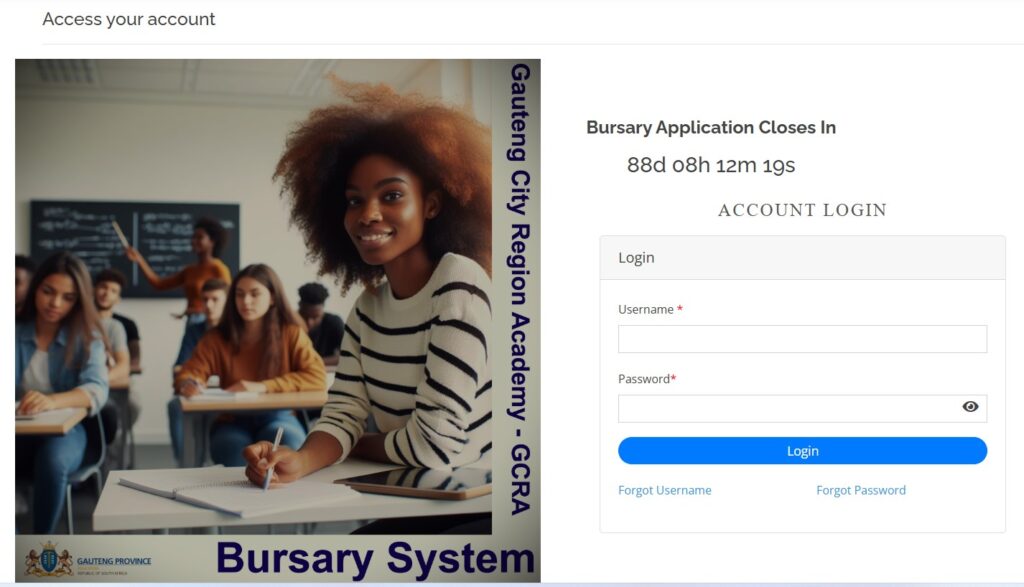
You’ll need to either log in if you’ve applied before or register as a new user.
If you’re a first-time applicant:
- Create an account with a valid email address
- Choose a strong password you’ll remember
- Verify your email address before proceeding
Step 3: Complete the Application Form
Fill in all sections of the online application form carefully:
Personal Information Section:
- Full names as they appear on your ID
- Contact details (phone number and email address)
- Physical and postal addresses in Gauteng
- Emergency contact information
Academic Information Section:
- Matric results or latest academic transcript
- Details of your chosen PSET institution
- Programme or course you’re registered for or wish to study
- Year of study (first year, second year, etc.)
Financial Information Section:
- Household income details
- Number of dependents in your family
- Other sources of funding (if any)
Step 4: Upload Your Documents
Upload all required documents in the specified format (usually PDF or JPG). Make sure each file is:
- Clearly labeled
- Under the maximum file size limit
- Legible and complete
Step 5: Write Your Motivation Letter
Your motivation letter is your opportunity to stand out. Address the following points:
- Why you need financial assistance
- Your academic goals and career aspirations
- How the GCRA bursary will help you achieve these goals
- Your commitment to completing your studies
- How you plan to contribute to Gauteng after graduation
Be honest, specific, and passionate. Avoid generic statements—make it personal.
Step 6: Review and Submit
Before hitting submit:
- Double-check all information for accuracy
- Ensure all documents are uploaded correctly
- Verify that your contact details are correct
- Read the terms and conditions carefully
Once satisfied, submit your application. You’ll receive a confirmation email with a reference number—keep this safe for tracking your application status.
Important Deadlines for GCRA Bursary 2026
Application Closing Date: Saturday, February 28, 2026
This is the final deadline for submitting your GCRA bursary application for the 2026 academic year.
Late applications are generally not accepted, so time management is crucial.
Why Early Application Matters
While the deadline is February 28, applying early offers several advantages:
- Avoid technical issues: The portal may experience high traffic close to the deadline
- Time for corrections: If documents are rejected, you’ll have time to fix and resubmit
- Better consideration: Early applications may receive earlier review
- Less stress: You won’t be rushing at the last minute
Pro tip: Aim to submit your application by mid-February 2026 to give yourself a buffer for any unexpected issues.
Other Important Dates
While specific dates may vary, here’s a general timeline for the GCRA bursary process:
| Period | Activity |
|---|---|
| December 2025 | Applications open |
| Saturday, February 28, 2026 | Application deadline |
| March – April 2026 | Application review and shortlisting |
| May – June 2026 | Successful applicants notified |
| July 2026 | Funding disbursement begins |
Check the official GCRA portal regularly for updates, as dates may be adjusted.
Tips to Strengthen Your GCRA Bursary Application
Competition for the GCRA bursary can be intense, especially for students who don’t automatically qualify.
Here are proven strategies to make your application stand out:
1. Ensure Document Quality
- Get proper certification: All documents must be certified by authorized individuals
- Check clarity: Scan documents at high resolution to ensure text is readable
- Complete pages: Don’t submit partial documents—include all pages
- Recent dates: Proof of residence should be recent (within 3 months)
2. Write a Compelling Motivation Letter
Your motivation letter can make or break your application. Here’s what works:
Do:
- Tell your personal story authentically
- Explain specific financial challenges you face
- Connect your studies to future career goals
- Show enthusiasm for your chosen field
- Demonstrate commitment to Gauteng’s development
- Use specific examples from your life
Don’t:
- Use generic templates from the internet
- Exaggerate or lie about your circumstances
- Submit a poorly written or grammatically incorrect letter
- Exceed the 2-page limit
- Focus solely on financial need without discussing aspirations
Below is a TikTok video to guide you write a good motivation letter for GCRA Bursary.
3. Highlight Your Academic Achievements
If you’ve excelled academically:
- Mention specific achievements (distinctions, awards, rankings)
- Include extracurricular activities showing leadership
- Reference any community service or volunteer work
- Provide context for your achievements (e.g., overcoming challenges)
4. Provide Accurate Income Information
Financial need is a key consideration:
- Be honest about household income
- Include all sources of income
- Explain any special circumstances (unemployment, illness, etc.)
- Provide supporting documentation (payslips, affidavits)
5. Choose the Right Programme
Select a programme that:
- Aligns with your academic strengths
- Has good career prospects
- Matches Gauteng’s skills needs
- You’re genuinely passionate about
GCRA prioritizes students in fields that will contribute to the province’s development.
6. Proofread Everything
Before submitting:
- Check for spelling and grammar errors
- Verify all dates and numbers
- Ensure consistency across documents
- Have someone else review your application
What Happens After You Submit Your Application?
Understanding the post-application process helps manage expectations:
Application Review Process
- Initial screening: Applications are checked for completeness and eligibility
- Document verification: Submitted documents are verified for authenticity
- Assessment: Qualifying applications are assessed based on academic merit, financial need, and other criteria
- Shortlisting: Candidates who meet all requirements are shortlisted
- Final selection: The bursary committee makes final funding decisions
If You’re Successful
Successful applicants will:
- Receive a notification via email and/or SMS
- Be required to sign a bursary contract
- Receive details about funding disbursement
- Get information about academic performance expectations
- Learn about renewal requirements for continuing students
The bursary contract is a legal document outlining:
- Your responsibilities as a bursary holder
- Academic performance requirements
- Funding amounts and payment schedules
- Consequences of non-compliance
- Any service obligations (if applicable)
Read this contract carefully before signing.
If You’re Not Selected
If your application is unsuccessful:
- You’ll receive notification of the outcome
- Feedback may be provided (though not always detailed)
- You can apply for other bursaries and scholarships
- Consider reapplying in the next cycle with an improved application
Alternative funding sources to explore:
- NSFAS (National Student Financial Aid Scheme)
- Company bursaries (banks, mining companies, etc.)
- University-specific bursaries
- NGO and foundation scholarships
- Provincial education department bursaries
Renewing Your GCRA Bursary
For students who received the GCRA bursary in previous years, renewal is possible but not automatic.
Here’s what you need to know about the renewal process:
Renewal Requirements
To qualify for renewal:
- Maintain satisfactory academic progress (typically 60% average or higher)
- Pass all required modules/courses
- Stay registered at your PSET institution
- Continue residing in Gauteng
- Submit renewal documentation on time
- Comply with all bursary contract terms
How to Renew your GCRA Bursary 2026
The renewal process typically involves:
- Accessing the GCRA bursary application portal
- Logging in with your existing credentials
- Completing a renewal application form
- Uploading updated academic transcripts
- Providing proof of current registration
- Submitting before the renewal deadline
Important: Even if you received funding before, you must complete the renewal application each year.
Understanding GCRA Bursary Terms and Conditions
Before accepting a GCRA bursary, understand the key terms and conditions:
Academic Performance Requirements
- Maintain a minimum average (usually 60% or higher)
- Pass all modules to progress to the next level
- Complete your qualification within the prescribed time
- Provide academic transcripts when requested
Service Obligations
Some bursaries include service obligations:
- Work-back requirements after graduation
- Service in Gauteng-based organizations
- Specific sector placement (depending on your field)
These details will be specified in your bursary contract.
What Happens if You Fail?
If you fail modules or don’t meet academic requirements:
- Your bursary may be suspended or canceled
- You might be required to repay funding received
- Future renewal applications may be declined
- You could be excluded from reapplying
That’s why maintaining good academic standing is crucial.
GCRA Bursary for Postgraduate Students
The GCRA bursary isn’t just for undergraduates—postgraduate students can also apply. Here’s what’s different:
Postgraduate Eligibility
To qualify for postgraduate funding:
- Hold a completed undergraduate qualification
- Be accepted for postgraduate studies (Honours, Masters, or PhD)
- Study at an accredited institution
- Meet all standard GCRA bursary requirements (age, residency, citizenship)
What Postgraduate Funding Covers
Postgraduate bursaries typically include:
- Full tuition and registration fees
- Research costs (where applicable)
- Study materials and books
- Laptop allowance (if not received previously)
- Accommodation and living allowance
Application Process for Postgraduate Studies
The process is similar to undergraduate applications, but you’ll need:
- Your undergraduate degree certificate and transcript
- Proof of acceptance for postgraduate studies
- A more detailed research proposal (for research-based programmes)
- Supervisor confirmation (where applicable)
How to Check Your GCRA Bursary Application Status
After submitting your application, you’ll want to track its progress.
Here’s how:
Online Status Check
- Visit the GCRA bursary application portal at gcrabursary.gauteng.gov.za/Account/Login
- Log in with your credentials
- Navigate to “Application Status” or a similar section
- Use your reference number to track progress
What Different Statuses Mean
- Received: Your application has been submitted successfully
- Under Review: Your application is being assessed
- Pending Documentation: Additional documents are needed
- Shortlisted: You’ve progressed to the next stage
- Successful: You’ve been awarded the bursary
- Unsuccessful: Your application was not successful
GCRA Contact Details
If you need to follow up on payments, check your application status, or resolve administrative issues, use the details below.
Physical Address 17 Simmonds Street Marshaltown Johannesburg 2000
GCRA Bursary Phone Numbers
- Toll-Free: 0800 000 789
- Landline: 011 355 0000
GCRA Bursay Email Addresses
- General Enquiries:
gdeinfo@gauteng.gov.za - Bursary Renewals Only:
Bursaries.Gcra@gauteng.gov.za
How to Contact GCRA Bursary for assistance
- Visit the official GCRA website for contact details
- Use the “Help” section on the application portal
- Email the bursary enquiries address
- Call during office hours (have your reference number ready)
Common GCRA Bursary Application Mistakes to Avoid
Learn from others’ mistakes—here are the most common errors that lead to application rejection:
- Missing documents: Incomplete applications are automatically disqualified
- Non-certified copies: Regular photocopies are not accepted
- Late submission: Applications received after the deadline are not considered
- Incorrect information: Mismatched details across documents raise red flags
- Poor-quality scans: Unreadable documents cannot be processed
- Generic motivation letters: Copy-pasted letters show a lack of genuine interest
- Wrong institution type: Applying when enrolled at non-accredited institutions
- Not meeting age requirements: Applicants outside the 18-35 age range
- Missing proof of residence: Cannot prove Gauteng residency
- Ignoring automatic qualification: Top achievers must still submit complete applications.
GCRA Bursary Frequently Asked Questions
Who qualifies for the GCRA bursary?
South African citizens by birth, aged 18-35, residing in Gauteng, who have completed matric and are accepted at or registered with an accredited PSET institution. Top achievers from Gauteng schools, especially from no-fee-paying and LSEN schools, receive preference.
Does the GCRA bursary cover accommodation?
Yes, the GCRA bursary covers both on-campus and off-campus accommodation costs, along with a living allowance for students staying off-campus.
What does the GCRA bursary cover?
The bursary provides full cost of study coverage, including tuition fees, registration fees, accommodation, books, study materials, a laptop allowance, and living expenses for off-campus students.
How do I apply for the GCRA bursary in 2026?
Apply online through the official GCRA bursary application portal. Complete the application form, upload all required documents (certified ID, proof of residence, matric certificate, proof of income, motivation letter, acceptance letter), and submit before Saturday, February 28, 2026.
When is the application deadline for the GCRA bursary 2026?
The closing date for the GCRA bursary 2026 is Saturday, February 28, 2026. Late applications are not accepted, so submit well before this date.
Can postgraduate students apply for the GCRA bursary?
Yes, postgraduate students who have completed an undergraduate qualification and are accepted for postgraduate studies at an accredited institution can apply for the GCRA bursary.
Can international students apply for a GCRA bursary?
No, only South African citizens by birth are eligible for the GCRA bursary. International students do not qualify.
How does GCRA bursary pay?
Tuition and registration fees are paid directly to your PSET institution. Allowances for accommodation, books, laptop, and living expenses are typically disbursed to you as the student according to the schedule in your bursary contract.
Can I apply for a GCRA bursary for a second degree?
This depends on the specific terms and conditions. Check with GCRA directly or review the application criteria carefully, as preference is typically given to first-time degree seekers or postgraduate students advancing their education.
What is the GCRA bursary monthly allowance?
The monthly allowance varies depending on your accommodation situation and the specific terms of your bursary contract. Contact GCRA directly for current allowance amounts.
Making the Most of the GCRA Bursary
The GCRA bursary represents more than just financial assistance—it’s an investment in your future and in Gauteng’s development.
By providing comprehensive funding coverage, the programme removes financial barriers that might otherwise prevent talented students from achieving their educational goals.
Taking Action
If you meet the eligibility criteria:
- Start preparing now: Gather your documents well in advance
- Write a thoughtful motivation letter: Take time to craft a compelling story
- Apply early: Don’t wait until the last minute
- Double-check everything: Accuracy matters
- Stay positive: Even if you’re not automatically qualified, a strong application can succeed
Beyond the Application
Remember that receiving the GCRA bursary comes with responsibilities:
- Maintain excellent academic performance
- Comply with contract terms
- Represent GCRA and Gauteng positively
- Consider how you’ll contribute to the province after graduation
Alternative Plans
While you wait for your GCRA bursary outcome:
- Apply for other bursaries and scholarships
- Explore NSFAS if you qualify
- Research part-time work opportunities
- Look into study loans as a backup option
Don’t put all your eggs in one basket—applying for multiple funding sources increases your chances of securing support.
The GCRA bursary 2026 offers a life-changing opportunity for Gauteng students to pursue higher education without financial stress.
With comprehensive coverage that includes tuition, accommodation, books, technology, and living expenses, this programme enables you to focus entirely on your studies and personal development.
By understanding the eligibility requirements, preparing a thorough application, meeting the Saturday, February 28, 2026, deadline, and following the tips in this guide, you can maximize your chances of securing this valuable funding.
Whether you’re an undergraduate student just starting your tertiary education journey or a postgraduate student advancing your qualifications, the GCRA bursary could be the support you need to achieve academic excellence and build a successful future.
Take the first step today—visit the GCRA bursary application portal, start gathering your documents, and prepare to submit an application that showcases your potential.
Your educational dreams are within reach, and the GCRA bursary is here to help you achieve them.